The Valve Steam Machine RAM shortage became one of the biggest stories surrounding Valve’s return to living-room PC hardware in 2026. The problem was not that the Steam Machine suddenly needed an unusual amount of memory. Instead, Valve was trying to launch a new gaming PC during a period when RAM and SSD components were becoming much harder and more expensive to secure.
Valve said the change in memory and storage costs made its original pricing goal no longer workable. At some points, the company also struggled to obtain certain components at any price, which directly reduced the number of systems it could prepare for launch. The shortages affected timing, production planning, retail pricing, and how Valve distributed the first units.
The Steam Machine was delayed, but it was not cancelled. Valve opened its reservation system in June, with purchase invitations and shipments beginning from June 29, 2026. The base 512GB model launched at $1,049, while the 2TB model was priced at $1,349. By late July, Valve said it was fulfilling orders daily and expected people already in reservation queues to receive a purchase opportunity by the end of 2026.
Snippet-Ready Definition:
The Valve Steam Machine RAM shortage refers to memory and storage supply problems that raised component costs, limited production, delayed Valve’s 2026 Steam Machine rollout, and contributed to higher retail pricing and restricted availability.
Quick Guide: Valve Steam Machine RAM Shortage
| Topic | Key Detail |
| Main cause | Strong AI data-center demand increased pressure on DRAM and NAND supply |
| Launch impact | Steam Machine faced delays before its June 29, 2026 rollout |
| Starting price | 512GB model launched at $1,049 |
| Higher model | 2TB version launched at $1,349 |
| RAM | 16GB DDR5 system memory |
| Availability | Limited production led Valve to use reservations and waitlists |
| Current status | Steam Machine launched and was not cancelled |
Key Things Buyers Should Know
- The shortage affected both RAM and SSD storage, not just one component.
- Higher memory costs made Valve’s original pricing plans harder to maintain.
- Limited component supply reduced the number of Steam Machines available at launch.
- The Steam Machine uses 16GB DDR5 RAM, and its system memory can be replaced or upgraded with compatible parts.
- Buyers should rely on Valve’s current pricing and availability information rather than older launch rumors.
What Caused the Global RAM and Memory Shortage?
The shortage grew from a wider change in the memory market. AI servers and large data centers began consuming far more memory and storage capacity, while chip manufacturers shifted more production toward higher-value server products. This put pressure on the supply of conventional DRAM used in PCs and NAND flash used in SSDs.
TrendForce reported in 2026 that memory makers were prioritizing server-related products, including high-bandwidth memory and enterprise storage. It projected sharp increases in conventional DRAM and NAND contract prices during the first half of the year, while later reports showed that tight DRAM supply was continuing into the second half.
For a company such as Valve, this matters because a Steam Machine cannot be built without both system RAM and solid-state storage. Even if processors, cases, cooling parts, and other components are ready, a shortage of memory or SSD parts can hold back complete systems. That is why the wider AI-driven memory boom became a direct Steam Machine problem rather than simply a concern for people building their own PCs.
Why the Memory Crisis Hit Valve’s Steam Machine
Every Steam Machine needs system memory for SteamOS, games, background tasks, and normal PC functions. It also needs an SSD for the operating system and game storage. Valve therefore had to secure large quantities of both parts before it could manufacture systems at scale.
The difficulty was not limited to paying more. Valve engineers said the company had to negotiate aggressively just to secure memory supply. Valve also stated that there were periods when some components could not be sourced at all, regardless of price. This is especially important because product makers normally need predictable bulk supply; buying small amounts of expensive retail RAM is not a practical way to manufacture thousands of computers.
The same pressure reached other Valve products. Steam Deck availability became intermittent in some regions earlier in 2026 because of memory and storage shortages, and Valve later raised Steam Deck OLED prices after component costs increased. The Steam Frame was also affected because it depends on memory and storage components of its own.
Valve Steam Machine Delayed: The 2026 Launch Timeline
When Valve announced its new Steam hardware in November 2025, the Steam Machine was expected in early 2026. As memory and storage prices rose, however, Valve stopped short of giving an immediate final price and firm shipping date.
In February 2026, Valve acknowledged that the memory and storage situation had complicated its plans and said it still hoped to ship the Steam Machine and Steam Frame in the first half of the year. Uncertainty continued into March, when Valve again reassured users that the Steam Machine was still planned for 2026 after wording in a company update caused cancellation concerns.
The clearer launch plan arrived in June. Valve opened sign-ups for a randomized reservation process, closed the first registration window on June 25, and began sending purchase opportunities from June 29. That date effectively marked the start of the 2026 Steam Machine rollout. The Valve Steam Machine delayed story therefore ended in a limited launch rather than a cancellation.
Steam Machine Price and the Cost of the RAM Shortage
The confirmed Steam Machine price is one of the clearest signs of how much the component market changed Valve’s plans. The 512GB Steam Machine costs $1,049 in the United States, while the 2TB version costs $1,349. A Steam Controller is optional rather than included with every standalone unit.
Valve did not publicly promise a specific low launch price before the shortage became severe, so older claims that the machine was definitely supposed to cost $500, $600, or another exact amount should be treated as estimates rather than official targets. What Valve did say is that its original pricing goal was no longer viable because the cost of parts had changed significantly.
The $300 gap between the two models is not simply the retail price of extra SSD capacity. Product pricing also includes sourcing, manufacturing, logistics, and the specific components Valve was able to secure. Still, storage clearly matters because the main hardware difference between the two retail models is their 512GB versus 2TB SSD capacity.
Steam Machine RAM Specs and Why They Matter
The current Steam Machine RAM specs include 16GB of DDR5 system memory. Reviews of production hardware identify it as DDR5-5600 SO-DIMM memory, which is replaceable PC memory rather than permanently soldered RAM. The machine also has 8GB of GDDR6 video memory attached to its graphics hardware. These are two different types of memory and should not be confused.
The 16GB of system RAM is used by SteamOS, games, applications, and background processes. For many current games, that amount is workable, but demanding software and heavy multitasking can use more. The separate 8GB of graphics memory stores data needed by the GPU, such as textures and rendering resources.
The wider shortage matters because Valve must buy these memory components in volume. A gaming PC having “only” 16GB of RAM does not protect it from a shortage. If consumer memory capacity is being squeezed by server demand and production shifts, even a normal-sized memory configuration can become expensive or difficult to source.
Steam Machine Specs Beyond the RAM
The Steam Machine specs are built around semi-custom AMD hardware. It uses a six-core, 12-thread Zen 4 CPU that can run up to 4.8GHz and a semi-custom RDNA 3 GPU with 28 compute units and 8GB of GDDR6 video memory. System memory is 16GB of DDR5, while storage is offered in 512GB and 2TB NVMe SSD versions.
For connectivity, the machine includes Wi-Fi 6E, Bluetooth 5.3, Gigabit Ethernet, USB-A and USB-C ports, DisplayPort 1.4, HDMI, and a microSD card slot. Valve positions it as a living-room PC that runs SteamOS and can connect directly to a television or monitor.
Valve has promoted high-resolution gaming with upscaling, but real performance depends heavily on the game and settings. Buyers should not read “4K capable” as a promise that every modern game will run natively at 4K and high frame rates. Production reviews have also shown that demanding games can require lower internal resolutions or adjusted settings.
From a shortage perspective, RAM, SSD storage, and memory used by graphics hardware have been among the most exposed parts because the wider AI and server market is competing for related manufacturing capacity.
Steam Machine RAM Upgrade Options
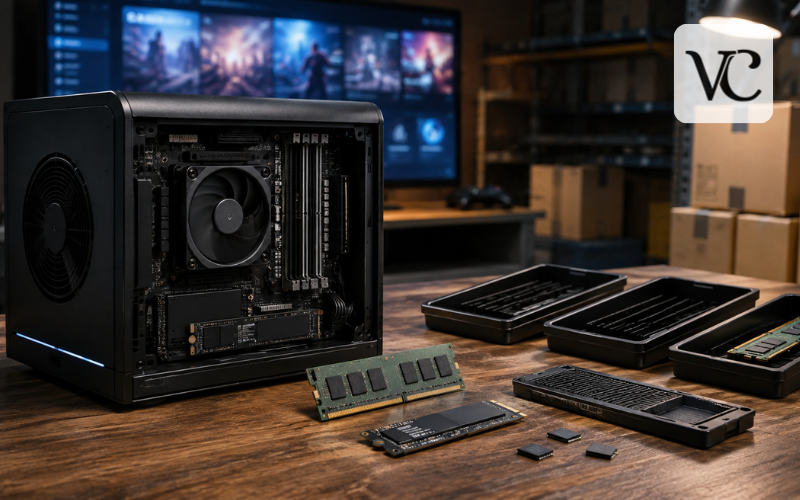
A Steam Machine RAM upgrade is possible because the system uses replaceable DDR5 SO-DIMM memory. That gives the device more flexibility than hardware with permanently soldered RAM. Reliable hardware reporting has also confirmed that RAM and SSD storage are the main internal parts designed to be replaceable.
An upgrade can make sense for people who plan to use the Steam Machine as more than a gaming box, such as for desktop work, heavy multitasking, or memory-demanding applications. It should not be assumed that adding more RAM will create a large frame-rate increase in every game. Gaming performance also depends on the CPU, GPU, graphics memory, game engine, resolution, and settings.
RAM and storage upgrades are separate jobs. Increasing RAM gives the system more working memory. Replacing or expanding the SSD gives it more space for games and files. The machine also supports microSD storage, which offers an easier way to add game capacity without opening the device.
Anyone opening the unit should follow Valve’s service guidance, use compatible components, and check the current warranty terms before making changes.
Limited Supply, Reservations, and the Randomized Waitlist
Valve did not use a normal first-come, first-served launch for the Steam Machine. Instead, it collected sign-ups and then randomized the order on June 25. People near the front were placed into reservation queues, while people beyond the number of units expected for the production run were placed on waitlists.
Valve explained that the system was designed to make the launch fairer and reduce the advantage held by bots, resellers, very fast internet connections, or people able to refresh a store page at exactly the right moment. Eligible accounts also had to meet purchasing and account requirements, and sign-ups were limited to one per household.
The shortage still sits behind the system because Valve has a limited number of machines to distribute. In July, the company said it was fulfilling orders daily. Some product-and-region queues had already progressed far enough for people to move from waitlists into reservation queues, while other buyers could still be waiting much longer.
Steam Machine 2: What the Name Actually Refers To
“Steam Machine 2” is a useful search phrase, but it is not the official name of Valve’s 2026 hardware. Valve simply calls the new product the Steam Machine.
The confusion comes from the history of the brand. Valve announced the original Steam Machine idea in 2013, and partner-made Steam Machines from companies such as Alienware and others officially reached the market in November 2015. Those systems varied widely in price and hardware because they were produced by different PC manufacturers.
The 2026 Steam Machine is different. It is Valve-designed hardware with a defined specification and a much more mature version of SteamOS, built after years of experience with the Steam Deck. Calling it a second-generation Steam Machine is understandable in casual discussion, but readers looking for official product information should search for Valve’s 2026 Steam Machine rather than expect a device formally named “Steam Machine 2.”
Was the Steam Machine Cancelled Because of the RAM Shortage?
No. The Steam Machine was not cancelled because of the RAM shortage. The shortage caused delays, uncertainty, higher prices, and restricted production, but Valve continued with the project.
Cancellation rumors became understandable during the first part of 2026 because Valve did not provide a firm shipping date, and one company update used cautious language about hoping to ship during the year. Valve quickly clarified that it still planned to release the hardware.
That question has now been settled by the actual rollout. Purchase invitations began from June 29, customers have received systems, and Valve continues to work through reservation queues. By late July, Valve said customers already holding reservations should receive a purchase opportunity by the end of 2026.
Older reports that speculated about Steam Machine cancelled plans should therefore be read in their original time context, not treated as the current status of the product.
Steam Machine vs Steam Deck During the Memory Shortage
The Steam Machine and Steam Deck serve different purposes even though both run SteamOS. Steam Deck is a battery-powered handheld designed for portable play. Steam Machine is a more powerful, plug-in living-room PC designed primarily for a TV or monitor.
The memory shortage has affected both products, but not in exactly the same way. Earlier in 2026, Valve warned that Steam Deck stock could be intermittent because of memory and storage shortages. It later brought the OLED models back with much higher pricing, with the 512GB OLED rising to $789 and the 1TB model to $949 in the United States.
For buyers, the choice should therefore be based mainly on use. Steam Deck still makes more sense for portable gaming, while Steam Machine is aimed at people wanting a couch-friendly SteamOS PC with stronger hardware. The shortage has narrowed the price gap, making the decision less about finding a cheap Valve device and more about which form factor fits the buyer.
What the RAM Shortage Means for Steam Machine Buyers Going Forward
The memory market still looks tight as of August 2026. Valve engineer Yazan Aldehayyat said in July that the situation was “still getting worse” and explained that consumer retail shelves can lag the bulk supply market Valve sees by three to six months. Pierre-Loup Griffais also said Valve was building as many Steam Machines as it could and remained limited by memory capacity.
This means buyers should not assume that falling prices on one retail RAM kit will immediately produce a Steam Machine price cut. Valve buys parts through manufacturing supply chains, and retail product prices can reflect contracts and inventory secured months earlier.
Industry data also points to continued pressure. TrendForce reported in late July that AI demand and capacity shifts were keeping DRAM supply tight, with the shortage expected to remain difficult to resolve in the near term.
For now, the most useful things to watch are Valve’s official Steam Hardware updates, reservation status, regional availability, and confirmed retail pricing. There is no confirmed future Steam Machine price cut that buyers should plan around. Waiting may eventually bring better availability, but any specific discount or price reduction would be speculation until Valve announces it.
Conclusion
The Valve Steam Machine RAM shortage changed almost every practical part of the 2026 launch. Rising RAM and storage costs weakened Valve’s original pricing plan, limited the number of machines it could manufacture, contributed to delays, and led to a randomized reservation and waitlist system.
Even so, the hardware did make it to market. The Steam Machine rollout began on June 29, with the 512GB model priced at $1,049 and the 2TB model at $1,349. Valve is still filling reservations, and the wider memory market remains tight.
For readers following the Steam Machine, the key point is simple: this was a delayed and supply-constrained launch, not a cancelled one. Because component conditions can change quickly, current Valve announcements are more useful than old price rumors or early-2026 cancellation speculation. Anyone considering a purchase should check the latest official price, reservation position, and regional stock before making a decision.
FAQs
Why was the Valve Steam Machine affected by the RAM shortage?
Valve needed large quantities of RAM and SSD storage for production. Strong demand from AI data centers tightened global memory supply, making these components more expensive and harder to secure.
Was the Steam Machine cancelled because of the RAM shortage?
No. The Steam Machine was delayed and faced limited availability, but Valve continued development. Its 2026 rollout began on June 29 after earlier uncertainty about pricing and production.
What are the Steam Machine RAM specs?
The 2026 Steam Machine comes with 16GB of DDR5 system RAM. It also has separate graphics memory used by the GPU for rendering games and handling visual data.
Can Steam Machine RAM be upgraded?
Yes, the Steam Machine uses replaceable DDR5 SO-DIMM memory. Users should choose compatible RAM and follow Valve’s service guidance before opening or modifying the system.
Will Steam Machine prices fall when the memory shortage improves?
Possibly, but there is no confirmed price cut. Retail prices can remain high even after component costs begin falling because manufacturers often buy parts months in advance.
Disclaimer: This article is for informational purposes only. Steam Machine pricing, availability, hardware specifications, reservation rules, and memory market conditions may change. Always check Valve’s official information before making a purchase or hardware upgrade decision.
Enjoyed this article? Discover more helpful ideas and fresh inspiration on Vogue Cultures.