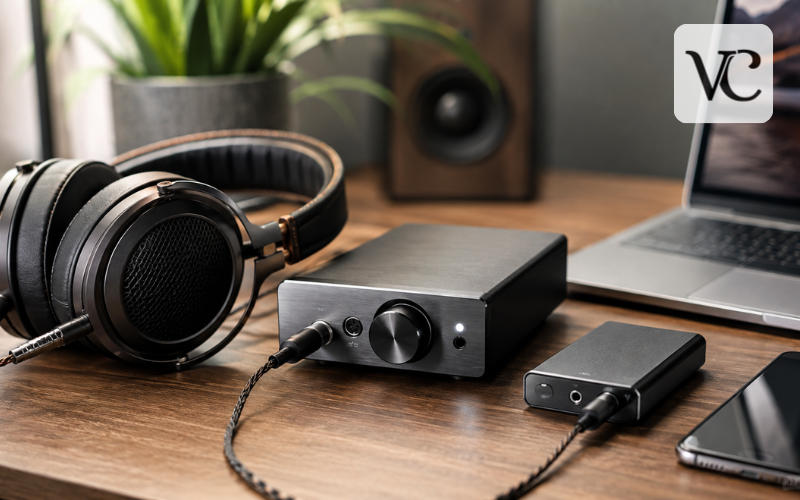
A good pair of headphones does not always need extra amplification, but some models perform better when they have a dedicated source of power. The best headphone amps provide enough power for your headphones, give you better control over volume, and can add useful connection options that a phone, laptop, or basic PC may not provide.
There are several types to choose from. Desktop headphone amps are designed for a permanent listening setup and usually offer more power and connection options. Portable headphone amps are smaller and designed for phones, laptops, and travel. A DAC/headphone amp combo adds digital-to-analog conversion as well as amplification, making it useful when your main music source is a computer or mobile device.
The right choice depends heavily on the headphones you own. Sensitive in-ear monitors (IEMs) may need very little power and can actually perform better with a quiet, low-gain output. Many regular dynamic headphones are easy to drive, while some high-impedance and planar magnetic headphones benefit from considerably more power. Impedance and sensitivity together help determine how demanding a headphone is.
This guide compares the best headphone amps for 2026 by price, portability, headphone type, gaming, music listening, and overall setup needs.
Snippet-Ready Definition:
Best headphone amps are devices that provide clean, controlled power to headphones, helping demanding models reach comfortable volume while offering useful features such as gain control, DAC conversion, balanced outputs, and improved connectivity.
Best Headphone Amps 2026 at a Glance
There is no single amplifier that is best for every listener. A small USB dongle can make more sense for an IEM user than a large desktop amplifier, while someone using demanding full-size headphones may need far more power.
| Model | Type | Ideal Use | Main Headphone Outputs | Key Strength | Approx. Price |
| iFi GO link 2 Max | Portable DAC/amp | Phones and laptops | 3.5mm, 4.4mm | Compact budget upgrade | Around $85 |
| Schiit Magni Unity | Desktop amp | Affordable desktop systems | 6.35mm | Strong power for the price | From $119 |
| iFi hip-dac 3 | Battery DAC/amp | Portable full-size headphones | 3.5mm, 4.4mm | Battery-powered versatility | Around $199 |
| FiiO K7 | Desktop DAC/amp | PC and music systems | 6.35mm, 4.4mm | Powerful all-in-one setup | Around $210–$220 |
| iFi ZEN CAN 3 | Desktop analog amp | Demanding headphones | 6.35mm, 4.4mm | Power and adjustable gain | Around $229 |
| Chord Mojo 2 | Premium portable DAC/amp | High-end portable listening | 3.5mm, 4.4mm | Advanced sound adjustment | Around $650 |
| RME ADI-2 DAC FS | Premium DAC/amp | Audiophile and studio use | Dedicated headphone/IEM outs | Deep EQ and control | Roughly $1,000–$1,300 |
These prices are approximate and can change by retailer or region. Current manufacturer and retailer information confirms the Magni at $119, GO link 2 Max at about $85, hip-dac 3 at $199, K7 around $210–$220, Mojo 2 around $650, and varying US pricing for the RME ADI-2 DAC FS.
Quick Steps for Choosing a Headphone Amp
- Check your headphones: Look at impedance and sensitivity before deciding how much amplifier power you need.
- Choose desktop or portable: Desktop amps suit permanent setups, while dongles and battery-powered amps are easier for travel.
- Decide between amp and DAC/amp: Choose a DAC/amp if you want one device to handle digital audio and amplification.
- Check connections: Make sure your PC, phone, DAC, and headphone cables match the available inputs and outputs.
- Avoid buying power you do not need: Sensitive IEMs often benefit more from low noise and suitable gain than very high output power.
What Makes a Headphone Amp Worth Buying?
The main job of a headphone amplifier is to take an audio signal and provide enough controlled power to drive your headphones. If your headphones already reach a comfortable volume from your phone or computer without distortion, noise, or weak dynamics, you may not need a separate amplifier.
A dedicated amp becomes more useful when your current source struggles to reach comfortable listening levels or when you are using headphones that need more voltage or current. It can also give you a better volume knob, several gain settings, multiple inputs, preamp outputs, or connections for different headphone cables.
A pure headphone amp only amplifies an analog signal, so it normally needs a separate DAC when your source is digital. A DAC/amp combo handles both jobs in one device. The DAC converts digital music from USB, optical, or another digital connection into an analog signal, and the amplifier then powers the headphones.
For easy-to-drive IEMs, more power is not automatically better. A low-noise output and suitable gain are often more important.
Best Desktop Headphone Amps
For a simple desktop system, the Schiit Magni Unity remains an attractive starting point. The current Magni costs $119 as an amplifier and preamp, with an optional internal DAC configuration available at a higher price. It provides three gain settings, including negative gain for sensitive headphones, and Schiit rates its output at 2.5 watts per channel into 32 ohms.
That combination makes it flexible enough for many IEMs, normal dynamic headphones, and more demanding full-size models. Its main limitation is that the headphone output is standard single-ended 6.35mm rather than balanced.
The iFi ZEN CAN 3 is another strong desktop choice if you already own a DAC. It is an all-analog amplifier with four gain levels and both 6.35mm single-ended and 4.4mm balanced headphone outputs. iFi rates it for up to 2,000mW under its stated balanced-output conditions, giving it useful reserves for demanding headphones.
The Magni is smaller, simpler, and less expensive. The ZEN CAN 3 provides more connection flexibility and built-in analog sound-adjustment options. Neither choice is automatically better; it depends on the rest of your system.
Best Portable Headphone Amps
Portable listeners have a different set of priorities. Size, battery life, cables, phone compatibility, and power consumption can matter just as much as maximum output.
The Chord Mojo 2 remains a premium portable option. The current version includes USB-C input, DSP-based tone adjustment, crossfeed, and 3.5mm plus 4.4mm headphone outputs. Chord lists output figures of 600mW into 30 ohms and 90mW into 300 ohms.
For a much lower price, the iFi hip-dac 3 combines USB-C digital input, a rechargeable battery, 3.5mm and 4.4mm headphone connections, selectable gain, and iEMatch for sensitive earphones. Its 2,200mAh battery is rated for up to 12 hours, while balanced output reaches 400mW into 32 ohms.
A dongle such as the GO link 2 Max is smaller still because it draws power from the connected device. That is easier to carry, but unlike the hip-dac 3, it does not have its own large rechargeable battery.
Best Headphone Amp DAC Combo
For many users, the best headphone amp DAC combo is more practical than buying two separate boxes. You connect one device to your PC, laptop, phone, or digital music source and get both digital conversion and headphone amplification.
The FiiO K7 is especially useful on a desk. It combines dual AK4493SEQ DACs with dual THX AAA 788+ amplifier sections and offers USB, optical, coaxial, and RCA inputs. Headphone connections include 6.35mm single-ended and 4.4mm balanced outputs. FiiO rates balanced output at up to 2,000mW into 32 ohms under its stated test conditions.
The standard K7 is primarily a wired device. FiiO also offers the K7 BT version for users who want Bluetooth connectivity.
Portable listeners can instead consider the Mojo 2 or hip-dac 3. Mojo 2 offers a more premium feature set and several digital inputs, while hip-dac 3 is considerably cheaper and includes its own battery.
Best Headphone Amps for Gaming and PC
The best headphone amps for gaming do not necessarily need special gaming branding. For most PC players, clean output, easy USB connectivity, low background noise, a convenient volume control, and enough power for the chosen headset or headphones are more useful.
The FiiO K7 works particularly well as a straightforward PC DAC/amp because a USB connection handles digital audio while the front volume control and two headphone outputs make daily use simple.
If you already own a DAC or sound card with an analog output, the ZEN CAN 3 is another option. Its Game mode is designed to emphasize positional audio cues, while Movie mode focuses more on speech clarity. These modes are optional, so users who prefer an unchanged signal can simply leave them disabled.
Competitive gamers should also remember that an amplifier cannot fix poor headphone imaging or an inaccurate game mix. Headphone quality remains important.
Best Headphone Amps for Music
Choosing the best headphone amps for music is less about finding the highest power figure and more about building a sensible match.
For a straightforward desktop music system, Magni Unity offers plenty of power without requiring a large investment. FiiO K7 makes more sense when you also need digital inputs and a DAC. Portable listeners can move toward hip-dac 3 or Mojo 2 depending on budget.
Listeners who prefer an unchanged signal may want a simple, clean amplifier. Others may appreciate optional controls such as the Mojo 2’s tone adjustment or the analog XBass and XSpace functions found on the ZEN CAN 3.
Lossless streaming and high-resolution music files can be enjoyable, but buying an expensive amplifier purely because it supports larger numbers is rarely a good approach. Your headphones and their compatibility with the amplifier matter more.
Best Audiophile Headphone Amplifier Options
At the premium end, the RME ADI-2 DAC FS stands out because it offers much more than basic amplification. It combines digital conversion with a powerful main headphone output, a separate low-noise IEM output, five-band parametric EQ, bass and treble adjustment, loudness control, crossfeed, USB, SPDIF connectivity, and remote operation.
That makes it especially useful for listeners who want precise control over different headphones rather than simply more power.
The Chord Mojo 2 takes a different approach. It is far smaller and designed for portable as well as desktop use, while still offering advanced tone controls and substantial driving capability for its size.
High-end buyers should consider whether they genuinely need advanced EQ, extra digital inputs, studio-style control, or portable operation. Spending more money does not guarantee a proportionally larger improvement, especially if the existing amplifier already powers the headphones correctly.
Best Headphone Amp Under $100
A strict $100 budget now includes surprisingly capable portable equipment. One of the most relevant 2026 options is the iFi GO link 2 Max, introduced at about $85.
It connects through USB-C and includes both a 3.5mm S-Balanced output and a 4.4mm balanced output. iFi rates the balanced connection at 241mW into 32 ohms, while the device supports PCM up to 384kHz and DSD256.
This type of dongle is a sensible choice for phones, tablets, laptops, IEMs, and many portable headphones. The tradeoff is limited connectivity and lower overall power than a larger desktop amplifier.
For a best headphone amp under $100 search, it is worth deciding whether portability matters more than future expansion. If you can stretch slightly above $100, Magni Unity opens the door to a much more powerful desktop setup.
Best Headphone Amps Under $1000
A $1,000 ceiling covers almost every type of headphone amplifier most listeners need.
Budget desktop users can start with the Magni Unity. The FiiO K7 adds an integrated DAC and digital inputs. ZEN CAN 3 offers stronger analog-focused flexibility, while hip-dac 3 covers battery-powered portable use. Mojo 2 sits toward the premium end but remains comfortably below $1,000 at its current US price of around $650.
For hard-to-drive planar magnetic or high-impedance headphones, check the manufacturer’s recommended power and compare it with amplifier output at a similar impedance instead of looking only at the largest advertised watt figure.
Once an amp already provides enough clean output, useful gain control, and the connections you need, spending hundreds more may provide fewer practical benefits.
Matching an Amp to Your Headphones
Two specifications are especially useful when matching headphones and an amp: impedance and sensitivity.
Impedance, measured in ohms, is part of the electrical load presented to the amplifier. Sensitivity describes how loudly the headphone can play for a given amount of input. A headphone with high sensitivity may be easy to drive even when other specifications look demanding. Lower-sensitivity models generally need more power.
High-impedance dynamic headphones often benefit from an amp capable of supplying enough voltage. Some planar magnetic headphones have lower impedance but still require substantial current because of their sensitivity.
Sensitive IEMs are different. They usually need little power, so low background noise and fine volume adjustment become important. This is why products such as Magni Unity offer negative gain and why the hip-dac 3 includes iEMatch. RME even provides a separate low-noise IEM output on the ADI-2 DAC FS.
Before buying, check your headphone manufacturer’s impedance, sensitivity, and amplifier recommendations.
Features to Check Before Choosing a Headphone Amp
Connection type is important, but a balanced output should not automatically be treated as better simply because it uses a 4.4mm or XLR connector. In some amplifiers, the balanced connection provides more available power or a different internal signal path; in others, the practical benefit may be small for your headphones.
Check the amplifier’s output at an impedance close to that of your headphones. Gain settings also matter because they determine how much the incoming signal is amplified. Sensitive headphones benefit from a low-gain option, while difficult headphones may require higher gain.
Next, consider your source. A pure analog amplifier such as the ZEN CAN 3 needs an analog signal from another DAC or source. A DAC/amp such as the K7 can accept USB, optical, coaxial, and analog inputs, while Mojo 2 provides several digital input choices.
Finally, think about everyday use. Desk space, battery life, cable length, easy access to the volume knob, heat, firmware support, phone compatibility, preamp outputs, and possible future headphone upgrades can be more important over time than a small difference in specifications.
Conclusion
The best headphone amps are the ones that match your headphones, source device, listening location, and budget rather than simply offering the largest power number.
For an affordable desktop setup, Schiit Magni Unity provides strong value. FiiO K7 is more convenient when you want a complete desktop DAC/amp, while ZEN CAN 3 suits listeners who already have a DAC and want a flexible analog amplifier. The GO link 2 Max and hip-dac 3 make portable listening easier at lower prices, while Chord Mojo 2 offers a more premium portable experience. RME ADI-2 DAC FS is better suited to listeners who want extensive control, EQ, and system flexibility.
Whether you are choosing a headphone amp for gaming, music, PC use, IEMs, or demanding audiophile headphones, proper matching should come before price. An amplifier with the right amount of clean power and the connections you actually use is usually a better choice than paying for features you do not need.
FAQs
Do I really need a headphone amp?
Not always. Easy-to-drive headphones and many IEMs work well from phones or computers. A dedicated amp becomes more useful when your headphones need extra power, better volume control, or additional connections.
What is the best headphone amp for a PC?
A DAC/amp such as the FiiO K7 is convenient for PC use because it combines digital conversion and amplification in one desktop unit and supports USB alongside other inputs.
Is a DAC the same as a headphone amp?
No. A DAC converts digital audio into an analog signal, while a headphone amp strengthens that signal to drive headphones. Many modern products combine both functions in one device.
Are balanced headphone outputs always better?
No. Balanced outputs can provide more power on some amplifiers, but they do not automatically improve sound quality. Your headphones, amplifier design, listening volume, and connection needs matter more.
What is a good headphone amp for portable listening?
Chord Mojo 2 suits premium portable setups, while iFi hip-dac 3 offers battery-powered portability and the GO link 2 Max provides a much smaller USB-C solution.
Disclaimer: This article is provided for general informational purposes. Headphone amplifier performance can vary depending on headphone impedance, sensitivity, source device, cables, listening volume, and personal preferences. Product specifications, availability, and prices may also change over time or by region. Always check the manufacturer’s current specifications and confirm compatibility with your headphones before purchasing.
Enjoyed this article? Discover more helpful ideas and fresh inspiration on Vogue Cultures.