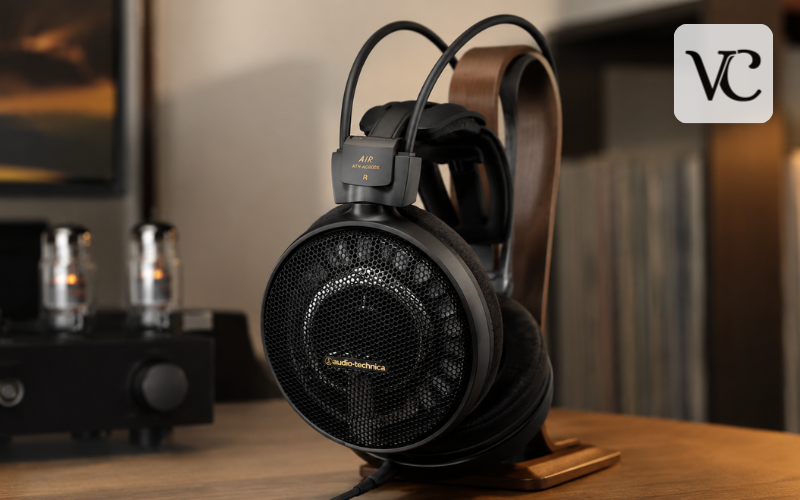
The Audio Technica ATH-AD900X audiophile open air headphones are full-size wired headphones designed mainly for people who listen to music, play games, or watch movies in a quiet indoor environment. Instead of sealing the earcups, the ATH-AD900X uses an open-air design that allows air and sound to move through the housings. The goal is a more spacious and natural listening experience rather than strong noise isolation.
The ATH-AD900X belongs to Audio-Technica’s Air Dynamic family and uses large 53 mm drivers, CCAW voice coils, lightweight aluminum honeycomb housings, cushioned earpads, and the company’s self-adjusting 3D Wing Support system. Audio-Technica describes the model as focused on clear vocal and instrumental reproduction, smooth tonal balance, precise imaging, and long-wearing comfort.
Those qualities make the ATH-AD900X interesting for home listening, but the open design also creates some important compromises. Sound can escape into the room, outside noise is easy to hear, and listeners looking for powerful sub-bass may prefer a different style of headphone.
Snippet-Ready Definition:
Audio Technica ATH-AD900X audiophile open air headphones are lightweight, open-back headphones with 53 mm drivers, a spacious soundstage, clear mids and highs, and a comfort-focused design made mainly for quiet home listening.
Quick Guide Table
| Feature | Audio-Technica ATH-AD900X |
| Headphone Type | Open-back / open-air |
| Driver Size | 53 mm |
| Frequency Response | 5 Hz–35,000 Hz |
| Impedance | 38 ohms |
| Sensitivity | 100 dB/mW |
| Weight | 265 g without cable |
| Cable | Fixed 3.0 m cable |
| Connector | 3.5 mm with 6.3 mm adapter |
| Main Strength | Wide, airy soundstage and clear detail |
| Best For | Home music listening, gaming, movies |
| Main Limitation | Sound leakage and little noise isolation |
Key Things to Consider Before Buying
- Choose the ATH-AD900X mainly for quiet indoor listening.
- Expect a wide and open soundstage rather than strong isolation.
- The bass is controlled but may feel light to bass-focused listeners.
- Its 38-ohm impedance means a powerful dedicated amplifier is usually not essential.
- Remember that the 3-meter cable is fixed, not detachable.
- Check current seller, warranty, return policy, and product condition before buying.
ATH-AD900X Design and Open-Air Construction
The ATH-AD900X has a distinctive design built around large circular earcups covered by lightweight aluminum honeycomb mesh. Unlike closed-back headphones, there is no solid outer shell trapping most of the sound inside each earcup. Audio-Technica classifies it as an open-air dynamic headphone.
This construction allows airflow around the drivers and reduces the enclosed feeling that some closed headphones can produce. It can also help music feel less confined to the space directly beside your ears. Instead, sounds may appear to come from a wider area around your head.
The open structure is one reason the ATH-AD900X works best at home. It does not try to block environmental noise, and people nearby may hear what you are playing. For someone listening alone in a bedroom, gaming room, study, or dedicated listening area, that may not be a problem. In a busy office, train, or airplane, it becomes much less practical.
At 265 grams without the cable, the headphones are relatively light for their large physical size.
Audio Technica ATH-AD900X Audiophile Open Air Headphones Specs
The main Audio Technica ATH-AD900X audiophile open air headphones specs help explain what the model is designed to do. It uses 53 mm dynamic drivers with copper-clad aluminum-wire, or CCAW, voice coils. Its stated frequency response is 5 Hz to 35,000 Hz, while maximum input power is rated at 1,000 mW.
Impedance is 38 ohms, and sensitivity is 100 dB/mW. The headphone itself weighs 265 grams, excluding its cable. These figures make it less demanding than many high-impedance studio headphones, although the quality and power of the source device still matter.
The ATH-AD900X has a 3.0-meter fixed cable, which is clearly designed with desktop or home systems in mind. The cable ends in a gold-plated 3.5 mm stereo connector, and a 6.3 mm adapter is included for equipment with the larger headphone socket.
The published frequency range should not be interpreted as a promise that every frequency is reproduced at the same loudness. Frequency-response numbers are useful specifications, but the actual listening experience depends on headphone tuning, fit, recording quality, and personal preference.
Audio-Technica ATH-AD900X Review: Sound Quality and Tonal Character
A balanced Audio-Technica ATH-AD900X review needs to start with what these headphones prioritize. Their strongest appeal is not heavy bass or strong isolation. Instead, they are designed around openness, clarity, separation, and a spacious presentation.
Audio-Technica describes the ATH-AD900X as providing clear and natural vocals and instruments, smooth tonal balance, precise imaging, and a broad dynamic range. In practical listening terms, that makes them especially interesting when a recording contains many individual instruments or small background details.
Vocals and acoustic instruments can feel prominent and easy to follow rather than hidden behind an overpowering low end. The open earcups also help create an airy character that can make recordings feel less closed-in.
This presentation will not suit everyone. A listener who enjoys strong bass pressure and a warm, heavy sound may consider the ATH-AD900X too light in the lower frequencies. Someone who values separation, vocals, strings, positional detail, and a sense of space may find the balance much more appealing.
Soundstage, Imaging, and Spatial Detail
Soundstage is one of the main reasons people consider the ATH-AD900X. In simple terms, soundstage describes how large or spacious the recorded environment seems. Instead of every sound appearing to come from the center of your head, a wide-sounding headphone can make different elements appear farther apart.
Imaging is related but different. Imaging describes how accurately you can identify where an individual sound appears within that space. Audio-Technica specifically highlights precise imaging and the spacious qualities of the ATH-AD900X’s open-back construction.
This combination can be useful with orchestral music, live recordings, movie soundtracks, and other audio that contains clear spatial information. Individual instruments may be easier to separate, while environmental sounds can feel more spread out.
However, an open headphone cannot create spatial information that is missing from the recording. Recording quality, mixing, game audio design, and source material still have a major influence on the result.
Bass, Midrange, and Treble Performance
The ATH-AD900X is better understood as a clarity-focused headphone than a bass-focused one. Its low frequencies are generally presented in a controlled way rather than with the strong physical impact associated with many closed-back or bass-enhanced headphones.
That does not automatically make the bass poor. Listeners who prefer clean bass that leaves space for vocals and instruments may enjoy this approach. Those who mainly listen to EDM, modern hip-hop, or other music where deep sub-bass is a major part of the experience may want more weight and rumble.
The midrange is particularly important to the ATH-AD900X’s character. Audio-Technica emphasizes natural vocal and instrumental reproduction, which helps explain why vocal recordings, acoustic music, strings, piano, and similar material can suit the headphone well.
The upper frequencies contribute to its sense of clarity and detail. Listeners who enjoy a bright, open presentation may appreciate this, while people who are sensitive to prominent treble may prefer a smoother or darker-sounding alternative.
ATH-AD900X for Gaming, Movies, and Everyday Listening
Although the ATH-AD900X is marketed as an audiophile headphone rather than a dedicated gaming headset, its open presentation and imaging can also work well for gaming. In games with carefully designed directional audio, a spacious headphone can make footsteps, movement, environmental effects, and other positional cues easier to separate.
It is important to remember that the ATH-AD900X does not include the gaming features found on a conventional headset. There is no built-in microphone, wireless connection, active noise cancellation, or gaming control unit.
For movies, its open presentation can give soundtracks more space, especially in quiet rooms. Dialogue remains important, while background effects and music have room to spread across the sound field.
Music remains its main strength. Acoustic recordings, classical music, jazz, vocals, live performances, soundtrack music, and recordings with detailed instrument placement are natural matches. Bass-focused listeners can still use it, but should not expect the same low-frequency impact as a strongly bass-tuned closed headphone.
Comfort, Earpads, and 3D Wing Support
Comfort is another major part of the ATH-AD900X design. Instead of relying only on a conventional padded headband, Audio-Technica uses its 3D Wing Support Housing. The two supports adjust as the headphones are placed on the head, spreading the load without requiring normal headband adjustment.
The headphones also use generously cushioned ear pads and a lightweight aluminum housing. Audio-Technica lists the weight at 265 grams without the cable.
Because the earcups are open, they also allow more airflow than sealed headphones. This can be helpful during longer listening sessions because the ears are not enclosed inside a completely sealed chamber.
Comfort is still personal. Head width, head shape, ear size, glasses, and preferred clamping pressure can change the experience. The unusual Wing Support system is comfortable for many users, but anyone buying without trying the headphones first should still choose a retailer with a sensible return policy.
Sound Leakage and Noise Isolation
The ATH-AD900X provides very little isolation by design. This is not a defect; it is a normal result of using open earcups.
When music is playing, some of that sound can escape through the outer mesh. At moderate or high volume, someone sitting nearby may be able to hear it. At the same time, sounds from the room can reach your ears easily.
That makes the ATH-AD900X a poor choice for commuting, flying, noisy offices, libraries shared with other people, or anywhere that requires privacy. It also means you may be tempted to raise the volume in a noisy environment, which is another reason to use it somewhere quiet.
A bedroom, home office, gaming room, or dedicated listening area is a much better match. Its design makes the most sense when isolation is unnecessary and you can take advantage of the spacious open-air presentation.
Amplification, Impedance, and Source Compatibility
With an impedance of 38 ohms and sensitivity of 100 dB/mW, the ATH-AD900X is not unusually demanding compared with high-impedance professional headphones.
A suitable PC headphone output, laptop, audio interface, DAC/headphone amp, or other well-designed source can potentially drive it to normal listening levels. Phones without a headphone jack will require a compatible USB-C or Lightning audio adapter, depending on the device.
A dedicated amplifier is therefore not automatically necessary. It may be useful if a particular computer or source has weak output, unwanted background noise, poor volume control, or other audio problems. A DAC/amp can also be useful when building a permanent desktop setup.
Buying an expensive amplifier simply because the ATH-AD900X is described as an audiophile headphone is unnecessary. The better approach is to try the existing source first and upgrade only if there is a clear reason.
Fixed Cable, Durability, and Everyday Practicality
The ATH-AD900X has a 3-meter cable, which gives plenty of reach from a desk, computer, amplifier, or home audio system. The cable enters from one side, helping keep the other side free.
The main disadvantage is that the cable is fixed. A detachable cable is easier to replace if it becomes damaged and is usually more convenient when storing or transporting headphones. With the ATH-AD900X, cable damage can be more troublesome to repair.
The gold-plated 3.5 mm plug works with standard headphone outputs, while the included 6.3 mm adapter makes it compatible with many amplifiers, audio interfaces, receivers, and other home equipment.
For long-term care, avoid tightly wrapping or sharply bending the cable. Store the headphones somewhere dry, keep dust away from the open mesh, and replace worn pads when appropriate. The 3-meter cable can also benefit from simple cable management when used at a computer desk.
ATH-AD900X Price, Amazon Availability, and Buying Considerations
The Audio Technica ATH-AD900X audiophile open air headphones price should be checked at the time of purchase rather than treated as one permanent figure. Availability now varies significantly by region and retailer.
As of August 12, 2026, Audio-Technica’s U.S. product page displays a price of $299.95, but the page currently marks the model as unavailable. The European Audio-Technica page displays €300 and shows it as out of stock. The product pages themselves remain active.
People searching for Audio Technica ATH-AD900X audiophile open air headphones on Amazon may see third-party, imported, used, or changing inventory depending on their country. Because stock is inconsistent, check who is actually selling the headphones rather than relying only on the marketplace name.
Also check whether the unit is new or used, whether a valid regional warranty applies, what accessories are included, and what return conditions are offered. This matters especially with an older model whose official direct stock may not always be available.
ATH-AD900X vs ATH-AD700X and ATH-R70X
The Audio-Technica ATH-AD700X is the closest comparison within the same traditional Air Dynamic style. It also uses 53 mm drivers, CCAW voice coils, an open-air housing, 3D Wing Support, 38-ohm impedance, a 3-meter cable, and a listed weight of 265 grams. Its official frequency response is 5 Hz to 30,000 Hz, compared with 5 Hz to 35,000 Hz for the ATH-AD900X. Maximum input power is 700 mW on the AD700X versus 1,000 mW on the AD900X.
For anyone reading an Audio-Technica ATH-AD700X review, the main point is that both models follow the same general idea: lightweight, spacious open-air listening. The AD900X sits as the higher model in this pairing rather than representing a completely different headphone concept.
The Audio-Technica ATH-R70X takes a more professional reference-oriented approach. It uses 45 mm drivers, weighs about 210 grams without its cable, has 470-ohm impedance, a 5–40,000 Hz response, and a detachable dual-sided cable. Those specifications make its source requirements and intended professional use quite different from the easier-to-drive ATH-AD900X.
There is also now an ATH-R70xa. Audio-Technica calls it its flagship professional open-back reference headphone and describes it as an enhanced version of the R70X. It retains 45 mm drivers and 470-ohm impedance but reduces weight to about 199 grams and introduces a redesigned headband and other changes aimed at critical listening and production work.
Conclusion
The Audio Technica ATH-AD900X audiophile open air headphones remain an interesting option for a specific type of listener. Their strongest qualities are the spacious open-air presentation, 53 mm drivers, clear vocal and instrumental reproduction, relatively low 265-gram weight, and comfort-focused 3D Wing Support design.
They make the most sense for someone who listens in a quiet room and values soundstage, separation, vocals, acoustic detail, and an airy presentation. They can also suit gaming and movie use when positional audio and a wide sense of space are more important than isolation.
Their weaknesses are equally important. They leak sound, provide little protection from outside noise, use a fixed 3-meter cable, and are unlikely to satisfy everyone who wants powerful sub-bass. Current availability is also inconsistent, with Audio-Technica’s U.S. and European stores showing the model as unavailable or out of stock at the time of writing.
For quiet home listening, the ATH-AD900X still offers a distinctive combination of openness, comfort, and clarity. For travel, noisy environments, private listening around other people, or bass-heavy preferences, a closed-back or differently tuned headphone will usually be the more practical choice.
FAQs
Are the Audio-Technica ATH-AD900X good for audiophile listening?
Yes. The ATH-AD900X is designed for detailed home listening, with an open presentation, clear vocals, strong instrument separation, and a wide soundstage that can suit many audiophile listeners.
Do the ATH-AD900X headphones need an amplifier?
Usually not. Their 38-ohm impedance and 100 dB/mW sensitivity make them relatively easy to drive, although a good DAC or amplifier may help if your existing source has weak or noisy output.
Are the Audio-Technica ATH-AD900X good for gaming?
They can work very well for gaming because their open-back design provides a spacious soundstage and good positional detail. However, they do not include a microphone or gaming-specific controls.
Do the ATH-AD900X leak sound?
Yes. Their fully open earcups allow sound to escape and also let outside noise in. They are therefore better suited to private rooms than offices, public transport, or shared spaces.
Is the ATH-AD900X good for bass-heavy music?
It can reproduce bass clearly, but its low end is relatively light and controlled. Listeners who want strong sub-bass impact for EDM or hip-hop may prefer a more bass-focused headphone.
Disclaimer: This article is provided for general informational purposes. Headphone comfort, sound quality, bass preference, and source compatibility can vary between users. Prices, availability, warranty terms, and retailer listings may also change, so check current product information before purchasing.
Enjoyed this article? Discover more helpful ideas and fresh inspiration on Vogue Cultures.