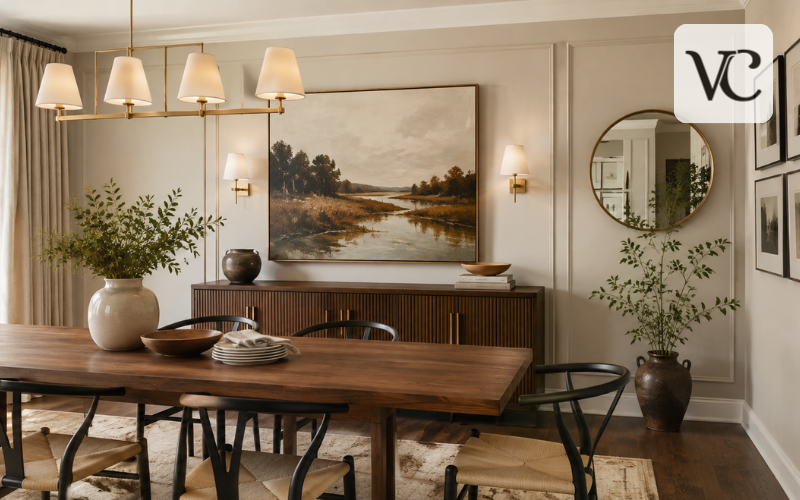
Dining room wall decor includes much more than framed pictures. It can be a large painting, a gallery wall, a mirror, a plate collection, wood paneling, decorative molding, wallpaper, or another textured finish. The right choice can make the room feel connected and intentional instead of looking like a table and chairs placed in an unfinished space.
A well-decorated wall can create a focal point, add personality, and visually tie together the dining table, sideboard, lighting, flooring, and nearby furniture. The best approach is not to follow a trend simply because it is popular. Start with the size and shape of your room, the wall you want to decorate, the colors already present, and the mood you want for everyday meals and gatherings.
Some rooms benefit from one strong feature, such as oversized art or an arched mirror. Others feel better with a group of smaller pieces, a neat gallery grid, or quiet architectural detail. The goal is to choose dining room wall decor that fits the space and feels natural to you.
Snippet-Ready Definition:
Dining room wall decor includes artwork, mirrors, gallery walls, plates, paneling, molding, and other decorative features used to add style, balance, personality, and visual interest to a dining space.
Quick Guide: Dining Room Wall Decor Options
| Decor Type | Best For | Overall Effect |
| Oversized artwork | Large or simple walls | Bold focal point |
| Gallery wall | Personal, collected spaces | Warm and expressive |
| Mirror | Small or darker dining rooms | Reflects light and adds depth |
| Decorative plates | Farmhouse, traditional, eclectic rooms | Unique and personal |
| Wall paneling or molding | Elegant and modern interiors | Adds architectural depth |
| Wallpaper | Feature walls | Adds color, pattern, or texture |
Simple Steps for Choosing Dining Room Wall Decor
- Measure the wall and nearby furniture before buying decor.
- Decide whether you want a bold focal point or a subtle background.
- Choose colors and materials that work with your table, chairs, flooring, and lighting.
- Select appropriately sized artwork, mirrors, plates, or wall treatments.
- Check placement from both seated and standing positions before installation.
- Avoid filling every empty wall; leave enough open space for visual balance.
Choosing Dining Room Wall Decor for Your Space
Before buying anything, look at the whole dining area rather than the empty wall alone. Measure the wall, note the width of the dining table or sideboard, and consider ceiling height. Also check where chairs pull out and where people walk.
Scale matters. A large dining room can usually handle bigger artwork, wider arrangements, or stronger wall treatments. In a small dining area, too many pieces can make the space feel restless. Leaving some blank wall around your decor gives the eye a place to rest.
Natural light also changes how wall decor looks. Dark artwork or deep wall colors may feel rich in a bright room but heavy in a dim one. Glass-fronted frames and mirrors can catch glare if they face strong windows or bright fixtures. Existing colors in the floor, table, chairs, rug, curtains, and light fittings should guide your choices without forcing everything to match.
Finally, decide what role the wall should play. It can be the main visual feature of the dining room, or it can quietly support a striking table or chandelier.
Oversized Art and Large Pictures for Dining Room Walls
Large pictures for dining room walls are useful when you want strong impact with very little visual clutter. One substantial piece can often anchor a sideboard or long dining table more successfully than several small frames scattered across the same wall.
The subject can be abstract art, landscapes, photography, botanical art, or something more personal. The subject matters less than the scale, colors, and overall feeling. When placing large art above a sideboard, console, or bench, make sure it feels visually connected to the furniture below rather than floating by itself.
A piece that is much narrower than the furniture may look undersized, while one that nearly touches the edges can feel cramped. Horizontal art often suits long furniture, while vertical pieces can emphasize height on a narrow wall. Frame choice matters too: thin frames feel lighter and more modern, while wider wood or decorative frames add warmth and visual weight.
Oversized art works especially well in simple rooms because it creates personality without requiring many separate objects. Recent design coverage continues to feature large-scale art as an effective way to finish a blank wall while keeping the composition clear.
Gallery Walls and Symmetrical Art Grids
A gallery wall can combine family photographs, paintings, prints, sketches, travel memories, and other meaningful pieces. The main decision is whether you want a neat, symmetrical arrangement or a more relaxed collected look.
A grid uses frames of the same or similar size with even spacing. This creates order and works well in modern, transitional, and formal dining rooms. A collected gallery wall uses different sizes and sometimes different frame styles. It can feel warmer and more personal, but it still benefits from a visual link such as a repeated color, similar frame finish, or consistent spacing.
Current design guidance often favors galleries that feel personal rather than filled with generic matching prints. Better Homes & Gardens, for example, highlights layouts that combine different-sized pieces while keeping the overall arrangement structured.
Before making holes, test the arrangement on the floor or tape paper templates to the wall. This makes it easier to adjust spacing and balance before installation.
Textured Walls, Paneling, Molding, and Wallpaper
Dining room wall decor does not have to hang from a hook. Architectural treatments can become the decoration themselves. Vertical wood slats, fluted panels, picture-frame molding, wainscoting, wallpaper, and textured finishes can all create depth without adding a collection of frames.
Wood slats and fluted surfaces bring warmth and strong vertical lines. Picture-frame molding offers a quieter effect and can work in traditional, elegant, or modern rooms depending on the paint color and spacing. Wainscoting adds structure to the lower wall, while wallpaper can introduce pattern, color, or a mural-like focal point.
A tone-on-tone treatment usually feels calmer, while contrasting wallpaper or a dark accent wall makes a stronger statement. Architectural Digest continues to include wallpaper and wood paneling among useful accent-wall approaches.
Keep maintenance and permanence in mind. Wallpaper, fixed molding, and paneling require more commitment than hanging a picture, so they make the most sense when you already like the room’s overall direction.
Modern Dining Room Wall Decor
Modern dining room wall decor usually works best when the design is clear and edited. Large abstract artwork, simple photography, sculptural wall pieces, and orderly grids all fit naturally into modern rooms. Materials such as wood, metal, glass, acrylic, and textured plaster can add interest without relying on ornate detail.
If the dining table or light fixture already has a strong shape, keep the wall slightly quieter. A simple table and plain chairs can handle a more dramatic artwork or wall treatment. Modern dining rooms often succeed through contrast: soft art against sharp furniture lines, warm wood beside cool metal, or a neutral wall behind a bold composition.
The key is restraint. Instead of adding more decor whenever the wall feels empty, check whether the existing pieces simply need better scale, spacing, or placement.
Elegant Dining Room Wall Decor
Elegant dining room wall decor depends more on proportion and finish than on expensive objects. Refined artwork, decorative molding, mirrors, soft colors, and carefully spaced displays can create a polished room without making it stiff.
Symmetry is useful when you want a balanced appearance. Two related artworks over a sideboard, matching sconces around a mirror, or a structured grid of prints can make the wall feel organized. Classic landscapes, botanical prints, subtle abstracts, and sculptural pieces all work when their colors relate naturally to the rest of the room.
Muted wall colors can allow frames, lighting, and furniture to stand out. Decorative molding painted in the same color as the wall adds depth without another pattern. Natural wood, fabric shades, soft lighting, ceramics, or a few personal objects can add warmth so the room still feels comfortable for everyday meals.
Small Dining Room Wall Decor Ideas
Small dining room wall decor ideas should make limited space feel intentional rather than packed. One well-scaled artwork may be more effective than several tiny frames. A compact gallery arrangement can also work if it stays within a clear visual boundary.
Narrow walls benefit from vertical art or stacked frames because they use height instead of width. Slim picture ledges can display a few lightweight pieces while taking up little depth, although shelves should not project into areas where people regularly move.
Mirrors can be useful in small dining spaces when they reflect a window, attractive light fixture, artwork, or another open part of the room. Designers commonly use mirrors to reflect light and create a stronger sense of depth. The effect depends on what the mirror faces, so check the reflection from both sitting and standing positions before mounting it.
Avoid decorating every narrow section of wall. A small room often feels calmer when one area is intentionally left simple.
Dining Room Wall Decor With Mirrors
A dining room wall decor mirror can be practical as well as decorative. Large round mirrors soften rooms with many straight lines, while rectangular mirrors can echo the shape of a sideboard or table. Arched mirrors add architectural shape, and organic mirrors suit relaxed or contemporary spaces. A group of smaller mirrors can create a gallery-like effect.
Size should relate to the wall and any furniture below it. A very small mirror above a wide cabinet can look lost, while an oversized mirror with almost no breathing room may dominate the wall. The frame matters too. Thin metal feels modern, carved wood can feel traditional, and aged finishes add character.
The reflection is just as important as the mirror itself. Position it so it catches daylight, a chandelier, artwork, greenery, or an attractive view instead of clutter. Architectural Digest specifically recommends considering proportion and notes that grouped mirrors can work when they share a common visual element.
For safety, heavy mirrors should be fixed with hardware suitable for both the mirror’s weight and the wall type.
Dining Room Wall Decor With Plates and Ceramics
Dining room wall decor plates can make a wall feel collected and personal. They naturally relate to food, craft, and entertaining, but the display does not have to look old-fashioned.
A symmetrical arrangement of similar plates creates a clean, traditional effect. A free-form cluster feels more casual and can mix different sizes. Vintage china can suit classic or cottage interiors, while handmade pottery and simple solid-colored ceramics can work in modern spaces. Contemporary design coverage has also shown plate displays arranged in looser, asymmetrical ways for a less formal look.
Before hanging, arrange the plates on the floor or make paper outlines. Start with the largest or most important piece, then build around it. Use proper plate hangers or wall fixings designed for the size and weight of the ceramics. Valuable or fragile pieces need especially secure support.
The strongest displays often include items with a story, such as travel finds, inherited dishes, or handmade pieces, rather than a random set bought only to fill a wall.
Farmhouse Dining Room Wall Decor
Dining room wall decor farmhouse style works best when it focuses on natural materials and useful character rather than themed signs covering every surface. Warm wood, simple landscapes, botanical prints, pottery, woven baskets, and modest wall paneling can create a relaxed farmhouse feeling without making the room look staged.
Vintage art is a natural fit, especially when the frame has some age or texture. Wood paneling or painted wainscoting can add architectural detail, while ceramics and baskets bring shape and craftsmanship. Neutral colors such as warm white, cream, muted green, soft gray, and natural brown help these materials sit together comfortably.
For a modern farmhouse approach, reduce the number of decorative objects. Use cleaner frames, fewer signs, and simpler arrangements. A large landscape, restrained gallery wall, or one pottery collection can provide more impact than many small themed pieces.
Turning Pinterest Inspiration Into a Personal Dining Room Wall
Searching dining room wall decor ideas Pinterest can be useful for finding layouts, color combinations, frame styles, mirror shapes, and paneling ideas. The problem comes when a saved image is copied without considering the room it was designed for.
A better approach is to save inspiration by category. Separate oversized art, gallery walls, mirrors, plate displays, wallpaper, and paneling. After collecting several images, look for repeated features. You may notice that you consistently prefer dark wood frames, quiet landscapes, round mirrors, or simple molding.
Next, compare the inspiration with your own wall dimensions, furniture, budget, lighting, and existing colors. A dramatic gallery wall from a large dining room may need to become a smaller grid in your home. A huge mirror may need to become a narrower shape.
Personal art, family photographs, travel pieces, inherited ceramics, or work from local artists can help the finished wall feel like part of your home rather than a copy of a social-media image.
Dining Room Wall Decor Sizing, Placement, and Common Mistakes
Accurate measurements prevent many decorating problems. Measure the full wall, then measure any sideboard, console, bench, or table that visually relates to it. Mark the proposed width and height of the art or mirror with removable painter’s tape so you can judge the scale from across the room.
Artwork should feel comfortable from both seated and standing positions. In a dining room, this matters because people spend much of their time sitting. If art is placed over furniture, think about the relationship between the two rather than using a fixed height rule without context.
Common mistakes include choosing pieces that are too small for a large wall, hanging unrelated objects with no visual connection, forcing perfect matching, and building a gallery wall so dense that individual pieces disappear. Glare is another issue. Before hanging glass-fronted art or mirrors, check how windows, pendants, and wall lights reflect at different times of day.
Renters can use picture ledges, removable hooks, or adhesive systems for lightweight decor where the manufacturer permits them. Heavy mirrors, shelves, large frames, and ceramics still need secure support.
Conclusion
Good dining room wall decor should suit the room rather than compete with it. Start with the available wall space, the size of your furniture, the amount of natural light, and the style you already enjoy. Then choose one clear direction, whether that is oversized artwork, a personal gallery, a mirror, a plate collection, or an architectural treatment such as molding or paneling.
You do not need to fill every blank wall. In many dining rooms, one strong feature looks more finished than several unrelated decorations. Pay attention to proportion, spacing, reflections, and the view from the dining table, and give important pieces enough room to stand out.
The most successful dining room wall decor feels connected to the people who use the room. Trends can provide ideas, but personal artwork, meaningful objects, and choices that fit the actual space will usually create a dining room that remains comfortable and visually complete for longer.
FAQs
What is the best wall decor for a dining room?
The best option depends on the room’s size and style. Large artwork, mirrors, gallery walls, decorative plates, molding, and paneling can all work when properly scaled and coordinated.
How do I decorate a large dining room wall?
Use one oversized artwork, a structured gallery wall, a large mirror, or architectural paneling. Larger features usually create better balance than several small decorations scattered across a wide wall.
What wall decor works well in a small dining room?
Choose one well-sized artwork, a compact gallery arrangement, vertical decor, or a strategically placed mirror. Keep the layout simple so the limited wall space does not feel crowded.
Are mirrors good for dining room wall decor?
Yes. Mirrors can reflect natural or artificial light and add visual depth. Position them where they reflect an attractive part of the room rather than clutter or unwanted views.
How high should dining room wall art be hung?
Place artwork where it feels comfortable from both seated and standing positions. When hanging it above furniture, consider the furniture height and keep enough space between the two for visual balance.
Disclaimer: This article provides general dining room wall decor and styling guidance. Suitable sizes, mounting methods, materials, and layouts may vary depending on your wall type, room dimensions, furniture, and decor. Heavy mirrors, shelves, artwork, or ceramics should always be installed using secure hardware appropriate for their weight and the wall surface.
Enjoyed this article? Discover more helpful ideas and fresh inspiration on Vogue Cultures.