
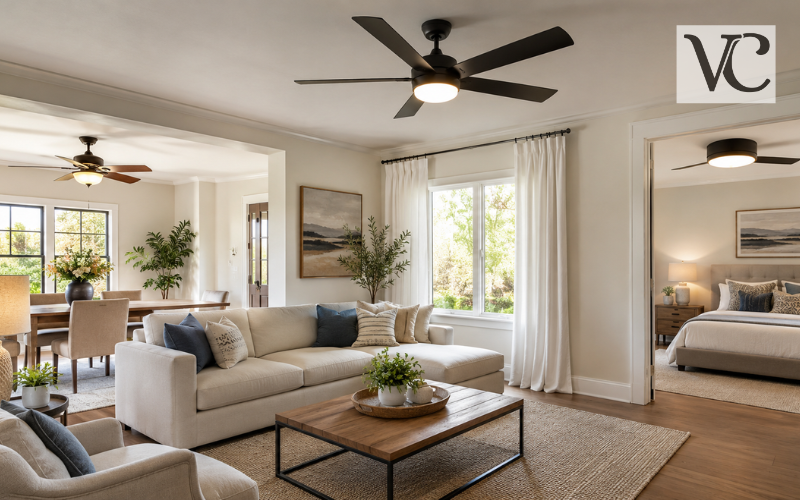
The best ceiling fans with lights combine two everyday needs in one fixture: steady airflow and useful overhead lighting. They work especially well in bedrooms, living rooms, dining areas, and home offices where ceiling space is limited.
A good model should move air without distracting motor noise or blade wobble. Its light should be bright enough for the room, comfortable at night, and easy to dim. Motor efficiency also matters because fans often run for many hours. Some homes need only a simple remote, while others benefit from app schedules, timers, or voice control.
Room size, ceiling height, and style affect the right choice. Low ceilings usually need a flush-mount fan, while high or sloped ceilings may require a downrod. This guide compares practical 2026 options from Honeywell, Dreo, Sofucor, and Hunter, then explains sizing, lighting, controls, and regional choices for Pakistan.
Quick Comparison Guide
| Model | Best For | Size | Motor and Airflow | Lighting | Controls |
| Honeywell Carmel | Best overall | 48 inches | Reversible motor with steady airflow | Dimmable warm LED | Remote control |
| Dreo Smart Ceiling Fan | Smart homes and larger rooms | 52 inches | Quiet DC motor with strong airflow | Dimmable, adjustable white tones and mood lighting | Remote, app, timers, and smart features |
| Sofucor Flush Mount | Low ceilings and bedrooms | 52 inches | Six-speed DC motor | Dimmable LED with three color tones | Remote and timer |
| Hunter Dempsey | Classic rooms and bedrooms | 52 inches | Three-speed reversible motor | Dimmable LED bulbs | Remote control |
| Khurshid AC/DC Fan | Energy-saving use in Pakistan | Varies | Efficient AC/DC or BLDC motor | Light availability depends on model | Remote on selected models |
Quick Steps for Choosing the Right Ceiling Fan
- Measure the room before selecting the blade span.
- Choose a flush-mount fan for ceilings below eight or nine feet.
- Compare CFM ratings to understand airflow strength.
- Select a quiet DC motor for bedrooms and long daily use.
- Check LED brightness, dimming, and color-temperature settings.
- Confirm remote, app, timer, and wall-switch compatibility.
- Review the motor warranty and availability of replacement parts.
- Make sure the ceiling electrical box is rated to support a fan.
Quick Picks for the Best Ceiling Fans With Lights
The Honeywell Carmel 48-Inch is the best overall choice for many medium rooms. It offers a familiar five-blade design, dimmable LED lighting, reversible airflow, and simple remote control.
The Dreo Smart Ceiling Fan 712S is the best smart and high-airflow option. Dreo rates this 52-inch model at up to 6,040 CFM. It has six speeds, app control, timers, adjustable white light, and RGB mood lighting. Dreo lists its noise level below 35 dB.
The Hunter Dempsey 52-Inch Low Profile is a strong bedroom choice for buyers who prefer a classic design and replaceable bulbs. The Sofucor KBS-52K077 is the best flush-mount option for low ceilings because it combines a 35-watt DC motor, six speeds, three light tones, and a timer.
In Pakistan, Khurshid AC/DC or BLDC fans may be more practical for buyers who prioritize electricity savings, solar or UPS use, and local service. Many local energy-saving fans do not include a light, so a separate fixture may still be necessary.
Best Ceiling Fans With Lights Comparison
| Model | Size and mount | Airflow and motor | Lighting | Controls | Best use | Main limitation |
| Honeywell Carmel | 48-inch, dual mount | Reversible motor | 800 lumens, 3000K, dimmable 20–100% | Remote | Medium bedrooms and living spaces | One fixed light color |
| Dreo 712S | 52-inch | Up to 6,040 CFM, six speeds, under 35 dB | Six brightness levels, five white tones, RGB light | App, remote, schedules, timers | Smart homes and larger rooms | More settings than some users need |
| Sofucor KBS-52K077 | 52-inch flush mount | 35W reversible DC motor, six speeds | 18W LED, three color tones | Remote and timer | Low ceilings and bedrooms | Not for sloped ceilings; fixed light module |
| Hunter Dempsey | 52-inch flush mount | Three-speed reversible AC motor; 3,768 CFM on high for the referenced variant | Two dimmable 800-lumen, 3000K bulbs | Handheld remote | Classic interiors and low ceilings | No app control and fewer speeds |
Honeywell’s current Carmel listing confirms the 48-inch span, 800-lumen light, 20–100% dimming, dual-mount installation, and remote operation. Hunter’s current Dempsey information confirms a 52-inch low-profile body, dimmable LED bulbs, a three-speed reversible motor, and a remote.
Specifications can vary by size, finish, and model number. Always compare the exact model number on the seller’s page with the manufacturer’s current specification sheet.
What Makes a Ceiling Fan With Light Worth Buying
A ceiling fan with a light is worth buying only when both parts perform well. Strong airflow does not help if the light is too dim, and attractive lighting cannot make up for a noisy or unstable fan.
The best models create a useful breeze at low and medium speeds, not only at maximum power. This matters for sleeping, reading, and relaxing. Motor quality affects noise, energy use, and control. DC motors often provide more speed settings and lower power use, while traditional AC motors can still be dependable and easy to service.
Lighting should be judged by lumens, color temperature, dimming range, and replacement options. Warm light around 2700K to 3000K suits bedrooms and lounges. Neutral or cooler light can work better for cleaning, reading, or office tasks. Buyers should also check whether the fan uses standard bulbs or a fixed LED module.
Good mounting hardware, balanced blades, clear instructions, and a useful warranty are equally important. ENERGY STAR explains that airflow depends on the complete fan design, including the motor, blade shape, speed, balance, and blade length.
Best Overall Ceiling Fans With Lights
The Honeywell Carmel is a practical best-overall choice because it meets the needs of many average rooms without making operation complicated. The current matte-black 48-inch model includes a dimmable 800-lumen LED light at 3000K, reversible blades, dual-mount compatibility, and a remote with a wall holder. Its main drawback is the fixed warm light color, which is less flexible than the multi-temperature systems from Dreo or Sofucor.
The Hunter Dempsey is better for buyers who want clean styling, a low-profile body, and an established fan brand. Hunter lists the 52-inch model for large rooms and ceilings below nine feet. It includes reversible blades, two dimmable bulbs, a remote, and a limited lifetime motor warranty. Its three-speed AC motor provides less fine control than a six-speed DC fan.
Sofucor offers the most flexible low-profile setup of these three. Its 35-watt DC motor has six speeds, while the integrated 18-watt light provides three color-temperature choices. The main limits are flat-ceiling installation and a light module that is not intended for replacement or upgrading.
Best Ceiling Fans With Lights and Remote Controls
The best ceiling fans with lights and remote controls let the fan and light work independently. You can keep the breeze running in a dark bedroom or use the light without turning on the fan.
Honeywell and Hunter keep operation simple with speed and light-dimming controls. Dreo and Sofucor provide more choices. Dreo adds six speeds, app schedules, several light temperatures, and 1-, 4-, or 8-hour timers. Sofucor includes six speeds, three light tones, a timer, and remote-controlled reverse direction.
Check wall-switch compatibility before buying. Some remote fans need constant power at the wall and use the remote or app for normal control. Never connect a fan motor or integrated LED to an ordinary dimmer unless the manufacturer approves it.
Memory settings are useful when the fan returns to the previous speed or light level. Remote-controlled reverse mode is also more convenient than climbing up to change a switch on the motor housing.
Dreo Ceiling Fan for Smart-Home Performance
Dreo is a strong choice for buyers who want more control than a basic remote provides. The 52-inch Smart Ceiling Fan 712S is rated at up to 6,040 CFM and offers six speeds, three wind modes, app scheduling, adjustable white lighting, and RGB ambient lighting. Dreo lists six brightness levels, five color temperatures, and noise below 35 dB.
The app can create routines, set timers, and adjust lighting without the remote. This is useful for a gentle overnight speed, a morning schedule, or changing from warm evening light to brighter task lighting.
Voice support depends on the exact model. Dreo’s 521S page lists Google Home and Alexa support, more than 5,600 CFM, a 2400-lumen light, and adjustable color temperatures from 2700K to 6500K. Buyers should not assume every Dreo fan has the same smart features.
A Dreo ceiling fan suits a modern living room, primary bedroom, game room, or connected home. It may be unnecessary for someone who only wants three speeds and a basic light.
Best Ceiling Fans With Lights for Living Rooms
Living rooms usually need wider blade spans, stronger airflow, and brighter lighting than small bedrooms. A 52-inch fan is a common starting point for a medium or large living area, although open-plan spaces may need a bigger fan, two fans, or higher verified airflow.
The Dreo 712S is the strongest performance choice in this group because its maximum 6,040 CFM gives it more capacity for larger rooms. Honeywell Carmel suits a medium living room where traditional styling and simple remote control matter more than app features.
Mounting must match the ceiling. Standard ceilings may use a short downrod or low-profile body. High ceilings need a longer downrod so the blades sit closer to the occupied area. Sloped ceilings require an approved angled mount. Honeywell’s Carmel supports standard or angled dual mounting, while the referenced Sofucor flush-mount model is designed only for flat ceilings.
A fan light may be enough for general use, but large living rooms often still need lamps or recessed lights to remove dark corners.
Best Bedroom Ceiling Fans With Lights
The best bedroom ceiling fans with lights should stay quiet at low speed and offer soft dimming. Smooth low-speed airflow often matters more during sleep than the highest available CFM.
The Hunter Dempsey is a strong traditional bedroom option. Its low-profile housing suits ceilings below nine feet, while the dimmable 3000K bulbs create a warm evening tone. Its three speeds are simple to use, although people who want more precise airflow may prefer a six-speed DC fan.
Sofucor’s flush-mount model works well in a larger bedroom with a low ceiling. It adds six speeds, three light colors, separate fan and light operation, and a timer. Dreo is better for users who want schedules, stronger airflow, and wider lighting control.
Do not buy a 52-inch fan automatically for a small bedroom. A 36- to 42-inch model may fit better. Check the fan’s total drop as well, especially near bunk beds or tall furniture.
Best Flush-Mount Fans for Low Ceilings
A flush-mount, hugger, or low-profile fan attaches close to the ceiling without a normal downrod. Hunter advises that fan blades should remain at least seven feet above the floor, and ceilings below eight feet usually need a low-profile design.
The Sofucor KBS-52K077 has an overall drop of about 10.8 inches and is recommended for eight- to nine-foot ceilings. Its six-speed DC motor, dimmable three-tone light, timer, and remote make it a feature-rich choice. Hunter Dempsey is the simpler alternative with three speeds, replaceable bulbs, and a limited lifetime motor warranty.
Flush mounting has a trade-off. Blades placed close to the ceiling may draw in less air than a similar downrod fan. ENERGY STAR notes that hugger fans generally move less air, so compare published CFM instead of judging by blade size alone.
How to Choose the Right Fan Size and Airflow
Measure the room’s length and width first. ENERGY STAR suggests 29- to 36-inch fans for rooms up to 75 square feet, 36- to 42-inch fans for 76 to 144 square feet, about 44 inches for 144 to 225 square feet, and 50 to 54 inches for 225 to 400 square feet. Manufacturer guidance may differ, so use both room size and airflow data.
CFM means cubic feet per minute. It shows how much air the fan can move at a stated speed, usually the maximum setting. Higher CFM can help in a larger room, but low-speed airflow, noise, efficiency, and even air distribution also matter.
The fan should be centered where possible, with blades at least seven feet above the floor. ENERGY STAR says eight to nine feet above the floor is a useful target for airflow when ceiling height allows it.
Do not choose by blade span alone. Consumer Reports’ 2026 testing measures airflow, adjustability, and noise, including the difference between high- and low-speed performance.
Lighting, Motor, and Smart Features to Compare
AC motors are common in traditional fans and often offer three speeds. DC motors usually provide more precise control, lower power use, and quieter operation. In Pakistan, “inverter fan” often describes an efficient BLDC or electronically controlled motor. An AC/DC model may also accept battery or solar-linked DC power. Check the input type and rated wattage because these terms are not always used consistently.
Lumens measure brightness, while watts measure power use. Color temperature describes the look of white light. Around 2700K to 3000K appears warm, 3500K to 4000K looks neutral, and 5000K or above looks cooler. A broad dimming range is more useful than simple on-off lighting.
Reversible airflow can improve year-round comfort. Normal direction creates a cooling breeze in warm weather, while reverse mode helps move warm air down from the ceiling in cooler months. ENERGY STAR notes that most residential ceiling fans include reversible operation.
App control, timers, schedules, and voice commands are helpful only when they simplify use. Also check whether the LED is replaceable. Standard bulbs are easy to service, while fixed modules may require a brand-specific part.
Ceiling Fan Brands, Reliability, and Brands to Avoid
People searching for the top 10 ceiling fan brands often compare Hunter, Honeywell, Minka-Aire, Casablanca, Fanimation, Kichler, Dreo, Sofucor, Matthews Fan Company, and important regional makers. No brand is best in every category, so judge reliability at model level.
Rather than publishing an unsupported list of ceiling fan brands to avoid, look for warning signs. These include missing CFM data, unclear motor warranties, no replacement remote, poor access to light modules, vague safety certification, repeated wobble complaints, and sellers that provide no model number or manual.
A Consumer Reports-style comparison focuses on measured airflow, the difference between high and low settings, and noise from both the motor and moving air. Those checks are more useful than relying only on star ratings or advertising words such as “silent” and “powerful.”
In Pakistan, service access and power conditions may matter more than imported smart features. Khurshid markets AC/DC and BLDC technology for lower energy use and low-voltage operation. Royal sells locally available inverter lines with remote controls, while Matthews Fan Company offers premium design-focused fans with light-kit models through selected dealers. Confirm that the exact local model includes a light, because many Pakistan-market inverter ceiling fans do not.
Conclusion: Choosing the Best Ceiling Fan With Light
The best ceiling fans with lights combine the right blade span, useful airflow, comfortable lighting, quiet operation, and controls that suit the household. Honeywell Carmel is a balanced choice for medium rooms. Dreo suits buyers who want stronger airflow and smart control. Sofucor works well for low ceilings and six-speed DC performance, while Hunter Dempsey offers a clean low-profile design with familiar controls and replaceable bulbs.
Measure the room and ceiling height, confirm the mounting type, compare verified CFM and noise information, and check the warranty before buying. Also consider how the light can be repaired or replaced later.
The most practical fan is not always the one with the longest feature list. Choose the model that safely fits the room, moves enough air at the speeds you will actually use, and provides comfortable lighting throughout the day.
Frequently Asked Questions
What size ceiling fan with light is best for a bedroom?
A fan between 36 and 44 inches usually suits a small bedroom. Larger bedrooms may need a 48- or 52-inch model with quiet low-speed airflow and dimmable lighting.
Are DC ceiling fans better than AC ceiling fans?
DC ceiling fans are usually quieter, more energy-efficient, and provide more speed settings. AC fans can still be reliable, affordable, and easier to repair in areas with limited replacement parts.
How many lumens should a ceiling fan light provide?
Around 800 to 1,500 lumens may be enough for a bedroom or small room. Larger living areas often need brighter output or additional lamps to prevent dark corners.
Are flush-mount ceiling fans suitable for every room?
Flush-mount fans work best with low ceilings because they keep the blades closer to the ceiling. However, they may move less air than comparable fans installed with a downrod.
Which ceiling fan with light is best for smart homes?
A Dreo smart ceiling fan is a suitable option for app schedules, timers, adjustable lighting, and voice-control compatibility. Always confirm the exact smart features of the model before purchasing.
Disclaimer: This article provides general information to help readers compare the best ceiling fans with lights. Product specifications, prices, warranties, availability, smart features, and energy ratings may change over time or vary by model and region. Always verify the latest details with the manufacturer or authorized seller before purchasing. Ceiling fans should be installed on a fan-rated electrical box and according to local electrical and building regulations. Hire a qualified electrician when wiring, mounting support, ceiling height, or installation safety is uncertain. The products mentioned are informational examples and are not paid endorsements.
Enjoyed this article? Discover more helpful ideas and fresh inspiration on Vogue Cultures.