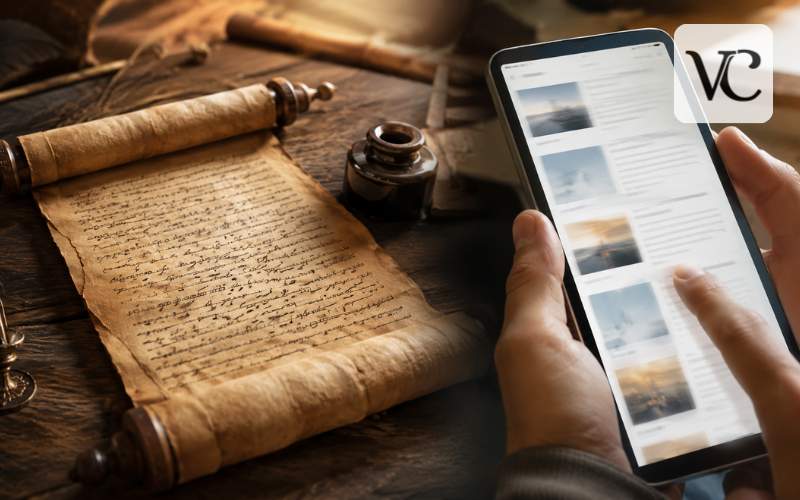
The word scrollr has a long history, but its meaning is still easy to understand. In its traditional sense, a scroll is a long piece of material—such as papyrus, parchment, paper, or silk—that is rolled up and used for writing, record keeping, religious texts, or artwork. In modern life, the same word is also used as a verb. When you move up, down, or sideways through a webpage, document, or app, you scroll.
These two meanings may seem very different, yet they share the same basic idea: information is revealed gradually as you move through it. A person reading an ancient scroll exposed one section at a time by unrolling it. A person using a phone or computer reveals new content by moving the screen view.
This article explains both sides of the word. It looks at the history of physical scrolls, the materials used to make them, their role in different cultures, and the shift from scrolls to bound books. It also explains how “scroll” became a digital navigation term and why good scrolling design matters today.
Snippet-Ready Definition:
Scroll can mean a rolled document used for writing or artwork, or the action of moving through digital content on a screen. Both meanings involve revealing information gradually as you move through it.
Quick Guide: Physical Scroll vs. Digital Scroll
| Feature | Physical Scroll | Digital Scroll |
| Meaning | Rolled material containing writing or art | Moving through content on a screen |
| Common materials | Papyrus, parchment, paper, silk | Digital webpages, apps, documents |
| How it works | Rolled and unrolled by hand | Moved with touch, mouse, keyboard, or trackpad |
| Main purpose | Preserve and display information | Navigate content beyond the visible screen |
| Common direction | Horizontal or vertical, depending on format | Usually vertical, sometimes horizontal |
| Used today? | Yes, especially in religion, art, and archives | Yes, widely used on phones and computers |
Common Ways the Word “Scroll” Is Used
- Historical scroll: A long rolled document containing text, records, or artwork.
- Religious scroll: A scroll used for sacred texts or ceremonies.
- Art scroll: A handscroll or hanging scroll used for painting and calligraphy.
- Vertical scrolling: Moving content up or down on a screen.
- Horizontal scrolling: Moving content left or right.
- Smooth scrolling: Animated movement between different parts of digital content.
The Two Main Meanings of Scroll
As a noun, a scroll usually means a long, flexible strip or roll that carries writing, images, records, or decoration. Traditional scrolls could be made from several sheets joined together, then rolled for storage. The exact form differed by place and period, but the basic idea was the same: the content existed on one continuous surface rather than on separate bound pages. The Library of Congress describes a manuscript roll as sheets of papyrus or parchment joined together to form a continuous document.
As a verb, to scroll means to move through content that does not fit inside the visible part of a screen or window. On a website, for example, only part of a long page may be visible at once. Scrolling brings hidden content into view. MDN describes the visible area of a scroll container as the “scrollport,” with other content becoming visible as the user moves through it.
Context usually makes the intended meaning clear. A museum may display a scroll, while a phone user may scroll through messages.
Where Physical Scrolls Came From
Scrolls developed because people needed practical ways to store longer written works. In the ancient world, a single sheet was often too small for a long text. By joining sheets together, writers could create a much larger writing surface and roll it into a compact form when it was not being read.
Scrolls were a standard way of preserving texts in antiquity, including in Egyptian, Greek, and Roman societies. Harvard’s Medieval Scrolls project notes that papyrus rolls were known thousands of years ago and became a major book format in the ancient world.
Papyrus became especially important in ancient Egypt and later across the Mediterranean. Surviving objects show that papyrus rolls were used for religious writings, letters, literary works, calculations, and administrative records. The British Museum, for example, holds ancient Egyptian papyri containing mathematical exercises, correspondence, and other kinds of written information.
Before the bound book became common, the scroll was one of the main ways to organize longer texts. It therefore played an important role in preserving knowledge, literature, religion, law, and records.
Materials Used to Make Traditional Scrolls
Traditional scrolls were not made from one universal material. The choice depended on local resources, cost, purpose, and writing traditions.
Papyrus was widely used in Egypt and the ancient Mediterranean. It was made from the papyrus plant and could be formed into sheets that were joined into long rolls. Parchment, made from prepared animal skin, became another important writing material and was used for both rolls and later books. Leather was also used in some manuscript traditions.
In East Asia, paper and silk became major materials for painted and written scrolls. The Metropolitan Museum of Art describes the Chinese handscroll as a continuous roll of paper or silk, often used for painting and calligraphy.
Some scrolls were wound around rods or fitted with rollers, while others were simply rolled around themselves. Sheets could be pasted, sewn, or otherwise joined depending on the tradition. These construction choices affected how a scroll was handled, stored, displayed, and preserved.
How Scrolls Were Written, Read, and Stored
Reading a scroll was different from turning the pages of a modern book. Instead of opening to a numbered page, a reader usually had to unroll the document until the desired section appeared. As reading continued, one part could be unrolled while another part was rolled up again.
Text could be arranged in columns or blocks along the long surface. Artwork could also develop across the scroll as a continuous visual sequence. This format made it possible to create a sense of movement, journey, or narrative that unfolded gradually.
Storage depended on the material and cultural setting. Scrolls might be tied, wrapped, placed in cases, kept in containers, or stored in boxes. Chinese handscrolls, for example, have traditionally been rolled when not in use and may be protected with wrapping and a wooden storage box. They are then unrolled section by section for viewing.
Because papyrus, parchment, paper, and silk can all be damaged by moisture, handling, light, pests, or age, surviving scrolls often require careful conservation. Modern museums use controlled storage and specialist treatment to protect fragile examples.
Scrolls in Ancient Egypt, Greece, and Rome
Ancient Egypt is closely linked with the history of the papyrus scroll because papyrus was produced there and used for many types of documents. Egyptian scrolls preserved religious texts, administrative information, letters, literary works, and educational material.
Some surviving examples are several metres long. The British Museum notes that the Rhind Mathematical Papyrus is more than five metres long and contains more than 80 mathematical problems. It shows how a scroll could serve as a practical teaching and record-keeping tool, not simply as a ceremonial object.
Papyrus rolls also became important in Greek and Roman written culture. Literary works, philosophy, poetry, law, and records could be copied onto rolls and stored in collections. The Bodleian Libraries preserve Greek and Latin papyri, including rolls containing parts of Homer’s Iliad and carbonized rolls from Herculaneum.
Over time, however, the codex—a group of leaves bound along one edge—became more common. The scroll did not disappear at once, but the codex offered practical advantages that helped it replace the roll for many everyday reading and writing purposes.
Religious and Ceremonial Scrolls
Scrolls have had lasting importance in religious life because some traditions preserved the format even after bound books became widespread. A well-known example is the Torah scroll in Judaism. A Torah scroll contains the Five Books of Moses and is traditionally handwritten on prepared material by a trained scribe. It is rolled around wooden supports and used in synagogue worship.
The Dead Sea Scrolls are another major example. These ancient manuscripts were discovered near the Dead Sea and include biblical texts as well as other Jewish writings. They have provided important evidence for scholars studying ancient Jewish society, religious ideas, languages, and the history of biblical texts.
Other religious cultures have also used scroll or roll formats at different times. However, these traditions should not be treated as identical. Materials, scripts, rituals, rules for handling, and reasons for keeping a text in scroll form can differ greatly.
Because sacred scrolls may still be active religious objects rather than only historical artifacts, respectful handling matters. In museums and libraries, preservation focuses on protecting fragile materials; in living religious traditions, handling may also follow specific ceremonial customs.
Handscrolls and Hanging Scrolls in Asian Art
In East Asian art, scrolls became important not only for writing but also for painting and calligraphy. Two common formats are the handscroll and the hanging scroll, and they are meant to be experienced differently.
A handscroll is a long horizontal work, often made from paper or silk. It is normally stored rolled up and viewed gradually on a table or another flat surface. The viewer unrolls a section, studies it, and then continues to the next part. The Metropolitan Museum of Art explains that Chinese handscrolls are traditionally viewed section by section, creating a personal experience that unfolds through time and space.
A hanging scroll is designed for vertical display. It can be hung on a wall so that the work is visible as a whole or largely at once. Both formats may combine painting, poetry, calligraphy, inscriptions, and seals.
The difference is important because the format shapes the viewing experience. A handscroll invites gradual discovery, while a hanging scroll is made for display and contemplation from a more fixed position.
Scroll vs. Codex: Why Bound Books Took Over
A scroll and a codex organize information in very different ways. A scroll presents content on a long continuous surface. A codex divides content into leaves or pages that are bound together along one side.
The codex made it easier to move quickly between different parts of a text. A reader could open near the middle without passing through everything before it. Pages could also be used more conveniently on both sides, and different passages could be compared with less physical handling. Oxford material on the history of the codex also highlights easier navigation and greater writing space among its practical advantages.
Scrolls still had strengths. They could hold long continuous images or texts, and some ceremonial, legal, and artistic uses suited the roll format. But for regular reading, study, reference, and transport, the codex became highly practical.
The change did not happen everywhere at the same time, and scrolls continued to survive in many settings. Even so, the page-based codex eventually became the standard shape for many manuscript and book traditions, while scrolls became more specialized.
Famous Historical Scrolls and What They Can Teach Us
Historical scrolls are valuable because they preserve more than words. They can reveal how people wrote, studied, worshipped, governed, calculated, created art, and recorded everyday life.
The Dead Sea Scrolls are important for the study of ancient Judaism and biblical texts. Egyptian papyri preserve everything from funerary writings to mathematical exercises and private letters. Chinese handscrolls can combine art, poetry, calligraphy, seals, and comments added by later owners, allowing researchers to trace how an artwork was viewed across generations.
The Herculaneum papyri offer a striking example of how new technology can help researchers study scrolls that are too fragile to open physically. These carbonized papyrus rolls were buried by the eruption of Mount Vesuvius in AD 79.
In February 2025, the Bodleian Libraries announced that researchers had produced images of text inside one of its Herculaneum scrolls using X-ray scanning, digital “virtual unrolling,” and machine-learning tools that helped detect ink. The process allowed researchers to examine material hidden inside the tightly rolled object without physically opening it.
Such work shows that scroll research is not only about the past. Modern imaging and conservation can reveal information that was previously inaccessible while reducing the need to handle delicate originals.
How “Scroll” Became a Digital Navigation Term
The modern digital meaning of scroll is easy to understand when compared with the physical object. An ancient reader moved a long roll to bring a new section into view. A modern user moves digital content through a limited screen area to reveal information that is currently hidden.
On computers, scrolling became a basic way to navigate documents, webpages, lists, and software windows. On smartphones and tablets, the action became even more familiar because people can move content directly with a finger.
In technical terms, digital content may exist inside a scrollable area that is smaller than the full content itself. MDN defines a scroll container as an element whose content can be moved when it extends beyond its visible area. The visible section is the part the user currently sees.
The old and new meanings therefore share a simple concept: the full information exists, but only part of it is visible at one time. Movement reveals the rest.
Main Types of Digital Scrolling
The most common form is vertical scrolling, where content moves up or down. This is the standard pattern for webpages, social feeds, articles, and many mobile apps. Horizontal scrolling moves content left or right and is often used for wide tables, image rows, timelines, galleries, or interfaces designed around sideways movement.
A scrollbar gives users a visual way to move through content and may also show roughly where they are within a page or panel. A scroll container is simply an area where more content exists than can be displayed at once.
Other patterns include smooth scrolling, where the movement is animated instead of jumping instantly; scroll snapping, where the view settles at defined positions; and infinite scrolling, where more items appear as the user continues downward. MDN notes that the CSS scroll-behavior property can control smooth movement when scrolling is triggered through navigation or certain programmatic methods.
Users can scroll with a mouse wheel, trackpad, touchscreen gesture, keyboard keys, scrollbar, or another suitable input device.
Scroll Design, Accessibility, and User Experience
Good scrolling should feel predictable. People should be able to move through a page without losing their place, fighting unexpected movement, or being forced through unnecessary animation. Standard scrolling patterns are often easier to understand because users already know how they behave.
Problems can appear when a website automatically moves the page, locks normal scrolling, changes direction without warning, or uses heavy scroll-based effects. Motion can also be uncomfortable or distracting for some users. For that reason, designers should use animation only when it helps people understand or use the content rather than simply adding visual movement.
Accessibility guidance also matters. WCAG 2.2 says motion animation triggered by interaction should be possible to disable when that animation is not essential. Accessibility guidance also calls for controls to pause, stop, or hide certain automatically moving or scrolling information that continues for more than five seconds alongside other content.
A user-friendly page should also remain usable with a keyboard and other appropriate input methods. The goal is simple: scrolling should help people reach information, not become an obstacle.
Conclusion
The word scroll connects one of the oldest ways of organizing written information with one of the most common actions in modern digital life. Ancient scrolls allowed people to preserve long texts, records, religious writings, and artwork on continuous rolls of papyrus, parchment, paper, silk, and other materials. Different cultures developed their own ways of creating, reading, storing, and valuing them.
Bound books eventually became more practical for many forms of reading, but scrolls never disappeared completely. They remain important in religion, art, historical research, museums, and manuscript collections.
Today, most people encounter the word as an action on a screen. We scroll through webpages, documents, messages, and apps to reveal content beyond the visible area. The technology is new, but the basic idea is surprisingly old: information unfolds as the reader moves through it. That link between past and present is why scroll remains such a useful and meaningful word.
FAQs
What is a scroll in simple words?
A scroll is traditionally a long piece of material rolled up for storing writing or artwork. In digital use, scrolling means moving through content that extends beyond the visible part of a screen.
What were ancient scrolls made from?
Ancient scrolls were commonly made from materials such as papyrus, parchment, and leather. In parts of Asia, paper and silk were also widely used for written, painted, and calligraphic scrolls.
Why did books replace scrolls?
Bound books, or codices, made it easier to find specific sections, turn between passages, use both sides of a page, and handle long texts without repeatedly rolling and unrolling material.
What does scrolling mean on a computer or phone?
Scrolling means moving a webpage, document, message list, or other digital content so that information outside the current visible area appears on the screen.
What is the difference between vertical and horizontal scrolling?
Vertical scrolling moves content up and down and is common on websites and mobile apps. Horizontal scrolling moves content left and right and is often used for galleries, tables, and timelines.
Disclaimer: This article is provided for general educational and informational purposes. Historical scroll formats, materials, terminology, religious practices, and digital scrolling methods can vary by culture, period, platform, and technology. Readers seeking specialist historical, conservation, religious, or web-accessibility guidance should consult qualified experts or authoritative sources.
Enjoyed this article? Discover more helpful ideas and fresh inspiration on Vogue Cultures.