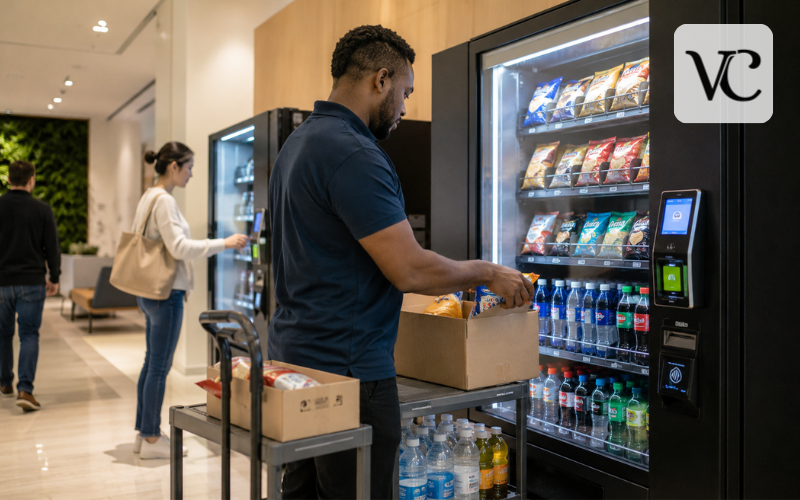
A vending machine business sells products through self-service machines placed in locations where people live, work, travel, exercise, or wait. The owner or operator is responsible for choosing the location, buying or leasing the machine, stocking products, setting prices, collecting payments, and keeping the machine working.
It attracts beginners and side hustlers because it can start with one machine and grow gradually, without needing a cashier. However, it does not run itself. Restocking, repairs, payment issues, and location relationships still need regular attention.
In 2026, successful vending is increasingly connected to modern payment technology and better sales data. Cantaloupe reported that 78% of vending sales in its 2025 data were cashless, showing why card, phone, and contactless payments have become important for operators.
This guide explains how a vending machine business works, what it may cost, where machines tend to perform well, how profits are created, what risks beginners should understand, and how a small route can be expanded carefully.
Snippet-Ready Definition:
A vending machine business is a self-service retail business where owners place machines in suitable locations, stock products, collect payments, and earn profit from sales after inventory and operating costs.
Quick Guide: Vending Machine Business
| Area | What to Know |
| Startup Cost | Depends on new, used, or smart machines, plus inventory, delivery, permits, and insurance |
| Best Locations | Offices, hospitals, gyms, apartments, schools, factories, and transit areas |
| Common Products | Snacks, drinks, coffee, healthy foods, hygiene items, and specialty products |
| Payment Options | Cash, cards, contactless payments, and mobile wallets |
| Main Expenses | Inventory, commissions, repairs, payment fees, fuel, insurance, and maintenance |
| Profit Potential | Varies by location quality, pricing, product demand, and operating costs |
| Work Required | Restocking, cleaning, repairs, inventory tracking, and location management |
Simple Steps to Start a Vending Machine Business
- Research local demand and identify suitable locations.
- Choose your vending niche, such as snacks, drinks, or specialty products.
- Set up the business legally and check local permit requirements.
- Secure a location before investing heavily in equipment.
- Buy or lease a reliable machine with suitable payment options.
- Stock products that match the location’s customers.
- Track sales and expenses and replace slow-selling products.
- Scale carefully after the first machine shows consistent results.
How a Vending Machine Business Makes Money
You place a machine where there is enough demand, stock it, and earn revenue from each purchase. Real profit is what remains after product costs and operating expenses.
Expenses can include commissions paid to location owners, payment-processing fees, fuel, equipment financing, repairs, insurance, spoilage, taxes, and replacement parts. Strong sales can still produce weak profits if pricing or route costs are poor.
Location is usually one of the biggest factors. A good machine in a weak location may struggle, while an ordinary machine in a busy workplace, hospital, or apartment building can perform much better. Product selection also matters because customers need to see items they actually want at prices they are willing to pay.
This is why vending is better described as semi-passive income rather than completely passive income. Customers can buy without you being there, but someone still has to manage the business behind the scenes.
Best Vending Machine Business Ideas to Explore
Snack and drink machines are often the simplest starting point because demand is familiar. Offices, factories, apartments, schools, and waiting areas can support quick purchases of bottled drinks, chips, chocolate, and similar products.
Healthy vending may work well in gyms, health-focused workplaces, medical facilities, and suitable educational settings. Products can include water, protein bars, nuts, low-sugar drinks, and lighter snack options.
Coffee machines suit workplaces, colleges, hospitals, and transport areas but may need more cleaning. Hygiene vending can work in restrooms, campuses, workplaces, and public facilities for menstrual care and basic toiletries.
Specialty machines can sell phone chargers, cosmetics, small electronics, toys, or other convenience items. They may support higher selling prices but need a strong match between the product and location.
For most beginners exploring vending machine business ideas, simple products with proven demand are easier to test before investing in expensive or unusual vending concepts.
How to Start a Vending Machine Business Step by Step
A beginner should treat the first machine as a business test rather than immediately trying to build a large route.
- Research the local market and identify places where people regularly need convenient food, drinks, or everyday products.
- Choose a vending niche that fits those customers and locations.
- Set up the business properly, including registration, tax requirements, banking, and any required permits.
- Approach property owners or managers and try to secure a suitable location before committing to expensive equipment.
- Buy, finance, or lease a machine that fits the available space and customer needs.
- Add reliable payment methods, especially card and contactless options where practical.
- Purchase opening inventory, set reasonable prices, test every selection, and make sure the machine is clean and easy to use.
- Monitor sales closely and adjust slow products, prices, or restocking schedules based on actual results.
Shopify’s updated 2026 vending guide follows a similar path: research the market, choose products, establish the business, find a location, obtain equipment, stock it, monitor results, and scale after learning what works.
Vending Machine Business Cost: What You Need to Budget
Vending machine business cost depends heavily on the equipment you choose. Used machines can reduce the initial investment, while new smart machines may cost several thousand dollars before inventory and setup expenses.
Shopify’s 2026 guide reports that used machines can start around $1,000, standard new machines around $3,000, while advanced smart machines can cost more than $7,000. Leasing may range roughly from $75 to $500 per month depending on the equipment and agreement. These are broad U.S. examples rather than fixed prices for every market.
The machine is only part of the budget. Also allow for delivery, moving costs, card-reader hardware, processing fees, opening inventory, business registration, permits, insurance, fuel, cleaning supplies, and repairs.
A low-budget launch may use one dependable used machine in a secure indoor site. A higher-budget setup may include a new machine, contactless payments, remote monitoring, financing, and more opening stock.
One mistake beginners can make is spending nearly all their available money on the machine. Keeping cash available for restocking and unexpected repairs can make the business easier to operate.
Choosing Between New, Used, and Smart Vending Machines
New machines cost more but may include modern payments, warranties, and fewer unknown repair issues. They can make sense when you have already secured a promising location and have enough capital.
Used or refurbished equipment may be more affordable, but inspection is important. Check refrigeration, vending motors, keypads, bill and coin systems, door seals, card-reader compatibility, and whether replacement parts are still readily available.
Smart machines can add remote inventory tracking, sales reports, alerts, and cashless payments, helping operators reduce unnecessary visits and identify fast-selling products.
Cashless capability deserves particular attention. Cantaloupe’s 2026 Micropayment Trends Report says 78% of vending sales in its 2025 data were cashless. The reported average cashless ticket was $2.45 compared with $1.57 for cash.
A beginner does not automatically need the newest machine. A reliable machine that suits the location, accepts common payment methods, has available parts, and leaves money for operating expenses may be a better investment.
Evaluating Local Demand and Vending Machine Business Near Me Opportunities
A “vending machine business near me” search should begin with demand, not equipment. Look for local buildings where people spend time but have limited access to quick food, drinks, or everyday items.
Good signs include repeat foot traffic, long operating hours, waiting areas, shift workers, or limited nearby shops. Competition matters too. A smaller building with few convenient alternatives may sometimes offer a better opportunity than a much busier location sitting beside a convenience store.
Talk with employees, residents, facility workers, or property managers when possible. Learn what people already buy, when demand is highest, and whether vending has previously been available at the property.
The goal is not simply to find the building with the most people. You need a good match between the customers, products, pricing, convenience, and operating costs.
Picking the Right Locations for Long-Term Success
Offices, hospitals, factories, apartment buildings, gyms, schools, colleges, and transport facilities are common vending locations because they can generate repeat traffic. Shopify’s 2026 guide similarly identifies offices, hospitals, educational facilities, gyms, apartment complexes, and transit hubs as potential placement opportunities.
Before agreeing to a site, check how many people regularly use it, what hours they are present, whether food or drink competitors are nearby, whether electricity is available, and whether the machine will be secure.
A written location agreement can clarify commission, access hours, electricity costs, responsibility for damage, exclusivity, contract length, and termination terms. Some property owners may request a percentage of sales, while others may accept vending as a useful amenity without charging commission.
Finding the location before buying the machine can lower risk because you will already know the available space, power supply, audience, and likely product needs.
Vending Machine Business Franchise vs Independent Ownership
A vending machine business franchise can provide a more structured starting point. Depending on the company, a package may include machines, training, branding, product guidance, or help finding locations.
The trade-off is cost and control. Franchise or vending-business packages may require larger upfront investments, and owners may have less flexibility over equipment, products, suppliers, or branding.
Independent ownership gives you more control over machines, locations, inventory, suppliers, and routes, but you must manage contracts, repairs, payment systems, purchasing, and location sales yourself.
Shopify notes that some structured vending programs can involve investments ranging from tens of thousands of dollars upward depending on the package and number of machines.
Before paying for any franchise or vending opportunity, review exactly what you are receiving. Location promises, training, warranties, fees, machine ownership, and ongoing costs should all be clear before money changes hands.
Buying a Vending Machine Business for Sale or an Existing Route
Buying an existing vending machine business for sale can save time because machines may already be placed and earning. However, value depends on much more than machine count.
Request genuine sales records, payment-processor reports, inventory expenses, machine service history, location agreements, commission terms, and repair records. Confirm whether location contracts can transfer to a new owner and whether each property wants to continue the arrangement.
Inspect every machine as well. Equipment that looks valuable on paper may require costly refrigeration work, payment upgrades, or replacement parts.
Route quality matters too. Machines spread across a large area can consume more time and fuel than a smaller route with locations close together.
Operator discussions on Reddit also regularly raise questions about verifying revenue, assessing location quality, calculating return on investment, and understanding the real workload before buying an existing vending route. Such discussions are useful for practical perspective, although individual earnings claims should not be treated as guaranteed results.
Legal Setup, Permits, Contracts, and Insurance
Legal requirements vary by country, state, city, product type, and vending location. In the United States, the Small Business Administration states that many businesses need a combination of state, local, and sometimes federal licenses or permits.
Food and beverage machines may also be affected by local health, food-safety, labeling, sales-tax, or vending rules. Always check the regulations that apply where the machine will operate instead of assuming another operator’s requirements apply to you.
Your business structure should also reflect your tax situation and risk level. Maintaining separate business banking and clear records can make sales, inventory expenses, commissions, and taxes easier to manage.
Location contracts should clearly state machine ownership, electricity arrangements, commission calculations, building access, and what happens when the relationship ends.
Insurance is another consideration. General liability insurance may provide protection against certain injury or property-damage claims, while other policies may cover business equipment depending on their terms. The SBA recommends evaluating insurance based on the risks faced by the individual business.
Inventory Planning, Product Mix, and Supplier Strategy
Choose inventory for the people using the machine. A gym may favor water, sports drinks, and protein snacks, while an office could sell more coffee, soft drinks, chocolate, and afternoon snacks.
Begin with a manageable range of familiar products instead of filling every slot with unusual options. Track what sells quickly and what remains untouched. Slow products use working capital and may expire before they generate revenue.
Wholesale clubs, distributors, direct suppliers, and specialty wholesalers can all work. Compare the true cost per item, including transportation, minimum orders, and storage needs.
Shelf life becomes especially important when selling sandwiches, dairy products, fresh food, or other refrigerated items. Stock rotation helps reduce waste.
Smart-machine data can simplify product decisions, but beginners do not need advanced software to learn. Even accurate sales and inventory records can show which products deserve more space and which should be removed.
Daily Operations, Maintenance, and Customer Experience
Daily and weekly work can include restocking, cleaning, checking expiration dates, handling refunds, fixing jams, and monitoring payment systems.
Refrigerated machines need extra attention because cooling failures can create waste and food-safety concerns. Outdoor or poorly supervised sites may face more vandalism, misuse, theft, or weather-related damage.
Customer experience still matters even without a cashier. A clean machine, clear pricing, working payment reader, properly delivered products, and visible contact information can make people more comfortable buying again.
The relationship with the property manager is equally important. Responding to problems quickly and keeping popular products available can help protect a valuable location from being offered to another vending operator.
Vending Machine Business Profits, Growth Potential, and Real-World Expectations
Vending machine business profits vary widely. They depend on customer traffic, selling prices, product costs, commissions, payment fees, spoilage, repairs, and the time and fuel needed to service the route.
Current payment data shows how customer convenience can influence vending sales. Cantaloupe reported more than $3.3 billion in vending-machine spending in its 2025 dataset, with 78% of sales cashless and cashless transactions carrying a higher average ticket than cash purchases. This does not mean adding a card reader will turn a weak location into a profitable one, but limiting payment options can create an unnecessary barrier.
Growth should normally follow proof. Once the first machine has produced consistent results, an operator can look for another location with similar customer behavior. Keeping machines geographically close can also reduce travel and make restocking more efficient.
Discussions about a vending machine business on Reddit often return to similar themes: location matters enormously, maintenance takes real time, restocking cannot be ignored, and revenue claims should be verified rather than accepted at face value.
A safer growth strategy is to scale from actual sales records rather than optimistic income projections.
Conclusion
A vending machine business can suit someone who wants to grow one location at a time with limited staff. It can make sales around the clock, but it still requires research, servicing, thoughtful inventory choices, and good relationships with location owners.
The strongest starting point is usually not buying the most expensive equipment. It is finding a location with genuine demand, choosing products that fit the people there, accepting convenient payment methods, and keeping enough money available for inventory and repairs.
If you are comfortable visiting locations, solving occasional machine problems, tracking numbers, and improving your route over time, vending may be worth considering. If you expect completely passive income without maintenance or customer issues, the reality may be very different.
In 2026, cashless payments and smarter machine data continue to shape the industry, but the basic formula remains simple: the right location, sensible costs, reliable equipment, useful products, and consistent service are what give a vending machine business its best chance of succeeding.
FAQs
Is a vending machine business profitable?
It can be profitable when machines are placed in strong locations and managed carefully. Profit depends on sales volume, product costs, commissions, repairs, payment fees, and other operating expenses.
How much does it cost to start a vending machine business?
Startup cost varies widely. A used machine may offer a lower-cost entry, while new smart machines cost more. You should also budget for inventory, transport, insurance, permits, and repairs.
What are the best places for vending machines?
Good locations usually have steady foot traffic and limited nearby convenience options. Offices, hospitals, factories, gyms, apartment buildings, schools, and transport facilities are commonly considered suitable locations.
Is a vending machine business passive income?
A vending machine business is better described as semi-passive. Machines can sell products without staff, but owners still need to restock inventory, clean equipment, handle repairs, and manage locations.
Should I buy a new or used vending machine?
Used machines can reduce startup costs but may require more repairs. New machines cost more but often include warranties, modern payment systems, and remote monitoring features.
Disclaimer: This article is for general informational purposes only and does not provide financial, legal, tax, or investment advice. Vending machine costs, profits, permits, insurance requirements, and business regulations vary by location and individual circumstances. Research your local market, verify current rules, and consider professional advice before investing in a vending machine business.
Enjoyed this article? Discover more helpful ideas and fresh inspiration on Vogue Cultures.