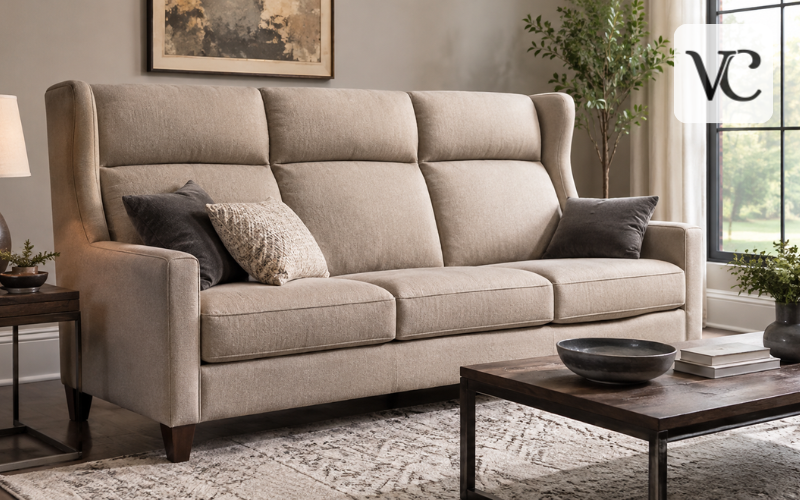
A high back sofa is a sofa with a taller-than-average backrest designed to support more of the upper body. Depending on the design, the back may reach the shoulders, neck, or head. This can make the sofa feel more supportive and enclosed than a low-profile model, especially for people who like to sit upright, read, watch television, or relax for longer periods. IKEA’s current sofa-buying guidance also notes that a high backrest can support the neck and shoulders, while seat depth and seat height influence how upright or relaxed the sitting position feels.
High-back designs can also have a strong visual effect. A tall back can make a sofa look formal, cosy, traditional, or private, depending on its shape and upholstery. However, height alone does not guarantee comfort. Before choosing one, consider the sofa’s overall size, seat depth, seat height, cushioning, upholstery, back angle, and how well it fits both your body and your room.
Snippet-Ready Definition:
A high back sofa is a sofa with a taller backrest designed to support more of the back, shoulders, neck, and sometimes the head, offering a more supportive and enclosed sitting experience.
Quick Guide: High Back Sofa Comparison
| Feature | High Back Sofa | Low Back Sofa |
| Back Support | More upper-back and shoulder support | Mainly lower and mid-back support |
| Comfort Style | Supportive and enclosed | Open and relaxed |
| Best For | Reading, TV, longer sitting | Casual lounging, modern spaces |
| Visual Appearance | Taller and more noticeable | Lower and visually lighter |
| Room Suitability | Medium to large rooms; some compact designs | Often suits smaller spaces |
| Common Styles | Wingback, traditional, modern, recliner | Minimalist, modular, contemporary |
Quick High Back Sofa Buying Checklist
- Measure the room and delivery route before buying.
- Check back height, seat height, and seat depth.
- Sit fully back and see whether your feet rest comfortably on the floor.
- Look for comfortable lower-back, shoulder, and neck support.
- Choose leather or fabric based on cleaning and daily use.
- Consider slimmer designs if the room is small.
- Check frame quality, cushion firmness, care instructions, and warranty.
What Makes a High Back Sofa Different?
The main difference is simple: a high back sofa extends farther up the body than a typical low-back sofa. A low sofa may support mainly the lower and middle back, while a taller back can provide contact around the shoulders and, in some models, the neck and head. This can be useful for people who prefer more upper-body support during relaxed sitting. IKEA similarly advises considering backrest height along with the way you prefer to sit.
Still, not every tall sofa feels the same. A straight, firm back creates a different sitting position from a soft, angled back with loose cushions. Some tall backs are mainly decorative, while others are shaped to give meaningful support. Seat depth also matters. A very deep seat may cause a shorter person to slide forward or lose lower-back contact, even if the backrest is tall. That is why back height should always be judged together with seat height, seat depth, cushion firmness, and back angle.
High Back Sofa vs Low Back Sofa
A high-back and a low-back sofa can both be comfortable, but they suit different preferences. A high-back model often feels more supportive around the shoulders and upper back and can create a sheltered, cocoon-like feeling. It may suit reading, relaxed conversation, television viewing, or people who prefer a more upright position. A low-back sofa usually looks lighter and more open, which can work well in modern rooms where clear sightlines are important.
The trade-off is visual weight. A tall sofa takes up more vertical space and may become a stronger feature in the room. In a compact space, it can feel bulky if its arms, depth, and frame are also large. A low-back sofa may make the room feel more open but may not provide the upper-body support some people want for longer sitting. IKEA’s guidance also distinguishes between deeper, lower seating for relaxed positions and higher, narrower seating for more upright sitting.
The better option therefore depends on comfort needs, room size, and how the sofa will actually be used.
What Makes the Most Comfortable High Back Sofa?
The most comfortable high back sofa is not simply the tallest one. Comfort comes from how several parts work together. The backrest should meet the natural shape of your back without pushing your head forward. Cushioning should feel supportive rather than hard or excessively soft, and the lower back should not be left floating away from the back cushion. The seat should also be deep enough for comfort without making it difficult to sit back properly.
Body size makes a major difference. A seat that feels ideal to a tall person may be too deep for a shorter person. Likewise, a low seat may be easy for one user but harder for another to rise from.
A useful test is to sit fully back, place your feet comfortably on the floor, and notice whether your knees, lower back, shoulders, and head feel naturally supported. Recent expert guidance also recommends paying close attention to seat height and whether the feet can rest naturally on the floor.
A truly comfortable high back sofa should fit the user rather than simply carry a comfort label.
Modern High Back Sofa Designs
A modern high back sofa does not have to look heavy or old-fashioned. Many contemporary designs use clean lines, slim arms, simple legs, and smooth upholstery to keep the overall shape visually light. Some use a tall fixed back, while others include integrated or adjustable headrests that can be raised when support is needed and lowered when a cleaner profile is preferred. Adjustable headrests and high-back forms are available across a range of contemporary sofa designs.
Geometric cushions, narrow armrests, modular sections, and simple stitching can also give a tall sofa a more current appearance. Neutral fabrics often make the extra height less dominant, while a strong colour can turn the sofa into a statement piece.
For smaller modern rooms, consider a high back with a slim frame, raised legs, and moderate depth. This combination can provide useful upper-body support without making the sofa appear unnecessarily bulky.
Traditional High Back Sofa Styles
Traditional high-back sofas often use their height as an important part of the design. Wingback styles have tall side panels or “wings” that create a sheltered appearance. Camelback sofas have a raised curved back, while rolled-arm and button-tufted designs add a more formal character. Chesterfield-inspired sofas often feature deep buttoning, substantial arms, leather or fabric upholstery, and a strong symmetrical appearance. Traditional sofa classifications commonly include styles such as Chesterfield and camelback designs.
However, a traditional high back sofa should be judged for comfort as well as appearance. Deep tufting and a tall frame may look impressive, but they do not automatically provide good neck or lower-back support.
Check where the cushions actually meet your body. A decorative crest, carved frame, or tall upholstered panel may add visual height without changing the sitting experience. The best traditional choice combines the character you want with a seat and back that feel comfortable in everyday use.
High Back Sofa Leather vs Fabric
If you are comparing high back sofa leather options with fabric models, think about how the sofa will be used every day. Leather can give a high-back design a formal, polished appearance and is often straightforward to wipe after minor spills when cared for according to the manufacturer’s instructions. Over time, leather may develop visible creasing and natural character. It should also be protected from strong heat and prolonged direct sunlight, which can contribute to drying or fading.
Fabric offers a wider choice of textures, colours, and patterns. Woven upholstery can feel casual and practical, while velvet creates a softer, more decorative finish. Performance fabrics may be useful in busy homes where stain resistance and easier maintenance are priorities.
Some sofas have removable covers, but removable does not automatically mean machine washable. DFS, for example, specifically advises following the care instructions for each upholstery type rather than assuming removable covers can be washed at home.
For homes with children or pets, compare stain resistance, snag risk, cleaning instructions, heat exposure, and replacement-cover availability before choosing.
High Back Sofa Sets and Seating Configurations
A high back sofa set can be arranged in several ways. A two-seater works well for smaller rooms or quiet seating areas, while a three-seater provides more everyday family space. Larger rooms may suit a sofa-and-chair combination, sectional, corner sofa, or reclining arrangement.
The right configuration depends on how people actually use the room. A family that regularly watches television together may value a larger sectional or reclining setup. A formal living room may work better with a high-back sofa and two coordinated chairs. In an open-plan room, the tall back can also help mark the boundary of the seating area.
Matching every piece is not necessary. A high-back sofa can be paired with different accent chairs, provided there is some connection through colour, upholstery, shape, wood finish, or overall style. This can make the space feel more natural and less like a complete showroom set.
Choose the number of seats around real household needs rather than simply filling every available wall.
Choosing the Right Back Height, Seat Depth, and Seat Height
Before buying, look beyond the sofa’s overall width. Important measurements include overall height, inside-back height, seat height, seat depth, arm height, total depth, and total width. These numbers help you understand both how the sofa will fit the room and how it may fit the person sitting on it.
Seat depth is especially important. A deeper seat provides more lounging space, but shorter users may need a cushion behind the lower back to sit comfortably. A shallower seat usually encourages a more upright position. IKEA’s sofa guidance recommends considering seat height, depth, and backrest height together because they all affect sitting position.
Seat height also affects whether the feet reach the floor comfortably and how easy it feels to sit down or stand up. Recent expert advice recommends checking whether the feet can rest flat and whether the knees sit in a comfortable, natural position, while recognising that ideal measurements vary between people.
A simple fit check is to sit fully back and assess your feet, knees, lower back, shoulders, and head together.
Matching a High Back Sofa to Your Room Size
Measure the room before choosing the sofa. Record the available wall length, floor space, ceiling height, and the distance to nearby tables, doors, windows, and main walkways. A high-back sofa can work in a small room, but a bulky frame, deep seat, wide arms, and dark upholstery may make it feel larger than its measurements suggest.
Delivery access matters too. Check the front door, internal doorways, hallways, stairs, landings, and lifts along the complete delivery route. Furniture measurement guidance recommends comparing these openings and turns with the sofa’s width, depth, height, and carrying position before delivery.
If you are buying a reclining sofa or sofa bed, also measure the space needed when it is fully extended. IKEA similarly advises measuring furniture in its open position when extra movement space is required.
In open-plan rooms, a tall sofa can act as a soft divider. In offices, libraries, and reading areas, a high back may create a more sheltered feel. High-sided acoustic seating is also commonly used in workplaces to create semi-private seating areas.
Best High Back Sofa for Different Needs
There is no single best high back sofa for every home. The right choice depends on who will use it and what they will do there.
Taller users may prefer a higher back and enough seat depth to accommodate longer legs. Readers may value a supportive back with comfortable arm height. People who watch television for long periods may prefer a design with a headrest, reclining function, or slightly angled back.
For older adults or anyone who finds very low seating difficult, a supportive seat that is not excessively low or deep may make sitting down and standing up more comfortable. Families may care more about durable upholstery, straightforward cleaning, supportive cushions, and enough seating for everyday use.
Formal rooms may suit structured leather or tufted designs, while open-plan spaces may benefit from high backs that create greater visual separation. IKEA’s current guidance also supports choosing seat depth, height, back height, and firmness according to personal sitting preferences rather than appearance alone.
Whatever the use, comfort, dimensions, construction, and fit should come before trend or looks.
High Back Sofa IKEA Options and What to Compare Before Buying
People searching for a high back sofa IKEA option should compare current products by measurements and comfort features rather than by photographs alone.
As of August 11, 2026, IKEA’s U.S. sofa category currently surfaces MANNARP as a sofa with a high back. However, sofa ranges, colours, prices, and stock differ by country and can change over time. IKEA’s own buying guidance recommends considering seat height, seat depth, backrest height, and firmness when comparing options.
Check whether the model has a fixed or loose back, removable covers, modular sections, a chaise, recliner features, or a sleeper function. Review the exact dimensions, materials, care requirements, return terms, and warranty information on the local product page.
IKEA also offers planning tools in several markets. Its UK site, for example, currently provides room and sofa-planning tools that allow buyers to explore different sizes, colours, and configurations.
Because stock and collections are regional, always check your country’s IKEA website before making a final decision.
High Back Sofa Pros, Drawbacks, Care, and Buying Checklist
A high back sofa can provide useful upper-body support, a comfortable enclosed feeling, and a strong visual presence. It may be especially appealing for people who dislike very low, open-backed seating or want a sofa that feels substantial. Tall backs can also help define a seating area in an open-plan room.
The drawbacks mostly relate to proportion and personal fit. A large high-back design can dominate a compact room, block sightlines, or feel too upright for someone who prefers deep lounging. A sofa can also have a tall back but still feel uncomfortable if the seat is too deep, too low, or poorly shaped for the person using it.
Care depends on the upholstery. Fabric and leather require different cleaning methods, so follow the manufacturer’s label rather than using one cleaner for everything. Deal with spills promptly and use only appropriate products. Fabric sofa care guidance also recommends regular attention to cushions and upholstery, while leather requires material-specific maintenance.
Before buying, use this short checklist:
- Sit on the sofa long enough to judge seat, back, neck, and shoulder comfort.
- Check overall width, height, depth, seat measurements, and delivery access.
- Look at frame construction, cushion filling, upholstery care, and warranty.
- Confirm that recliners, chaises, or sofa-bed sections have enough room to open fully.
- Check cleaning instructions, replacement-cover availability, delivery terms, and current stock.
These practical checks are usually more useful than choosing a sofa simply because it is advertised as luxurious or comfortable.
Conclusion
A high back sofa can be a strong choice when you want more upper-body support, a more enclosed sitting feel, or a sofa with greater visual presence. The best option is not decided by height alone. Back shape, seat depth, seat height, cushioning, upholstery, room size, and the user’s body proportions all affect comfort.
That is why the most comfortable high back sofa will differ from one person to another. Measure your room carefully, check the full product dimensions, and test the sitting position whenever possible. If you are buying online, compare measurements, materials, care instructions, and delivery requirements instead of choosing only by style.
A well-chosen high back sofa should feel comfortable for the people using it while remaining balanced and practical within the room.
Frequently Asked Questions
What is the main benefit of a high back sofa?
A high back sofa can provide greater upper-back, shoulder, and sometimes neck support than a low-back sofa. It can also create a comfortable, sheltered seating area for reading, relaxing, or watching television.
Are high back sofas more comfortable?
They can be more comfortable for people who prefer fuller back support, but comfort depends on seat depth, height, cushioning, back angle, and body size. A taller backrest alone does not guarantee better comfort.
Is a high back sofa suitable for a small living room?
Yes, but choose carefully. A slim high back sofa with narrow arms, moderate depth, raised legs, and lighter upholstery can work better in small rooms than a bulky, deeply cushioned design.
Is leather or fabric better for a high back sofa?
Neither is universally better. Leather offers a polished look and relatively simple surface cleaning, while fabric provides more colours, textures, and softness. Household use, pets, children, climate, and maintenance preferences should guide the choice.
What should I measure before buying a high back sofa?
Measure the sofa’s width, overall height, depth, seat height, seat depth, and arm height. Also measure doors, hallways, stairs, lifts, and available floor space to ensure comfortable placement and delivery.
Disclaimer: This article provides general information to help readers understand and choose a high back sofa. Comfort, support, dimensions, materials, and suitability can vary by person, manufacturer, and model. Always check current product specifications, care instructions, warranty terms, availability, and exact measurements before purchasing. When possible, test the sofa in person to determine whether its seating position and support suit your individual comfort needs.
Enjoyed this article? Discover more helpful ideas and fresh inspiration on Vogue Cultures.