
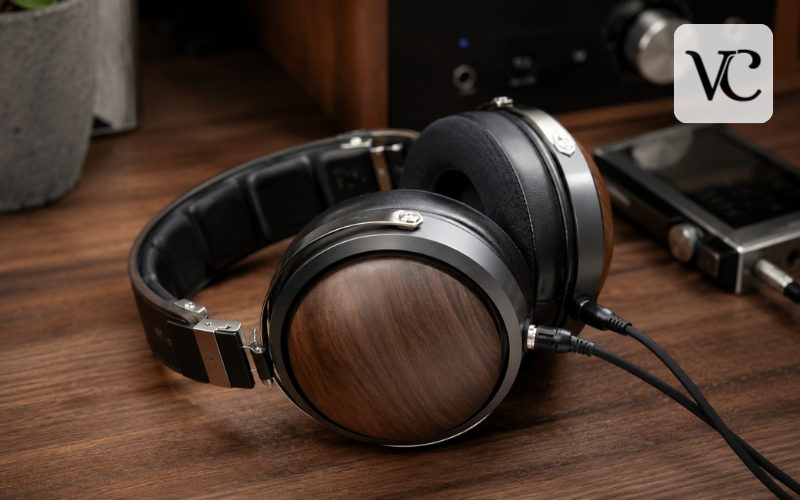
The FiiO FT1 is a wired, closed-back, over-ear headphone designed for people who want full-size hi-fi sound without moving into expensive audiophile gear. It uses a traditional dynamic driver rather than a planar driver, has no Bluetooth or active noise cancellation, and focuses on sound quality, comfort, and simple wired use. FiiO positions it as its first closed-back over-ear headphone, and the model continues to stand out because it combines real wood earcups, a large 60mm driver, detachable cables, and relatively easy power requirements.
The FT1 has a warm, bass-forward character, while independent measurements show fairly even mids and treble. It is not automatically the best choice for everyone: isolation is limited, bass depends on seal, and some listeners may prefer a leaner or brighter sound. This guide covers sound, comfort, cables, power needs, price, comparisons, and real-user feedback.
Snippet-Ready Definition:
The FiiO FT1 is a wired, closed-back over-ear headphone featuring 60mm dynamic drivers, real wood earcups, detachable cables, and a warm, bass-rich sound designed for comfortable everyday hi-fi listening.
FiiO FT1 Quick Guide
| Feature | FiiO FT1 Details |
| Headphone Type | Closed-back, over-ear |
| Driver | 60mm dynamic driver |
| Impedance | 32Ω |
| Sound Character | Warm, full-bodied, bass-focused |
| Earcups | Natural walnut or beech wood |
| Connections | 3.5mm and 4.4mm balanced cables |
| Wireless | No built-in Bluetooth |
| ANC | No active noise cancellation |
| Best For | Music, gaming, home and desk listening |
| Amplifier Needed? | Usually not; relatively easy to drive |
Quick FiiO FT1 Buying Checklist
- Choose the FiiO FT1 if you prefer warm sound with strong, deep bass.
- Make sure you want a wired headphone, as Bluetooth is not built in.
- Consider your glasses and head shape because a poor earpad seal can reduce bass.
- A basic dongle DAC or good headphone output is normally enough for everyday listening.
- Consider the FT1 Pro instead if you prefer an open-back design and a flatter presentation.
- Compare it with the DT 770 PRO if brighter, more studio-focused sound is important to you.
FiiO FT1 Specifications and Key Features at a Glance
At the center of the FT1 is FiiO’s second-generation 60mm dynamic driver. It uses a nanowood-fiber composite diaphragm and a W-shaped suspension design. The headphone has a 32-ohm impedance, a sensitivity rating of 98dB/mW at 1kHz, and a listed frequency response of 10Hz to 40kHz. It weighs about 340g without the cable. These numbers help explain why it can reach useful listening levels from many ordinary sources without requiring a large desktop amplifier.
The FT1 is a closed-back design with natural walnut or beech wood earcups. FiiO supplies two approximately 1.5m silver-plated oxygen-free copper cables: one with a 3.5mm plug and another with a 4.4mm balanced plug. A 3.5mm-to-6.35mm adapter and protective storage case are also included. This is a generous package for a headphone that originally entered the market around the $150 price level.
FiiO FT1 Design, Wood Earcups, Build Quality, and Comfort
The wooden earcups are one of the FT1’s most recognizable features. Natural grain and shade vary from pair to pair, but that cosmetic difference should not be treated as proof of different sound. The multi-axis headband and 38mm sliding adjustment help the earcups adapt to different head shapes.
At around 340g, the FT1 is not extremely light, but independent testing describes the fit as comfortable. The large pads and moderate clamp can work well for long listening sessions, although comfort always depends on head and ear shape. The full-size frame does not fold into a compact travel shape, so it is better suited to a desk, home setup, or carrying case than a small daily bag.
Build quality deserves some context. FiiO acknowledged that a small number of early FT1 and FT1 Pro units had pivot screws that could loosen because of adhesive failure. The company says the structure was changed and that batches produced from November 20, 2024 onward resolved that issue. That makes older used units worth inspecting more carefully, while later production should not be judged solely by reports from the earliest batches.
How the 60mm Dynamic Driver and Acoustic Design Work
A 60mm driver is large for a conventional headphone, but size alone does not guarantee better sound. FiiO uses it to support deeper bass and stronger low-frequency energy, while the composite diaphragm is designed to remain light and controlled.
FiiO’s W-shaped suspension increases the effective vibrating area of the diaphragm compared with a more conventional layout. The company also uses a U-shaped acoustic damping tube and an angled internal baffle to manage pressure and resonance inside the closed cup. These are engineering choices, not automatic proof of superior performance. What matters to a listener is the final tuning, and independent measurements show that the result is a generally warm sound with elevated low end and fairly even mids and treble.
FiiO FT1 Frequency Response and Overall Sound Signature
The FiiO FT1 frequency response is easiest to understand as warm rather than strictly neutral. Bass receives extra emphasis, giving kick drums, bass guitars, electronic beats, and movie effects more weight. The midrange stays comparatively even, so vocals and most instruments are not pushed far behind the bass. Treble is also relatively smooth compared with headphones that use a strong upper-frequency peak to create a brighter sense of detail.
Frequency-response graphs should not be treated as a perfect prediction of what every owner will hear. Measurement rigs differ, and over-ear headphones interact with the listener’s head, ears, hair, glasses, and pad seal. RTINGS found the FT1 particularly sensitive to these fit differences in the bass. A graph is therefore useful for understanding the general tuning, but fit can change the low end noticeably in real use.
Bass, Midrange, Treble, Soundstage, and Imaging
Bass is the most obvious part of the FT1’s personality. Sub-bass reaches low, while the mid-bass adds punch and warmth. This can make electronic, pop, hip-hop, rock, and cinematic music feel energetic. The tradeoff is that listeners who want a strictly flat low end may hear too much warmth or weight on some tracks.
The midrange is one of the reasons the headphone avoids sounding like a simple “bass-heavy” model. Voices generally remain clear and full, while guitars, piano, and other instruments retain useful body. Treble is smoother than on many bright studio-style headphones, which may appeal to people who are sensitive to sharp highs. Independent measurements also show relatively smooth peaks and dips overall.
Soundstage should be judged with closed-back expectations. The FT1 offers useful left-to-right space and positional cues, but not the airy presentation of a good open-back headphone. Its appeal is more about the combination of impact, smoothness, and easygoing tuning.
FiiO FT1 for Music, Gaming, Work, and Home Listening
For everyday music, the FT1 is a flexible choice if you enjoy some bass warmth. Pop, electronic, hip-hop, and rock benefit naturally from its low-end energy, while acoustic and vocal recordings remain clear enough because the midrange is not heavily recessed. People who listen mainly to very neutral studio recordings may prefer a flatter headphone, but the FT1 is tuned more for enjoyable listening than strict monitoring.
The wired analog connection also makes it useful for gaming because there is effectively no wireless transmission delay. The added bass can make explosions and action scenes feel fuller, while positional cues remain usable. There is no built-in microphone, however, so multiplayer voice chat requires a separate microphone.
For office use, the picture is mixed. Comfort and wired simplicity are advantages, but the FT1 does not block as much background noise as an ANC headset, and it lacks call features. It makes more sense for quiet desk work, home listening, casual editing, and gaming than for a noisy open office or frequent video meetings.
FiiO FT1 Power Requirements: Do You Need a DAC or Headphone Amp?
With a 32-ohm impedance and 113dB/Vrms sensitivity rating, the FT1 is designed to be relatively easy to drive. A laptop headphone jack, portable music player, USB dongle DAC, desktop interface, or suitable phone adapter can usually provide enough level for normal listening. There is little reason to assume that a large, expensive amplifier is required simply because the FT1 is marketed as a hi-fi headphone.
A DAC/headphone amplifier can still provide better volume control, cleaner output from a weak source, or a 4.4mm balanced socket. These are practical benefits, not a requirement. If your current source reaches comfortable volume without obvious noise or distortion, an upgrade is not automatically necessary.
FiiO FT1 Cable, Connections, and the Wireless Question
The stock FiiO FT1 cable setup is unusually flexible for this price class. One cable ends in a standard 3.5mm plug for common headphone outputs, while the second uses a 4.4mm balanced plug for compatible audio players and DAC/amps. Both cables are detachable, which makes damaged cables easier to replace and allows owners to choose different lengths later.
A balanced 4.4mm connection can offer more output power on some devices, but it does not automatically make the FT1 sound better than the 3.5mm connection. The source design matters more than the plug name.
People searching for FiiO FT1 wireless should know that the standard FT1 is not a Bluetooth headphone. It has no internal battery, wireless receiver, ANC system, or onboard controls. A portable Bluetooth DAC/amp can receive music wirelessly and then feed the FT1 through its cable, but the headphone itself remains a passive wired model.
Passive Isolation, Sound Leakage, Seal, and Glasses
Closed-back construction helps reduce outside sound, but the FT1 should not be confused with an active noise-cancelling headphone. FiiO advertises up to 26dB of passive sound attenuation under its test conditions, while independent testing found that the headphone does much better against sharper high-frequency sounds than against conversation, HVAC rumble, or bus and engine noise.
Seal is especially important. If the pads sit evenly around the ears, the FT1 can deliver the strong bass response it is known for. Thick glasses can create a gap between the pad and skin, and RTINGS measured a large bass reduction in that situation. Long hair, head size, pad position, and individual anatomy can also change the response.
Leakage is lower than with an open-back design, but some sound can still escape at higher volumes.
FiiO FT1 vs FT1 Pro: Similar Names, Very Different Headphones
The FiiO FT1 vs Pro comparison is not simply standard model versus upgraded model. The FT1 uses a 60mm dynamic driver inside closed wooden cups. The FiiO FT1 Pro uses a much larger 95×86mm planar magnetic driver and an open-back housing. It is rated at 20 ohms, weighs about 374g, and is designed around a different acoustic approach.
The FT1 has stronger bass warmth and blocks more outside sound. The FT1 Pro has a flatter measured balance and, because it is open-back, lets far more outside noise in and music out. Independent testing also found the Pro more consistent across different fits.
For a bedroom, office, or shared home where leakage matters, the standard FT1 is usually the more practical design. For a quiet private room where openness and a flatter presentation matter more than isolation, the FT1 Pro makes more sense.
FiiO FT1 vs DT 770 PRO: Choosing Between Two Closed-Back Favorites
The FiiO FT1 vs DT770 decision is largely about tuning, construction, and source needs. The FT1 is warmer and bassier, while the classic Beyerdynamic DT 770 PRO is known for a clearer, brighter studio-style presentation. Beyerdynamic still offers the traditional DT 770 PRO in different impedances, including 32, 80, and 250 ohms, so the ideal source depends on the version. The 32-ohm model is the easiest match for portable devices, while the 250-ohm version is better suited to stronger stationary outputs.
The FT1 also has an advantage for cable replacement because its cables detach. The traditional DT 770 PRO uses a fixed cable, though Beyerdynamic’s long-running design has a strong reputation for repairability and studio durability. The DT 770 PRO’s velour-pad versions are also well known for comfort and stronger passive isolation, while some listeners find its treble too bright over long sessions.
Choose the FT1 if you want more bass weight, smoother highs, detachable cables, and a more lifestyle-oriented wood design. Choose the DT 770 PRO if you prefer its brighter monitoring character, proven studio construction, and specific impedance options.
FiiO FT1 Price, Reddit Feedback, and Overall Value
The FiiO FT1 price started around the $149 to $159 range in the United States, depending on retailer and period. Pricing in 2026 still varies. For example, B&H listed the walnut FT1 at $164.99 when checked in August 2026, showing that it remains close to its original price class rather than moving into a premium bracket. Regional taxes, availability, finish, and sales can change the final cost.
Value is helped by the real-wood earcups, two detachable cables, 6.35mm adapter, and storage case. RTINGS still lists the FT1 among notable mid-range closed-back choices in 2026, while noting fit sensitivity and some build limitations.
FiiO FT1 Reddit discussions show why personal preference matters. Some owners praise the strong bass, clear vocals, comfort, accessories, and overall value. Others describe the mid-bass as excessive, want a wider soundstage, dislike aspects of the treble, or simply feel the online hype raised expectations too high. There are also discussions about glasses and seal, with experiences varying from no problem at all to noticeable changes in fit or bass. These comments are useful as personal reports, not controlled test results.
The FT1 makes the most sense for someone who wants a comfortable wired closed-back headphone with strong low-end presence and smooth everyday tuning. People who need ANC, Bluetooth, maximum isolation, strict neutrality, or very bright studio detail should compare other options before buying.
Conclusion
The FiiO FT1 still has a clear place in 2026 because its strengths are easy to understand. It offers a warm, substantial sound, useful bass extension, real-wood styling, detachable 3.5mm and 4.4mm cables, and power requirements that are friendly to ordinary sources. Its 60mm dynamic driver and closed-back design make it especially appealing for listeners who want an enjoyable home or desk headphone without needing a complicated audio setup.
Its limitations are equally important. Passive isolation cannot replace strong ANC, the bass response depends on a good seal, glasses can change the low end, and the full-size design is not especially portable. It is also warmer than the FT1 Pro and generally less bright than the classic DT 770 PRO, so choosing between them comes down to environment and sound preference rather than a simple ranking.
For listeners who prefer full, smooth, bass-friendly sound and want a wired closed-back headphone around the mid-budget price range, the FT1 remains a strong option to consider. Those who want a flatter open-back presentation, stronger travel isolation, wireless features, or a brighter monitoring sound may be better served elsewhere. The best choice is the one that matches your ears, source, listening space, and music—not the model receiving the most online attention.
Frequently Asked Questions
Is the FiiO FT1 good for everyday music listening?
Yes. The FiiO FT1 offers strong bass, clear mids, and relatively smooth treble, making it suitable for pop, rock, electronic, hip-hop, vocals, and general home listening.
Does the FiiO FT1 need a headphone amplifier?
Usually not. Its 32-ohm impedance makes the FT1 relatively easy to power from many laptops, portable players, dongle DACs, and suitable headphone outputs without a powerful desktop amplifier.
Is the FiiO FT1 wireless?
No. The standard FiiO FT1 is a passive wired headphone with no built-in Bluetooth. You can use an external Bluetooth DAC/amp, but the headphone itself remains wired.
What is the difference between FiiO FT1 and FT1 Pro?
The FT1 uses a closed-back 60mm dynamic driver and has warmer bass. The FT1 Pro uses an open-back planar magnetic driver and generally provides a flatter, more spacious presentation.
Is the FiiO FT1 better than the DT 770 PRO?
Neither is universally better. The FT1 generally sounds warmer and bassier, while the DT 770 PRO has a brighter studio-style character. The better choice depends mainly on your sound preference.
Disclaimer: This article is for general informational purposes only. FiiO FT1 specifications, included accessories, availability, and prices may vary by region, retailer, and production period. Sound, comfort, bass response, and fit are subjective and can differ between listeners.
Enjoyed this article? Discover more helpful ideas and fresh inspiration on Vogue Cultures.