Black tapware is a broad term for taps, mixers, spouts, shower controls, and related water fittings finished in black. It can appear in bathrooms, kitchens, laundries, and other wet areas, with matte black being the most familiar option.
What was once treated as a bold design trend is now a common alternative to chrome. The reason is simple: black fixtures create clear contrast and can work with many materials without making a room feel overly decorative. They can sit against white tiles, natural stone, timber, concrete, or pale cabinetry and still look deliberate.
Black tapware is used for basin mixers, bath spouts, shower mixers, kitchen sink mixers, pull-out taps, and laundry fittings. However, colour should not be the only buying factor. Before choosing a product, look at the finish quality, internal parts, dimensions, water-pressure requirements, plumbing layout, water efficiency, warranty, and cleaning instructions.
Black is not automatically better than chrome, brushed nickel, or other finishes. The best choice is the one that suits the room, performs well in daily use, and can be maintained without difficulty.
Snippet-Ready Definition:
Black tapware refers to bathroom, kitchen, and laundry taps, mixers, spouts, and shower fittings finished in black, usually matte black, to provide strong visual contrast and a modern, coordinated appearance.
Quick Guide to Black Tapware
| Feature | Quick Guide |
| Common finishes | Matte black, satin black, black chrome, gunmetal-style finishes |
| Common uses | Basins, showers, baths, kitchen sinks, laundries |
| Popular styles | Round, square, wall-mounted, tall mixers, pull-out kitchen mixers |
| Finish methods | PVD, electroplating, powder coating |
| Main benefit | Strong contrast and versatile modern appearance |
| Main drawback | Water spots and mineral marks can be more noticeable |
| Cleaning | Soft cloth, warm water, and mild soap |
| Before buying | Check dimensions, finish, WELS rating, warranty, plumbing compatibility |
Quick Steps for Choosing Black Tapware
- Choose the location – Decide whether you need tapware for a bathroom, kitchen, shower, bath, or laundry.
- Check the plumbing setup – Confirm whether you need wall-mounted or deck-mounted fittings.
- Measure carefully – Check spout height, reach, basin or sink size, and available clearance.
- Compare the finish – Look at matte black, electroplated, PVD, or other finishes and check their care requirements.
- Check efficiency and certification – Australian buyers should review WELS information and relevant product certification.
- Review warranty and spare parts – Choose products with clear warranty terms and replacement-part support.
- Plan maintenance – Consider whether visible water marks and regular wiping will suit your household.
Why Black Tapware Remains Popular in Modern Interiors
The main visual strength of black tapware is contrast. A dark tap against a white basin, pale stone benchtop, or light tiled wall becomes easy to notice without needing an unusual shape. In darker rooms, black can also blend into charcoal cabinetry, dark stone, or industrial-style finishes.
This flexibility lets black suit minimalist, contemporary, industrial, and modern-classic interiors. Round mixers create softer lines, while square designs look more architectural. Matte black absorbs light and appears softer than polished black or black chrome, while darker metallic finishes reflect more light. Room lighting can also change how deep or warm the finish appears.
The practical side still matters. Dark surfaces can show dried water droplets, soap film, or pale mineral marks clearly. A good design choice should therefore consider cleaning habits and finish durability as carefully as appearance.
Black Tapware Bathroom Styles and Layout Options
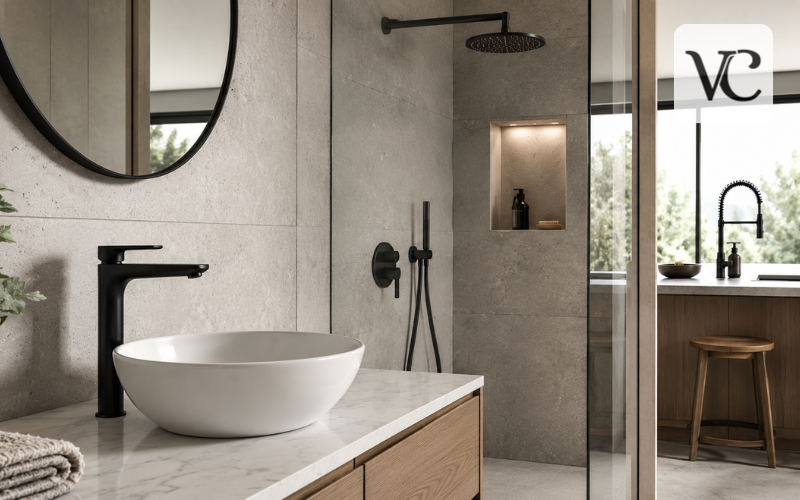
A black tapware bathroom can be designed in many ways because the finish is available across most common fixture types. For a standard inset basin, a regular-height mixer is often enough. Above-counter vessel basins usually need a taller mixer or a wall-mounted outlet so water reaches comfortably over the bowl.
Wall-mounted basin mixers create a clean vanity surface and can free up bench space. They also require more planning because the in-wall plumbing and spout position need to be set correctly before the wall is finished. Deck-mounted mixers are generally simpler when the basin or vanity already has a suitable tap hole.
For baths and showers, black options include bath spouts, wall mixers, diverters, hand showers, overhead showers, and rail systems. A diverter directs water between outlets, such as an overhead and hand shower.
Round tapware feels softer, while square designs create stronger lines. Check scale carefully: a very tall mixer can overwhelm a small vanity, while a short spout may not project far enough into a wide basin.
Kitchen Black Tapware: Choosing a Practical Mixer
Kitchen black tapware has to do more than look good because the kitchen mixer is usually one of the most frequently used fittings in the home. High-arch and gooseneck designs provide useful clearance for large pots, tall containers, and deep sinks.
Pull-out and pull-down spray mixers can make rinsing vegetables, cleaning sink corners, and filling larger cookware easier. Some models also offer more than one spray pattern. A swivel spout is especially useful with double-bowl sinks because it allows water to be directed from one bowl to the other.
Before buying, compare the mixer height with any shelf, window, or cabinet above the sink. Also check spout reach. A tap that ends too close to the back edge can make washing awkward, while one that projects too far forward may increase splashing.
A deep sink can usually handle a taller mixer more comfortably than a shallow bowl. For everyday use, smooth lever operation, sensible spray control, adequate clearance, and easy cleaning are often more important than choosing the most dramatic design.
Black Tapware Sets for a Consistent Finish
A black tapware set usually means a coordinated group of fittings chosen for the same room or throughout the home. In a bathroom, this may include a basin mixer, shower mixer, bath spout, shower rail, and matching accessories. In a larger project, the same finish may continue into the kitchen and laundry.
Buying from one collection can make coordination easier because the shapes, surface texture, and shade of black are more likely to match. This matters because “matte black” is not a universal colour standard. One manufacturer’s finish may appear warmer, smoother, glossier, or slightly greyer than another.
Mixing finishes can also work. Black pairs with brushed nickel, stainless steel, brass, or chrome when the combination is intentional. Problems are more noticeable when several slightly different black finishes sit close together.
For renovations, plan the full fixture schedule first so mixers, spouts, shower parts, and accessories can be coordinated before items become unavailable.
Matte Black Tapware and Other Black Finish Options
Matte black tapware is popular because its low-shine surface creates a clean and understated look. It reflects less light than polished finishes and can make simple tap shapes appear more architectural.
However, “black” includes several different finishes. Satin black has a slight sheen, polished black is more reflective, and black chrome has a darker metallic character. Gunmetal is not true black; it normally has a softer grey-metal appearance and can look different depending on the room’s lighting.
Surface texture affects maintenance as well as style. Glossy finishes may show fingerprints, while matte finishes can make pale water marks or soap residue more noticeable. Hard-water deposits are particularly visible when they dry white against a dark surface.
Online photographs may not show colour accurately because screens, lighting, and surrounding materials affect appearance. If matching matters, view a physical sample or display where possible.
PVD Black Tapware vs Electroplating and Powder Coating
PVD black tapware refers to products coloured using Physical Vapour Deposition. In simple terms, PVD places a very thin coating onto the prepared surface inside a controlled vacuum environment. The deposited material bonds closely to the surface, which can provide strong wear and scratch resistance when the process and base product are well made.
Electroplating uses an electrical process to deposit a metal coating onto the tap body. It is widely used for decorative plumbing finishes and can be durable when properly prepared and applied.
Powder coating is different again. Dry powder is commonly given an electrostatic charge so it is attracted to a prepared metal surface. The coated part is then cured so the powder forms a continuous layer.
PVD is often positioned at the premium end because of its durability and process cost, but the label alone is not a guarantee of quality. Surface preparation, coating thickness, base material, quality control, and how the tap is used all affect long-term performance.
It is also important not to assume that every black product from a brand uses PVD. For example, Caroma currently describes black in its Urbane collection as electroplated, while PVD is used for several other metallic colours in that range.
Pros and Cons of Black Tapware
Black tapware has clear advantages. It gives strong contrast, works with many colour palettes, and can help connect taps, shower fittings, handles, and accessories into one visual theme. There is also now a broad choice of bathroom and kitchen formats, so buyers are not limited to a small number of statement products.
There are practical drawbacks too. Water spots and limescale may stand out more clearly on a dark finish. Lower-quality coatings can scratch, chip, or wear unevenly, especially around frequently touched areas. Harsh cleaners and abrasive pads can also damage some surfaces.
Replacement is another consideration. If a range is discontinued, finding exactly the same black years later may be difficult. Chrome generally creates fewer colour-matching problems.
For most households, the choice comes down to priorities. Black suits people who like the look and are comfortable with gentle cleaning. In very hard-water areas, a finish that hides mineral marks more easily may be more practical.
How Durable Is Black Tapware?
Durability has two parts: the tap itself and the coloured surface. A tap can have a strong body and reliable cartridge while its outer finish ages poorly, or the finish can remain attractive while internal components eventually need servicing.
Brass is widely used for tap bodies, while some products use stainless steel or other suitable metals. Many modern mixers use ceramic cartridges because they provide smooth control and can offer long service when manufactured well. Current Bunnings listings, for example, include matte-black basin mixers with ceramic cartridges and lead-free construction, showing how these specifications are commonly presented to buyers.
The black finish should tolerate normal handling, moisture, and regular cleaning, but no decorative surface is immune to wear. Rings, sharp objects, abrasive cloths, and aggressive chemicals can shorten its life.
Look for clear finish information, a meaningful warranty, spare-part support, and proper care instructions. Vague product details make long-term value harder to judge.
Choosing the Best Black Tapware for Your Home
The best black tapware is not simply the most expensive product or the one with the strongest visual impact. It should fit the basin or sink correctly, work with the available water pressure, suit the plumbing, and be comfortable to use every day.
Start with dimensions. Check spout height, projection, mixer clearance, and the size of the tap hole. For wall-mounted products, confirm the rough-in body and installation depth before walls are closed. Kitchen buyers should also check swivel range and pull-out hose reach where relevant.
Finish technology and warranty deserve attention, but they should be considered alongside cartridge quality, spare-part support, and installation requirements. If the product will be heavily used, serviceability can matter more than a small difference in purchase price.
For Australian buyers, water efficiency and compliance are also important. Taps covered by the WELS scheme must be registered before they are supplied, and the official WELS register can be used to confirm registration and efficiency information. Regulated plumbing products also need WaterMark certification before WELS registration.
Black Bathroom Taps at Bunnings, Caroma, and Other Retailers
People searching for black bathroom taps – Bunnings will currently find several matte-black formats rather than one single range. Bunnings lists black basin mixers and wall fittings, including matte-black basin mixers, wall-mounted spouts, and related bathroom tapware. Its kitchen range also includes black pull-out and dual-function mixers. Stock and exact models can change, so specifications should be checked at the time of purchase.
When comparing matte black tapware at Bunnings, look beyond price. Check WELS information, dimensions, construction, cartridge type, warranty, installation needs, and replacement-part availability.
Caroma black tapware is another option commonly considered in Australia. Caroma currently offers bathroom tapware across basin mixers, wall-mounted fittings, bath and shower mixers, spouts, and coordinated collections. Its Liano II products include matte black alongside PVD brushed nickel, brushed brass, and gunmetal options, while the Urbane collection describes black as electroplated.
Brand recognition is useful, but the individual product specification should make the final decision.
Installation Checks Before Buying Black Tapware
Installation planning is especially important with wall-mounted and concealed tapware. A deck-mounted mixer normally needs the correct tap hole and enough bench space around it. A wall-mounted mixer requires the in-wall body, water connections, and outlet position to be planned before tiling or other final wall finishes.
Measure spout projection so water lands in a useful area of the basin. In kitchens, mixer reach should suit the sink size and bowl arrangement.
Check water-pressure requirements and confirm that replacement tapware is compatible with the existing plumbing rather than assuming every mixer is interchangeable.
Concealed mixers and diverters should be selected early in a renovation because changing them later can involve opening finished walls. In Australia, regulated plumbing products should also be properly certified, and installation should be completed by a licensed plumber where required. The WELS consumer guidance notes that WaterMark certification is required before a licensed plumber can install regulated plumbing products.
Cleaning and Maintaining Black Tapware
Gentle cleaning is one of the best ways to protect black tapware. A soft microfiber cloth with warm water and mild soap is suitable for many products, but the manufacturer’s own instructions should always take priority.
After cleaning, rinse away soap residue and dry the fixture with a soft cloth. Drying is particularly helpful where hard water leaves pale mineral marks. Regular wiping can prevent heavy buildup that might otherwise encourage more aggressive cleaning later.
Avoid abrasive pads, rough brushes, bleach, harsh solvents, acidic cleaners, and strong limescale products unless the manufacturer specifically says they are safe for that finish. Phoenix Tapware, for example, advises mild liquid detergent or soap and water and warns against harsh detergents, solvents, acidic cleaners, citrus-based cleaners, limescale removers, and vinegar on its products.
Care can differ by finish, so a method that is acceptable for one product may not be right for another. PVD, electroplated, and coated surfaces should all be treated according to their specific care guide. Good maintenance can reduce staining and unnecessary wear, but it cannot make a finish completely scratch-proof or prevent all aging.
Conclusion
Black tapware can be a practical and attractive choice for bathrooms, kitchens, and laundries when it is selected for more than colour alone. The right product should suit the room’s style, fit the basin or sink, work with the plumbing and water pressure, and have a finish that matches your expectations for cleaning and long-term use.
Before buying, compare construction, finish method, dimensions, water-efficiency information, certification, warranty, and access to spare parts. If you are coordinating several fixtures, also check that the black shade and texture match across the full range.
Used thoughtfully, black tapware can provide strong contrast and a consistent look without needing to dominate the room. The most reliable choice is one that combines a finish you like with practical sizing, sound installation, sensible maintenance, and dependable product support.
FAQs
Is black tapware a good choice for bathrooms?
Yes. Black tapware works well in many bathrooms because it creates contrast with tiles, stone, timber, and light surfaces. However, finish quality, cleaning needs, plumbing compatibility, and water marks should also be considered.
Does black tapware scratch easily?
Scratch resistance depends on the finish and manufacturing quality. Well-made PVD or electroplated surfaces can offer good durability, while lower-quality coatings may show scratches or wear more quickly with rough cleaning.
Is matte black tapware hard to keep clean?
Matte black tapware is not necessarily difficult to clean, but pale water spots and mineral deposits can be more visible. Regular wiping with a soft cloth and mild soapy water usually helps.
Is PVD black tapware better than powder-coated tapware?
PVD finishes can offer strong wear and scratch resistance, but PVD alone does not guarantee better quality. Surface preparation, base material, manufacturing standards, warranty, and everyday care also affect durability.
Can black tapware be used in both kitchens and bathrooms?
Yes. Black tapware is available for basin mixers, showers, baths, kitchen sinks, and laundries. The important point is choosing the correct size, format, water-pressure requirements, and plumbing configuration for each location.
Disclaimer: This article provides general information about black tapware, finishes, selection, installation, and maintenance. Product specifications, warranties, WELS ratings, finishes, and installation requirements can vary by manufacturer and may change over time. Always check the latest product documentation and follow the manufacturer’s care instructions. Plumbing work should be completed by a suitably licensed professional where required by local regulations.
Enjoyed this article? Discover more helpful ideas and fresh inspiration on Vogue Cultures.