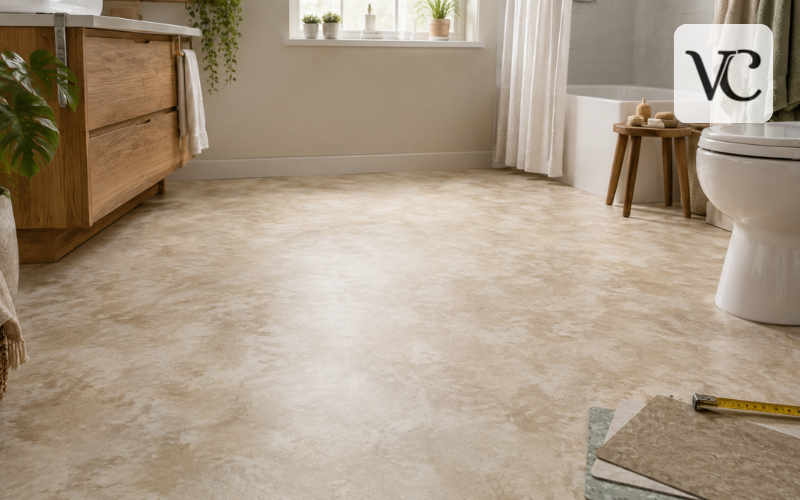
Linoleum bathroom flooring can be a practical choice for homeowners who want a durable floor made largely from natural materials. Genuine linoleum is different from vinyl. It is traditionally made with ingredients such as linseed oil, wood flour, resin, limestone, pigments, and a jute backing. Modern products are available in many colours and patterns, so linoleum can suit both traditional and contemporary bathrooms.
Linoleum also tends to feel warmer and slightly softer underfoot than hard surfaces such as ceramic tile. Its smooth surface can be straightforward to maintain when the correct cleaning methods are used.
However, choosing linoleum for a bathroom requires more care than simply selecting a pattern. Not every product is designed for damp rooms, and genuine linoleum should not automatically be described as completely waterproof. The floor format, seams, edges, subfloor, adhesive, and installation method can all affect how well it handles moisture.
This guide explains where linoleum works well, how it compares with vinyl, what “waterproof” really means, which formats are available, how to install and maintain it, and what to check before buying.
Snippet-Ready Definition:
Linoleum bathroom flooring is a resilient floor covering made mainly from natural materials such as linseed oil, wood flour, limestone, and jute. It can work well in bathrooms when the correct product and moisture-safe installation are used.
Quick Guide: Linoleum Bathroom Flooring
| Feature | Quick Details |
| Main materials | Linseed oil, wood flour, limestone, resin, pigments, and jute |
| Bathroom suitability | Suitable when the specific product is approved for bathroom use |
| Water performance | Varies by product; not all linoleum is fully waterproof |
| Common formats | Sheet/roll, tiles, and selected click systems |
| Main advantage | Durable, comfortable, natural-material flooring |
| Main concern | Seams, edges, subfloor moisture, and standing water |
| Maintenance | Regular vacuuming and manufacturer-approved damp cleaning |
| Installation | Professional fitting is helpful for complex or moisture-prone bathrooms |
Simple Steps for Choosing Linoleum Bathroom Flooring
- Confirm that the flooring is genuine linoleum, not vinyl.
- Check whether the manufacturer approves it for bathroom use.
- Compare sheet, tile, and click formats according to moisture exposure.
- Review slip-resistance and water-performance specifications.
- Make sure the subfloor is smooth, dry, firm, and level.
- Follow the exact manufacturer guidance for seams, edges, adhesives, and cleaning.
What Linoleum Bathroom Flooring Is Made Of
Authentic linoleum is a resilient floor covering made primarily from natural and renewable materials. Forbo, one of the major modern linoleum manufacturers, describes its Marmoleum products as using ingredients including linseed oil from flax, wood flour, pine rosin or resin, limestone, pigments, and jute.
This composition is one of the main reasons linoleum appeals to people looking for an alternative to PVC-based flooring. Vinyl flooring, by comparison, is a synthetic product based on PVC. The two materials can look similar once installed, but their construction is very different.
Modern linoleum can also have factory-applied surface finishes designed to improve resistance to normal wear, staining, scratching, and everyday dirt. Manufacturers may describe particular products as anti-static, bacteriostatic, antimicrobial, or hygienic, but these claims should be checked against the exact product specification rather than assumed to apply to every linoleum floor.
Linoleum vs Vinyl Bathroom Flooring: The Difference That Matters
The words “lino” and “vinyl” are often used as though they mean the same thing, especially in casual conversations about sheet flooring. They do not.
True linoleum uses materials such as linseed oil, wood flour, resin, limestone, and jute. Vinyl is a PVC-based synthetic flooring material. Luxury vinyl tile, usually called LVT, and luxury vinyl plank are also vinyl products rather than linoleum.
The difference becomes particularly important in bathrooms. Many modern vinyl floors are specifically sold as waterproof or designed for areas exposed to moisture. Home Depot, for example, currently lists numerous waterproof vinyl sheet, tile, and plank products for bathrooms.
Traditional linoleum needs more careful product selection and installation. It can handle normal cleaning and everyday bathroom use when correctly specified, but its moisture performance varies by construction.
If natural composition is the main reason you want linoleum bathroom flooring, check the manufacturer’s data sheet. Do not rely on a shop using “lino” as a general name for flexible flooring.
Is Linoleum a Good Choice for Bathroom Floors?
Linoleum can work well in a normal residential bathroom when the product is approved for the application and installed correctly. Its strengths include durable surfaces, a comfortable feel underfoot, easy everyday cleaning, a broad colour range, and a composition based largely on natural materials.
The main concern is moisture. A family bathroom where occasional splashes are wiped up is different from a wet room where water regularly covers the floor. The condition of the subfloor, quality of the seams, perimeter details, and flooring construction become especially important in wetter spaces.
This distinction is worth understanding before buying. Forbo, for example, offers dedicated wet-room safety flooring for spaces where water and slip risks are more demanding rather than presenting every standard linoleum product as a wet-room solution.
For an ordinary bathroom, suitable linoleum can therefore be a good option. For a shower room or continuously wet floor, choose a system specifically approved for that level of water exposure.
Waterproof Linoleum Bathroom Flooring: What “Waterproof” Really Means
People often search for waterproof linoleum bathroom flooring, but the word “waterproof” needs context.
A water-resistant floor can cope with normal spills or damp cleaning when properly installed. A waterproof flooring system must also deal with the joints, edges, wall connections, pipe openings, and other places where water might travel underneath the surface.
Traditional sheet linoleum should not automatically be treated as waterproof. Forbo states that correctly installed Marmoleum sheet can create a water-resistant floor and that welded seams are not required in every installation. Skilled installation can produce closely fitted seams without welding where the specification allows it.
At the same time, newer products are changing what is available. Current Marmoleum Cinch LOC SEAL, for example, is marketed with a waterproof core, while the manufacturer also describes the system as water-resistant flooring.
The important lesson is to judge the exact product, not the word “linoleum.” Even with an improved core, installation instructions and treatment around the perimeter and fixtures remain important.
Sheet, Tile, or Click Linoleum for a Bathroom
Linoleum is available in several formats, and each creates a different bathroom floor.
A bathroom linoleum roll, or sheet product, can be useful because large areas can be covered with relatively few joints. In a small bathroom, an installer may be able to create a particularly continuous-looking surface. Fewer seams can also simplify moisture management, although edges and penetrations still need careful attention.
Linoleum tiles offer more design freedom. Colours can be mixed to create checkerboard, geometric, border, or custom layouts. The trade-off is that there are more joints to fit accurately.
Click products require extra care because the construction has changed over time. For example, Forbo’s older 2017 Marmoleum Click instructions explicitly stated that the product was unsuitable for damp areas such as bathrooms. Current Marmoleum Cinch LOC SEAL has a different construction and is promoted as a water-resistant system with a waterproof core.
Always follow the instructions for the exact generation and model you are buying.
Best Linoleum Bathroom Flooring: Features Worth Comparing
There is no single best linoleum bathroom flooring for every home. The right choice depends on the bathroom, the amount of moisture it receives, the subfloor, and how the floor will be installed.
Start by confirming that the manufacturer allows the product to be used in your type of bathroom. Then read its guidance on water exposure, adhesives, joints, edge treatment, and subfloor moisture.
Slip performance deserves attention too. A smooth floor that performs well in a dry bedroom may not be the best choice beside a bath or shower. Some manufacturers produce linoleum with increased slip resistance; Forbo, for example, currently offers Marmoleum R10 for applications needing greater grip. However, even an R rating should be considered alongside the intended use rather than treated as a universal guarantee of bathroom safety.
Also compare the surface finish, warranty, cleaning instructions, available sizes, colours, expected traffic, and installation requirements before making your final choice.
Linoleum Bathroom Flooring Ideas for Different Styles
Modern linoleum bathroom flooring ideas go far beyond the plain institutional floors many people remember from older buildings. Current linoleum ranges include marbled, mottled, solid, linear, mineral-inspired, and naturally textured finishes. Modular tiles also allow several colours to be combined within one floor.
In a small bathroom, a light neutral or softly marbled surface can create a calm, uncluttered appearance. Using the same flooring across the visible floor area also reduces visual breaks.
For a traditional bathroom, two contrasting tile colours can create a checkerboard or simple geometric pattern. Mid-century and retro interiors can work well with muted greens, warm browns, mustard shades, or other period-inspired colours.
Larger bathrooms provide more space for darker floors, borders, and stronger patterns. If the walls or vanity are already visually busy, a quieter floor often creates better balance. If the room is simple, the linoleum itself can become the main design feature.
Luxury Linoleum Bathroom Flooring and Premium Design
Luxury linoleum bathroom flooring is usually more about thoughtful design and installation than a separate technical category.
A premium result can come from choosing carefully coordinated colours, using modular pieces to create a custom pattern, or adding subtle borders around the room. Modern linoleum can also provide sophisticated marbled and mineral-style finishes without needing to copy the printed appearance of luxury vinyl.
The rest of the bathroom should guide the floor choice. Warm linoleum colours can work well with timber vanities and brass fittings, while cool greys and muted greens can complement white sanitaryware, stone-look wall tiles, or minimalist interiors.
Good design should never override practical needs. A beautiful floor is still the wrong choice if the specific product is unsuitable for the expected water exposure. Slip performance, installation requirements, and moisture protection should therefore be considered at the same time as colour and pattern.
Preparing the Bathroom Subfloor Correctly
Good linoleum installation starts below the visible floor. The subfloor needs to be firm, clean, smooth, level, and sufficiently dry for the selected flooring and adhesive system.
This is particularly important with flexible sheet flooring because bumps, old adhesive, cracks, or other defects underneath may eventually affect the finished surface. Manufacturers therefore provide detailed preparation and moisture requirements for their products and adhesives. Forbo’s installation guidance, for example, stresses proper substrate preparation and publishes moisture limits for different installation systems rather than using one limit for every product.
Before laying linoleum bathroom flooring, the installer should also consider the position of the toilet, vanity, doorway, pipes, bath, and floor transitions. These areas can require accurate cutting and careful detailing.
Do not try to solve an existing damp subfloor simply by covering it. Find and correct the source of the moisture first, then follow the flooring and adhesive manufacturer’s current requirements.
Seams, Edges, Fixtures, and Moisture-Safe Installation
Bathroom installation is not just about keeping the centre of the floor dry. Water often reaches vulnerable areas around the bath, toilet, pipes, door thresholds, walls, and flooring joints.
Sheet seams should fit accurately and remain fully bonded. Forbo’s current technical guidance explains that properly cut linoleum seams should fit naturally together and be rolled while the adhesive is still workable to achieve good adhesion.
It is also important not to apply one installation rule to every linoleum product. Some installations may require welding, particular adhesives, moisture barriers, sealants, or special perimeter details, while others use different methods. Forbo specifically notes that welding is not necessary for every properly installed Marmoleum sheet floor.
This is one area where professional fitting may be worthwhile, especially if the bathroom has an irregular layout, several pipe penetrations, difficult subfloor conditions, or significant moisture exposure. Accurate installation can be more important to long-term performance than choosing the most expensive floor.
Slip Resistance, Cleaning, and Long-Term Durability
A bathroom floor should be easy to clean, but it also needs suitable grip because water can increase the chance of slipping.
Do not assume all linoleum has identical slip performance. Check the technical information for the specific product and consider where it will be installed. Manufacturers offer different finishes and specialist products where higher slip resistance is needed.
Routine care is generally simple. Dust, hair, and loose dirt can be removed with a vacuum or dust mop, while suitable modern linoleum can be damp-mopped with a manufacturer-approved cleaner. Forbo’s residential guidance recommends removing spills and using damp cleaning with a pH-neutral product for its Marmoleum floors.
Standing water should still be dealt with promptly. Avoid harsh chemicals or cleaning methods that are not approved for the floor. Correct maintenance helps preserve the surface finish, while good installation reduces the risk of moisture reaching vulnerable areas below.
Buying Linoleum: Rolls, Clearance, Home Depot Searches, and Costs
When shopping for bathroom linoleum rolls, first make sure the seller is offering genuine linoleum rather than vinyl sheet flooring. Check the product specification, composition, dimensions, bathroom-use guidance, and installation instructions before ordering.
A linoleum flooring rolls clearance deal can offer useful savings, but price should not be the only consideration. Confirm that enough material remains for the whole bathroom, including cutting waste. It is also sensible to check the production batch, colour consistency, warranty status, condition of the roll, return policy, and whether matching material would still be available if extra flooring were needed.
People searching for bathroom linoleum flooring at Home Depot should be particularly careful about terminology. As of August 2026, Home Depot’s current bathroom sheet-flooring results prominently feature vinyl products, including TrafficMaster waterproof vinyl sheet flooring. Its wider bathroom flooring selection also contains many waterproof luxury vinyl products. This does not mean every future listing will be the same, so check current product composition rather than assuming a sheet floor is linoleum.
Finally, calculate the full project cost. Flooring, adhesive, preparation materials, trims, waste, and professional labour can matter as much as the advertised price per square foot.
Conclusion
Linoleum bathroom flooring can be an attractive option when you want a resilient floor with a high proportion of natural materials, a comfortable feel, and plenty of design possibilities. The key is choosing a product that genuinely suits the bathroom rather than assuming all linoleum performs the same way around water.
First, confirm that you are buying authentic linoleum rather than vinyl or LVT. Then consider how much moisture the room receives, whether sheet, tile, or a suitable modern click system makes the most sense, what slip performance you need, and whether the subfloor is ready for installation.
Most importantly, read the current instructions for the exact flooring product. Older click products, traditional sheet linoleum, and newer water-resistant or waterproof-core systems can have very different requirements.
When the product, room conditions, and installation method are properly matched, linoleum can provide a durable and distinctive bathroom floor without sacrificing practical everyday use.
FAQs
Is linoleum bathroom flooring waterproof?
Not every linoleum floor is waterproof. Some modern products offer improved water resistance or waterproof cores, but seams, edges, installation quality, and manufacturer instructions still affect bathroom performance.
Is linoleum better than vinyl for a bathroom?
Neither is automatically better. Linoleum appeals to people wanting more natural materials, while many vinyl products provide stronger built-in waterproof performance. The right choice depends on moisture levels and priorities.
Can you use sheet linoleum in a bathroom?
Yes, suitable sheet linoleum can work in residential bathrooms when correctly installed. Its large continuous surface creates fewer joints, but perimeter edges, fixtures, seams, and subfloor moisture still require careful attention.
How long does linoleum bathroom flooring last?
Quality linoleum can provide long-term service when properly installed and maintained. Its actual lifespan depends on product quality, bathroom moisture, traffic, cleaning methods, subfloor condition, and installation workmanship.
Is linoleum flooring slippery when wet?
Slip performance varies between products and finishes. For bathrooms, check the manufacturer’s documented slip-resistance rating and avoid assuming that every linoleum surface provides the same grip when exposed to water.
Disclaimer: This article provides general information about linoleum bathroom flooring. Product construction, water resistance, installation requirements, warranties, and maintenance instructions vary by manufacturer. Always check the current technical guidance for your specific flooring product and consider professional installation where moisture exposure is significant.
Enjoyed this article? Discover more helpful ideas and fresh inspiration on Vogue Cultures.