An ottoman and coffee table setup is a practical way to make a living room more comfortable without giving up a useful hard surface. A coffee table gives you a stable place for drinks, books, remotes, snacks, and décor, while an ottoman adds softness and can serve as a footrest, extra seat, or even hidden storage.
There is no single correct way to combine the two. Some people use a traditional coffee table and a separate ottoman. Others use a large upholstered ottoman as the main table and place a sturdy tray on top. You can also choose nesting furniture, a coffee table with ottomans underneath, or a slide-over table that fits above part of an ottoman.
The best choice depends on how you use your living room. A small apartment may benefit from furniture that can do several jobs, while a larger family room may have enough space for separate pieces. Storage needs, seating needs, sofa size, and daily habits all matter.
A well-planned ottoman and coffee table arrangement should make the room easier to use, not simply more stylish.
Snippet-Ready Definition:
An ottoman and coffee table setup combines a soft footrest or extra seat with a stable surface for drinks, books, and décor, creating a flexible and practical centerpiece for a living room.
Quick Guide: Ottoman and Coffee Table Options
| Type | Best For | Main Benefit | Keep in Mind |
| Separate ottoman and coffee table | Medium to large living rooms | Maximum flexibility | Requires more floor space |
| Ottoman coffee table with tray | Relaxed living rooms | Soft comfort with a firm surface | Use a sturdy, level tray |
| Coffee table with ottomans underneath | Small rooms and apartments | Extra seating without clutter | Check that stools slide out easily |
| Round ottoman and coffee table | Compact or busy layouts | Easier movement around furniture | May provide less tabletop space |
| Square ottoman and coffee table | Sectionals and balanced layouts | Large central surface | Can feel bulky in narrow rooms |
| Rectangular ottoman and coffee table | Standard sofas | Fits long seating areas naturally | Avoid choosing an oversized piece |
| Over-ottoman slide table | Multipurpose rooms | Switches easily between work and comfort | Measure clearance carefully |
| Storage ottoman coffee table | Family rooms | Hidden storage plus seating | Check lid and hinge operation |
Simple Guide to Choosing the Right Setup
- Measure the living room first: Check the open area between your sofa, chairs, and walkways.
- Think about daily use: Decide whether you need more tabletop space, foot support, extra seating, or storage.
- Choose the right shape: Round works well for easy movement, rectangular suits standard sofas, and square designs often complement sectionals.
- Consider the surface: Use wood or another firm tabletop for frequent drinks, or add a sturdy tray to an upholstered ottoman.
- Check storage needs: Hidden compartments or nesting stools can be useful in smaller or multipurpose rooms.
- Keep proportions balanced: The furniture should complement the sofa without making the seating area feel crowded.
How an Ottoman and Coffee Table Can Work Together
One of the simplest options is to use a normal coffee table with a matching or coordinating ottoman nearby. This gives you the best of both surfaces: the table stays firm and stable, while the ottoman remains soft and comfortable.
Another option is to let the ottoman become the main coffee table. This works well when flexibility matters more than having a large hard surface. A tray can hold cups, candles, or small decorative items while the remaining space stays available as a footrest.
You can also pair a smaller hard-surface table with a larger upholstered ottoman. This arrangement is useful when you want a place for drinks without giving up the comfort of a large padded piece.
Convertible designs can be even more practical. Some include hidden storage, removable tops, nested stools, or a rigid surface that slides over the ottoman. These designs reduce the need for several separate pieces of furniture.
The main tradeoff is simple: soft surfaces are comfortable but less stable, while hard surfaces are better for drinks and objects but cannot provide the same comfort. A good combination balances both needs.
Choosing an Ottoman and Coffee Table for the Living Room
Before buying an ottoman and coffee table for the living room, look at the sofa or sectional first. The central furniture should feel related to the seating area in both size and height.
Start by measuring the open floor area between the sofa, chairs, and walkways. Leave enough room for people to move without having to squeeze around the furniture. A commonly used guideline is to leave about 18 inches between the seating and the central table when the room allows it, but the exact distance should fit your space and how you move through it.
Height also matters. A table or ottoman that is much higher than the sofa seat can feel awkward to use, while one that is very low may be uncomfortable for reaching drinks or books.
In smaller rooms, movable or multifunctional furniture can be especially helpful. A storage ottoman, nesting set, or compact slide-over table may give you more value than two large separate pieces.
Proportion is more important than following one strict rule. The furniture should feel large enough to serve the seating area without blocking normal movement.
Round Ottoman and Coffee Table Ideas
A round ottoman and coffee table arrangement can work especially well in compact living rooms or spaces where people walk around the furniture often. The curved shape removes sharp corners and can make movement feel smoother.
Round pieces also suit curved sofas, loveseats, and seating layouts where chairs face one another. They help create a softer visual center and can make a room feel less rigid.
One large round ottoman offers a generous footrest and can become a central table when topped with a tray. Several smaller round ottomans offer more flexibility because they can be moved apart and used as individual seats or footrests.
If the ottoman has a padded or tufted top, choose a tray that sits flat and does not wobble. It should be large enough to hold the items you regularly use but not so large that it covers the entire surface.
Round designs are most useful when you value easy movement and a softer look.
Square Ottoman and Coffee Table Layouts
A square ottoman and coffee table can suit rooms with balanced or symmetrical layouts. The shape works particularly well with large sectionals, corner sofas, and seating arrangements that surround the central area from more than one side.
A square piece can create a strong visual center without making the room feel divided. In a larger living room, it can also provide more usable surface area than a small rectangular table.
You can choose a fully upholstered square ottoman, a hard-frame square coffee table, or a hybrid piece that combines wood or metal with padded sections. The right choice depends on whether comfort or tabletop space is more important.
Larger square ottomans often include useful hidden storage. This can be practical for blankets, toys, magazines, or remote controls that would otherwise create clutter.
Make sure the square is not so large that it blocks the path around the sofa. The piece should anchor the seating area while still leaving comfortable space to move.
Rectangular Ottoman and Coffee Table Arrangements
A rectangular ottoman and coffee table is one of the easiest shapes to pair with a standard sofa. Its long form follows the sofa line naturally and can provide a useful surface without taking up too much depth.
A long upholstered ottoman can give several people a place to rest their feet. If you still need a firm surface, place a smaller side table or narrow coffee table beside it.
Rectangular storage ottomans are also useful in family rooms because they can hold blankets, board games, remotes, or other everyday items. Some designs have hinged lids, while others use removable tops.
The main concern is scale. A very long or deep piece can make the room feel crowded, especially in a narrow space. Check the walkways on both ends and make sure people can still reach the sofa comfortably.
For many living rooms, the rectangular shape offers a practical balance between surface area, comfort, and efficient use of space.
Wood Ottoman and Coffee Table Combinations
A wood ottoman and coffee table pairing combines a dependable hard surface with softer seating. Wood is useful for drinks, books, serving trays, and décor because it does not compress like upholstered furniture.
The wood tone can match the sofa legs, shelves, media unit, or other furniture in the room, but it does not have to match exactly. A slightly different tone can create contrast while still feeling coordinated.
Solid wood is often heavier, while veneer can provide the appearance of wood with different construction, weight, and price depending on the product. Mixed-material tables may combine wood with metal frames, glass, or upholstered sections.
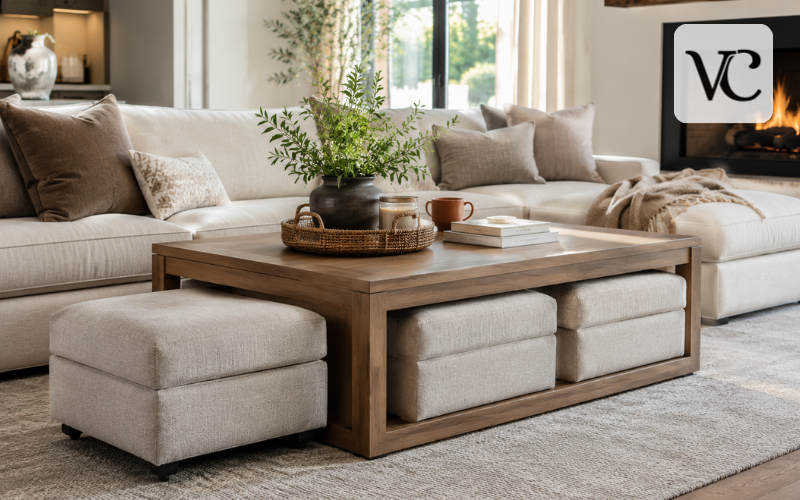
Another practical setup is a wood-framed coffee table with small upholstered ottomans stored underneath or placed nearby. This gives you hard surface space and extra seating in one area.
Routine care matters. Wipe spills quickly, use coasters when needed, and avoid dragging heavy objects across the surface. If the table is moved often, consider its weight before choosing a large solid-wood design.
Fabric Ottoman and Coffee Table Designs
A fabric ottoman and coffee table can make a living room feel softer and more inviting. Upholstery adds texture and can help balance rooms that already contain many hard surfaces.
Common choices include linen-style fabrics, velvet, leather, faux leather, and performance fabrics designed for easier cleaning. The best material depends on how the room is used. Homes with children or pets may benefit from a durable, easy-care fabric, while a less frequently used sitting room may allow more delicate upholstery.
Tufted ottomans have a classic, decorative look, but their uneven surface can make trays and cups less stable. Smooth upholstered tops are easier to use as tables.
If you plan to place drinks on the ottoman regularly, use a firm tray. It creates a safer, flatter surface and also helps protect the fabric from small spills.
Choose the fabric for real life, not only appearance. A beautiful ottoman is more useful when it can handle the way your household actually uses the room.
Coffee Table With Ottomans Underneath
A coffee table with ottomans underneath is a smart option when floor space is limited. The table usually has an open base or specially shaped frame that allows smaller ottomans or stools to slide beneath it.
When the extra seats are not needed, they remain tucked away and keep the room looking organized. When guests arrive, you can pull them out for seating, footrests, or temporary side surfaces.
Some nested ottomans include storage inside, which adds another useful function. This can be helpful for small apartments, family rooms, or multipurpose spaces where every piece of furniture needs to earn its place.
Before choosing this style, check how easily the ottomans slide in and out. There should be enough clearance for the upholstery, and the stools should not be so heavy that moving them becomes inconvenient.
This design works best for people who want a normal hard coffee table but also need flexible extra seating without permanently using more floor area.
Over-Ottoman and Waterfall Coffee Table Designs
An over-ottoman or waterfall coffee table is designed to slide above part of an upholstered ottoman. It usually has a rigid top with side supports that extend down toward the floor, allowing the table to sit over the soft piece.
This setup gives you a stable surface for a laptop, drinks, snacks, or books while leaving much of the ottoman available as a footrest.
The main advantage is flexibility. You can move the table when you need more soft surface or slide it into position when you need a firm tabletop.
Clearance is important. The opening must be wide and high enough to fit over the ottoman without rubbing against the upholstery. Measure both pieces carefully before buying or building this type of arrangement.
A slide-over design may be more useful than a permanent tray if you frequently switch between relaxing, working, eating, and entertaining in the same room.
Ottoman Coffee Table With Tray
An ottoman coffee table with tray is one of the simplest ways to make upholstered furniture more practical. The tray creates a hard, level area on top of a soft surface, making it easier to hold cups, books, candles, and small decorative objects.
The tray should suit the size of the ottoman. A large tray provides more stable surface area, but it may reduce the space available for resting your feet. A smaller tray keeps more of the ottoman usable for comfort.
Rimmed trays are helpful for drinks because the raised edge can help contain small spills or keep objects from sliding off. Flat trays can look lighter and may be easier to lift and store.
Try not to fill the tray with too many decorative items. The ottoman should still be easy to use in daily life.
For many households, this setup offers a simple way to combine the comfort of an ottoman with the function of a coffee table without replacing existing furniture.
Storage, Lift-Top, and Multifunctional Ottoman Coffee Tables
Multifunctional ottoman coffee tables are useful when storage or flexibility is a priority. Hidden compartments can keep blankets, toys, magazines, games, and remote controls out of sight while keeping them close to the seating area.
Lift-top designs can raise part of the surface, creating a more comfortable height for working on a laptop or eating a casual meal. Reversible tops may have upholstery on one side and a hard tray-like surface on the other.
Some designs also include nested stools that can be pulled out when extra seating is needed. This is especially useful in homes where the living room has to serve several purposes.
Before buying, check how lids, hinges, and lift mechanisms work. Make sure there is enough space to open them without hitting the sofa or nearby furniture. It is also worth checking whether the lid feels easy and secure to operate during normal use.
The best multifunctional design is not the one with the most features. It is the one that solves the problems you actually have, such as clutter, limited seating, or lack of tabletop space.
Arranging and Styling an Ottoman and Coffee Table Without Clutter
A good ottoman and coffee table arrangement should feel comfortable and easy to use. Start by keeping enough space around the furniture for normal movement. If people regularly bump into corners or have to turn sideways to pass, the setup is probably too large.
Scale is also important. A common starting point is a coffee table that is around two-thirds of the sofa’s width, but this is only a guide. The final size should suit the room and the seating layout.
Avoid placing unstable drinks directly on deep padding or tufting. Use a tray or nearby hard surface instead.
For styling, a few useful objects are usually enough. Books, a bowl, a tray, or a small decorative piece can add interest without covering the entire surface. The ottoman should remain usable as a footrest or extra seat when needed.
The table and ottoman do not have to match perfectly. Coordinating the shape, wood tone, fabric, or color is often enough to make the pieces feel connected. For example, a warm wood coffee table can work beside a neutral fabric ottoman even when they come from different furniture collections.
Common mistakes include choosing furniture that is too tall, too wide, difficult to move, or unsuitable for everyday household needs. Styling should support the function of the room rather than make the furniture harder to use.
Conclusion
The right ottoman and coffee table setup depends on how your living room is used. Shape, size, material, storage, and available floor space all affect which combination will work best.
Round designs can make movement easier, square pieces can suit large or balanced seating areas, and rectangular options often pair naturally with standard sofas. Wood provides a dependable hard surface, while fabric adds comfort and softness. Nesting designs save space, slide-over tables provide flexibility, and an ottoman coffee table with tray offers a simple way to combine two functions.
Instead of choosing only by appearance, think about everyday habits. Consider where you place drinks, whether you need extra seating, how often you use a footrest, and whether hidden storage would reduce clutter.
A well-chosen ottoman and coffee table should make the living room more comfortable, more useful, and easier to enjoy without taking over the space.
FAQs
Can you use an ottoman as a coffee table?
Yes. A large upholstered ottoman can work as a coffee table, especially when topped with a firm tray that provides a stable surface for drinks, books, remotes, and small décor.
Should an ottoman and coffee table be the same height?
They do not need to be exactly the same height. However, both should sit at a comfortable level relative to the sofa so they are easy to reach and use.
Is a coffee table with ottomans underneath good for a small room?
Yes. A coffee table with ottomans underneath can save floor space because the stools stay tucked away until you need extra seating, footrests, or temporary surfaces.
What shape ottoman works best with a sofa?
Rectangular ottomans often suit standard sofas, while square designs work well with sectionals. Round ottomans can be useful in compact rooms where easier movement around furniture is important.
Do I need a tray on an ottoman coffee table?
A tray is strongly recommended when you regularly place drinks or small objects on an upholstered ottoman. It creates a flatter, firmer surface and can also help protect the fabric.
Disclaimer: This article provides general information about ottoman and coffee table layouts, sizes, materials, and everyday use. Furniture dimensions, construction, weight limits, storage mechanisms, and care requirements vary by product, so always check the manufacturer’s specifications before purchasing or arranging furniture.
Enjoyed this article? Discover more helpful ideas and fresh inspiration on Vogue Cultures.