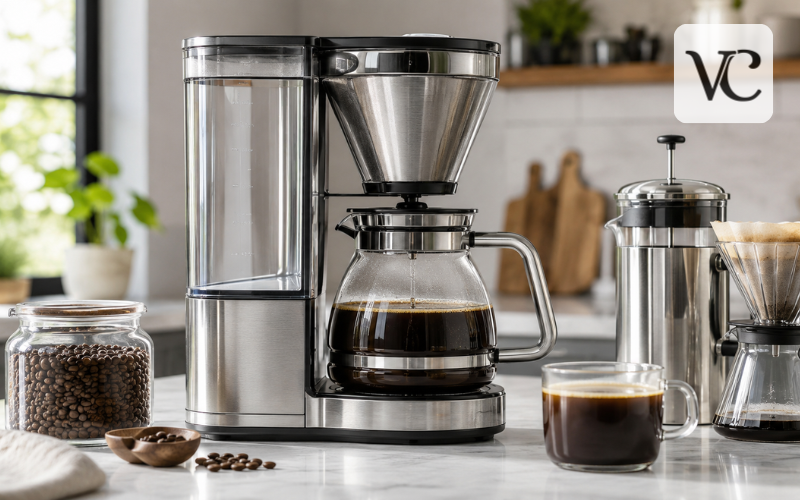
A plastic free coffee maker is a brewer designed to reduce or remove plastic from the parts that hold water, heat water, or come into contact with brewed coffee. That sounds simple, but the term can mean different things depending on the product.
Some coffee makers keep plastic completely away from both water and coffee while still using small plastic pieces on the outside. Others use a plastic cold-water reservoir but keep hot water and finished coffee away from plastic.
Interest in these brewers has grown as shoppers look for ways to reduce plastic contact with food and drinks, especially when heat is involved. However, this does not mean conventional coffee makers are proven unsafe. Research into microplastics and their possible health effects is still developing, so choosing less plastic is better viewed as a personal materials preference rather than a health guarantee.
The main choices include automatic drip machines, pour-over brewers, French presses, moka pots, and other stovetop coffee makers. Automatic models are easier for busy mornings, while glass and stainless steel manual brewers usually make it easier to see exactly what touches your water and coffee.
This guide explains those differences and compares practical plastic-free coffee maker choices available in 2026.
Snippet-Ready Definition:
A plastic free coffee maker is a brewer designed to keep plastic away from water and brewed coffee. It typically uses materials such as stainless steel, borosilicate glass, ceramic, or silicone for key brewing components.
Quick Checklist Before Buying
- Check whether “plastic-free” means the whole machine or only the brew path.
- Look at the water reservoir, internal tubing, showerhead, filter basket, and carafe.
- Remember that BPA-free plastic is still plastic.
- Check whether silicone seals or gaskets are used.
- Choose automatic brewing for convenience or manual brewing for simpler construction.
- Look for replacement carafes, filters, seals, and other parts before buying.
Plastic-Free Machine vs. Plastic-Free Brew Path
The brew path is the route water and coffee travel through a brewer. Depending on the machine, this can include the water reservoir, heating system, internal tubing, showerhead, filter basket, seals, carafe, and carafe lid.
A machine can have a stainless steel exterior while hiding plastic tubing inside. The opposite can also happen: an automatic brewer may have plastic pieces on its exterior while keeping them completely away from water and coffee.
That is why shoppers should look beyond appearance and marketing labels.
“BPA-free” does not mean plastic-free either. A BPA-free Tritan reservoir, for example, is still made from polymer plastic even though it does not contain BPA. The Ratio Eight Series 2 is a good example because its cold-water reservoir is Tritan, while its hot-water path avoids plastic.
Silicone also deserves separate consideration. It is commonly used for flexible, heat-resistant seals and connections. It is not the same material as common rigid plastics, but it is still a synthetic polymer. Someone trying to avoid every polymer should therefore check silicone parts as well.
Best Plastic Free Coffee Maker Options in 2026
There is no single best plastic free coffee maker for every household. The right choice depends on whether convenience, durability, capacity, or the lowest possible plastic contact matters most.
| Coffee Maker | Style | Main Brew-Contact Materials | Capacity | Best For |
| SimplyGoodCoffee The Brewer | Automatic drip | Stainless steel, borosilicate glass, silicone | 40 oz / 8 cups | Automatic brewing with no plastic or aluminum contacting water or coffee |
| Ratio Eight Series 2 | Premium automatic drip | Glass, stainless steel, silicone, aluminum heater | 40 oz | Premium brewing with no plastic on the hot-water side |
| Frieling French Press | Manual press | 18/10 stainless steel | 17–44 oz | Durable all-stainless manual brewing |
| CHEMEX Classic | Pour-over | Borosilicate glass | Several sizes | Simple glass brewing with few hidden components |
| Bialetti Venus | Stovetop moka | Stainless steel brewing body with gasket | Several sizes | Compact stovetop brewing |
SimplyGoodCoffee currently provides one of the clearest automatic choices for people specifically avoiding plastic contact with water and coffee. Manual glass and stainless steel brewers remain simpler and are often more affordable.
The Ratio Eight Series 2 is another strong premium choice, although it should not be described as an entirely plastic-free appliance because its cold-water reservoir and outer body contain polymer.
Simply Good Coffee Brewer: The Plastic-Free Automatic Option
The Simply Good Coffee Brewer is currently an 8-cup, 40-ounce automatic drip machine. According to the manufacturer, no plastic or aluminum comes into contact with water or coffee.
Its reservoir and carafe use borosilicate glass, while stainless steel is used for major brew-path components, including its internal flow path, boiler, showerhead, and filter basket. Medical-grade silicone is used where flexible seals and connections are needed. It accepts standard #4 cone filters.
A full batch is rated at about six minutes without the bloom cycle, and the machine operates within a listed brewing range of 195–205°F. Its bloom setting wets the coffee grounds before the main brewing cycle to encourage more even extraction. Forbes testing found that using the bloom setting increased full-pot brewing time to roughly eight minutes.
The removable components are designed for straightforward cleaning, and the company lists replacement items such as carafes, filter baskets, showerheads, and seal kits.
One distinction is important. The Simply Good plastic-free coffee maker is best described as having a plastic-free water and coffee path rather than having literally no plastic anywhere. Forbes reports that exterior plastic pieces are present but do not touch water or coffee.
As of August 2026, SimplyGoodCoffee also lists a programmable version with a 24-hour timer, with September 2026 shipping shown on its product page.
Plastic-Free Coffee Maker Automatic Alternatives
Finding a truly plastic-free coffee maker automatic model is difficult because automatic brewing requires reservoirs, heaters, tubing, seals, controls, and a stable outer housing.
The Ratio Eight Series 2 is one of the main premium alternatives. It brews up to 40 ounces and uses borosilicate glass water lines, a stainless steel showerhead and brew basket, silicone connections, and either glass or stainless steel carafe options.
However, its cold-water tank is made from Tritan plastic, and its body uses polymer. Ratio also states that water briefly passes through an uncoated aluminum heating element before continuing through the rest of the brewing path.
A full brew typically takes around eight to ten minutes. The machine provides two brew programs for different batch sizes rather than a large set of programmable controls, and it does not use a traditional hot plate.
This highlights an important compromise: as more automation and convenience features are added, finding an appliance with absolutely no plastic anywhere becomes increasingly difficult.
Plastic-Free Drip Coffee Maker Comparison
The leading plastic-free drip coffee maker options approach the issue differently.
SimplyGoodCoffee focuses on keeping both cold water and hot coffee away from plastic. Its 40-ounce brewer uses a glass reservoir and carafe with stainless steel in the main brew path. It also includes an optional bloom cycle and uses widely available #4 cone filters.
Ratio Eight Series 2 also brews up to 40 ounces, but its cold water starts inside a Tritan plastic reservoir. Once brewing begins, the hot-water side relies mainly on glass, stainless steel, silicone, and an aluminum heater rather than plastic.
Ratio uses flat-bottom paper filters or an optional reusable stainless basket and generally completes a full batch in eight to ten minutes.
Price should not be the only deciding factor because promotions and availability change. Capacity, materials, replacement parts, filters, brew time, and the amount of automation you actually need are more useful long-term comparison points.
Plastic-Free Coffee Maker Single-Serve Choices
A genuinely plastic-free coffee maker single-serve option is much easier to find in manual form than as an automatic pod machine.
Pod brewers normally rely on water reservoirs, internal hoses, pod holders, piercing systems, and molded components. Removing plastic from every one of these areas is difficult.
For one cup at a time, a stainless steel pour-over cone, ceramic dripper, or small glass pour-over brewer is usually much simpler. These options contain few hidden components and can be paired with a stainless steel or glass kettle.
The trade-off is convenience. A pod brewer may require little more than pressing a button, while pour-over coffee requires heating and manually adding water.
Still, manual brewing gives buyers far greater control over the materials touching their drink. Check the filter holder, support ring, lid, base, and reusable filter carefully because a brewer marketed as “stainless steel” may still include plastic in smaller components.
All Stainless Steel Coffee Maker No Plastic Options
For shoppers specifically looking for an all stainless steel coffee maker no plastic, a stainless steel French press is one of the easiest formats to understand.
Frieling’s French press is constructed from 18/10 stainless steel and uses a double-wall insulated design. It is available in 17-, 23-, 36-, and 44-ounce sizes and uses a stainless steel filtration system instead of a plastic filter basket. The manufacturer describes the press as entirely stainless steel.
Stainless steel stovetop percolators can also work, although buyers should inspect handles, lid knobs, baskets, stems, and seals before assuming the whole brewer is metal.
The Bialetti Venus is frequently included in low-plastic coffee maker discussions because its brewing body is stainless steel. However, it is not literally an all-stainless appliance. The Venus uses a sealing gasket and has a heat-resistant handle.
Stainless steel is highly durable and retains heat well, making it particularly useful for people who value long service life.
Glass and Manual Plastic-Free Coffee Makers
Manual brewers have one major advantage: their construction is usually easy to inspect.
The CHEMEX Classic is made from borosilicate glass and, on the classic version, has a wooden collar secured with a leather tie. Water and brewed coffee remain inside the glass vessel and paper filter, with no internal tubes or hidden plastic reservoir.
A stainless steel French press works differently. Coffee grounds steep directly in hot water before the metal plunger separates them from the finished drink.
Pour-over brewing passes water through the grounds and filter as you pour, while a moka pot uses stovetop pressure to move heated water through ground coffee.
Glass offers a clear view of the brewing process and does not retain coffee odors easily, but it can break if dropped. Stainless steel is much harder to damage and retains heat better, although you cannot see what is happening inside.
Manual methods require slightly more effort, but their simple construction also means fewer hidden components.
Materials That Matter in a Plastic Free Coffee Maker
Stainless steel is widely used in coffee equipment because it is durable, corrosion-resistant, and easy to clean. Terms such as 304 stainless steel and 18/10 stainless steel commonly appear on food-contact products.
Borosilicate glass is another popular material. It handles changes in temperature better than ordinary household glass and does not absorb coffee smells easily. That makes it useful for water tanks, carafes, and pour-over brewers.
Silicone is most often found in seals, gaskets, and flexible connectors where hard glass or steel cannot create a watertight connection.
Tritan is different. It is a BPA-free copolyester plastic. It can make a strong, clear reservoir, but BPA-free does not mean plastic-free.
Other commonly hidden plastic areas include filter baskets, reservoir lids, carafe lids, drip-stop mechanisms, handles, internal tubing, and parts around the heating assembly.
Reading the complete materials list is therefore more useful than judging a brewer from its stainless steel appearance.
How to Choose the Right Plastic Free Coffee Maker
Start with the way you actually make coffee.
Someone brewing a full pot every morning may value the convenience of an automatic machine enough to pay more for a clearly documented plastic-free water path. Someone making one or two cups may find that a stainless steel or glass manual brewer is simpler and easier to verify.
Pay attention to capacity as well. An “8-cup” machine often means around 40 ounces, not eight large household mugs.
Next, check the reservoir, heater, water lines, showerhead, filter basket, lid, carafe, seals, and reusable filters individually. Do not rely entirely on the phrase “plastic-free.”
Replacement parts are another important consideration. A well-built brewer is more useful if you can replace a broken carafe or worn gasket instead of throwing away the complete appliance.
The best plastic free coffee maker should balance your material preferences with brewing quality, cleaning, counter space, time, capacity, and budget.
Cleaning and Maintaining Plastic-Free Coffee Makers
Plastic-free does not mean maintenance-free. Coffee oils and minerals from water can build up on stainless steel, glass, filters, and inside automatic brewing systems.
Wash removable carafes, baskets, and reusable filters regularly according to the manufacturer’s instructions. Avoid harsh abrasive pads that may scratch polished stainless steel or glass surfaces.
Automatic brewers also require descaling because minerals can collect inside the heater and water path. Follow the specific brewer’s instructions for the recommended descaling product and cleaning schedule rather than assuming every coffee maker should be treated the same way.
Inspect silicone seals and gaskets occasionally. Cracking, stretching, hardening, or leaking can be signs that a seal needs replacement.
Availability of replacement carafes, baskets, seals, and other parts can significantly extend the useful life of a coffee maker and prevent a minor failure from turning into a complete appliance replacement.
What Plastic Free Coffee Maker Reddit Discussions Reveal
Plastic free coffee maker Reddit discussions can be useful for understanding what real shoppers struggle with, although personal comments should not be treated as verified product specifications or scientific evidence.
Recent 2026 discussions repeatedly show interest in automatic coffee makers that avoid plastic contact with hot water. Cost is one of the most common complaints. Users frequently mention SimplyGoodCoffee and Ratio but also describe them as expensive compared with conventional drip machines.
Other users return to CHEMEX, stainless steel French presses, moka pots, and stainless steel pour-over cones because the construction is easier to inspect and the price is often lower.
Convenience comes up repeatedly too. Shoppers ask for automatic timers, preset morning brewing, keep-warm features, and larger capacities. Some also discover plastic inside filter baskets, reservoirs, or lids after initially assuming a stainless-looking machine was plastic-free.
The useful takeaway is not that Reddit has identified one universal winner. It is that checking every coffee-contact component matters more than trusting a broad product label.
Conclusion
Choosing a plastic free coffee maker becomes much easier once you understand the difference between an entirely plastic-free appliance and a plastic-free brew path.
Very few automatic coffee makers eliminate plastic from every part of their construction. However, some machines now keep it completely away from water and brewed coffee.
SimplyGoodCoffee currently stands out among automatic drip brewers because its water and coffee path uses stainless steel, borosilicate glass, and silicone without plastic or aluminum contact. The Ratio Eight Series 2 takes a different approach: it keeps plastic away from the hot-water and coffee side but still uses a Tritan cold-water reservoir and polymer body.
For people who prefer simpler construction, glass pour-over makers such as CHEMEX and all-stainless French presses remain practical alternatives with very few hidden components.
Ultimately, the right choice depends on how much plastic you want to avoid, how many cups you brew, how much convenience you need, and what you are comfortable spending. Instead of relying only on words such as “plastic-free,” check the current material specifications for every part that touches your water and coffee.
Frequently Asked Questions
What is the best plastic free coffee maker?
The best option depends on your brewing style. SimplyGoodCoffee The Brewer is a notable automatic choice, while glass pour-over brewers and stainless steel French presses offer simpler construction with fewer hidden components.
Are there completely plastic-free automatic coffee makers?
Completely plastic-free automatic machines are uncommon. Some models keep plastic away from the water and coffee path while still using plastic in exterior panels, controls, insulation, or other non-contact components.
Is a stainless steel coffee maker always plastic-free?
No. A stainless steel exterior does not guarantee plastic-free construction. Some machines may still contain plastic reservoirs, internal tubing, handles, filter baskets, lids, or other hidden parts.
Is BPA-free the same as plastic-free?
No. BPA-free means the material does not contain bisphenol A, but it can still be plastic. Buyers wanting to avoid plastic should check the actual materials used throughout the brewing path.
Are manual coffee makers easier to find without plastic?
Yes. Glass pour-over brewers, stainless steel French presses, and some stovetop coffee makers have fewer internal components, making it easier to identify exactly which materials come into contact with water and coffee.
Disclaimer: This article is intended for general informational purposes only. Product materials, designs, specifications, prices, and availability can change over time. A coffee maker described as “plastic-free” may still contain plastic or polymer components outside the water or coffee-contact path. Always review the latest manufacturer specifications before purchasing. Information about reducing plastic exposure should not be considered medical or health advice, and no coffee maker can be assumed to provide specific health benefits solely because of the materials used.
Enjoyed this article? Discover more helpful ideas and fresh inspiration on Vogue Cultures.