
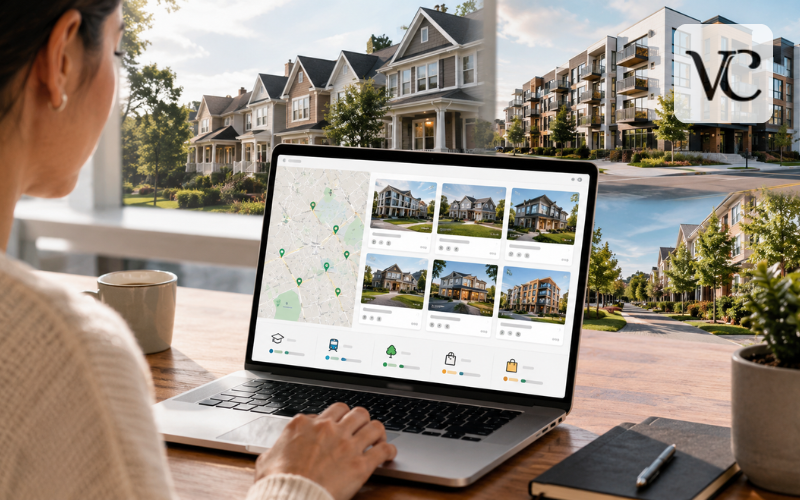
Finding a home involves more than looking at bedrooms, bathrooms, and price. Buyers and renters also want to understand the neighborhood, nearby services, commuting options, and what daily life may feel like before making a decision. Trulia brings many of these details together in one real estate search platform.
Trulia can be used to search for homes for sale and rental properties across the United States. Along with property listings, it provides neighborhood information, local reviews, photos, and other insights intended to help people research both a home and the surrounding area.
This makes the platform useful for several types of users. A buyer can compare properties and neighborhoods, a renter can explore apartments and houses, and a homeowner can research estimated property values. People who are still deciding where to live can also use Trulia to learn more about different communities before narrowing their search.
This guide explains how Trulia works, what its main features offer, where its information comes from, and which details should be independently checked before making an important housing decision.
Snippet-Ready Definition:
Trulia is an online real estate platform owned by Zillow Group that helps people search for homes for sale and rent while exploring neighborhood information, property details, local insights, and estimated home values.
Quick Guide to Trulia
| Trulia Feature | What It Helps You Do |
| Homes for Sale | Browse houses, condos, townhomes, land, and other properties |
| Homes for Rent | Find apartments, houses, condos, and other rentals |
| Search Filters | Narrow results by price, property type, bedrooms, bathrooms, and features |
| Neighborhood Insights | Research local amenities, schools, resident opinions, and other area information |
| Saved Homes & Searches | Keep track of properties and receive updates on matching listings |
| Trulia Estimate | View an automated estimate of a property’s possible market value |
| Mobile Apps | Search and save properties using iPhone or Android devices |
Simple Steps for Using Trulia
- Enter the city, ZIP code, neighborhood, or location you want to search.
- Choose whether you are looking for a home to buy or rent.
- Set filters for your budget, bedrooms, bathrooms, and preferred property type.
- Compare listings, photos, property details, and neighborhood information.
- Save promising homes or searches for easier tracking.
- Verify important property, price, ownership, and neighborhood details before making a decision.
What Trulia Is and How It Fits Into Zillow Group
Trulia is an online real estate marketplace designed to help people explore properties and neighborhoods. Although it has its own website, branding, search tools, and mobile apps, it is part of Zillow Group.
Zillow acquired Trulia in February 2015, when the companies combined and Zillow Group was formed as a collection of real estate and home-related brands. This relationship explains why users may sometimes notice connections between information or services on Trulia and Zillow.
The platform mainly serves people looking to buy or rent homes, but it also provides information that can be useful to homeowners researching property values. Real estate professionals can also interact with the platform through professional registration and related Zillow Group services.
For everyday users, however, Trulia is mainly a property discovery and neighborhood research tool. Its main purpose is to help people understand not just what a property offers, but what living in the surrounding area might be like.
How Trulia Home Search Works
A Trulia home search normally starts with a location. On the mobile app, for example, Trulia says users can enter a city, state, or ZIP code to begin searching. The website also allows people to browse real estate in specific states, cities, and neighborhoods.
After selecting an area, filters can make the results more relevant. Depending on the type of search and available listings, users can narrow properties by factors such as price, number of bedrooms and bathrooms, property type, and other home features. Instead of opening every listing, a buyer or renter can use these filters to remove options that clearly do not match their needs.
Map-based searching is particularly useful when location matters as much as the property itself. It allows users to see how available homes are spread across an area and compare nearby neighborhoods.
People can also save properties they like. Trulia says saved homes can receive updates when certain details change, including listing status, price, or an announced open house. Saved searches can also provide updates when new matching homes reach the market.
Trulia Homes for Sale
People searching Trulia homes for sale can browse a wide range of residential properties. Depending on the local market, results may include single-family houses, condos, townhomes, lots or land, and other residential listing types.
Individual property pages commonly provide information such as the asking price, photos, bedroom and bathroom count, square footage, address, property description, and listing status. Open-house information may also appear when one is scheduled. Current state-level pages on Trulia show these types of property details alongside neighborhood research options.
The most useful approach is to narrow the results around actual needs. Someone with a fixed budget, for example, may first set a price range and number of bedrooms, then consider location and additional features. This reduces time spent looking at properties that would not be realistic choices.
Listing details should still be checked before making a financial decision. Trulia states that listing information comes from brokers, agents, Multiple Listing Services (MLSs), website vendors, and other sources across the United States. For Sale by Owner information can also reach Trulia through Zillow. Because property status and details can change, buyers should confirm important information with the listing professional or another reliable source.
Trulia Homes for Rent
The rental side of Trulia is designed for people looking for apartments, houses, townhomes, condos, and other available rental housing. Trulia’s current rental section allows users to search listings while also researching prices and neighborhood information.
A renter can use filters to focus on properties that fit a certain monthly budget, bedroom count, bathroom requirement, or housing type. Other filters may help narrow listings according to features such as pet policies or specific amenities, depending on the property and location.
Searching for Trulia homes for rent is more useful when the property is considered together with its surroundings. A beautiful apartment may be less suitable if the commute is difficult or important services are far away. On the other hand, a simpler rental might be a better match because of its location, neighborhood, or access to daily needs.
Rather than choosing from photos alone, compare rent, space, lease information, amenities, location, neighborhood details, and the total practical cost of living there. Any fees, deposits, lease conditions, utilities, and pet rules should be confirmed directly before committing.
Trulia for Rent by Owner
A Trulia for rent by owner search focuses on rental properties offered by private owners rather than only professionally managed apartment communities. Trulia currently maintains location-based pages specifically for apartments and other rentals listed as being available through private owners.
Working directly with an owner can sometimes create a more personal rental process, but it does not automatically mean the property is cheaper or the terms are more flexible. Lease conditions, maintenance responsibilities, deposits, application requirements, and communication practices can vary widely from one landlord to another.
Private rentals also deserve careful verification. The Federal Trade Commission warns that scammers sometimes copy legitimate property listings or create listings for homes that are not actually available. The FTC recommends checking the rental address, confirming who owns or manages the property, and being cautious when someone pressures you to pay before properly viewing or verifying the home.
Never treat the presence of an online listing as proof that a person has the legal right to rent the property.
Trulia Neighborhood Insights and Local Information
One of Trulia’s most recognizable features is its attention to the neighborhood around a property. Its home page highlights resident reviews, original neighborhood photos, and local insights alongside homes for sale.
The platform’s What Locals Say feature uses input from people who describe their own neighborhoods. Trulia explains that its neighborhood information is collected through questions and reviews about aspects of local life that may matter to someone considering a move. This can provide useful context that property specifications alone cannot show.
On Trulia’s mobile apps, Local Info includes map overlays covering categories such as schools, crime, local amenities, and natural disasters. App listings also describe neighborhood maps, commuting information, resident reviews, and related local tools.
These features are best treated as a starting point. Resident opinions are subjective, while third-party datasets can have limits or delays. If schools, safety, flood exposure, transportation, or another local issue is important to your decision, verify it through the appropriate official or specialist source as well.
Trulia Estimates, Home Values, and Market Information
A Trulia Estimate is an estimated market value for a property. It can give homeowners, buyers, or sellers a general starting point when researching how much a home might be worth, but it should not be confused with a formal valuation.
Trulia states that its Estimate is now derived from Zillow’s Zestimate. The underlying valuation model considers information that can include home facts, location, market conditions, and public or user-provided data. Trulia property pages may also show nearby home values, similar sales, property history, and local market information where sufficient data is available.
The most important limitation is that an automated estimate does not inspect the home in person. Renovations, condition, unusual property features, local demand, or inaccurate public records can affect the difference between an online estimate and a real-world sale price.
Trulia itself states that a Trulia Estimate is not an appraisal and recommends supplementing it with other research, which may include visiting the property, obtaining a professional appraisal, or requesting a comparative market analysis from a real estate professional.
Trulia Login and Saved Account Features
A Trulia login is not necessary simply to understand what the platform is, but an account becomes more useful when someone wants to keep an organized record of an ongoing property search.
After signing in, users can save homes and searches rather than repeatedly finding the same properties. Trulia says a saved home can generate updates when its status changes and, for active listings, when the price changes or an open house is added.
Saved searches can also make a long search easier to manage. Instead of manually repeating the same location and filters every day, users can retain the search and receive updates about matching listings.
These notifications can be controlled. Trulia’s current support guidance allows account holders to choose daily updates or no updates for saved searches, delete searches, remove saved homes, and adjust other notification preferences.
For people who search regularly, these simple account features can reduce repetitive browsing without changing how listings themselves should be evaluated.
Using Trulia on iPhone and Android
Trulia is available on mobile devices as well as through its website. The current Trulia real estate app is available through Apple’s App Store, while Trulia apps for home and rental searches are also available through Google Play.
The mobile experience is useful when someone wants to research properties while traveling, exploring a neighborhood, or comparing homes away from a computer. Users can search locations, browse a map, apply filters, save homes, and keep track of saved searches. Trulia’s support documentation says saved searches can alert users when new homes matching their criteria enter the market.
The apps also provide access to Trulia’s Local Info tools. After selecting a location, users can choose local map overlays to explore information such as schools, crime, amenities, and natural-disaster data.
Mobile tools can make searching convenient, but important property or neighborhood information should still be verified rather than accepted only because it appears in an app.
Trulia for Agents and Real Estate Professionals
Searches for Trulia for agents, Trulia for professionals, or Trulia agent login usually come from real estate professionals looking for the business side of the platform rather than its ordinary home-search features.
The standard Trulia sign-in page is designed for regular account access using an email address and password. On that same page, Trulia currently displays a separate registration option specifically for real estate professionals.
This distinction matters because a home buyer or renter generally does not need a professional account simply to search, save properties, or research neighborhoods. Professional access is intended for people working within the real estate industry and may connect them with services offered across the broader Zillow Group ecosystem.
Because professional products, advertising options, account systems, and listing-management processes can change, agents should use Trulia’s current professional registration path rather than relying on older guides describing past Trulia products.
A Smarter Way to Use Trulia During a Home Search
The best way to use Trulia is to begin with clear limits rather than scrolling through hundreds of attractive properties. Decide what you can realistically afford, where you would consider living, how much space you need, and which requirements are genuinely essential.
Once those basics are clear, use filters to reduce unrelated results. Then look beyond the listing itself. Compare commute needs, neighborhood characteristics, nearby services, school information where relevant, and anything else that could affect everyday life.
Saving a small group of serious options can also make comparisons easier. Instead of remembering details from many properties, return to your saved homes and compare them on the factors that matter most.
Before contacting an agent, landlord, owner, or property manager, review the details one more time and note anything that needs confirmation. Online research is valuable for creating a shortlist, but it should lead to further checking rather than replace it.
Trulia’s Strengths, Limitations, and Details Worth Verifying
Trulia’s main strength is the way it combines property discovery with information about the surrounding area. Buyers and renters can move from looking at a house or apartment to learning about the neighborhood without starting their research from zero on another platform.
However, not every piece of information should be treated as final. Trulia receives listing data from several outside sources, including agents, brokers, MLSs, and vendors. Home-value estimates rely on models and available data, while neighborhood reviews reflect individual experiences. School, crime, commute, natural-disaster, and market information may also come from outside datasets that can change or have limitations.
Before making a decision, confirm the property’s current price and availability, physical condition, ownership or management, boundaries, fees, lease or sale terms, and any local factor that could materially affect you.
For this reason, Trulia works best as a research and discovery tool. It can help users find options and ask better questions, but major financial or housing decisions deserve additional verification.
Conclusion
Trulia can make the early stages of a home search easier by bringing property listings and neighborhood research into the same experience. Buyers can explore homes for sale, renters can compare rental options, and users who are still choosing an area can review local information before deciding where to focus.
Its search filters, maps, saved properties, alerts, neighborhood insights, mobile tools, and home-value information are most useful when they help reduce a large market into a manageable group of realistic choices.
At the same time, a convenient online platform cannot confirm every detail involved in buying or renting a home. Listing information may change, automated valuations are not appraisals, and local data or resident opinions should not be the only basis for judging a neighborhood.
Using Trulia as a starting point, then independently confirming the information that matters most, gives buyers and renters a more informed and practical way to approach their housing search.
FAQs
What is Trulia mainly used for?
Trulia is mainly used to search for homes for sale and rental properties in the United States. It also provides neighborhood information that can help users compare locations before choosing a home.
Is Trulia owned by Zillow?
Yes. Zillow acquired Trulia in 2015, and Trulia now operates as part of Zillow Group while continuing to provide its own real estate website, apps, and search experience.
Can I find Trulia homes for rent by owner?
Yes, private-owner rental listings may appear on Trulia where available. Renters should still confirm the property, landlord, lease terms, and ownership before paying deposits or sending money.
Is a Trulia Estimate the same as a home appraisal?
No. A Trulia Estimate is an automated estimate based on available property and market data. It is not a professional appraisal and should not be used alone to determine a home’s value.
Do I need a Trulia login to search for homes?
You can browse many Trulia listings without an account. Signing in becomes more useful when you want to save homes, keep saved searches, or receive updates about matching properties.
Disclaimer: This article is provided for general informational purposes only and does not constitute real estate, financial, legal, or appraisal advice. Property prices, availability, estimates, neighborhood data, and listing details may change or come from third-party sources. Always verify important information with the property owner, listing agent, local authority, lender, or other qualified professional before making a housing or financial decision.
Enjoyed this article? Discover more helpful ideas and fresh inspiration on Vogue Cultures.