Learning how to get rid of weeds naturally is less about finding one miracle spray and more about choosing the correct method for each area. A weed growing between patio stones can be treated differently from one growing beside a tomato plant or in the middle of a healthy lawn. Natural weed control may involve pulling roots, applying heat, blocking sunlight with mulch, or improving the surrounding grass and plants so weeds have fewer opportunities to return.
The most important point is that many homemade weed killers are non-selective. Vinegar, boiling water, rubbing alcohol, salt, and intense heat can damage almost any vegetation they touch. They cannot distinguish between an unwanted weed and a flower, vegetable, tree root, or patch of turf. Precise application is therefore just as important as the treatment itself.
It is also important to be realistic about promises involving overnight or permanent weed removal. Some treatments can make leaves wilt within hours, but visible damage does not always mean the roots have died. Deep-rooted and spreading weeds may require complete removal, repeated treatment, or long-term suppression before they stop returning.
Quick Guide to Natural Weed Control
| Natural Method | Best Used For | Speed | Important Caution |
| Hand pulling | Lawns and garden beds | Immediate | Remove the complete root to prevent regrowth |
| Vinegar spray | Young weeds on hard surfaces | Within hours | Can damage grass and desirable plants |
| Boiling water | Driveway, patio, and pavement cracks | Immediate | Kills any vegetation it touches |
| Cardboard and mulch | Garden beds and larger bare areas | Several weeks | Keep mulch away from plant stems |
| Solarization | Empty, heavily weeded areas | 2–6 weeks | Works best during hot, sunny weather |
| Taller mowing | Weed prevention in lawns | Gradual | Use a height suitable for the grass species |
| Dense planting | Garden beds and borders | Long term | Avoid overcrowding desirable plants |
Step-by-Step Guide: How to Get Rid of Weeds Naturally
- Identify the weed and its location. Determine whether it has shallow roots, a taproot, or spreading underground stems.
- Pull young weeds after rain. Loosen the damp soil and remove the entire crown and root whenever possible.
- Treat hard-surface weeds carefully. Use boiling water or a targeted vinegar treatment only where grass and garden plants will not be affected.
- Cover cleared soil. Place overlapping cardboard over problem areas and add a 5–10 cm layer of organic mulch.
- Prevent new growth. Mow lawns at an appropriate height, fill bare patches, maintain dense planting, and remove new seedlings before they produce seeds.
What Kills Weeds Naturally?
Natural weed control works through several basic processes. Hand pulling physically removes the crown and roots. Heat damages plant cells. Vinegar and certain other contact treatments dry or burn exposed foliage. Mulch, cardboard, and opaque coverings prevent sunlight from reaching weeds. A dense lawn or closely planted garden reduces the open soil and light available for new seedlings.
These methods do not all produce the same results. Contact treatments usually damage only the parts of the plant they touch. A small annual weed may die after its leaves are destroyed, but an established perennial can recover using energy stored in its roots. Research summarized by the University of Maryland Extension indicates that acetic acid is most effective on very young weeds and may only kill the top growth of established tap-rooted plants.
Thermal control can also include flame weeding. A propane weed torch is passed briefly over young foliage to rupture plant cells rather than set the plant on fire. However, flame weeding carries burn and fire risks, should never be used during dry or windy conditions, and often fails to control underground roots.
The weed’s location should guide the choice. Boiling water may be suitable for paving cracks but dangerous around grass. Cardboard and mulch work well in garden beds but cannot be placed over an established lawn. Hand removal takes more effort, but it is often the safest option when weeds are growing close to desirable plants.
Identify the Weed Before Choosing a Treatment
Before applying anything, examine how the weed grows. Young annual weeds usually have shallow roots and complete their life cycle within one season. They are often easy to pull or suppress before they produce seeds.
Deep-rooted perennials can be more difficult. Dandelions and similar weeds may regrow when part of the taproot remains in the soil. Other weeds spread through rhizomes, creeping stems, underground tubers, bulbs, or root fragments. Burning or drying their leaves may weaken them temporarily without removing the structures responsible for regrowth.
The surrounding area also matters. In a lawn, targeted removal combined with better turf care is normally safer than a homemade spray. In a vegetable or flower bed, hand pulling, shallow cultivation, cardboard, and organic mulch may work well. Heat or carefully directed contact treatments are more practical on gravel, patios, and sidewalk joints where desirable vegetation is absent.
Correct identification can also prevent a small problem from becoming worse. Some weeds spread when underground roots or tubers are broken into pieces. If a weed is invasive, toxic, thorny, or unfamiliar, identify it through a reliable local gardening or extension resource before pulling or treating it.
Hand Pulling Weeds From the Root
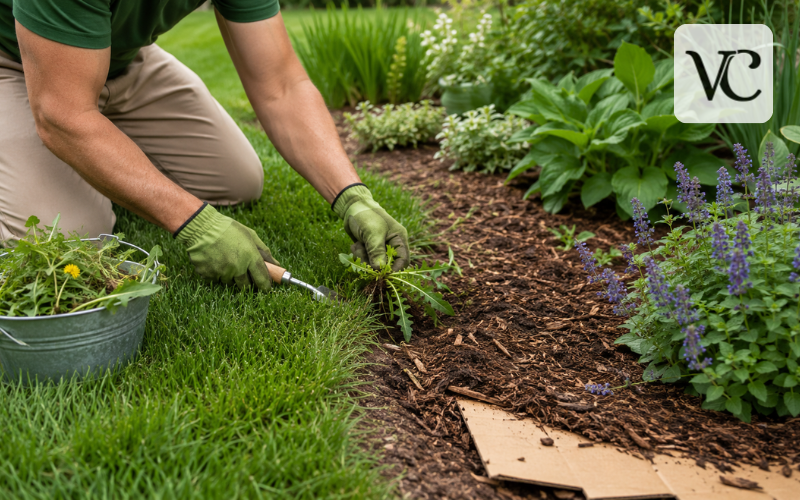
Hand pulling remains one of the best solutions for anyone wondering what kills weeds naturally down to the root. When the crown and root system are removed successfully, the weed is controlled immediately without leaving spray residue on neighboring grass or garden plants.
Pull weeds after rainfall or watering, when the soil is moist but not muddy. Hold the plant close to its base, loosen the soil around it, and pull upward steadily. Avoid grabbing only the leaves because the foliage may break away while the crown remains underground. Broadleaf weeds are generally easier to remove from moist soil.
A narrow hand weeder, dandelion fork, or hori-hori knife can help reach taproots while limiting disturbance to nearby plants. Insert the tool beside the root, loosen the surrounding soil, and gently lift the plant. Press displaced soil back into the hole afterward, especially when working in a lawn.
Remove weeds before they flower or develop seeds. A mature seed head can increase future weed pressure even after the original plant is gone. Avoid shaking seed-bearing plants over the garden, and do not place persistent roots or mature seed heads in a cool compost pile where they may survive.
How to Get Rid of Weeds Naturally With Vinegar
A common homemade vinegar treatment combines household white vinegar with a very small quantity of dish soap. The soap helps the liquid spread across waxy foliage rather than immediately rolling off. The mixture should be directed only at unwanted leaves during calm, dry weather.
Vinegar should be viewed as a contact treatment rather than a guaranteed root killer. Household vinegar may damage small, newly emerged weeds, but mature plants often survive. Established perennial weeds can develop brown foliage and then produce fresh growth from protected roots.
Research reviewed by the University of Maryland Extension found that lower acetic-acid concentrations work best on very young weeds with only a few leaves. Larger plants, perennial weeds, and grasses are less dependable targets. Multiple treatments may be needed, and even then the roots may survive.
Stronger horticultural acetic-acid products require far greater caution. A product containing around 20% acetic acid is not simply stronger kitchen vinegar. It can cause serious eye damage and skin burns. The word “natural” should never be treated as a substitute for protective equipment, careful handling, and label instructions.
Never spray vinegar broadly across a lawn, vegetable plot, or flower bed. Use a narrow stream, shield nearby plants with cardboard, and avoid applying it near exposed roots. Spot treatment on isolated hard-surface weeds is generally more practical than repeatedly soaking productive garden soil.
How to Get Rid of Weeds With Boiling Water
Boiling water damages plant cells quickly and can be useful for weeds growing in sidewalk cracks, gravel joints, patio seams, and gaps between paving stones. Pour it slowly over the center of the plant while keeping the container close to the ground to reduce splashing.
The leaves and stems may collapse almost immediately. However, rapid wilting does not guarantee that a deep root has died. Small seedlings and shallow-rooted annuals are more likely to be controlled completely. Established perennial weeds may recover from crowns or roots protected below the heated surface.
Boiling water is completely non-selective. It can kill lawn grass, flowers, vegetables, and shallow tree or shrub roots. Avoid pouring it where the hot water could run downhill into a planted area.
Personal safety is equally important. Wear closed shoes and protective gloves, keep children and pets away, and avoid carrying a large pot over steps, slopes, or uneven paving. Hot water and steam are recognized thermal weed-control methods, but safe handling and accurate placement are essential.
What Kills Weeds Down to the Root Overnight?
No natural treatment reliably kills every weed down to the root overnight. Vinegar, lemon juice, rubbing alcohol, boiling water, and flame can produce rapid leaf damage, but the roots may remain alive below the surface.
This is especially common with mature perennials. Their underground structures store carbohydrates that allow new leaves to emerge after the original foliage has been burned, cut, or dried. The weed may look dead for several days before fresh growth appears.
For an isolated plant, complete hand removal is the fastest dependable method. Dig around the crown, loosen the surrounding soil, and remove as much of the taproot, rhizome, bulb, or tuber as possible. When full removal is not practical, repeatedly cutting off new growth can slowly weaken the underground system by preventing the leaves from rebuilding its energy reserves.
Claims that one household mixture will permanently eliminate every weed overnight are misleading. A more realistic approach is to remove existing growth, prevent seed production, exhaust stubborn roots, and improve the area so new weeds are less likely to establish.
Other Fast Natural Weed-Killing Sprays
Lemon juice and diluted rubbing alcohol are sometimes suggested as natural weed-killing sprays. Their acidic or drying action may scorch tender foliage, especially on small weeds growing in pavement seams. However, they are not dependable treatments for large plants or deep root systems.
These homemade mixtures are non-selective. Spray drift can mark or kill nearby grass, flowers, herbs, and vegetables. Use them only during calm weather and apply them with a narrow nozzle, sponge, or small brush when desirable plants are close to the weed.
Do not mix household ingredients indiscriminately. Vinegar, alcohol, soap, bleach, and other cleaning products should not be combined in untested mixtures. Creating a stronger solution does not automatically create a safer or more effective weed treatment.
Salt-based sprays deserve particular caution. Salt draws moisture away from plant tissues, but it can also accumulate in the soil, damage roots, restrict water uptake, increase compaction, and harm future plant growth.
Salt should not be used in lawns, vegetable gardens, flower beds, around trees, or anywhere runoff could reach productive soil. Even for driveway and pavement weeds, pulling, boiling water, or mechanical removal is usually a cleaner long-term choice.
Natural Weed Control Without Killing Grass
The safest way to get rid of weeds naturally without killing grass is to target individual plants. Pull them after rainfall or watering, or use a slim fork-style weeder that reaches underneath the crown without removing a large section of turf.
After removing the weed, press the soil back into place. If a bare patch remains, add suitable grass seed during the recommended planting season for your lawn type. Leaving open soil encourages another generation of weeds.
Avoid applying vinegar, salt, boiling water, lemon juice, or rubbing alcohol to lawn weeds. These treatments can damage surrounding grass as easily as the unwanted plant. Even careful spraying may leave a dead brown patch that creates more open space for future weed seeds.
Healthy, dense turf is the strongest long-term defense. Mow at a height suitable for the grass species, avoid cutting the lawn excessively short, correct compacted soil, and overseed thin areas. Dense grass shades the soil and occupies the space that young weeds need. University extension guidance also identifies healthy turf density as an important defense against lawn weeds.
Removing Weeds From Garden Beds Safely
Garden beds require careful treatment because the roots and leaves of desirable plants often overlap with weeds. Pull unwanted plants while they are young and the soil is damp. Early removal reduces root development and prevents seed production.
Near shallow-rooted flowers and vegetables, loosen only the upper soil around the weed. Deep digging can cut crop roots and bring buried weed seeds closer to light, moisture, and suitable germination temperatures.
When a weed is tangled through a perennial plant, hold the wanted plant in place while gently easing the weed out. If removing the entire root would damage the surrounding plant, cut the weed at ground level. Repeat the process whenever new growth appears. Continued removal can gradually weaken its underground reserves.
Avoid salt and broad vinegar spraying in productive soil. When using any contact treatment, place a piece of cardboard between the weed and nearby plants. Apply only enough liquid to wet the unwanted foliage rather than saturating the soil.
After removal, cover the exposed area with organic mulch or an appropriate ground cover. Open patches of soil provide ideal places for windblown and dormant weed seeds to germinate.
Cardboard and Mulch for Long-Term Suppression
Cardboard and organic mulch can suppress existing weeds while reducing new germination. Begin by cutting tall weeds close to the ground and removing flowers or seed heads.
Lay plain cardboard over the soil and overlap adjoining pieces so weeds cannot find gaps in the barrier. Wet the cardboard to hold it in place, then cover it with approximately 5 to 10 centimeters of wood chips, shredded bark, or another coarse organic mulch.
Sheet mulching works because the cardboard and mulch prevent sunlight from reaching weeds and weed seeds. Oregon State University Extension recommends overlapping the barrier and commonly suggests covering it with approximately 2 to 3 inches of wood chips.
Avoid placing mulch directly against tree trunks, shrub stems, vegetable stalks, or the crowns of perennial plants. Constant moisture against stems can encourage decay and other problems. Leave a small open ring around each plant.
Inspect the bed periodically. Wind, birds, foot traffic, and natural decomposition can create thin areas where sunlight reaches the soil. Replenish the mulch when needed, but avoid building an unnecessarily deep mound.
Solarization and Tarping for Heavily Weeded Areas
Solarization and tarping are practical options for an empty bed or future garden area that is heavily covered with weeds. They should not be placed over plants you intend to keep.
Solarization uses clear plastic to trap solar heat in the moist soil. Occultation, commonly called tarping, uses an opaque covering to block light. Clear plastic generally creates higher soil temperatures, while an opaque tarp relies more heavily on darkness and time.
Prepare the area by cutting tall growth, moistening dry soil, and removing objects that could puncture the covering. Stretch the plastic or tarp tightly across the ground and secure every edge with soil, boards, bricks, or sandbags.
Treatment time depends on the climate, season, weed species, and covering material. Under hot conditions, solarization may kill existing vegetation in around two to three weeks. Opaque tarping commonly requires four to six weeks. Cooler climates and persistent perennial weeds may need longer.
Once the growth underneath is dead, remove the cover and disturb the soil as little as possible. Deep digging can bring dormant seeds into the upper layer, where they receive the light and moisture needed to germinate.
How to Get Rid of Weeds in the Garden Permanently
Permanent weed removal is rarely achievable with one treatment. Seeds can enter a garden through wind, birds, animals, compost, imported soil, tools, footwear, and neighboring properties. Some weed seeds can also remain dormant underground until conditions become favorable.
A better goal is lasting control. Remove established roots, prevent weeds from flowering, and cover open soil. Inspect beds frequently so seedlings can be pulled before their roots become established.
Mulch around existing plants and use dense planting where appropriate. Flowers, vegetables, and ground covers should still receive enough airflow, light, water, and root space, so crowding plants excessively is not helpful. The aim is to reduce unnecessary gaps rather than create unhealthy competition.
Perennial weeds should ideally be controlled before a new garden is planted. Once their roots become mixed with vegetables, ornamental plants, or ground covers, removing them without causing damage becomes much more difficult.
Avoid repeatedly turning deep soil unless it is necessary for another gardening task. Excessive cultivation can expose buried weed seeds and create fresh areas where they can germinate. Shallow, targeted disturbance is normally enough for small seedlings.
Preventing Weeds From Returning
Prevention creates the greatest long-term improvement. Keep lawns dense, maintain an effective mulch layer, remove new seedlings early, and never allow persistent weeds to scatter seeds across the property.
Clean soil and plant fragments from tools after working in an infested area. Avoid moving contaminated soil or mature weed material into clean beds. Where practical, fill bare areas with suitable grass, ground cover, garden plants, or mulch.
Corn gluten meal is sometimes marketed as a natural pre-emergent weed treatment, but expectations should remain modest. It does not kill weeds that are already growing, and its results can be inconsistent. University of Minnesota Extension states that it may or may not provide effective weed control.
Corn gluten meal also contains nitrogen and can act as fertilizer as it decomposes. University of Maryland Extension notes that it is generally less effective than conventional pre-emergent products and may add a considerable amount of nitrogen when applied at weed-control rates. It can also interfere with grass seed, flower seed, or vegetable seed that you intentionally plant.
Ultimately, the best way to get rid of weeds naturally is to combine immediate removal with prevention. Pull complete roots whenever possible, reserve boiling water and contact treatments for appropriate hard surfaces, protect desirable plants from non-selective remedies, and keep bare soil covered.
Consistent attention will not prevent every weed from ever appearing again. However, it can stop a few seedlings from becoming a serious infestation while protecting the health of your lawn, garden plants, and soil.
Frequently Asked Questions
What kills weeds naturally?
Hand pulling, boiling water, vinegar, mulch, solarization, and repeated cutting can control weeds naturally. The most effective choice depends on the weed’s roots and whether it grows in a lawn, bed, or paved area.
How can I get rid of weeds naturally overnight?
Boiling water or vinegar may wilt small weeds within hours, but visible damage does not guarantee root death. Removing the complete root by hand is usually the fastest reliable method for individual weeds.
Does vinegar kill weeds down to the root?
Vinegar mainly burns the leaves it touches. It may kill young annual weeds, but established perennials often regrow from surviving roots and may require repeated treatment or physical removal.
How do I remove weeds without killing grass?
Pull lawn weeds by hand or use a narrow weeding tool to remove their roots. Avoid vinegar, salt, boiling water, and non-selective sprays because they can also kill surrounding grass.
Can weeds be removed permanently?
Permanent removal is difficult because new seeds continually enter lawns and gardens. Long-term control depends on removing roots, preventing seed production, covering bare soil, and maintaining dense, healthy grass or plants.
Disclaimer: Natural weed-control methods are not automatically harmless. Vinegar, boiling water, alcohol, salt, and heat can injure people, damage soil, and kill desirable vegetation. Apply treatments precisely, follow product labels, wear suitable protection, and avoid flame weeding during dry, windy, or fire-prone conditions.
Enjoyed this article? Discover more helpful ideas and fresh inspiration on Vogue Cultures.