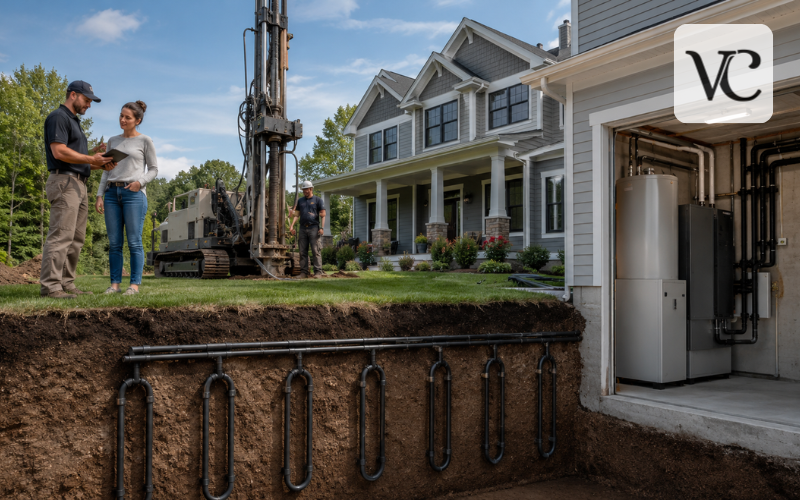
A residential geothermal heating and cooling system uses the stable temperature below the ground to help heat a home in winter and cool it in summer. Instead of burning fuel or exchanging heat with changing outdoor air, it moves heat between the house and a buried or submerged pipe network. This underground network is commonly called the ground loop.
The cost to install geothermal HVAC is usually much higher than the price of a standard furnace, central air conditioner, or air-source heat pump. In 2026, a realistic planning range for many complete residential projects is about $15,000 to $45,000, although straightforward installations may fall closer to $12,000 and difficult projects can exceed $50,000. Current pricing guides show wide ranges because the work includes much more than the indoor heat pump.
The final price depends on system capacity, soil and rock, available yard space, loop design, labor, and any ductwork or electrical upgrades. This guide explains each factor, along with Texas pricing, monthly expenses, replacement costs, and current incentives.
Average Cost to Install Geothermal HVAC
For most homeowners, $15,000 to $45,000 is the most useful national starting range for a complete system. A basic project may cost around $15,000 to $25,000 when the home is modest in size, the yard is easy to access, existing ducts can be reused, and a horizontal or suitable water-based loop is possible.
A mid-range installation often lands between $25,000 and $35,000. Complex vertical-loop projects, large homes, difficult rock drilling, extensive duct changes, or major site restoration can raise the total to $35,000 to $50,000 or more. Carrier lists an overall range of $12,000 to $45,000, while Bryant places many standard residential installations between $15,000 and $30,000.
A complete estimate should normally cover the heat pump, loop piping, circulation equipment, excavation or drilling, indoor connections, labor, startup, and testing. Permits, soil testing, landscaping, electrical work, old-equipment removal, and duct changes may appear separately. Online averages are therefore starting points, not fixed prices.
Cost to Install Geothermal HVAC per Square Foot
The cost to install geothermal HVAC per square foot often works out to roughly $8 to $20 per square foot for common residential projects. This is a derived planning range rather than a standard contractor pricing method.
For example, a $20,000 system in a 2,000-square-foot house equals $10 per square foot. A $40,000 installation in the same house equals $20 per square foot.
Smaller homes can have a higher rate because drilling-rig setup, permits, controls, testing, and crew costs do not shrink much with the building. Simple horizontal-loop projects may stay near the lower end, while vertical drilling or major duct upgrades may reach $20 per square foot or more. A professional load calculation is more reliable than floor area alone.
Geothermal HVAC Cost by Home Size
Larger houses usually need a higher-capacity heat pump and a longer or deeper ground loop. However, the required size is also affected by insulation, air leakage, ceiling height, window area, sun exposure, local weather, and the number of occupants.
A well-sealed 2,500-square-foot home may need less capacity than a poorly insulated 2,000-square-foot home.
The following figures are broad 2026 planning estimates for a complete installation:
| Home size | Likely planning range |
| 1,200–1,500 sq. ft. | $15,000–$23,000+ |
| 1,500–2,000 sq. ft. | $18,000–$28,000+ |
| 2,000–2,500 sq. ft. | $20,000–$36,000+ |
| 2,500–3,500 sq. ft. | $30,000–$50,000+ |
HomeAdvisor estimates that a 2,000-square-foot home commonly needs about three to four tons, but layout and insulation can change the result. An oversized system wastes money, while an undersized one may rely too heavily on backup heat.
Geothermal Heat Pump Cost by System Size
Geothermal heat pumps are commonly sized in tons. One ton equals 12,000 BTUs of heating or cooling capacity per hour. The word “ton” describes output, not the equipment’s physical weight.
Current consumer cost data places the heat-pump capacity portion at roughly $2,500 to $8,000 per ton, depending on efficiency, compressor type, brand, controls, and configuration. A complete installation costs more because it also includes the loop field, drilling or trenching, piping, labor, and indoor work.
| System capacity | Approximate equipment or capacity cost | Possible complete installed cost |
| 2 tons | $5,000–$16,000 | $15,000–$30,000 |
| 3 tons | $7,500–$24,000 | $18,000–$40,000 |
| 4 tons | $10,000–$32,000 | $22,000–$45,000+ |
| 5 tons | $12,500–$40,000 | $28,000–$50,000+ |
A 4 ton geothermal heat pump cost may be about $10,000 to $32,000 before all site work. A practical complete budget is often $22,000 to $45,000 or more, depending mainly on the loop and drilling requirements.
How Geothermal Heating and Cooling Works
In winter, fluid in the buried loop absorbs heat from the ground. The indoor heat pump raises that heat to a useful temperature and sends it through the home’s ducts or another distribution system.
In summer, the process reverses. Heat is removed from the house and released into the cooler ground. This allows one system to provide both heating and air conditioning.
The main parts are the indoor heat pump, ground loop, circulation pump, controls, and the home’s ducts or water-based distribution system. Some units can also assist with hot water.
The U.S. Department of Energy describes horizontal, vertical, pond or lake, and open-loop designs. The right choice depends on climate, soil, land, water, and local costs.
Complete Geothermal Installation Cost Breakdown
The indoor heat pump is only one part of the bill. Capacity, variable-speed operation, zoning, humidity controls, and hot-water assistance can raise its price.
Ground-loop work may cost about $8,000 to $35,000 or more, with horizontal trenches usually costing less than specialized vertical drilling.
HomeAdvisor estimates that specialized labor can represent 50% to 70% of the project. Soil testing, excavation, regrading, piping, permits, delivery, equipment removal, inspections, and startup may add to the total.
Before signing a contract, ask whether the quoted price includes the loop field, manifolds, circulation pumps, electrical connections, thermostat, duct transitions, permits, landscaping repair, warranties, and final system testing. A low estimate may leave out work that later appears as an additional charge.
Cost by Geothermal Ground Loop Type
The loop design often causes the largest difference between quotes. The figures below are broad totals associated with each system type, not the price of pipe alone.
| Loop type | Typical project range | Space requirement | Installation difficulty |
| Pond or lake loop | $10,000–$32,000 | Suitable nearby water body | Low to moderate when the site qualifies |
| Horizontal loop | $15,000–$34,000 | Large open yard | Moderate trenching |
| Vertical loop | $20,000–$45,000 | Small surface area | High due to deep drilling |
| Open loop | $10,000–$28,000 | Reliable clean water supply | Varies with permits and discharge rules |
Horizontal loops are often the best value for new construction or rural properties with enough land. Vertical loops fit urban and suburban lots because boreholes use less surface space, but drilling raises the cost.
Pond or lake loops can be economical when the water body has enough depth, volume, and quality. Open-loop systems use groundwater or surface water directly and are practical only where a dependable supply exists and local water rules allow discharge.
The lowest-cost loop is not always the best. Design must also account for heat transfer, water quality, ground conditions, and local rules.
Property Conditions That Affect the Final Price
Soil and geology affect both heat transfer and digging. Dry soil may require more loop length, while shallow bedrock, unstable ground, or a high water table can increase drilling time.
Access for heavy equipment also matters. Fences, trees, pools, septic systems, steep slopes, buried utilities, and narrow gates may complicate the work or require smaller and slower equipment.
Climate determines heating and cooling demand, while the distance between the loop field and the mechanical room affects piping. A very hot region may need a system designed around high cooling demand, while a colder climate may require more heating capacity or backup heat.
New construction is often cheaper because ducts, wiring, and loop placement can be planned before walls and landscaping are finished. Retrofitting may require more protection, demolition, and repair.
Ductwork, Electrical, and Additional Upgrade Costs
Existing ducts must be large enough and properly sealed to move the required airflow. Minor changes may cost around $1,000, while extensive duct modification or replacement can add $1,400 to $5,600 or more. Older homes with undersized returns, damaged ducts, or inaccessible runs may cost more.
Electrical work may include a new circuit, disconnect, wiring, or panel upgrade. Zoning, advanced thermostats, variable-speed equipment, and backup heat also add cost.
Trenching may disturb lawns, irrigation, walkways, and planting beds, while vertical drilling can create material that needs removal. HomeAdvisor places common geothermal permit costs around $100 to $650, with possible extra water permits for open-loop systems.
Homeowners should ask whether landscaping restoration is included. A quote that covers drilling but not soil removal, grading, grass replacement, or irrigation repairs may not reflect the true final expense.
Using a Geothermal Installation Cost Calculator
A geothermal installation cost calculator can help create an early budget, but its result is only as useful as the information entered.
At minimum, include the home’s square footage, ZIP code or region, estimated system tonnage, preferred loop type, available land, current heating fuel, insulation quality, and whether existing ducts can be reused.
To build a low-to-high range, add an equipment allowance based on tonnage, a loop estimate, and likely duct, electrical, permit, and landscaping costs. Include a contingency for unknown ground conditions.
A calculator cannot inspect rock depth, airflow, water quality, buried services, or the home’s true heating load, so an on-site assessment is still necessary.
When comparing estimates, make sure every contractor is pricing the same capacity, loop design, drilling depth, efficiency level, duct scope, backup heat, warranty, and restoration work. A lower total is not necessarily a better deal when the project details are different.
Cost to Install Geothermal HVAC in Texas
The cost to install geothermal HVAC in Texas commonly falls within the national range, but the state’s long cooling season can influence equipment capacity and loop design. A properly sized system must handle high summer temperatures and humidity without being selected only from square footage.
Texas soil, geology, and lot size vary greatly. Rural properties may offer enough land for horizontal trenches, although travel and rig mobilization can add cost. Urban projects may require expensive vertical bores because of tight access, while suburban properties often fall between these conditions.
Prices can therefore differ considerably between Dallas–Fort Worth, Houston, Austin, San Antonio, smaller cities, and rural communities. Contractor availability, permits, rock conditions, groundwater, and access for drilling equipment all influence the estimate.
Homeowners should check city programs, electric utilities, cooperatives, and municipal utilities before signing. Texas’s State Energy Conservation Office describes HOMES and HEAR rebate programs, but its current page uses future language about what the programs “will provide.” Availability and enrollment should therefore be confirmed rather than assumed. The page also advises checking local utilities and municipalities for additional incentives.
Monthly Costs, Savings, Lifespan, and Replacement Expenses
The residential geothermal heating cost per month is not one fixed number. A broad estimate for heating and cooling operation is around $100 to $200 per month, but efficient smaller homes may use less. Large homes, extreme weather, high thermostat settings, and expensive electricity can push costs higher. Angi gives the same general operating range.
Multiply expected HVAC electricity use by the local rate for a better estimate. In April 2026, the U.S. Energy Information Administration reported 18.83 cents per kWh nationally and 16.99 cents in Texas. At the Texas rate, 600 kWh costs about $102 and 1,200 kWh about $204. Actual use requires an energy model, not square footage alone.
The Department of Energy says geothermal heat pumps can reduce energy use by roughly 30% to 60% compared with conventional options. However, bill savings depend on the system being replaced, fuel prices, climate, insulation, and household habits.
A homeowner replacing electric resistance heat or fuel oil may see a stronger payback than someone replacing an efficient natural-gas system. Payback can range from several years to well over a decade, so guaranteed savings claims should be avoided.
The indoor heat pump often lasts 20 years or more, while a properly installed ground loop may last 25 to 50 years or longer. When the indoor equipment eventually fails, reusing a compatible loop can make replacement much cheaper than a first installation.
A three-ton geothermal heat pump replacement cost is currently estimated at around $7,000 to $15,000 when the existing loop remains usable. Larger, variable-speed, or premium units may cost more.
Routine costs include filters and periodic inspection. Compare warranty coverage separately for the compressor, parts, labor, and loop workmanship.
One major 2026 update concerns the federal tax credit. Older articles may still state that geothermal installations receive a 30% Residential Clean Energy Credit. The current IRS page says the 30% credit applies to qualified property installed from 2022 through December 31, 2025, and is not available for property placed in service after that date.
Therefore, a new system first placed in service in 2026 should not be budgeted with that federal 30% credit unless the law changes again. Local, state, utility, builder, and income-based programs may still apply, so eligibility should be checked before work begins.
Conclusion
The cost to install geothermal HVAC in 2026 is commonly around $15,000 to $45,000, with large or difficult projects reaching $50,000 or more. Home size matters, but loop type, drilling conditions, yard access, ductwork, electrical service, local labor, and system design can have an equal or greater effect.
Geothermal can be worthwhile for homeowners who plan to stay long enough to benefit from lower energy use, want steady year-round comfort, and have a property that supports an affordable loop design.
It is especially attractive in new construction, major renovations, homes replacing costly heating fuels, and properties where the durable ground loop can serve more than one generation of indoor equipment.
The safest next step is a site evaluation and proper load calculation. Compare two or three itemized quotes covering the same capacity, loop design, drilling scope, efficiency, warranties, incentives, and restoration work.
Frequently Asked Questions
How much does it cost to install geothermal HVAC?
A complete residential geothermal HVAC installation generally costs $15,000 to $45,000. Large homes, vertical drilling, difficult soil, duct replacement, and limited equipment access can increase the final price.
How much does geothermal HVAC cost per square foot?
The cost commonly works out to around $8 to $20 per square foot. However, contractors usually price geothermal systems according to capacity, loop design, drilling conditions, and required property upgrades.
How much does a 4-ton geothermal heat pump cost?
A 4-ton geothermal heat pump may cost approximately $10,000 to $32,000 for equipment, while a complete installation can range from about $22,000 to $45,000 or more.
Is a vertical geothermal loop more expensive?
Yes. Vertical loops normally cost more because contractors must drill deep boreholes using specialized equipment. They are commonly chosen for smaller properties without enough open land for horizontal trenches.
Can an existing geothermal ground loop be reused?
A properly installed loop may be reused when replacing the indoor heat pump, provided it remains in good condition and is compatible with the new equipment. This can reduce replacement expenses considerably.
Disclaimer: The prices in this guide are general estimates for educational and budgeting purposes. Actual geothermal HVAC installation costs vary according to location, home design, system capacity, soil conditions, loop type, permits, equipment availability, and contractor rates. Tax credits, rebates, and utility programs may change, so homeowners should confirm current eligibility with relevant government agencies, tax professionals, utility providers, and qualified local geothermal contractors before making financial or installation decisions.
Enjoyed this article? Discover more helpful ideas and fresh inspiration on Vogue Cultures.