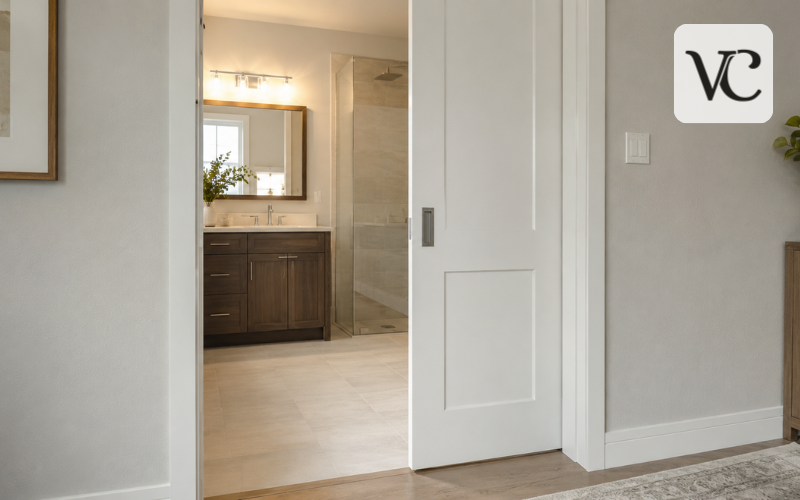
A bathroom pocket door is a sliding interior door that moves sideways and disappears into a hollow space inside the wall. Unlike a hinged door, it does not swing into the bathroom, hallway, or bedroom. This makes it especially useful where every inch of floor space matters.
Pocket doors for bathroom entrances can make a compact room feel less crowded, improve movement around sinks and toilets, and create a clean, uncluttered look. They are commonly used in powder rooms, en-suites, toilet compartments, and bathrooms connected to dressing areas. However, a good bathroom pocket door must do more than save space. It also needs suitable privacy hardware, dependable rollers, a moisture-tolerant finish, and a door panel that provides enough visual and sound separation.
The best choice depends on the wall structure, available opening, door material, desired style, and budget. Before buying, it is important to consider what is hidden inside the wall and whether the existing framing can hold the required track system.
Quick Guide to Bathroom Pocket Doors
| Feature | Best Choice | Why It Matters |
| Door material | Solid-core MDF, sealed wood, composite, or privacy glass | Improves durability, privacy, and moisture resistance |
| Privacy | Solid-core or opaque glass door | Reduces visibility and improves sound control |
| Lock | Privacy lock with emergency release | Allows secure use and emergency access |
| Track | Heavy-duty soft-close system | Provides quieter and smoother movement |
| Glass type | Frosted, satin, or opaque safety glass | Shares light while limiting visibility |
| Best location | Small bathroom, en-suite, powder room, or toilet area | Saves the space needed for a swinging door |
| Installation | New construction or open-wall renovation | Makes framing and utility checks easier |
| Maintenance | Clean tracks and inspect rollers regularly | Prevents sticking, rattling, and uneven movement |
How to Choose Pocket Doors for a Bathroom
- Measure the doorway, wall thickness, and available pocket space.
- Check the wall for plumbing, wiring, vents, and structural supports.
- Choose a solid-core, sealed wood, composite, or privacy-glass door.
- Confirm that the track can support the full weight of the door.
- Select a bathroom privacy lock with an outside emergency release.
- Add soft-close hardware for quieter and safer operation.
- Use suitable seals to reduce light gaps and improve sound privacy.
- Hire a professional when structural or utility changes are required.
Why Pocket Doors Work Well in Bathrooms
A traditional door needs an open arc to swing. In a small bathroom, that arc can compete with the vanity, toilet, storage, or walking area. A pocket door removes this problem because the panel slides into the wall instead of moving across the room. It can make the layout easier to use without increasing the room’s actual size.
This design works particularly well in a narrow powder room, a bedroom en-suite, a separate toilet area, or a bathroom where a hinged door would block a cabinet or fixture. It can also improve movement for someone using a walker or wheelchair because there is no door leaf swinging through the approach area.
Where formal accessibility rules apply, doorways on accessible routes generally need at least 32 inches of clear opening, measured to the leading edge of a sliding door. Residential requirements can vary, so local rules should still be checked.
A pocket door is less practical when the wall contains important plumbing, heating ducts, large electrical runs, or structural parts that cannot be moved. It may also be a poor fit when maximum sound isolation is essential, because sliding doors usually leave small gaps around their edges.
Pocket Door Bathroom Ideas for Different Layouts
For a small bathroom, a simple single-panel pocket door can open up the area beside the vanity or toilet. A flush painted panel blends into the wall and suits minimalist interiors, while a paneled door adds a more traditional look without taking up extra floor space.
Between a bedroom and an en-suite, wood pocket doors for bathroom entrances can match the bedroom trim or built-in furniture. In a Jack-and-Jill bathroom, two separate sliding pocket doors can give each bedroom its own entrance. Each opening should have a proper privacy lock so one user can secure both sides when needed.
Pocket doors also work well between a bathroom and dressing room, beside a laundry-bathroom combination, or at the entrance to a private toilet compartment. Farmhouse designs may use shaker-style wood panels, while modern rooms often use flat doors, dark hardware, or frosted glass. Traditional spaces can use raised panels and painted trim.
The style can change, but the door thickness, weight, and hardware compatibility must remain suitable for the pocket frame.
Best Materials for Bathroom Pocket Doors
Solid-core MDF is a popular choice because it feels substantial and usually provides better sound control than a lightweight hollow-core door. Engineered wood can offer a stable surface for paint or veneer, while natural solid wood provides warmth and visible grain. Composite doors may be useful where humidity is a concern, although their quality and appearance vary by product.
Hollow-core doors are lighter and often less expensive, but they normally block less sound and may feel less private. A solid-core door generally offers a stronger sound barrier and a more solid feel, although wood-based materials can still expand or contract as heat and moisture levels change.
Glass is another option, especially where natural light is valuable. It does not swell like wood, but privacy depends on the glass pattern and lighting conditions.
Whatever material is chosen, the finish should be suitable for an interior exposed to regular bathroom humidity. The top, bottom, faces, and edges of wood-based doors should be properly finished according to the manufacturer’s instructions, particularly after trimming.
Wood Pocket Doors for Bathroom Interiors
Wooden pocket doors for bathroom spaces can look warm, elegant, and timeless. Shaker panels suit farmhouse and transitional bathrooms, flat slabs work well in modern rooms, and raised-panel doors complement traditional interiors. A clear or stained finish highlights the grain, while paint makes it easier to match walls, cabinets, and trim.
Solid wood is attractive but can respond to changes in moisture. Engineered wood and solid-core alternatives may be more predictable, depending on their construction and finish. The bathroom should also have effective ventilation so moisture does not remain trapped around the doorway.
To reduce swelling, peeling, or warping, avoid leaving raw edges exposed. Any cut made for sizing or hardware should be sealed again. The bottom of the door deserves special attention because moisture from cleaning, wet flooring, or nearby showers can reach it. A well-finished door should move freely without rubbing the guides or jambs.
When matching the door to the room, exact duplication is not always necessary. A wood tone that relates to the vanity, flooring, or mirror frame can create a coordinated look without making every surface identical.
Sliding Pocket Doors with Glass
Sliding pocket doors with glass are useful when a bathroom lacks natural light or connects to a darker hallway. Frosted, satin, textured, fluted, or opaque glass can brighten the surrounding area while reducing direct visibility. However, no decorative glass should be assumed to provide complete privacy without checking it in real lighting.
Lightly frosted and fluted glass may reveal shadows, movement, or outlines, especially when the bathroom is brighter than the room outside. A denser etched finish, laminated privacy layer, or fully opaque panel is a safer choice where privacy is the main concern.
Glass used in doors should meet the applicable safety-glazing requirements. Tempered glass is designed to break into smaller pieces, while laminated glass holds broken fragments within an internal layer. The correct option depends on the door system, local code, and manufacturer. Federal safety rules cover architectural glazing used in doors and other hazardous locations.
A framed glass door usually offers more edge protection and may coordinate easily with the track hardware. Frameless designs look lighter but require a system specifically designed for the glass thickness and weight.
Double Pocket Doors for Bathroom Entrances
Double pocket doors for bathroom entrances use two panels that slide into opposite wall cavities. They can create a wide, balanced opening for a large primary bathroom, dressing suite, or accessible layout. When open, they create an impressive connection between rooms without leaving door panels in the way.
This design requires enough clear wall length on both sides of the opening. Both pockets must be straight, level, and free from plumbing or structural conflicts. The tracks also need to be aligned so the two panels meet evenly in the middle.
Privacy hardware is more complicated than it is on a single door. The meeting edges need a lock or latch designed for paired pocket doors, and the gap between panels must be controlled as closely as the system allows. For accessible double-leaf doorways, at least one active leaf generally needs to provide the required clear width and maneuvering space.
Double doors are not automatically better. In a small bathroom, one wider pocket door is often simpler, quieter, and easier to lock.
Bathroom Privacy, Locks, and Sound Control
A bathroom pocket door should have a genuine privacy lock rather than a simple finger pull. A suitable lock normally includes an interior thumb turn or similar control, an outside emergency release, and an edge pull that lets the user retrieve the door after it has moved fully into the pocket.
Pocket-door hardware is available with dedicated privacy functions, including self-latching designs with an emergency release on the outside.
For better sound control, choose a solid-core door and keep the clearances around it as small as the hardware allows. Soft seals or carefully selected weatherstripping can reduce light leaks and some sound transmission at the jambs. The seals must not create so much friction that the door becomes difficult to operate.
Even a well-built pocket door will rarely soundproof a bathroom as completely as a heavy hinged door with full perimeter seals. The top track area, bottom guide, and pocket opening create natural paths for sound. Homeowners should aim for improved privacy rather than perfect acoustic isolation.
Tracks, Rollers, and Soft-Close Hardware
The track and rollers determine how smoothly a pocket door operates. Heavy solid-core, wood, and glass doors need hardware rated for their actual weight. A weak or poorly installed track can lead to dragging, rattling, uneven gaps, and early wear.
Soft-close hardware catches the moving door near the end of its travel and brings it to a controlled stop. Some systems also provide soft-open action. This reduces slamming and can protect fingers, locks, trim, and rollers.
Current heavy-duty pocket-door kits are available for solid-core doors weighing well over 100 pounds, but capacity and minimum door width vary by system. Some soft-open and soft-close mechanisms also require wider door panels than single-direction soft-close systems.
Whenever possible, choose a track that can be serviced without destroying the finished wall. Removable head trim or an accessible track section makes later adjustment easier.
Routine care usually involves keeping the track clean, checking guides and fasteners, and following the manufacturer’s advice on lubrication. Applying the wrong lubricant can attract dust or damage plastic components.
Measurements and Wall-Cavity Requirements
Correct measurement begins with the desired clear opening, not only the size printed on the door slab. The installer must account for the jambs, stops, guides, overlap, and the small part of the panel that may remain inside the pocket when the door is open.
The wall must provide enough length and thickness for the panel and pocket frame. A single pocket often needs roughly the width of the door beside the opening, plus framing allowances. Exact requirements depend on the selected kit.
Before work begins, the wall should be checked for plumbing pipes, electrical cables, vents, blocking, and structural framing. Bathrooms often place water and drain lines inside the same walls where a pocket might otherwise go. A load-bearing wall may require engineered changes rather than ordinary reframing.
The chosen slab must also match the frame’s permitted thickness, height, width, and weight. Locks and pulls require enough material for secure installation, while glass doors need hardware made specifically for their construction.
Do not order the door based only on the existing rough opening. Confirm the manufacturer’s frame dimensions and calculate the finished clear opening after the door, stops, jambs, and hardware are in place.
Installing a Pocket Door in a Bathroom
Installing a pocket door during new construction is usually simpler because the wall is already open. The frame can be positioned before drywall, plumbing fixtures, and finished trim are installed. Retrofitting an existing bathroom normally requires removal of drywall and framing on at least one side of the wall.
The general process includes creating the correct rough opening, fitting the pocket frame and overhead track, hanging the panel, adjusting the rollers, installing the guides, and adding the jambs and trim. The frame must remain square and straight. Even a small bow can cause the door to scrape inside the pocket.
Bathroom installation also requires moisture-aware finishing. Cut edges should be sealed, damp trim should be avoided, and the doorway should not receive direct spray from a shower.
Plumbing and electrical changes should be completed by qualified trades where required. Screws, hooks, towel bars, cabinets, and other fixtures should not be attached to a pocket wall unless suitable fixing points have been planned. A screw that enters too deeply can scratch or block the hidden door panel.
Professional installation is often the safer choice when the wall may be load-bearing, pipes or wires need moving, the opening is being widened, or a heavy glass or solid-wood panel is used.
Replacement Pocket Doors for Bathroom Use
A pocket door may need attention if it becomes difficult to slide, no longer closes evenly, rubs inside the wall, rattles on the track, or fails to lock. The problem may be the door slab, rollers, guides, lock, track, or frame rather than the entire system.
If the frame remains straight and the hardware is serviceable, replacing only the slab can be the simplest option. The new door must match the existing thickness, height, weight limit, hanger positions, and lock location. Measurements should be taken from the actual opening and old panel, not from assumptions about standard sizes.
A full replacement may be necessary when the track is bent, the frame has shifted, the pocket is too narrow, or the original system cannot support a heavier door.
Some existing pocket frames can accept retrofit soft-close kits, but compatibility must be confirmed before purchase. For example, retrofit products may be designed only for particular frame series rather than every pocket-door system.
Replacement is also a useful time to add a better privacy lock, improve edge sealing, and choose a moisture-resistant finish. If the old door was hollow-core, changing to a solid-core panel may improve the feel and sound control, but only when the existing track can support the extra weight.
Costs, Pros, Cons, and Mistakes to Avoid
The total cost depends on the door material, hardware quality, opening size, wall construction, finish work, and local labour rates. A basic hollow-core replacement can be relatively simple, while a solid-wood or glass door in a modified wall can require framing, electrical work, plumbing changes, drywall repair, painting, and custom hardware.
The main benefit is efficient use of space. A pocket door can free the area beside a vanity, improve the path through a compact bathroom, and give the room a cleaner appearance. It can also be easier to approach than a swinging door when the opening is sized and planned for accessibility.
The disadvantages are equally important. Retrofitting can be disruptive, sound control is usually weaker than with a sealed hinged door, and the pocket wall cannot freely hold pipes, wiring, anchors, or heavy fixtures. Repairs may also be difficult if the track is hidden behind permanent trim.
Common mistakes include buying a door before inspecting the wall, choosing hardware with too little weight capacity, leaving wood edges unfinished, using glass that is not private enough, and failing to plan an emergency-release lock.
Another mistake is focusing only on the visible door panel. The track, rollers, guides, frame, lock, seals, and installation quality have a major effect on how the door performs over time.
The best result comes from balancing appearance with privacy, reliable movement, moisture resistance, and future service access.
Conclusion
Pocket doors for bathroom entrances can be an excellent upgrade when space is limited and the wall can safely hold the system. The best results come from choosing a stable, properly finished door, matching its weight to quality rollers and track hardware, and using a dependable privacy lock with an outside emergency release.
Before purchasing, inspect the wall cavity carefully. Confirm the opening size, check for plumbing and wiring, identify any structural concerns, and make sure the door and frame are compatible. For glass designs, select proper safety glazing and test the privacy level under real lighting.
A pocket door should not be chosen for appearance alone. When privacy, moisture resistance, sound control, accessibility, and maintenance are considered together, it can save valuable space while still making the bathroom feel comfortable and private.
Frequently Asked Questions
Are pocket doors suitable for bathrooms?
Yes, pocket doors are suitable for bathrooms when they have a privacy lock, moisture-resistant finish, and dependable track system. They are especially useful in small bathrooms where a swinging door takes up valuable space.
Do bathroom pocket doors provide enough privacy?
A solid-core pocket door with a quality privacy lock and small perimeter gaps can provide good everyday privacy. However, it may not block sound as effectively as a properly sealed hinged door.
What is the best material for a bathroom pocket door?
Solid-core MDF, properly sealed wood, composite materials, and opaque safety glass are good options. The best material depends on the required privacy, bathroom humidity, door weight, maintenance needs, and interior style.
Can plumbing be installed inside a pocket-door wall?
Plumbing should generally not pass through the space used by the sliding door. Pipes, wiring, vents, and wall supports must be checked before installation because they can block or damage the pocket system.
Can an existing bathroom door be replaced with a pocket door?
Yes, but the wall usually needs to be opened and reframed. The project may become more difficult if the wall contains plumbing, electrical wiring, ductwork, or important structural supports.
Disclaimer: This article provides general information about pocket doors for bathroom use. Installation requirements, safety-glazing rules, accessibility standards, and building codes can vary by location and door system. Consult the product manufacturer and a qualified contractor before modifying walls, plumbing, electrical wiring, or structural framing.
Enjoyed this article? Discover more helpful ideas and fresh inspiration on Vogue Cultures.