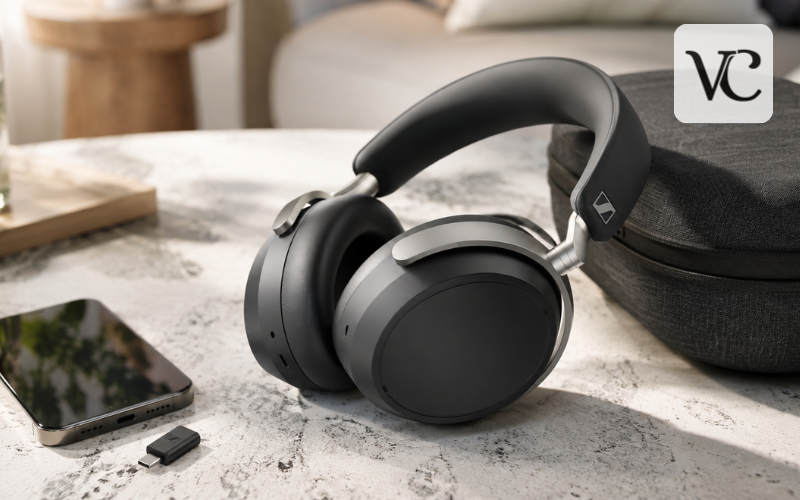
The Sennheiser HDB 630 is a premium closed-back wireless headphone made for listeners who want a more balanced, detailed sound without giving up everyday features such as Bluetooth and active noise cancellation. Rather than pushing heavy bass or using an obviously colored sound profile, Sennheiser positions the HDB 630 around a neutral, reference-style presentation. It uses a 42 mm dynamic driver, supports wireless and wired listening, and includes advanced sound-adjustment tools.
This makes the HDB 630 somewhat different from a typical lifestyle noise-cancelling headphone. It is still designed for travel, work, and everyday listening, but sound accuracy receives more attention. Important features include adaptive ANC, Bluetooth 5.2, the included BTD 700 dongle, USB-C audio, parametric EQ, Crossfeed, and battery life rated at up to 60 hours.
Those features make an impressive package on paper, but the Sennheiser HDB 630 review story is not simply about specifications. Comfort, fit, noise cancellation, price, and personal sound preference can all determine whether it is the right headphone for you.
Snippet-Ready Definition:
The Sennheiser HDB 630 is a premium wireless closed-back headphone designed for balanced, reference-style sound, adaptive noise cancellation, long battery life, high-resolution connectivity, and advanced sound customization.
Sennheiser HDB 630 Quick Guide
| Feature | Quick Details |
| Headphone Type | Wireless, closed-back, over-ear |
| Driver | 42 mm dynamic transducer |
| Sound Style | Neutral, balanced, reference-focused |
| Noise Control | Adaptive ANC and Transparency Mode |
| Battery Life | Up to 60 hours |
| Connectivity | Bluetooth 5.2, USB-C, 3.5 mm |
| Wireless Codecs | aptX Adaptive, aptX HD, aptX, AAC, SBC |
| Included Dongle | BTD 700 USB-C adapter |
| Sound Controls | 5-band parametric EQ and Crossfeed |
| Weight | About 311 g |
| Launch Price | $499.95 in the US |
Key Things to Check Before Buying
- Decide whether you prefer neutral sound or stronger, boosted bass.
- Check whether the 311 g design feels comfortable for long listening sessions.
- Consider whether advanced EQ and the BTD 700 dongle are useful for your devices.
- Compare the HDB 630 with the Momentum 4 if price and everyday value matter.
- Look at current authorized-retailer and refurbished prices before buying.
Sennheiser HDB 630 Release Date and Market Position
The official Sennheiser HDB 630 release date timeline began on October 8, 2025, when Sennheiser announced the model and opened pre-orders. The company said shipments would begin on October 21, 2025 through authorized dealers and its own online store. Its launch price was $499.95 in the United States and €499.90 in Europe.
That price clearly placed the HDB 630 above mainstream wireless headphones and above Sennheiser’s Momentum 4. Sennheiser designed it primarily for listeners who care strongly about sound quality but still want portability, wireless convenience, and noise cancellation.
The physical platform has a connection to the Momentum 4. Sennheiser states that the HDB 630 inherited its chassis from the Momentum 4, but received a customized acoustic system intended for more focused listening. In other words, the familiar exterior does not mean the two headphones have identical tuning or performance.
Sennheiser HDB 630 Specifications and Design
At the center of the HDB 630 is a 42 mm dynamic transducer manufactured at Sennheiser’s Tullamore production facility in Ireland. The headphones use an over-ear, closed-back design and weigh 311 grams without the cable. Synthetic leatherette is used for the ear pads.
The headphones support touch-based controls for everyday functions, along with microphones used for calls, ANC, and Transparency Mode. On-head detection and other intelligent settings can be managed through the Smart Control Plus app.
Sennheiser also provides a fairly complete accessory package. The box includes the HDB 630, BTD 700 USB-C Bluetooth dongle, 1.2-meter USB-C cable, 1.2-meter 3.5 mm audio cable, airline adapter, and protective carrying case.
The design is therefore less about being extremely small or light and more about providing several listening options in one portable headphone.
Sound Quality and Neutral Reference Tuning
Sound is the main reason to consider the Sennheiser HDB 630. Sennheiser describes its tuning as neutral and reference-oriented, with controlled bass, natural mids, and carefully managed treble. Independent testing from RTINGS also characterizes its overall sound as highly balanced.
The bass is designed to extend low without dominating the rest of the music. Listeners who are used to strongly boosted wireless-headphone bass may therefore find the HDB 630 more restrained. That can be useful for acoustic recordings, vocals, classical music, jazz, and detailed modern productions where separation matters.
The midrange is another important part of the tuning. Voices and lead instruments are presented clearly rather than being pushed behind the bass. Sennheiser also designed the acoustic system to produce a relatively spacious presentation for a closed-back headphone.
Fit still matters. RTINGS reports relatively poor frequency-response consistency, meaning the exact sound can change when the cups are positioned differently or when the seal is affected. Glasses, hair, head shape, and repeated repositioning can therefore influence bass and overall tonal balance.
BTD 700 Dongle, Bluetooth and High-Resolution Listening
One of the HDB 630’s most useful additions is the included BTD 700 USB-C dongle. It lets compatible phones, tablets, and computers use aptX Adaptive even when that capability is not built directly into the device. This is particularly useful for devices where normal Bluetooth codec options are limited.
The HDB 630 uses Bluetooth 5.2 and supports aptX Adaptive, aptX HD, aptX, AAC, and SBC. Sennheiser lists support for resolution up to 24-bit/96 kHz when using compatible USB-C, analog, or BTD 700 configurations.
There are four practical ways to listen. Standard Bluetooth provides maximum convenience. The BTD 700 gives compatible devices access to the higher-quality aptX Adaptive path. USB-C offers direct digital audio, while the included 3.5 mm cable provides compatibility with traditional headphone outputs.
Higher bit-depth and sample-rate numbers should not automatically be treated as proof of better audible sound. Recording quality, mastering, fit, volume, and personal hearing can be just as important.
Active Noise Cancellation, Transparency and Call Quality
The HDB 630 combines its sealed earcups with adaptive active noise cancellation. In normal use, that makes it suitable for offices, public transport, flights, and other places where outside sound could interfere with music.
Independent RTINGS testing found its overall noise isolation to be strong, particularly against office chatter, fan noise, and many mid- and higher-frequency sounds. Its weaker area was very low-frequency rumble, such as some engine noise.
Transparency Mode provides the opposite function. Instead of reducing outside sound, it lets more environmental audio through when you need to hear announcements, talk briefly with someone, or stay aware of your surroundings.
Call performance is respectable rather than exceptional. RTINGS found that the microphone separated speech from surrounding noise effectively, but voices could sound somewhat thin because the microphone does not capture as much low-frequency body.
Battery Life and Charging Performance
Sennheiser rates the HDB 630 for up to 60 hours of battery life with ANC active, which is strong endurance for a premium noise-cancelling model. Sennheiser’s support documentation also notes that runtime can fall to around 45 hours when using aptX Adaptive at 24-bit/96 kHz through the BTD 700.
Independent testing naturally produces different figures. RTINGS measured roughly 54 hours, illustrating why manufacturer ratings should be treated as best-case guidance rather than a guarantee. Volume, codec, wireless connection, processing features, temperature, and battery age can all change real-world results.
There is also a small difference in Sennheiser’s own published fast-charge information. The original launch announcement states that 10 minutes of charging can provide up to seven hours of listening, while the current US comparison chart lists up to six hours for the HDB 630.
Another point worth knowing is that the headphones must remain powered even when using their analog connection.
Smart Control Plus, Parametric EQ and Crossfeed
The Smart Control Plus app is especially important for owners who want to adjust the HDB 630 rather than simply accept its factory tuning.
Its standout feature is a parametric equalizer. A normal graphic EQ gives you fixed frequency bands that can be raised or lowered. The HDB 630 goes further by allowing the listener to select the frequency being changed, choose how wide or narrow that adjustment should be, and select different filter types. Sennheiser also provides A/B comparison tools.
That makes it possible to adjust a narrow area of brightness, change the amount of bass, or modify vocal presence without making broad changes across the entire sound.
Crossfeed takes a different approach. It gently blends some information between the left and right channels. This can make older recordings with instruments placed strongly on only one side feel closer to listening through stereo speakers rather than headphones.
None of these adjustments are required. Listeners who already enjoy the neutral stock tuning can simply leave it unchanged.
Comfort, Fit, Build and Portability
Comfort is more personal than sound specifications suggest. At 311 grams, the HDB 630 is not unusually heavy for a premium over-ear headphone, but the shape of the headband and earcups can affect how comfortable that weight feels. The ear pads use synthetic leatherette, which helps create a strong seal but can also hold more heat than highly breathable materials.
RTINGS found the headphones comfortable enough for long travel, although it noted that the center of the headband may create pressure for people with larger heads. The same testing also found that correct positioning matters for consistent sound.
Owner impressions are mixed. Some Reddit users report good comfort, while others mention shallow-feeling pads, heat, ear pressure, or difficulty finding an ideal fit. These comments are useful as personal experiences, but they should not be treated as universal results.
For travel, the earcups swivel and a protective case is included. However, the headphones do not fold down into a particularly compact package.
Sennheiser HDB 630 Review: Main Strengths and Trade-Offs
The main strength of the HDB 630 is the combination of balanced sound and unusually deep customization for a wireless headphone. The parametric EQ, Crossfeed, BTD 700 dongle, wired USB-C audio, long battery life, and adaptive ANC give listeners considerable flexibility. Independent testing also supports the view that its overall tonal balance is one of its strongest qualities.
It works particularly well for music and office listening, while its battery makes it practical for long journeys. Movies also benefit from clear dialogue and stereo detail.
Gaming is more complicated. RTINGS found the wireless Bluetooth latency higher than ideal for timing-sensitive competitive games, even though casual games are less demanding. The headphone also needs power in analog wired use.
The other trade-offs are price, fit sensitivity, a relatively large travel case, and ANC that is strong overall but less effective against some deep low-frequency rumble. These drawbacks do not make the HDB 630 poor; they simply matter differently depending on how you plan to use it.
Sennheiser HDB 630 vs Momentum 4
The Sennheiser HDB 630 vs Momentum 4 comparison is especially relevant because the two models share clear design DNA. However, the HDB 630 is not a Momentum 4 replacement or simple successor.
The Momentum 4 is the less expensive model and offers a more consumer-oriented sound, while the HDB 630 moves toward a more neutral and reference-focused presentation. RTINGS found the HDB 630 more balanced overall, with stronger noise isolation and better microphone performance, while noting that the Momentum 4 remains much cheaper and still provides strong sound quality.
The HDB 630 also includes the BTD 700 dongle and adds the more advanced parametric EQ and Crossfeed system. These advantages matter most to listeners who actively care about fine sound adjustment and connection quality.
For someone primarily seeking good wireless sound, ANC, and long battery life at a lower price, the Momentum 4 may provide better value. For a listener willing to spend more for neutral tuning and deeper sound control, the HDB 630 makes a stronger case.
Sennheiser HDB 630 Price, Sale, Refurbished Options and Price History
The original Sennheiser HDB 630 price was $499.95 in the United States and €499.90 in Europe. As of August 13, 2026, Sennheiser’s official US store still lists the new HDB 630 at $499.95, so its direct US price has not dropped below launch MSRP on the page checked for this article. Retailer prices can still differ.
Anyone looking for a Sennheiser HDB 630 sale should therefore compare the offer with both the current manufacturer price and recent retailer prices. A percentage discount can look attractive even when another authorized seller has already been charging less.
Official Sennheiser HDB 630 refurbished units also exist in some markets. Sennheiser currently maintains refurbished HDB 630 listings, although price, stock, warranty terms, and availability vary by country. For example, its Netherlands refurbished listing showed a discounted price when checked.
For Sennheiser HDB 630 price history, look at actual historical selling prices rather than MSRP alone. This helps distinguish a meaningful discount from normal price movement.
Sennheiser HDB 630 Reddit Feedback and Who It Suits Best
Discussions about the Sennheiser HDB 630 on Reddit show why personal experience matters with premium headphones. Positive owner comments often focus on balanced sound, detailed reproduction, the parametric EQ, and the flexibility provided by the included dongle. Some users consider the sound particularly impressive for a closed-back ANC headphone.
Negative experiences are more varied. Some owners report heat or pressure from the pads, pairing or touch-control frustrations, concerns about value, or simply a preference for a different tonal balance.
Reddit can therefore be useful for discovering issues to investigate, but individual posts should not replace controlled testing or personal listening.
The HDB 630 makes the most sense for someone who prioritizes balanced sound, detailed customization, long battery life, and flexible high-quality connectivity. A buyer whose priorities are stronger bass, the lightest possible construction, the lowest price, or absolute class-leading noise reduction may find another model more suitable.
Conclusion
The Sennheiser HDB 630 takes a different path from many premium wireless headphones. Instead of making maximum bass impact or ANC performance its only selling points, it combines a more neutral sound with advanced EQ controls, Crossfeed, the BTD 700 dongle, USB-C audio, adaptive ANC, and battery life rated at up to 60 hours.
Its strongest argument is sound-focused versatility. You can use it as a normal Bluetooth headphone, connect through the supplied dongle, listen through USB-C, or use a traditional 3.5 mm connection. The parametric EQ also gives experienced listeners much more control than the basic bass-and-treble adjustments found on many wireless models.
There are still compromises. The $499.95 US price remains high as of August 2026, comfort and sound consistency depend partly on fit, the headphones are not especially compact, and independent testing shows that ANC performance drops somewhat against very deep low-frequency noise.
For listeners who value accurate, customizable wireless sound above everything else, the HDB 630 is a serious option. For someone focused mainly on maximum ANC, stronger bass, lighter construction, or lower cost, paying the premium may be harder to justify. The right choice ultimately depends on which of those priorities matters most in everyday listening.
Frequently Asked Questions
Is the Sennheiser HDB 630 good for audiophile listening?
Yes. It is designed around a more neutral and detailed sound profile than many mainstream wireless headphones, while still offering ANC, Bluetooth, USB-C listening, and advanced EQ controls.
How long does the Sennheiser HDB 630 battery last?
Sennheiser rates the HDB 630 for up to 60 hours of playback with ANC enabled. Actual battery life can vary with volume, codec, connection method, and other settings.
What is the difference between the HDB 630 and Momentum 4?
The HDB 630 focuses more heavily on neutral tuning and advanced sound customization. The Momentum 4 is generally less expensive and may better suit buyers seeking strong everyday wireless performance and value.
Does the Sennheiser HDB 630 support wired listening?
Yes. It supports both USB-C digital audio and 3.5 mm analog connections, giving users alternatives to Bluetooth when connecting to phones, computers, audio players, or other compatible equipment.
Is the Sennheiser HDB 630 worth the price?
It may be worthwhile for listeners who value balanced sound, parametric EQ, flexible connectivity, and long battery life. Buyers mainly seeking maximum ANC or lower cost may prefer alternatives.
Disclaimer: This article is for general informational purposes only. Specifications, prices, availability, firmware features, refurbished stock, and retailer offers for the Sennheiser HDB 630 may change over time. Always confirm current details with Sennheiser or an authorized retailer before purchasing.
Enjoyed this article? Discover more helpful ideas and fresh inspiration on Vogue Cultures.