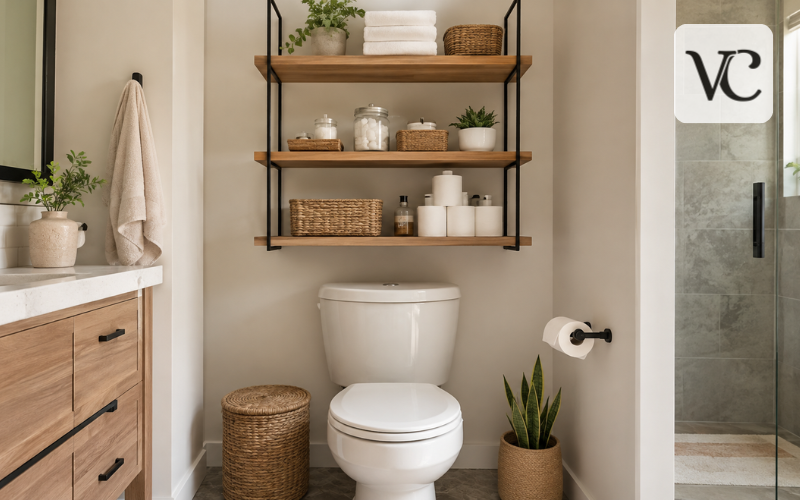
Bathroom shelves over toilet are storage shelves, racks, or cabinets placed on the wall above the toilet or built as a freestanding unit that fits around it. Their main purpose is simple: they use vertical space that often stays empty. This can be especially useful in a small bathroom, powder room, apartment, or shared family bathroom where floor space and cabinet space are limited.
Unlike a standard wall cabinet, over-the-toilet storage is designed around the toilet area. Some options are light and open, such as floating shelves, while others include doors, baskets, hooks, or multiple shelves. Freestanding designs can add storage without permanently changing the wall, while wall-mounted shelves keep the floor clear. Current bathroom-storage ranges also show a mix of open shelves, wall cabinets, narrow units, and over-the-toilet organizers for this purpose.
The right choice depends on the size of the bathroom, the width and height of the toilet, what you need to store, and how much visual space you want to keep open.
Snippet-Ready Definition:
Bathroom shelves over toilet are storage shelves, cabinets, or racks placed above or around a toilet to use vertical wall space for towels, toiletries, toilet paper, and bathroom essentials.
Quick Guide Table
| Type | Best For | Main Benefit | Keep in Mind |
| Floating shelves | Small bathrooms | Saves floor space | Needs secure wall mounting |
| Freestanding rack | Renters | Easy to place and move | Check stability and toilet clearance |
| Storage cabinet | Hidden storage | Keeps clutter out of sight | Can feel bulky in tight rooms |
| Short storage unit | Low ceilings or windows | Fits limited vertical space | Offers less storage |
| Adhesive shelves | Lightweight essentials | No drilling required | Not suitable for heavy items |
Simple Steps for Choosing Bathroom Shelves Over Toilet
- Measure the toilet width, tank height, and available wall space.
- Decide whether you prefer open shelves or closed storage.
- Choose floating shelves for a lighter look or a freestanding unit for easier setup.
- Check shelf depth so it does not project too far over the toilet.
- Choose materials that are easy to clean and suitable for bathroom humidity.
- Follow the manufacturer’s mounting and weight-limit instructions.
Main Types of Bathroom Shelves Over Toilet
There is no single design that works for every bathroom. Floating shelves are one of the simplest choices because they attach directly to the wall and leave the floor open. They work well for towels, spare toilet paper, small containers, and a limited amount of decor.
Freestanding over-the-toilet units stand on the floor and usually have legs positioned on both sides of the toilet. Many provide two, three, or more shelves. Cabinets offer more privacy because they hide personal items and cleaning supplies behind doors. Ladder-style and open-frame organizers have a lighter appearance and can suit bathrooms where a large cabinet would look too heavy.
No-drill or adhesive shelves are another option for lighter items, but their safe load depends on the product, wall surface, and mounting system. Open shelves are easier to reach, while enclosed storage reduces visible clutter. IKEA’s current bathroom-storage range, for example, includes wall-mounted shelving, narrow units, and cabinets with both open and closed storage options.
Bathroom Shelves Over Toilet Ideas for Different Layouts
Good bathroom shelves over toilet ideas begin with the room layout rather than the style of the shelf. In a very small powder room, one or two shallow floating shelves may be enough. They can hold spare toilet paper, hand towels, or a small basket without making the wall feel crowded.
A bathroom with little vanity storage may benefit from two or three shelves arranged vertically. The lower shelf can hold everyday supplies, while higher shelves can store backup items used less often. Small baskets or trays are useful because they group loose toiletries together and make open shelving look calmer.
In a larger bathroom, a freestanding unit or toilet storage cabinet can provide more useful space without taking over the room. The key is to leave some empty space between objects instead of filling every shelf. Over-the-toilet storage works best when it solves a real storage problem and still allows the bathroom to feel comfortable and easy to move through. Retail storage guidance also recommends using vertical and narrow storage to make better use of limited bathroom space.
Floating Bathroom Shelves Over the Toilet
Floating bathroom shelves over the toilet are a good choice when you want storage without adding furniture around the toilet base. Because the brackets are hidden or visually minimal, these shelves can create a clean, open look. They are especially practical in narrow bathrooms where a freestanding frame could reduce usable space.
A single shelf works well when only a small amount of storage is needed. Two or three shelves provide more room for folded towels, toilet paper, jars, or lightweight toiletries. However, adding more shelves does not always improve the space. Too many can make a small wall look busy.
Shelf depth also matters. A shallow shelf is often easier to use above a toilet because it is less likely to project too far into the room. Placement should allow comfortable access to the toilet and tank. For secure installation, wall studs provide strong support when available, while properly rated anchors may be used where appropriate and according to the shelf instructions.
Freestanding Over-the-Toilet Storage
Freestanding over-the-toilet storage is designed with legs that sit on the floor while the shelving rises above the toilet tank. This makes it useful for renters, people who want easier installation, or bathrooms where drilling several shelf brackets into the wall is not desirable.
These units commonly come with two, three, or more storage levels. Some use slim metal frames, while others combine metal with wood-look shelves for a warmer appearance. Current over-the-toilet products from IKEA and Walmart show how these designs can include open shelves, rails, hooks, baskets, or adjustable parts.
Before buying, check the width between the legs, the height of the lowest shelf, and the total height of the unit. It should fit around the toilet without blocking the tank lid, flush controls, or nearby fixtures. Stability is also important. A tall shelving unit may still need to be secured to the wall if the manufacturer requires it, even though it is technically freestanding.
Toilet Storage Cabinets for a Cleaner, Less Cluttered Look
A toilet storage cabinet offers a different look from open shelving because it hides at least part of what is stored inside. This can be helpful in a bathroom where you want to keep personal supplies, cleaning products, extra toiletries, or spare packages out of sight.
Some cabinets are fully enclosed, while others combine a closed upper section with an open shelf below. Adjustable internal shelves can be especially useful because bottles, folded towels, and paper products do not all need the same amount of height. IKEA currently highlights bathroom wall cabinets that offer closed, open, or mixed storage, reflecting the same practical choice between quick access and a cleaner appearance.
The main tradeoff is visual weight. A deep or wide cabinet can make a small toilet area feel boxed in. In a tight room, a narrow cabinet or partly open design may feel more balanced while still giving you hidden storage where you need it.
Over-the-Toilet Storage With Doors
Over-the-toilet storage with doors is useful for people who prefer a tidier look. Closed doors can hide spare toiletries, cleaning supplies, personal-care products, and packaging that would otherwise make open shelves appear crowded.
Solid doors give the most visual privacy. Glass-front doors can make a cabinet feel lighter, but they still show what is inside. Mixed designs, with open shelves below and doors above, offer a practical middle ground. You can keep attractive or frequently used items within easy reach while storing less decorative supplies behind doors.
Door clearance should be checked before purchase. A cabinet may fit the wall but still be awkward if a door hits a side wall, mirror, shower screen, or nearby fixture when opened. Some bathroom cabinets allow the door to be fitted to open from either side, which can help in a tight layout.
For a very small bathroom, a full cabinet may feel too bulky. In that case, shallow floating shelves or a compact open organizer may keep the room feeling more spacious.
Short Over-the-Toilet Storage for Tight Spaces
Short over-the-toilet storage can be the better option when the wall above the toilet is partly blocked. A window, towel bar, wall light, sloped ceiling, mirror edge, or other fixture may leave too little height for a tall shelving unit.
A low-profile shelf or compact organizer can make use of the space directly above the tank without reaching high up the wall. This can also be helpful for people who want basic storage rather than a large amount of extra capacity.
The most important point is access. The storage should not prevent you from lifting the toilet tank lid when maintenance is needed, using top-mounted flush controls, or cleaning behind the toilet. It should also leave enough room to reach items without knocking them against the wall or shelf above.
Instead of choosing the tallest option that fits, choose the smallest unit that solves the storage problem. Tall, narrow bathroom storage can save floor space, but compact storage may be more comfortable when the room has unusual dimensions or fixed obstacles.
Choosing the Right Size, Height, and Shelf Depth
Measuring first is one of the most important steps when choosing bathroom shelves over toilet. Start with the toilet width, the height of the tank, the wall width behind it, and the clear vertical space above it. For a freestanding unit, also measure the floor space on both sides of the toilet.
Then check how far the shelf or cabinet will project from the wall. Deep storage may hold more, but it can also feel intrusive in a narrow bathroom. Nearby sinks, doors, shower screens, towel rails, and walking paths should remain easy to use.
Do not rely on product photos alone. Retailer images can make a unit look larger or smaller depending on the bathroom shown. Compare your measurements with the published product dimensions before ordering or drilling. Current products vary widely in width, depth, shelf height, and adjustability, including models with adjustable shelf positions and clearance for different toilet shapes.
Careful measuring reduces the chance of ending up with storage that technically fits but is uncomfortable to use.
Best Materials for Bathroom Shelves Over Toilet
The best material depends on the bathroom style, the amount of moisture in the room, and how much maintenance you are willing to do. Wood and wood-look shelves add warmth, but finishes should be suitable for bathroom conditions. Engineered wood products can also work well when they are designed with moisture-resistant surfaces or protected edges.
Metal shelves create a clean, structured look and are often used in modern or industrial designs. Glass can make a small bathroom feel visually lighter because it does not create the same solid block as a thick wood shelf. Bamboo and acacia are also used in bathroom shelving, and IKEA currently lists them among wood options suited to moisture-prone bathroom use.
Bathroom storage is also sold in moisture-resistant wood, tempered glass, laminates, brass, metal, and MDF, depending on the product.
Whatever material you choose, check the manufacturer’s care instructions. A shelf that is easy to wipe clean and has a finish suited to bathroom humidity will usually be easier to live with over time.
Organizing Bathroom Shelves Above the Toilet
Good organization is about making the shelves useful, not simply filling them. Keep the items you use most often on the easiest-to-reach shelf. This might include extra toilet paper, hand towels, or everyday toiletries. Backup supplies can go higher, provided they remain safe and easy to reach.
Small baskets, trays, and containers are useful for loose items because they prevent the shelves from looking messy. They also make cleaning easier because several small products can be moved at once. Open shelving works best when there is a clear balance between practical storage and decoration.
Avoid putting too many objects above the toilet. Crowded shelves collect dust more easily and can make a small bathroom feel visually busy. Heavier items should be placed where the shelf and mounting system can safely support them, and breakable items should not sit where they can be easily knocked down.
IKEA’s current bathroom organization guidance also recommends keeping frequently used items accessible while using shelves, cabinets, and containers to control clutter.
Installation, Stability, and Bathroom Safety
Safe installation matters more than appearance. Before mounting floating shelves, decide exactly where they will sit and check the wall type. When possible, fixing shelving into wall studs provides stronger support. If studs are not in the right position, use anchors that are appropriate for the wall and rated for the expected load, following the shelf manufacturer’s instructions.
Do not drill blindly into a wall where plumbing or electrical wiring may be hidden. Drilling into areas with pipes or wiring can cause damage and create a safety risk.
Tall freestanding storage should also be treated carefully. The U.S. Consumer Product Safety Commission continues to recommend securing tall furniture to the wall to reduce tip-over risk. Follow the instructions supplied with the unit, especially when children may use the bathroom.
Adhesive shelves should only hold the type and weight of items allowed by the mounting system and should only be installed on surfaces the manufacturer says are suitable.
Finding the Best Over-the-Toilet Storage at IKEA, Walmart, and Other Retailers
Finding the best over the toilet storage is less about choosing a particular store and more about comparing the right details. Look at the overall width, toilet clearance, shelf depth, number of shelves, door style, material, adjustable parts, wall-fixing requirements, and stated load limits.
For shoppers researching IKEA over the toilet storage, IKEA’s current U.S. bathroom shelving category specifically describes over-the-toilet shelving as a way to add vertical storage without using extra floor space. IKEA also sells wall-mounted bathroom cabinets and, in some regional markets, dedicated over-the-toilet units such as the FRÖSJÖN shelf. Product names and availability can differ by country.
Walmart over the toilet storage listings currently include open metal racks, freestanding organizers, cabinets with doors, adjustable shelves, hooks, baskets, and other space-saving designs.
Because retailer ranges and prices change, check the current product page before buying. Dimensions and installation needs are more important than choosing by appearance alone.
Conclusion
Bathroom shelves over toilet can turn an underused wall area into practical storage without taking over the room. The best setup depends on the space you actually have and the items you really need to store.
Floating shelves are useful when you want to keep the floor clear and maintain an open look. Freestanding racks can be convenient when you prefer fewer permanent wall changes. A toilet storage cabinet or over-the-toilet storage with doors can hide clutter, while short over-the-toilet storage works well around windows, lights, mirrors, and other obstacles.
Before choosing any design, measure the toilet and surrounding wall carefully. Think about shelf depth, door movement, cleaning access, material, stability, and installation. Current bathroom-storage ranges show that there are many configurations available, from simple wall shelves to enclosed cabinets and multi-tier freestanding units.
The most useful choice is not the unit with the most shelves. It is the one that fits safely, keeps needed items organized, and makes the bathroom easier to use every day.
FAQs
Are bathroom shelves over toilet good for small bathrooms?
Yes. They use vertical space that often goes unused, making them useful for storing towels, toiletries, and toilet paper without taking up valuable floor space.
How high should shelves be above a toilet?
The correct height depends on the toilet and shelf design. Leave enough clearance for comfortable use, tank access, cleaning, and safe movement around the toilet.
Are floating shelves better than freestanding over-the-toilet storage?
Floating shelves save floor space and look more open, while freestanding units may be easier for renters. The better option depends on your bathroom layout and installation preferences.
What should I store on shelves above the toilet?
Common items include spare toilet paper, folded towels, lightweight toiletries, baskets, and small decor. Avoid overcrowding the shelves or placing unstable breakable objects near the edge.
Can I use adhesive shelves above a toilet?
Yes, but only for lightweight items and suitable wall surfaces. Always follow the adhesive manufacturer’s weight limits and installation instructions to reduce the risk of the shelf falling.
Disclaimer: This guide provides general information about bathroom shelves over toilet and storage options. Product sizes, weight limits, installation methods, and wall requirements vary, so always check manufacturer instructions and your bathroom measurements before purchasing or installing shelving.
Enjoyed this article? Discover more helpful ideas and fresh inspiration on Vogue Cultures.