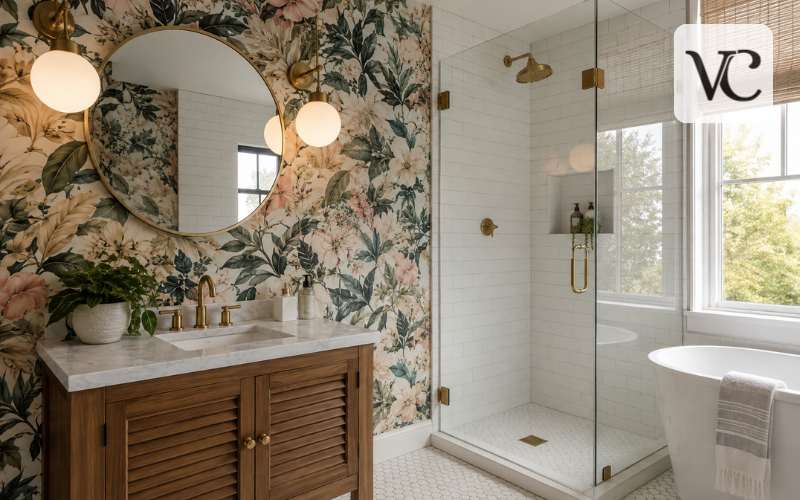
Bathroom wallpaper can add color, pattern, and personality to a room that is often finished mainly with tile and paint. However, a bathroom is not the same as a bedroom or living room. Steam, changing temperatures, splashes, and high humidity can affect both the wallpaper surface and the adhesive behind it. For that reason, the best choice is not simply the pattern you like most. The material, wall location, ventilation, and installation method all matter.
A powder room with only a toilet and sink usually creates much less moisture than a full bathroom with a frequently used shower. In a full bathroom, wallpaper can still work well on walls that stay mostly dry, especially when the room has effective ventilation. Areas that receive direct water, such as shower walls, need a true waterproof wallcovering system rather than ordinary decorative wallpaper.
This guide explains materials, waterproof options, peel-and-stick products, design, placement, installation, and care so you can choose a finish that suits your bathroom.
Snippet-Ready Definition:
Bathroom wallpaper is decorative wallcovering designed for bathroom conditions. Depending on the material, it may resist humidity, steam, and light splashes, while specialist waterproof systems can be used in direct wet areas.
Quick Guide Table
| Type | Best For | Moisture Resistance | Main Advantage |
| Vinyl wallpaper | Full bathrooms, dry walls | High | Durable and easy to clean |
| Moisture-resistant non-woven | Powder rooms, low-splash areas | Medium | Easy installation and many designs |
| Peel-and-stick wallpaper | Renters, powder rooms | Varies by product | Easy to apply and remove |
| Fiberglass waterproof system | Showers and wet zones | Very high | Designed for direct water exposure |
| Traditional paper wallpaper | Well-ventilated powder rooms | Low | Wide range of decorative styles |
Simple Steps for Choosing Bathroom Wallpaper
- Identify whether the room is a powder room or full bathroom.
- Check where steam and direct water splashes occur.
- Choose vinyl or another moisture-resistant material for humid areas.
- Use a true waterproof system for shower walls and direct wet zones.
- Check the manufacturer’s moisture and cleaning ratings.
- Test a sample against your bathroom lighting, tile, and vanity colors.
- Fix leaks, dampness, or mold before installation.
- Maintain good ventilation to help protect the wallpaper.
Is Wallpaper a Good Choice for a Bathroom?
Yes, wallpaper can be a practical choice in many bathrooms, but its success depends on where it is installed. A well-ventilated powder room gives you the most freedom because there is little steam and usually only occasional splashing. Standard high-quality wallpaper may be suitable here if the wall is dry and properly prepared.
A full bathroom needs more care. Walls away from the shower or above a tiled half-wall may suit moisture-resistant wallpaper. Inside a shower enclosure, regular wallpaper should not be assumed safe because the surface receives repeated direct water. Current bathroom-wallpaper guidance from major manufacturers similarly recommends keeping standard wallcoverings away from constant water exposure.
Ventilation also affects durability. An extractor fan or other effective ventilation helps remove humid air before moisture remains on walls for long periods. If a bathroom has recurring condensation, leaks, damp patches, or poor airflow, solve those problems before wallpapering. In areas that are constantly wet, tile, waterproof wall panels, or a specialist wet-room wallcovering will generally be a better fit.
Best Types of Wallpaper for Bathrooms
Vinyl wallpaper for bathroom walls is popular because its surface is tougher and easier to wipe than ordinary paper wallpaper. Solid vinyl and vinyl-coated wallcoverings can handle everyday humidity better than delicate paper finishes, although their exact performance depends on the individual product. Always check the maker’s instructions instead of assuming every vinyl wallpaper has the same water resistance. Current vinyl-wallpaper suppliers describe suitable vinyl products as durable and able to cope with humid bathroom conditions.
Another option is fiberglass or glass-fiber wallcovering. Some specialist systems use fiberglass because it is stable and suited to demanding environments. When it is combined with the correct primers, adhesives, membranes, and protective finishes, it can form part of a waterproof decorative system. Instabilelab, for example, currently offers fiberglass wallcoverings intended for humid bathroom environments.
Moisture-resistant non-woven wallpaper can also work on suitable bathroom walls, but “non-woven” alone does not mean waterproof. Ordinary paper and natural materials such as grasscloth need more caution because moisture can cause marks, staining, or raised seams.
In simple terms, vinyl often suits general bathroom walls, rated non-woven products can work in drier areas, and engineered fiberglass systems are better candidates for demanding wet locations.
Bathroom Wallpaper Waterproof Options for Wet Areas
The words used on wallpaper labels can be confusing. “Washable” normally describes how the surface can be cleaned. “Moisture-resistant” or “water-resistant” means a product can tolerate some humidity or light contact with water. Neither description automatically means it can withstand a daily shower. “Waterproof” should be reserved for a product or complete system specifically designed to stop water from reaching the wall beneath it. Tempaper, for example, clearly states that its bathroom peel-and-stick wallpaper is moisture resistant but not waterproof.
For direct wet zones, look for a system intended for showers or similar environments. Wall&decò currently describes its AQUABOUT WET SYSTEM as a waterproof wallcovering for bathrooms, showers, kitchens, spas, and other wet settings. Its system uses fiberglass wallcovering together with specified preparation and protective components.
Instabilelab also offers fiberglass-based bathroom wallcoverings designed for humid and demanding areas. The important point is that these are not simply decorative rolls placed on a wet wall. Their performance depends on installing the complete system correctly.
If you want wallpaper inside a shower, read the technical instructions carefully and follow the manufacturer’s specified primer, adhesive, sealing layers, and finishing products. Mixing parts from different systems or skipping a protective step may remove the protection the system was designed to provide.
Bathroom Wallpaper Peel and Stick: Where It Works Best
Bathroom wallpaper peel and stick products have a self-adhesive backing, so no separate paste is needed. This can appeal to renters, DIY decorators, or anyone who expects to update the room again.
Their main limitation is that performance varies widely. Some peel-and-stick wallpaper is made for dry rooms only, while other vinyl-coated products are rated for humid spaces. For example, Tempaper currently describes its bathroom peel-and-stick wallpaper as moisture resistant but not waterproof, and it advises keeping it away from shower and splash areas.
A powder room or a dry accent wall is therefore a safer location than the inside of a shower or immediately beside a frequently splashed tub. The wall surface matters too. Self-adhesive wallpaper generally holds best on a smooth, clean, sound surface; some manufacturers also recommend testing the surface before completing a full installation.
If you are considering peel and stick in a full bathroom, check the exact moisture guidance for that product, test a sample, and pay attention to ventilation. Removable does not automatically mean suitable for steam, and a product that works well in one bathroom may fail in another with heavier shower use.
Bathroom Wallpaper Ideas for Different Design Styles
The best bathroom wallpaper ideas combine a pattern you enjoy with a material suitable for the space. Botanical prints are a natural fit because leaves, flowers, and garden-inspired designs can soften hard surfaces such as tile, stone, glass, and metal. Large tropical foliage creates a stronger statement and can make a plain bathroom feel more immersive.
Geometric and abstract patterns suit contemporary spaces, especially when the vanity, mirror, and fixtures have simple lines. Traditional homes can take floral, damask, heritage, or block-print-inspired designs, while scenic murals can turn one large wall into the main visual feature.
Textured or fabric-look wallpaper adds depth without a strong pattern. Whatever the style, let one or two features lead the room. If the wallpaper is bold, simpler flooring and accessories usually create better balance.
Modern Bathroom Wallpaper for a Clean, Updated Look
Modern bathroom wallpaper does not have to mean a plain gray wall. Clean geometric forms, restrained abstract marks, fine stripes, soft organic shapes, and simple large-scale patterns can all feel current without becoming visually noisy.
Neutral tones such as warm white, sand, clay, taupe, muted green, and soft brown work well with natural wood and stone. Black or deep charcoal can add contrast when the room has enough light. A large pattern can also work in a small bathroom because fewer repeats may feel calmer than a dense tiny print.
For a modern scheme, pair wallpaper with simple fixtures. A floating vanity, slim-framed mirror, uncomplicated lighting, and clean hardware allow the wallcovering to stand out. Use one feature wall for a quieter result or cover suitable dry walls for a more immersive effect. Choose a design you are likely to enjoy beyond a short-lived trend.
Luxury Bathroom Wallpaper Without Making the Room Feel Overdone
Luxury bathroom wallpaper often succeeds through material quality, scale, and careful coordination rather than through an expensive-looking pattern alone. Large botanical artwork, scenic murals, Art Deco geometry, rich textural effects, and hand-drawn-style designs can make a bathroom feel more considered.
Dark wallpaper can be especially effective with good lighting. Deep green, navy, chocolate, charcoal, or burgundy can create a calm, enclosed atmosphere when balanced with lighter stone, reflective mirrors, or warm metal details. Marble, wood, brushed brass, and other natural-looking finishes pair well with expressive wallpaper because they add texture without introducing another busy motif.
In wet areas, a specialist waterproof wallcovering can create a continuous appearance. Keep the scheme controlled by repeating a small group of materials and colors instead of adding a new finish to every surface.
Wallpaper Ideas for Small Bathrooms and Powder Rooms
Small bathrooms can handle more pattern than many homeowners expect. Because the wall area is limited, a bold print can become a clear design feature instead of dominating a large room. Powder rooms are especially suitable for experimentation because they usually have less moisture than full bathrooms.
Light backgrounds can make a compact room feel fresh and open, but dark wallpaper is not automatically a mistake. A small powder room can feel deliberate and intimate in a deep color, particularly with a good mirror and layered lighting.
Pattern scale should support the effect you want. Small repeats feel detailed, oversized florals can feel more graphic, and vertical motifs can emphasize height.
If you want a practical compromise, place wallpaper above wainscoting, tile, or moisture-resistant wall panels. The lower surface can handle everyday bumps and splashes while the wallpaper provides color and character above.
Bathroom Wallpaper Kids Will Enjoy as They Grow
Bathroom wallpaper kids enjoy does not need to look like nursery decor. Animals, stars, clouds, plants, maps, waves, simple shapes, and playful graphics can feel fun for younger children without becoming unsuitable as they grow.
In a family bathroom, durability matters more than in a rarely used guest powder room. A washable or wipeable material makes sense where toothpaste, fingerprints, and small splashes are common. Even then, keep delicate wallpaper away from the rim of a bathtub, the immediate sink splash zone, and other areas that stay wet unless the product is specifically rated for that exposure.
Pick one or two wallpaper colors for towels or storage rather than matching everything. If children’s tastes may change quickly, a bathroom-rated removable product on a suitable dry wall can make future updates easier.
Choosing the Right Pattern, Color, and Wallpaper Placement
Before ordering several rolls, look at the bathroom as a whole. The size of the walls, amount of daylight, tile color, floor pattern, vanity finish, and metal fixtures all affect how wallpaper will appear. A sample viewed in the actual room is more useful than judging a design only from a screen.
Dark colors can look richer in a bright room and much heavier in a windowless one. Large motifs need enough visible wall area to be understood, so check where mirrors, cabinets, doors, and towel rails will interrupt the pattern.
Decide whether wallpaper should lead the room or act as a supporting finish. One feature wall is focused; covering all suitable walls feels more enveloping. Wallpaper above tile or paneling can be practical in full bathrooms.
Most importantly, map the wet zones before choosing placement. Decorative wallpaper that is only moisture resistant should stay away from repeated direct spray and standing water.
How to Prepare and Install Bathroom Wallpaper Properly
Good installation starts before the first strip is cut. Inspect the wall for leaks, damp patches, mold, flaking paint, loose plaster, or other damage. Wallpaper should not be used to hide a moisture problem. Fix the cause and allow the wall to dry fully. Current manufacturer guidance similarly recommends beginning with a clean, dry wall free from mold, dust, and loose finishes.
The surface should be clean, smooth, sound, and prepared according to the wallpaper manufacturer’s directions. Use the recommended primer and adhesive for pasted products. For peel-and-stick wallpaper, follow the maker’s surface requirements because some paints, textures, or freshly painted walls may affect adhesion.
Measure carefully and plan the pattern before cutting. Take extra care around seams, sink backsplashes, corners, and fixture openings, where moisture may reach an edge.
After installation, allow adhesives, sealers, and protective finishes to cure for the stated time before exposing the room to heavy steam or water. Keep the bathroom ventilated during normal use. For a proprietary waterproof shower system, follow its instructions as a complete process rather than treating it like ordinary wallpaper. Wall&decò’s current wet-area system, for example, includes primer, glue, fiberglass material, and protective finishes.
Common Bathroom Wallpaper Problems, Care, and Real-World Lessons
Peeling edges are one of the most common complaints in bathrooms. Possible causes include high humidity, weak or unsuitable adhesive, dirty walls, repeated splashing, poor surface preparation, or wallpaper that was never designed for the location. Bubbling can come from trapped air during installation, but it can also indicate moisture getting behind the material.
Mold or mildew is more serious. If staining keeps returning, the wallpaper smells damp, or the wall feels soft, removing part of the covering may be necessary to find the source. A leaking pipe or persistent condensation problem will not be solved by resealing an edge.
Clean wallpaper only as the manufacturer allows. “Washable” and “scrubbable” are not identical ratings, and harsh cleaning can damage the surface. Check seams and corners periodically in high-use bathrooms.
Bathroom wallpaper Reddit discussions show why one person’s experience should not be treated as a universal rule. In one homeowner discussion, some users reported peel-and-stick wallpaper holding well after careful wall preparation, while others said it began falling in full bathrooms exposed to regular shower humidity. Another discussion includes a homeowner who reported years of successful use on a bathroom wall, illustrating how ventilation, placement, wall condition, and the exact product can change the result.
These experiences can be useful when identifying possible problems, but manufacturer specifications should carry more weight when deciding whether a product is safe for a particular wet or humid area.
Conclusion
Bathroom wallpaper can be both practical and attractive when it is matched to the conditions of the room. A low-moisture powder room gives you the widest range of choices, while a full bathroom benefits from durable, moisture-resistant materials and reliable ventilation. Vinyl and suitable non-woven wallcoverings can work well on many dry bathroom walls, but their individual specifications should always guide the decision.
For walls exposed to direct shower water, choose a genuine waterproof system designed for that purpose rather than assuming ordinary “bathroom” wallpaper will cope. Specialist products such as engineered fiberglass wet-area systems are designed for conditions that standard decorative wallpaper is not intended to handle.
Peel-and-stick wallpaper can be convenient for dry or moderately humid areas, but its success depends on the exact product, surface preparation, ventilation, and placement.
The strongest result balances appearance with everyday use. Choose a pattern you enjoy, place it where its material can perform properly, prepare the wall carefully, and maintain good ventilation. That gives bathroom wallpaper a better chance of staying attractive for years.
FAQs
Can you use wallpaper in a bathroom?
Yes. Wallpaper can work well in bathrooms when the material matches the moisture level. Powder rooms offer more flexibility, while full bathrooms usually need moisture-resistant wallpaper and effective ventilation.
What type of wallpaper is best for bathrooms?
Vinyl wallpaper is a practical choice for many bathroom walls because it is durable and easier to clean. Direct shower areas require a specialist waterproof wallcovering system designed for constant water exposure.
Is bathroom wallpaper waterproof?
Not always. Products labeled washable, moisture-resistant, or water-resistant are not automatically waterproof. Wallpaper inside showers should be specifically approved as part of a waterproof wet-area system.
Does peel-and-stick wallpaper work in bathrooms?
It can work in powder rooms and lower-moisture areas if the product is suitable for humidity. Heavy steam and repeated splashing may weaken some removable adhesives, so always check the manufacturer’s guidance.
How do you stop bathroom wallpaper from peeling?
Start with a clean, dry, smooth wall, use the recommended adhesive or primer, keep vulnerable seams away from direct splashes, and maintain good ventilation to reduce prolonged humidity.
Disclaimer: Bathroom conditions and wallpaper products vary. Always check the manufacturer’s installation, moisture-resistance, cleaning, and wet-area instructions before use. Repair leaks, mold, or dampness before wallpapering, and use a professionally specified waterproof system where walls receive direct water.
Enjoyed this article? Discover more helpful ideas and fresh inspiration on Vogue Cultures.