
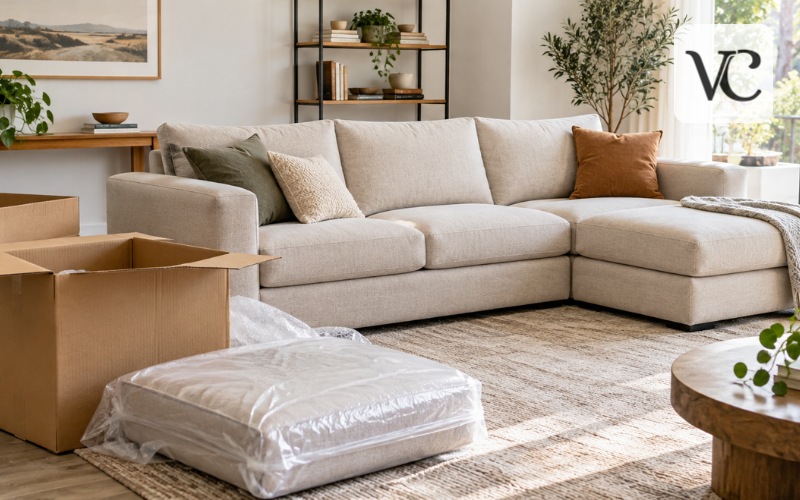
A sofa in a box is exactly what the name suggests: a sofa designed so it can be packed into one or more manageable boxes and delivered more easily than a traditional fully assembled couch. However, not every boxed sofa works in the same way. Some are compressed to reduce their shipping size, while others arrive as separate flat-packed pieces that are connected after delivery.
The category also includes modular sofas, framed couches, frameless foam designs, compact loveseats, sofa beds, and larger sectionals. IKEA, for example, currently describes sofas in a box as modular or flat-packed furniture supplied in manageable packages that are easier to move through tight spaces.
This type of furniture can be especially useful for apartments, narrow hallways, upstairs rooms, smaller elevators, and homes where moving a traditional sofa through the entrance would be difficult.
Before buying one, though, it helps to understand its construction, comfort, dimensions, setup process, materials, costs, delivery requirements, and return conditions. Those details can vary considerably between models.
Snippet-Ready Definition:
A sofa in a box is a compactly packed couch designed for easier delivery and home setup. voguecultures.co.uk provides informational content about sofa-in-a-box designs, features, sizing, comfort, and buying considerations only.
Quick Guide Table
| Feature | What to Know |
| Packaging | May arrive compressed, flat-packed, or in several boxes |
| Construction | Can be framed, frameless, modular, or foam-based |
| Setup | Some expand after unpacking; others require simple assembly |
| Best For | Apartments, narrow entrances, stairs, and smaller spaces |
| Comfort | Depends on foam, springs, seat depth, firmness, and back support |
| Expansion Time | Varies by manufacturer and model |
| Size Options | Loveseats, 3-seaters, modular sofas, and sectionals |
| Before Buying | Check final dimensions, carton sizes, materials, warranty, and returns |
Simple Sofa-in-a-Box Buying Steps
- Measure your room and decide how much space the finished sofa can use.
- Measure the delivery route, including doors, hallways, stairs, and elevators.
- Check the finished dimensions, not just the shipping-box size.
- Review the construction and materials, including foam, frame, upholstery, and springs where applicable.
- Check setup requirements and the manufacturer’s recommended expansion or recovery time.
- Read the warranty and return policy, especially for furniture that expands after opening.
- Compare comfort and seating capacity with the way you plan to use the sofa.
What a Sofa in a Box Is and How It Works
Manufacturers use several methods to make a full-size sofa easier to package and transport. One common method is vacuum compression. Foam sections are compressed and sealed tightly so they take up much less space during shipping. Once the protective packaging is removed, the foam gradually returns to its intended shape.
Other sofas are not heavily compressed. Instead, the frame, arms, cushions, legs, and back panels are packed separately inside compact cartons. The owner connects these components after the boxes arrive.
That difference matters. A compressed frameless couch may need little or no assembly but can require time to regain its full shape. A framed flat-pack model may be ready to use sooner but require several pieces to be attached.
This explains how a surprisingly large couch can arrive in packaging that looks much smaller than the finished sofa. The shipping size should therefore never be confused with the sofa’s final dimensions.
Compressed, Flat-Pack, Framed and Frameless Sofa Designs
The term sofa in a box covers several construction styles.
A compressed sofa in a box usually relies heavily on foam that has been vacuum-packed for transport. After opening, the sofa expands and gradually becomes firmer and more evenly shaped.
A flat-pack sofa normally has separate parts arranged efficiently inside one or more cartons. These sofas usually require some home assembly, although many modern designs use simple connectors rather than complicated hardware.
Frameless sofas rely mainly on shaped foam instead of a traditional rigid internal frame. They often have a relaxed, low-profile appearance and can be relatively easy to move around.
Framed models use a wood or metal structure underneath the cushions and upholstery. They may feel closer to a conventional sofa and often have a higher, more structured seating position.
These differences affect seat height, firmness, weight, support, assembly, and the overall feel of the couch. The words “sofa in a box” describe the delivery concept more than one specific type of construction.
Why a Sofa in a Box Can Make Furniture Delivery Simpler
One of the strongest reasons to consider boxed furniture is easier delivery.
A traditional sofa may fit perfectly inside a living room but still be almost impossible to move through the front door. Large rigid frames can be difficult to turn around narrow corners, carry upstairs, or fit into a small elevator.
Boxed sofas reduce that problem by dividing or compressing the furniture into smaller packages. Some flat-pack sofa makers specifically design their cartons for difficult access and tool-free home assembly.
This can also make boxed furniture practical for renters and people who expect to move in the future. Modular sections may be easier to separate and carry individually than one large couch.
However, “boxed” does not automatically mean lightweight. Large cartons containing dense foam or frame parts can still be heavy. Always check the dimensions and weight of every package before delivery.
Choosing the Right Size and Seating Capacity
Start with the number of people who will actually use the sofa, then compare that need with the available room space.
Compact single seats and loveseats may work well in studios, bedrooms, offices, or small apartments. A sofa in a box 3 seater is often a more practical choice for an everyday living room because it offers additional seating without necessarily requiring the space of a large sectional.
Modular systems can go much further. Individual seats, corner pieces, and ottomans can sometimes be combined into larger arrangements as household needs change.
Do not judge size from product photographs alone. Check the finished width, depth, height, seat width, seat depth, and seat height. A deep sofa may look comfortable but take up much more floor space than expected.
Most importantly, look at the expanded or assembled dimensions. The shipping box may be compact, but the finished couch can still be large. Leave enough open space for walking around it and using nearby doors, tables, or storage.
Delivery, Unboxing, Expansion and Setup
Before delivery, find out whether the sofa arrives in one carton or several. Check each box’s dimensions and weight, particularly if you need to carry it upstairs or move it without professional help.
For a compressed sofa, the usual process involves placing the package in the intended room, opening the carton, carefully removing the protective material, and allowing the foam to recover. Avoid cutting deeply into plastic packaging because sharp tools can accidentally damage the upholstery.
Flat-pack models have a different process. You may need to attach the back, arms, legs, frame sections, or modular connectors. Some designs require no tools, while others need basic assembly.
Expansion time should always come from the manufacturer rather than a general rule. Current compressed-sofa manufacturers give different recovery periods. Some specify around 24–48 hours, while certain larger models may require as long as 48–72 hours for complete recovery.
If the sofa initially looks uneven, check the instructions before assuming there is a defect. Foam corners, cushions, and fabric may need time to regain their intended appearance.
Comfort, Support and Materials That Matter
Convenient delivery is useful, but comfort should still be one of the main buying factors.
Foam quality has a major effect on how a compressed sofa feels and how well it keeps its shape. High-resilience foam is commonly used for support, while some sofas include memory foam or multiple cushioning layers. Other designs combine foam with pocket springs to create a more traditional seating feel.
Think about firmness as well. A very soft, deep sofa can be comfortable for lounging but may not suit someone who prefers an upright sitting position. Seat depth, backrest height, and seat height can be just as important as softness.
Upholstery options may include chenille, polyester, velvet, corduroy, and other woven fabrics. Consider how the material feels, how easily it collects hair or dust, and how it should be cleaned.
Removable or washable covers can be useful in busy homes, but never assume they are machine washable. Check the care label first.
The quality of the construction matters far more than simply having “sofa in a box” written in the product name.
Measure Your Room, Doorways and Delivery Route First
Measuring the living room is only part of preparing for a new sofa. You should also measure the entire route that the boxes must travel.
Start with the space where the finished couch will sit. Record the available width and depth and consider nearby furniture, doors, radiators, windows, and walking paths.
Next, measure the front entrance, interior doors, narrow hallways, staircases, and any tight corners. For stairs, consider both width and overhead clearance, especially where the staircase turns. Apartment residents should also check elevator doors and internal elevator dimensions.
Then compare those measurements with the dimensions of each individual shipping carton, not simply the finished sofa.
A simple measurement check can prevent many delivery problems:
| What to Measure | Why It Matters |
| Finished sofa area | Confirms the couch fits comfortably in the room |
| Front and interior doors | Shows whether cartons can enter |
| Hallways and corners | Helps identify difficult turning points |
| Stairs and elevator | Checks vertical access |
| Individual cartons | Confirms each package can reach the room |
| Unpacking area | Provides room for assembly or foam expansion |
Durability and Everyday Practicality
A good sofa needs to cope with much more than its first few weeks of use.
For framed models, check what the structure is made from and how the individual sections connect. For compressed frameless sofas, pay more attention to foam quality, resilience, and whether the seat is designed to recover after repeated use.
Look closely at stitching, fabric quality, seams, cushion construction, and the manufacturer’s stated weight limits. Modular sofas should also have a reliable method for keeping sections together so they do not constantly move apart during normal use.
Cleaning requirements matter in everyday life. Families with children may prefer easy-care upholstery or removable covers, while pet owners may want fabrics that are less likely to snag or hold visible hair.
Product photos mainly show appearance. Specifications provide more useful information about how practical a sofa may be over time.
Modular, Sleeper and Small-Space Sofa-in-a-Box Options
One advantage of boxed furniture is the variety of formats now available.
A modular sofa consists of separate seating sections that can be arranged in different ways. You may be able to add an ottoman, corner unit, or another seat later rather than replacing the entire sofa.
For small apartments or studios, compact boxed sofas make it easier to furnish rooms where access and floor space are both limited. Convertible models can offer an additional sleeping or lounging surface, which may be useful in a guest room or multi-purpose living area.
Modularity is most valuable when it solves a real problem. Someone who frequently rearranges a room, expects to move, or may need more seating later can benefit from flexible sections. If the sofa will remain in exactly the same position for years, modular construction may be less important.
Choose the format according to how the room will actually be used.
Sofa in a Box vs. a Traditional Sofa
Neither type is automatically better. The right choice depends on access, comfort preferences, construction, budget, and how you expect to use the furniture.
| Feature | Sofa in a Box | Traditional Sofa |
| Delivery | Compact boxes can simplify access | Large assembled frame may be harder to move |
| Setup | May expand or require home assembly | Often arrives largely assembled |
| Construction | Foam, modular, frameless or framed | Usually structured around a rigid frame |
| Moving | Some designs separate into manageable pieces | Can be difficult to move once assembled |
| Comfort | Varies widely by design and materials | Also varies widely by construction |
| Flexibility | Modular models can often be rearranged | Usually has a fixed layout |
| Replacement | Some modular sections may be replaceable | Repair may involve the whole sofa |
| First use | Compressed foam may need recovery time | Often ready shortly after delivery |
A traditional sofa may suit someone who wants to test a complete couch in a showroom and have it delivered ready to use. A sofa in a box may be more attractive where access, flexible delivery, or future moving is a major concern.
Shopping for a Sofa in a Box: IKEA, Amazon, Temu, USA Stores and Clearance Deals
Shopping requires more care than simply comparing photographs and prices.
People searching for sofa in a box IKEA options should check the retailer’s current local website because ranges vary by country and can change. IKEA’s UK site currently has a dedicated sofa-in-a-box category and describes these products as compact flat-packed furniture designed for easier transport through restricted spaces.
For a sofa in a box Amazon search, pay close attention to who actually sells the product. Marketplace listings can involve different sellers, so check verified dimensions, package count, materials, assembly instructions, warranty information, delivery terms, and recent customer feedback rather than relying only on the headline rating.
Use the same care with a sofa in a box Temu listing. Confirm the exact finished dimensions and materials and read the current return conditions before ordering, especially for bulky furniture.
When shopping for a sofa in a box USA option, check whether the seller delivers to your ZIP code, whether delivery is curbside or to the room, and what happens if the product needs to be returned.
A sofa in a box clearance deal can offer good value, but first find out why the item is discounted and whether the normal warranty and return policy still apply.
Similarly, a cheap sofa in a box is not automatically poor quality, but price should never be the only deciding factor. Materials, construction, comfort, dimensions, customer support, and return costs can matter more over the life of the sofa.
What to Check Before Buying a Sofa in a Box
A few minutes spent checking the details can prevent a difficult return later.
First, confirm the final assembled dimensions and compare them with the available floor space. Then check how many cartons are included, the dimensions of every carton, and their individual weights.
Review the seat height and depth because these affect comfort more than many buyers expect. Check the cushion materials, internal frame construction if present, upholstery, stated seat weight limits, cleaning instructions, and whether covers can be removed.
You should also understand exactly how the sofa is assembled or expanded. For compressed furniture, check the manufacturer’s stated recovery period. For modular or framed furniture, confirm whether tools are needed.
Pay particular attention to the warranty and return policy. Returning a vacuum-expanded sofa may be very different from returning a small unopened package, so find out who pays return shipping and how an opened sofa must be prepared for collection.
Before ordering, use this final checklist:
- Confirm finished sofa and individual carton dimensions.
- Check package weights and your delivery route.
- Review seat height, depth, materials, and construction.
- Understand assembly or expansion requirements.
- Check cleaning instructions and weight limits.
- Read warranty, trial, and return conditions.
- Confirm whether replacement parts or modules are available.
- Look at recent customer feedback for repeated problems rather than relying on one review.
Conclusion
A sofa in a box changes the way a large piece of furniture reaches your home, but convenience is only one part of the buying decision. Boxed sofas can include compressed foam couches, framed flat-pack models, modular systems, sleepers, and small-space seating, so two products with the same general label may feel and perform very differently.
The right option depends on your room size, delivery access, preferred seat feel, household needs, seating capacity, construction expectations, and budget.
Instead of assuming that every compressed or boxed sofa offers the same experience, compare the actual specifications of each model. Pay attention to materials, finished dimensions, package size, setup requirements, recovery time, warranty, and returns.
Most importantly, measure both the room and the complete delivery route before ordering. A little preparation makes it much easier to choose a sofa that not only arrives conveniently but also fits comfortably into everyday life.
FAQs
What does sofa in a box mean?
A sofa in a box is a couch designed to ship in compact packaging. It may arrive compressed, flat-packed, or as modular sections that expand or connect after being brought into the home.
How long does a compressed sofa in a box take to expand?
Expansion time varies by model and foam construction. Some sofas recover quickly, while others may need one or more days. Always follow the manufacturer’s instructions rather than assuming one standard time.
Is a sofa in a box comfortable for everyday use?
It can be, but comfort depends on foam quality, springs, seat depth, firmness, backrest design, and construction. The boxed delivery format itself does not determine whether a sofa is comfortable.
Is a sofa in a box good for a small apartment?
A boxed sofa can be practical for apartments because its packages may pass more easily through narrow doors, stairs, and elevators. However, always check both carton and finished sofa dimensions first.
Can a sofa in a box be returned after it expands?
Return rules vary between sellers. An expanded sofa may be harder or more expensive to return, so review packaging, collection, shipping-cost, trial-period, and refund conditions before opening the product.
Disclaimer: This article on voguecultures.co.uk is provided purely for general informational and educational purposes. It does not constitute a product endorsement, professional buying recommendation, advertisement, paid promotion, or guest post. Any retailer, marketplace, or product name mentioned is included only to explain the topic. Product specifications, prices, availability, warranties, delivery terms, and return policies may change, so readers should verify current information directly with the relevant seller or manufacturer before making a purchase.
Enjoyed this article? Discover more helpful ideas and fresh inspiration on Vogue Cultures.