
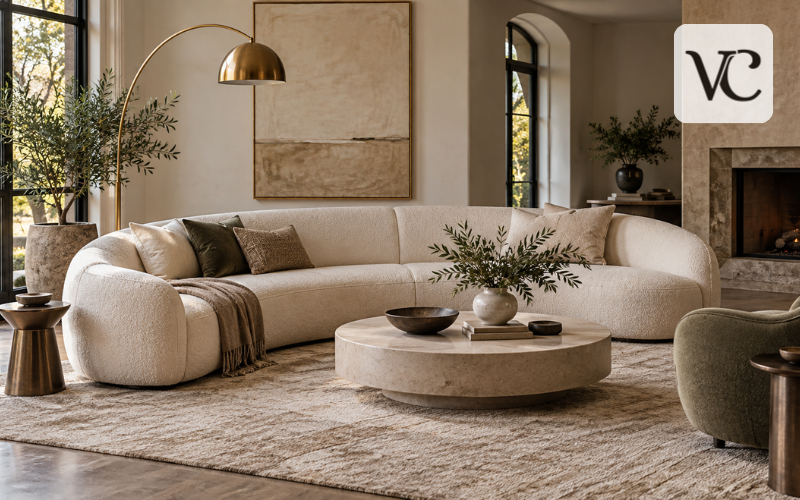
A curved couch is a sofa with a rounded, arched, or gently flowing shape instead of the straight lines found on most traditional sofas. Some have only a slightly curved back, while others form a noticeable crescent or semicircle. This softer shape can make a living room feel less rigid and give the seating area a more relaxed, welcoming appearance.
People often choose curved couches because they combine furniture with visual interest. A well-placed design can become a natural focal point without needing bright colors or heavy decoration. The curved seating arrangement can also make it easier for people to face one another, which works well in rooms used for conversation and entertaining.
Still, appearance should not be the only reason to buy one. Curved sofas need careful measuring and thoughtful placement. Their shape can take up floor space differently from a rectangular sofa, and not every model fits neatly against a wall.
This guide explains the main curved couch styles, sizing, small-space options, sectionals, fabrics, leather, legs, placement, styling, and practical buying considerations so you can decide what genuinely suits your room.
Snippet-Ready Definition:
A curved couch is a sofa with a rounded or flowing shape designed to create softer seating and room layouts. voguecultures.co.uk only provides informational content about curved couches and this article.
Quick Guide Table
| Feature | Quick Guidance |
| Best for | Living rooms, conversation areas, and open spaces |
| Small spaces | Choose compact curves, slim arms, and lighter profiles |
| Larger rooms | Consider a curved sectional or wider modular design |
| Popular fabrics | Bouclé, chenille, velvet, linen blends, performance fabric |
| Leather option | Stylish and often easier to wipe clean |
| Placement | Can work well floated away from the wall |
| With legs | Creates a lighter, more open appearance |
| Before buying | Check dimensions, comfort, delivery access, and fabric care |
Quick Curved Couch Buying Checklist
- Measure the full width, depth, height, and curved footprint.
- Check doors, stairs, elevators, and hallways for delivery access.
- Leave enough space for comfortable movement around the couch.
- Choose a seat depth and height that match how you normally sit.
- Select upholstery according to cleaning needs, pets, children, and daily use.
- Check construction quality, care instructions, warranty, and return policy.
- Make sure the shape works with your room instead of choosing on appearance alone.
What Makes a Curved Couch Different From a Standard Sofa
The biggest difference is the silhouette. A standard sofa normally has a straight back and front edge, while a curved couch may have a rounded backrest, bowed seat, curved arms, or a combination of all three. This creates a softer and often more sculptural appearance.
That shape also changes how the furniture interacts with the room. A straight sofa can often sit neatly along a flat wall or inside a corner. An L-shaped sectional naturally follows two walls or helps divide an open room. A curved sofa may leave unused space behind it when placed against a straight wall, so many designs look more natural when positioned slightly away from the wall.
The curve can also affect how people sit. Instead of everyone facing exactly the same direction, people seated at opposite ends may naturally turn slightly toward each other. This can make the arrangement feel more social.
However, a curved design is not automatically better. If your room is narrow, heavily dependent on wall-mounted furniture, or needs every inch of floor space, a conventional sofa may sometimes be easier to arrange.
Curved Couch Styles and Shapes Worth Knowing
Curved couches come in more forms than the dramatic semicircular sofas often shown in designer homes. A gentle crescent shape is one of the easiest options to use because the curve is noticeable without requiring an unusually large room.
More dramatic semicircular and C-shaped designs create a strong centerpiece. These can work especially well around a round coffee table or in a large conversation area.
Modern minimalist and Japandi-inspired versions usually have simple forms, low backs, soft neutral colors, and textured fabrics. Their curves tend to be smooth rather than decorative. Mid-century-inspired sofas often have a more expressive silhouette, sometimes combined with tapered legs, rich upholstery, or an asymmetrical shape.
There are also compact two- or three-seat models, large statement couches, modular systems, and oversized curved sectionals. Symmetrical shapes give a room a balanced appearance, while an asymmetrical curve can feel more relaxed and contemporary.
Instead of choosing a style simply because it is trending, look at how the actual shape relates to the size, architecture, and purpose of your room.
Choosing the Right Curved Couch Size for Your Room
Measurements matter with any sofa, but they are particularly important with curved furniture. Do not look only at the listed width. Check the overall width, maximum depth, back height, seat height, and the furthest point of the curve.
A useful approach is to mark the approximate footprint on your floor with painter’s tape before buying. This gives you a clearer idea of how much usable space will remain around the couch.
Remember to consider walking routes. People should be able to move between the sofa, coffee table, chairs, doors, and other furniture without constantly squeezing around corners.
Delivery measurements are just as important. Check your front door, hallway width, staircase, elevator, and any tight turns the couch must pass through. A sofa that fits perfectly in the living room is still a problem if it cannot reach the room.
If you plan to float the couch away from the wall, also think about the back. Because more of the sofa will be visible, a neatly finished back can matter almost as much as the front.
Curved Couches for Small Spaces
Curved couches for small spaces can work surprisingly well when the proportions are right. A compact couch with a gently rounded back may soften a small room without consuming much more space than a traditional sofa. Current design coverage also shows that small sofas and sectionals do not necessarily make compact rooms feel crowded when their footprint and layout are carefully chosen.
The key is restraint. Avoid choosing a deep semicircular couch simply because its listed width fits the wall. The depth of the curve may extend much further into the room than expected.
Models with slim arms, raised legs, shallow depths, and lighter visual shapes can be easier to use in apartments. A loveseat-sized curved sofa can also create the effect without overwhelming the floor plan.
Before purchasing, consider what else the room needs. If the sofa leaves no comfortable route to the door, no space for a practical table, or forces other furniture into awkward positions, the curve is probably too large.
In a small room, the best shape is usually one that improves the layout rather than becoming the entire layout.
Curved Couch Sectional Designs for Larger Seating Needs
A curved couch sectional combines the flowing appearance of curved seating with the larger capacity of sectional furniture. Depending on the design, it may use several rounded modules to create an arc, broad semicircle, or gentle U-shaped arrangement.
These sofas can be useful in open-plan rooms because they create a defined seating zone without relying on walls. The curve can help turn a large open area into a more intimate place for talking, relaxing, or gathering around a central table.
Modular designs offer more flexibility. Individual sections may be rearranged, expanded, or separated if the room changes. However, not every modular sofa can create a true curve, so check how the individual pieces actually connect.
Large curved sectionals also require generous floor space. Their widest measurement may not tell the whole story because the arc can extend forward significantly.
Before choosing one, compare the actual number of comfortable seats with the space it uses. A beautiful sectional is only practical if it provides enough seating without making movement around the room difficult.
Fabric Curved Couch vs. Curved Couch Leather
A fabric curved couch gives you a wide range of textures, colors, and comfort levels. Bouclé is associated with soft, sculptural furniture because its looped texture adds warmth and visual depth. Velvet can make the curve look richer, while chenille tends to feel soft and comfortable. Linen blends can create a lighter appearance, and performance fabrics may be useful in busy households when easier maintenance is important.
The right choice depends on how the couch will actually be used. Homes with pets may need to consider snagging, hair, scratching, and cleaning. Families with young children may place more importance on stain resistance and removable or washable covers.
A curved couch leather offers a different character. Leather can emphasize the smooth shape of the sofa and may develop a natural patina with age. It is often easier to wipe than many absorbent fabrics, but care requirements vary according to the type and finish of the leather.
Climate and comfort also matter. Leather and heavily textured fabric feel different against the skin, so try the upholstery in person when possible instead of choosing by appearance alone.
Curved Couch With Legs vs. Low-Profile Designs
A curved couch with legs often looks lighter because visible floor space continues underneath the sofa. Slim wooden or metal legs can also add definition to a soft, rounded body.
This can be useful in smaller rooms where a large upholstered base might otherwise feel visually heavy. Current design advice has also highlighted raised furniture as one way of creating a lighter impression in compact interiors.
Low-profile curved couches create a different mood. They often sit closer to the floor and can feel casual, cozy, and lounge-like. Their wide bases can make the curved form look more substantial and sculptural.
Practical details should influence the choice too. Raised legs can provide easier access for cleaning underneath, although clearance varies. Low furniture may be comfortable for lounging but could feel less convenient to people who prefer a higher seat.
Check the actual seat height rather than assuming that exposed legs automatically mean a high seat or that a low-profile frame always sits very low.
Searching for a Curved Couch at IKEA
People searching for a curved couch IKEA option should look beyond the exact phrase “curved couch.” IKEA’s range changes by country and over time, and many sofas with rounded forms are described by their collection name rather than placed in a dedicated curved-sofa category.
For example, IKEA currently lists LILLESÄTER sofas and sectionals in some markets with noticeably rounded, soft profiles. The company also sells modular ranges that allow buyers to build different seating configurations, although these are not necessarily true semicircular sofas. Availability, colors, modules, and pricing vary by location.
When comparing IKEA options, study the product measurements and photos rather than relying only on the name. Check the overall depth, seat depth, back shape, cover material, removable-cover information, and available modules.
It is also worth confirming stock directly on the IKEA website for your country before planning the rest of the room around a particular model. A sofa available in one market may not be offered in another.
What Makes the Best Curved Couch for Your Home
There is no single best curved couch for every home. The right one is the sofa that fits your room, feels comfortable to you, suits your normal activities, and can handle the way your household uses furniture.
Start with the frame and cushioning. A couch should feel stable when you sit down, while the cushions should provide the level of softness or support you prefer. People who lounge for long periods may prefer a deeper seat, while someone who usually sits upright may find a more moderate seat depth comfortable.
Seat height matters too. Two curved couches can look almost identical in photographs yet feel completely different once you sit on them.
Pay attention to the upholstery quality, seams, cushion construction, frame information, warranty, care instructions, and replacement-cover options where available.
Budget should be considered alongside expected use. Spending more only makes sense if the materials, construction, comfort, or features provide real value for your household. A visually impressive couch that is uncomfortable or difficult to maintain is unlikely to feel like a good purchase after everyday use begins.
The Best Ways to Position a Curved Couch
A curved sofa often benefits from a little space around it. Instead of automatically pushing it against the nearest wall, test a floating position if your room is large enough. Designers increasingly use floating furniture to create clearer zones and more intentional room layouts rather than treating wall placement as the default.
A curved couch can face a fireplace, television, large window, artwork, or central coffee table. In a conversation-focused room, its natural arc can also face one or two accent chairs.
The important point is to preserve movement. Do not float the couch simply because curved sofas are often styled that way in photographs. If placing it in the center blocks the main walking route, moving it closer to a wall may be the more sensible choice.
Think about sightlines as well. Sit in several positions and check whether people can comfortably see the focal point and one another.
A successful arrangement should feel natural when the room is actually being used, not just when it is photographed.
Styling a Curved Couch Without Overdoing the Curves
Round and oval tables often work naturally with a curved couch because their edges follow the same visual flow. They can also reduce the number of sharp corners near the curved seating area.
That does not mean everything in the room needs to be rounded. Too many circles and arches can make the design feel forced. Straight-lined shelves, rectangular artwork, simple side tables, or a structured rug can provide useful contrast.
Choose a rug large enough to visually connect the sofa with the main seating area. A rug that is too small can make even a beautiful couch look disconnected from the rest of the room.
Lighting can reinforce the shape without copying it exactly. A floor lamp with a gentle arc, a rounded pendant, or a simple table lamp may be enough.
Neutral cream, beige, taupe, and earthy shades can highlight texture and form, while deeper green, rust, blue, or brown can turn the sofa into a stronger focal point. The right approach depends on whether you want the curve itself or the upholstery color to receive the most attention.
Curved Couch Benefits, Limitations, and Buying Mistakes
The main appeal of a curved couch is its ability to soften a room filled with straight walls, cabinets, doors, and rectangular furniture. Its sculptural form can give a living area character, while the seating angle may make conversations feel more natural.
The same shape can create limitations. Curved couches may be harder to position against walls, and larger models can use more central floor space than expected. Standard rectangular coffee tables or tightly arranged furniture may also feel awkward beside a strong curve.
One of the most common buying mistakes is judging the sofa only from its front-facing product photograph. Always review measurements and side views. It is also risky to ignore delivery access or assume that a beautiful upholstery fabric will suit your household’s cleaning needs.
Before ordering, make sure you have checked:
- The full width, maximum depth, height, and curved footprint.
- Doorways, halls, stairs, elevators, and tight delivery turns.
- Walking space around the intended sofa position.
- Seat depth, seat height, cushioning, and upholstery care.
- Return policies, warranty terms, and any assembly requirements.
A few minutes spent checking these details can prevent a difficult and expensive mismatch.
Conclusion
A curved couch can change the feeling of a room by replacing hard furniture lines with a softer, more flowing shape. It can work as a subtle design feature, a comfortable everyday sofa, or a strong centerpiece depending on its size, fabric, color, and placement.
The most important step is choosing one for the room you actually have rather than the room shown in a product photo. Measure the complete footprint, consider natural walking routes, check delivery access, and think about how you normally sit, relax, entertain, and clean your furniture.
Small rooms may benefit from compact curves and lighter profiles, while larger spaces can support deep sofas and curved sectionals. Fabric, leather, exposed legs, and low-profile bases each bring different practical advantages and visual effects.
Ultimately, the right curved couch should do more than look attractive. When its dimensions, materials, comfort, and layout all suit your home, the curve becomes a useful part of the room rather than simply a design trend.
FAQs
Is a curved couch good for a small living room?
Yes, a curved couch can work in a small living room when its overall footprint is compact. Choose slimmer arms, moderate depth, and a gentle curve so the sofa does not block walking space.
Does a curved couch need to be placed away from the wall?
Not always. Many curved couches look attractive when floated into a room, but placement should depend on available space, traffic flow, and the couch’s shape rather than following one fixed rule.
What type of coffee table works with a curved couch?
Round and oval coffee tables often complement the flowing shape of a curved couch. However, a simple rectangular table can also work when its size and position allow comfortable movement around the seating area.
Is fabric or leather better for a curved couch?
Neither is automatically better. Fabric offers more textures and colors, while leather provides a different appearance and care routine. Choose according to comfort, maintenance, household use, climate, and personal preference.
Are curved couches comfortable for everyday use?
They can be very comfortable, but comfort depends more on cushioning, seat depth, back support, and seat height than the curved shape itself. Testing the sofa before buying is helpful when possible.
Disclaimer: This article is provided by voguecultures.co.uk for general informational and educational purposes only. We are only sharing helpful information about curved couches, including styles, sizing, materials, placement, and buying considerations. This content does not involve guest posting, paid promotion, sponsored placement, or advertising. Product availability, specifications, prices, and features may change, so readers should verify important details directly with the relevant retailer or manufacturer before making a purchase.
Enjoyed this article? Discover more helpful ideas and fresh inspiration on Vogue Cultures.



