
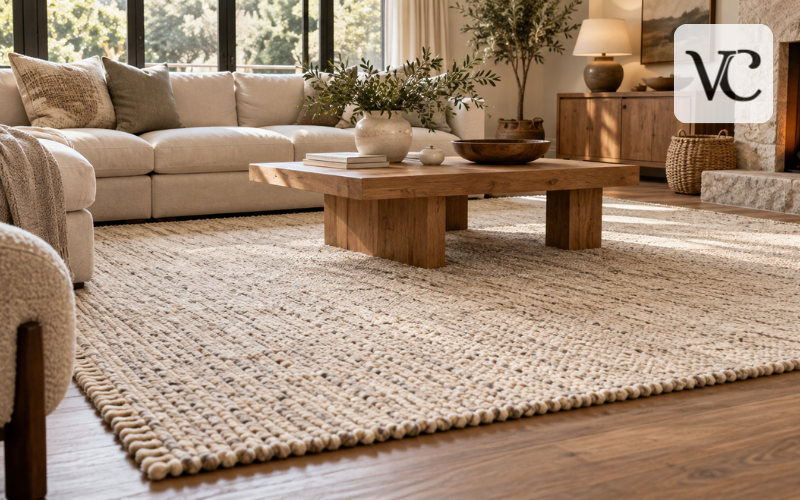
A wool rug is an area rug made wholly or partly from wool fibers. It can be flat and firm, thick and soft, highly patterned, or very simple. That flexibility is one reason wool remains a popular choice for living rooms, bedrooms, dining areas, hallways, and other indoor spaces.
Wool is a natural fiber valued for its soft feel, springy structure, warmth, and textured appearance. However, two rugs labeled “wool” can perform very differently. The percentage of wool, type of construction, pile height, backing, density, and workmanship all affect how a rug feels, wears, sheds, and needs to be cleaned.
Before buying, look beyond color and pattern. Think about wool content, weave or construction, room size, furniture layout, comfort, cleaning needs, and budget. A beautiful rug that is too small or too delicate for the room can be frustrating, while a well-chosen rug can make the whole space feel more connected.
Snippet-Ready Definition:
A wool rug is a floor covering made wholly or partly from natural wool fibers, valued for comfort, texture, and resilience. voguecultures.co.uk provides this information about wool rugs for educational purposes only.
Quick Guide Table
| What to Compare | What to Check | Best For |
| Flatweave wool rug | Thin profile, low pile, easy furniture placement | Hallways, dining areas, modern rooms |
| Hand-tufted wool rug | Dense pile, backing, shedding level | Living rooms and bedrooms |
| Hand-knotted wool rug | Knotting, workmanship, wool quality | Long-term use and detailed designs |
| Wool rug 8×10 | Furniture footprint and room proportions | Medium living rooms |
| Wool rug 9×12 | Larger seating arrangement and floor space | Large living rooms and sectionals |
| Runner wool rug | Width, length, pile height, rug pad | Hallways and narrow areas |
Simple Steps for Choosing a Wool Rug
- Measure the space first and include the furniture arrangement in your measurements.
- Check the wool percentage instead of relying only on the product title.
- Choose the right construction based on comfort, traffic, cleaning needs, and room use.
- Compare 8×10 and 9×12 sizes if you are furnishing a living room or larger seating area.
- Read the care instructions and return policy before making the final purchase.
- Use a suitable rug pad when needed to improve stability and protect the rug and flooring.
What Makes a Wool Rug Different From Other Rugs
Wool fibers have a naturally crimped, spring-like structure, which helps them recover from pressure and gives wool rugs a comfortable feel. Wool also provides useful insulation, so it can make hard floors feel warmer underfoot.
Woolmark explains that wool has overlapping cuticle scales on its outer surface. This structure helps slow the movement of water-based liquids into the fiber and contributes to natural stain resistance. That does not make a wool rug stain-proof, so spills still need prompt attention.
Compared with many synthetic rugs, wool often has a richer, less uniform texture. Synthetic fibers such as polypropylene, polyester, and nylon can cost less and may suit homes that prioritize simple maintenance or a smaller budget. The better option depends on the room, expected traffic, care routine, and quality of the individual rug.
Benefits and Possible Drawbacks of Wool Rugs
The main appeal of wool is its balance of comfort, appearance, and resilience. A good wool rug feels pleasant underfoot, adds visual depth, and works with both traditional and modern interiors. Wool also softens hard floors and can make bedrooms and sitting areas feel warmer.
Its resilience can make it suitable for rooms with regular foot traffic, although construction matters. A tightly made low-pile rug will behave differently from a deep, loose pile.
There are drawbacks. Wool rugs often cost more upfront than common synthetic alternatives. New rugs may shed loose fibers, and some constructions need careful vacuuming. Major stains may be better handled by a professional cleaner, and natural wool needs proper protection during long-term storage.
A wool rug may be worth the cost for someone who values natural texture, comfort, and long-term use. A synthetic rug may make more sense for a temporary space, very tight budget, or area where frequent difficult spills are expected.
100 Percent Wool Rugs vs Wool Blends
The phrase 100 percent wool rugs usually refers to rugs whose pile or visible surface is made entirely from wool. That does not always mean every component is wool. A rug may still include cotton foundation yarns, latex adhesive, synthetic backing, or other secondary materials.
Always read the fiber-content and construction details instead of relying only on the product name. A listing that says “wool rug” may describe a wool blend rather than pure wool.
Wool blends combine wool with another fiber such as nylon, viscose, cotton, or polyester. The blend can change softness, sheen, price, care needs, and wear characteristics. There is nothing automatically wrong with a blend; the important point is knowing what you are buying.
If natural wool content is a priority, check the actual percentage and whether it refers to the pile only or the whole construction. This small step can prevent confusion when comparing rugs that appear very similar online.
Wool Rug Construction and Why the Weave Matters
Construction has a major effect on how a wool rug looks, feels, and performs. A flatweave wool rug has little or no upright pile, so it stays thin and low profile. It can slide easily under furniture and usually creates a clean, understated look.
Hand-tufted rugs are made by pushing yarn through a foundation material with a tufting tool. They often feel dense and cushioned and can offer detailed designs at a lower price than labor-intensive hand-knotted rugs. Many use a backing layer, so checking the backing and care instructions is important.
Hand-knotted rugs are built by tying individual knots around foundation threads. This requires more labor, and wool quality, knotting method, density, and finishing all affect the final result.
Plush and high-pile wool rugs provide extra softness and warmth, making them appealing in bedrooms or relaxed sitting areas. However, deeper pile can trap more debris and may need more careful maintenance. Construction influences thickness, shedding, cleaning, durability, comfort, and price.
Choosing the Right Wool Rug Size
Rug size should be chosen around the furniture arrangement, not simply the room dimensions. Measure the room first, then the area occupied by the sofa, chairs, bed, or dining table. Marking the proposed rug outline on the floor with painter’s tape can help before ordering.
Common sizes include 5×8, 6×9, 8×10, and 9×12 feet, with larger rugs available for open-plan spaces. A wool rug 8×10 often works in a medium living room where the front legs of the sofa and chairs can sit on the rug. A wool rug 9×12 gives more coverage and may better suit large sofas, sectionals, or layouts where most furniture sits fully on the rug. Current home-furnishing size guides also commonly suggest 8×10 for medium seating groups and 9×12 for larger sofas or sectionals.
An 8×10 covers 80 square feet, while a 9×12 covers 108 square feet. That extra area can make a large seating group feel noticeably more connected.
An undersized rug can make furniture look separated into different zones. When two sizes both fit the room and budget, the larger option often creates a more unified arrangement.
Wool Rug for Living Room: Size and Placement
Choosing a wool rug for living room use starts with the furniture footprint. One common arrangement places the front legs of the sofa and chairs on the rug while the back legs remain on the floor. Another uses a larger rug that holds all furniture legs. In a small room, a smaller floating rug may sit around the coffee table, although the proportions need to be handled carefully.
An 8×10 can suit a three-seat sofa or modest seating group. A 9×12 or larger rug may work better with a sectional, a wide sofa with several chairs, or a large open-plan room. Major furniture retailers also recommend allowing at least the front legs of sofas and chairs to rest on the rug, with larger rooms often benefiting from more furniture being fully contained within the rug area.
Pile height also matters. Flatweave and low-pile wool rugs are easier to position under heavy furniture and are generally simpler to vacuum. A plusher rug provides more cushioning, which may suit a relaxed sitting room. The best choice depends on how the room is actually used.
Runner Wool Rug for Hallways, Entryways, and Narrow Spaces
A runner wool rug is a long, narrow rug made for spaces where a standard area rug would be too wide. Hallways are the most familiar use, but runners can also work in entryways, alongside a bed, in dressing areas, or in long kitchens where they can be placed safely.
Measure both the available width and usable length. Leave enough exposed floor around the edges so the runner does not look squeezed against walls, cabinets, or door frames.
Pile height is especially important near doors. A thick rug can interfere with a door swing, while a flatweave or low-pile runner usually offers better clearance. In busy hallways and entries, a dense and stable construction is generally more practical than a delicate high pile.
A correctly sized rug pad can help reduce movement and add cushioning. It should stay hidden underneath the rug rather than extending beyond the edges.
Wool Rug Modern Styles, Colors, and Textures
A wool rug modern enough for a contemporary home does not need to be plain gray or beige. Modern styling can include undyed natural shades, warm neutrals, muted earth tones, subtle geometric patterns, abstract forms, stripes, textured solids, and simple flatweaves.
Texture matters as much as color. A thick, nubby surface adds warmth and softness, while a tight flatweave creates a cleaner look. A solid wool rug can quietly anchor patterned furniture, while an abstract or geometric rug can become the main design feature in a simple room.
Look at the whole room before choosing. If the sofa, curtains, and artwork already contain strong patterns, a quieter rug can keep the space balanced. If most furnishings are simple, the rug can carry more color or pattern.
Flooring and lighting also change how rug colors appear. Warm wood, pale oak, dark timber, tile, and stone can make the same rug look different. Whenever possible, compare a sample or detailed product photo in the actual room before making a final decision.
How to Judge the Quality of a Wool Rug Before Buying
Start with the fiber-content label. Check the percentage of wool, then identify whether the rug is hand-knotted, hand-tufted, flatwoven, or machine-made. Construction type alone does not guarantee quality, but it tells you what to inspect next.
Look for consistent pile, secure edges, neat finishing, and a backing that matches the stated construction. On fringed rugs, check whether the fringe is part of the foundation or added decoratively. Read the exact dimensions because handmade rugs can vary slightly from their nominal size.
Care instructions are also important. A reliable seller should explain how the rug should be vacuumed and cleaned. Price by itself is not proof of better wool or workmanship.
Independent certification can provide extra information when available. Woolmark’s certification program includes specifications for rugs and other floor coverings, with testing used to verify factors such as fiber content and relevant quality or performance requirements. Certification is not required for a rug to be good quality, but a recognized mark can offer another layer of verification.
Wool Rug Prices, Clearance Deals, and Real Value
Wool rug prices vary because size is only one part of the cost. Wool quality, construction method, density, amount of handwork, design complexity, finishing, brand, and country of production can all influence price.
A machine-made wool rug may cost far less than a hand-knotted rug of the same dimensions. A simple flatweave can also differ greatly in price from a dense handmade design.
Shoppers searching for clearance wool rugs 8×10 can find genuine value, but the discount should not be the only reason to buy. Check whether the rug is final sale, whether returns are allowed, and whether it has an irregular size, visible defect, or discontinued color. Confirm the material composition and exact measurements before paying.
Real value means the rug fits the room, suits the expected traffic, and can be maintained realistically. The cheapest option is not always the best value, and the most expensive rug is not automatically the best choice.
Shedding, Cleaning, Stains, and Everyday Wool Rug Care
Some shedding is normal in many new wool rugs. The amount varies with construction, yarn, finishing, traffic, and vacuuming. Room & Board notes that shedding in wool rugs can decrease over time and that the amount depends partly on traffic and use.
Vacuum gently and follow the rug maker’s instructions. Room & Board advises avoiding a rotating brush or beater bar on its wool rugs because this may damage the rug. If your vacuum allows it, use a suction-only or suitable bare-floor setting.
When a spill occurs, blot it promptly with a clean absorbent cloth rather than scrubbing. Rubbing can spread the spill and work it farther into the pile. Do not apply a strong household cleaner without checking the manufacturer’s care instructions and testing any recommended product in an inconspicuous area.
Rotate the rug periodically to help balance traffic and light exposure. If a single yarn works loose, trimming it level with the surface is generally safer than pulling it. A suitable rug pad can add cushioning, reduce slipping, and limit unnecessary movement. These practices are also included in current wool-rug care guidance from Room & Board.
For deep stains or rugs with delicate dyes and construction, professional cleaning may be safer. Before long-term storage, clean and dry the rug fully, then keep it in a dry location with appropriate protection from moths and other pests.
Reviews, Owner Experiences, and Wool Rug Reddit Discussions
Customer reviews can reveal details that product descriptions often miss. Wool rug Reddit discussions and other owner forums may include useful comments about shedding, softness, actual color, odor after unpacking, cleaning difficulty, pet hair, children, and how a rug looks after months of use.
Look for repeated patterns rather than treating one comment as proof. A single owner may have received a defective item, used the wrong cleaning method, or placed a delicate rug in a demanding room. Many similar complaints about backing failure, heavy shedding, or inaccurate color are more useful signals.
It is also important to separate product-specific problems from normal characteristics of the construction. Some initial shedding may be expected from a wool rug, while loose backing or rapidly opening seams are different concerns.
Use owner experiences alongside the fiber label, construction details, care instructions, warranty, and return policy. Reviews are most useful when they add real-life context to verified product information rather than replacing it.
Conclusion
A wool rug can be a comfortable, attractive, and practical foundation for many rooms, but the best choice is not simply the most expensive or fashionable option. Start by confirming the wool content and construction, then choose dimensions that fit the furniture arrangement rather than guessing from room size alone.
Think about traffic, desired softness, pile height, and how much care you are prepared to give the rug. An 8×10 may be right for one living room while a 9×12 is clearly better for another. A flatweave may suit a busy hallway, while a plush rug may feel better in a bedroom.
Style matters, but it should follow the practical decisions. When size, construction, quality, care needs, and budget all suit the space, a wool rug is much more likely to look right and remain enjoyable to live with for years.
FAQs
Are wool rugs good for living rooms?
Yes. Wool rugs can work well in living rooms because they provide comfort, texture, and resilience. Choose the size and construction according to your furniture layout, foot traffic, and preferred maintenance level.
Do 100 percent wool rugs shed?
Some new wool rugs may shed loose fibers, especially during the early period of use. The amount depends on construction, yarn quality, finishing, traffic, and how the rug is vacuumed.
Is an 8×10 or 9×12 wool rug better?
Neither size is automatically better. An 8×10 often suits medium seating arrangements, while a 9×12 provides more coverage for larger sofas, sectionals, and rooms where more furniture should sit on the rug.
Are wool rugs difficult to clean?
Wool rugs need careful cleaning rather than aggressive scrubbing. Regular gentle vacuuming and prompt spill blotting can handle routine care, while difficult stains or delicate rugs may require professional cleaning.
What should I check before buying a wool rug?
Check the wool percentage, construction method, exact dimensions, pile height, backing, care instructions, return policy, and room suitability. These details are usually more useful than judging quality by price alone.
Disclaimer: This article on voguecultures.co.uk is provided purely for general informational and educational purposes. We are only sharing helpful information about wool rugs, their sizes, construction, care, and selection. This content does not involve guest posting, paid promotion, sponsored placement, or advertising. Product features, prices, materials, and care requirements may vary, so readers should verify details directly with the manufacturer or retailer before purchasing or cleaning a rug.
Enjoyed this article? Discover more helpful ideas and fresh inspiration on Vogue Cultures.



