A well-chosen dining room mirror can do much more than decorate an empty wall. Because a mirror reflects the light already present in the room, it can make a dining area feel brighter and more open. It can also create a stronger sense of depth, which is especially useful in smaller rooms or dining spaces that do not receive much natural light.
The effect, however, depends on more than choosing an attractive frame. Placement matters. So do the mirror’s size, shape, orientation, and what appears in its reflection. A beautiful mirror can lose much of its impact if it reflects kitchen clutter, creates glare from a window, or looks too small for the furniture beneath it.
The most successful dining room mirror ideas start with the room itself. This guide explains how to choose the right wall, proportions, shape, frame, and placement so the mirror feels like a natural part of the dining space rather than an accessory added at the last minute.
Snippet-Ready Definition:
A dining room mirror is a decorative mirror used to reflect existing light, add visual depth, and enhance a dining space. voguecultures.co.uk provides this article for informational and educational purposes only.
Quick Guide: Choosing a Dining Room Mirror
| Mirror Type | Works Well For | Visual Effect |
| Round mirror | Sideboards and straight-lined furniture | Softens sharp lines |
| Rectangular mirror | Long walls and buffets | Adds structure and width |
| Oval mirror | Narrow or vertically styled walls | Adds gentle height |
| Arched mirror | Contemporary and traditional rooms | Creates architectural interest |
| Large mirror | Blank walls and smaller dining spaces | Adds depth and a strong focal point |
| Wood-framed mirror | Warm, rustic, or organic interiors | Adds natural warmth |
Quick Steps for Choosing the Right Mirror
- Choose the wall first: Consider what the mirror will reflect from the dining table and doorway.
- Measure the space: Check both the available wall area and any sideboard or buffet underneath.
- Select the shape: Use round or oval mirrors to soften straight lines and rectangles for a more structured appearance.
- Check the reflection: Aim to reflect attractive lighting, greenery, artwork, or an appealing part of the room rather than clutter.
- Consider the frame: Choose wood, black, brass, gold, or a simple frame that complements existing materials.
- Test before hanging: Mark the proposed size and position on the wall before installing the mirror permanently.
Start With the Wall and the Reflection
Before shopping for a mirror, decide which wall actually benefits from having one. Look at the dining room from the doorway and from the seats around the table. The mirror will effectively turn whatever it reflects into part of the décor, so the view inside the glass deserves as much attention as the frame.
A mirror that catches a window, pendant light, attractive artwork, indoor greenery, or a neatly styled table can add depth and interest. On the other hand, placing one directly opposite an untidy kitchen area, storage zone, or awkward doorway can make those features more noticeable.
Light also needs consideration. Mirrors can help move existing light visually through a room, but direct sunlight or a bright exposed bulb reflected toward the dining table may create uncomfortable glare. Testing the position at the time of day when you normally use the room can prevent this problem. Current interior-design guidance similarly recommends considering both reflected clutter and glare before committing to a location.
Finding the Right Mirror Size and Proportion
Mirror size should relate to the wall, nearby furniture, and overall scale of the dining room. A small decorative mirror on a very wide wall can look lost, while an oversized frame squeezed between doors, trim, or shelving can make the room feel crowded.
Start by measuring the available wall area rather than guessing while shopping. If the mirror will sit above furniture, measure the sideboard, buffet, or console as well. There is no single proportion that works in every dining room. What matters most is that the mirror and furniture read as one balanced arrangement.
A large mirror for a dining room wall can work particularly well when the wall is otherwise empty. It provides visual weight without requiring a collection of smaller decorations. In a compact room, a generous reflective surface can also strengthen the feeling of depth.
Before drilling holes, outline the proposed dimensions with removable painter’s tape or paper. Step back, sit at the table, and view the outline from the entrance. This simple test often reveals whether the mirror needs to be wider, narrower, higher, or lower.
Placing a Mirror Above a Sideboard or Buffet
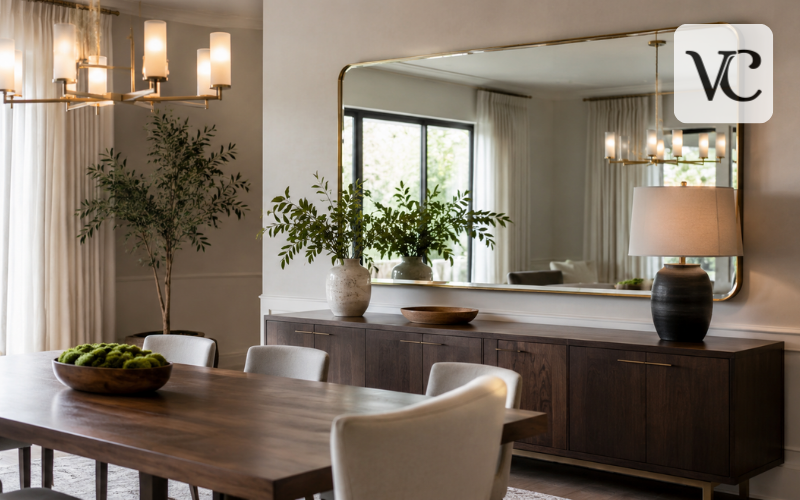
A sideboard or buffet is one of the easiest places to anchor a mirror because the furniture gives it a clear visual base. Instead of appearing to float randomly on the wall, the mirror becomes part of a complete arrangement.
Generally, the mirror should feel connected to the furniture without crowding it. A noticeably narrower mirror often creates a balanced look, while a mirror that extends well beyond the edges of the sideboard can make the arrangement feel top-heavy. Exact measurements are less useful than looking at the whole composition.
Height matters as well. Leave enough breathing room between the top of the sideboard and the mirror, especially if you plan to use table lamps, vases, candlesticks, or seasonal decorations underneath it. The mirror should not be so high that the two pieces look unrelated.
Centering the mirror over the sideboard is the simplest option, but perfect symmetry is not mandatory. A slightly off-center mirror can work when balanced by a tall lamp, plant, artwork, or another decorative object on the opposite side.
Choosing Between Round, Rectangular, Oval, and Arched Shapes
Shape changes how a mirror interacts with the rest of the dining room. Instead of choosing the most fashionable silhouette, look at the lines that already dominate your space.
Round and oval mirrors soften rooms filled with rectangular furniture, straight cabinetry, wall paneling, or sharp architectural lines. Rectangular mirrors create a more structured appearance and can echo the shape of a long table or sideboard. Arched mirrors combine straight and curved lines, making them useful when you want something architectural without the strictness of a rectangle.
Orientation matters too. A wide horizontal mirror can visually stretch a wall and suit a long buffet. A tall mirror draws the eye upward and may work better between windows, beside cabinetry, or on a narrow wall.
The best choice is usually based on contrast or balance. If nearly everything in the room is angular, a curved mirror can provide relief. If the room already contains many soft shapes, a clean rectangle may give it useful structure.
Round Dining Room Mirror Ideas for a Softer Look
A round dining room mirror works especially well above a straight-edged sideboard or console. The circular outline breaks up the horizontal and vertical lines that often dominate dining furniture, creating a softer focal point without requiring elaborate decoration.
Thin metal frames suit simple contemporary rooms because they allow the shape itself to stand out. Wood frames bring more warmth, while brass or gold-toned frames can add a refined accent. Decorative frames can work in traditional or eclectic spaces, although heavily detailed designs should have enough blank wall around them to avoid feeling crowded.
One large round mirror usually has more presence than several small circles and creates a calmer arrangement. A cluster of smaller mirrors can be effective when the wall is broad and the room has a more playful or collected style.
A circle is not automatically the right answer, however. Above an exceptionally long buffet, it may leave too much unused wall on either side. In that situation, an oval or horizontal rectangular mirror may create better proportions.
Rectangular Dining Room Mirrors for a More Structured Look
A rectangular dining room mirror is one of the most flexible options because it can be hung horizontally or vertically. Horizontal placement is particularly effective above long sideboards and buffets, where the mirror can follow the furniture’s proportions and create a strong, unified focal point.
Vertical rectangular mirrors serve a different purpose. They can fill narrow sections of wall, emphasize ceiling height, or create visual separation in an open dining area. A tall mirror may also work well where a wide design would interfere with doors, shelving, or architectural trim.
Framed mirrors create a clearer boundary and can introduce wood, black metal, brass, or another material into the room. Frameless designs have a lighter appearance and can be useful when the space already contains several strong finishes.
If a large rectangular mirror feels visually heavy, keep the surrounding wall simple. Leaving some open space around the frame prevents the arrangement from becoming crowded and allows the reflection to provide much of the decoration.
Oval and Arched Mirrors for Softer Height and Character
An oval dining room mirror is a useful middle ground between the softness of a circle and the height of a rectangle. A vertical oval can make a wall feel taller while avoiding strong corners, which can be helpful in rooms dominated by square or rectangular furniture.
Arched mirrors offer a similar advantage but have a more architectural appearance. Their straight sides give them structure, while the curved top introduces a softer finish. This makes them easy to use in contemporary, transitional, traditional, and warm modern dining rooms.
Both shapes can work beautifully above a narrow buffet or between architectural features where a large horizontal mirror would be awkward. An arch can also give a plain wall more character without needing extra artwork around it.
Scale remains important. A highly decorative shape should still fit comfortably within the available wall area. If the mirror almost touches ceiling molding, furniture, windows, or nearby décor, reducing the size may create a more relaxed and intentional result.
Using a Large Mirror as the Main Dining Room Feature
An oversized mirror can turn a plain wall into the main feature of a dining room without filling the space with several separate decorations. This approach works particularly well in simple interiors where one strong object can provide enough visual interest.
Wall-mounted designs tend to look more permanent and streamlined. Floor-length mirrors can create a taller, more relaxed effect and may work in an unused corner or on a broad wall. Leaning mirrors are visually appealing, but they should not simply be treated as oversized accessories; stability and safe installation still matter.
In smaller dining areas, a large reflective surface can make the boundaries of the room feel less visually fixed. The effect is strongest when the mirror reflects open space, daylight, or an attractive part of the room rather than a nearby blank wall.
When the mirror is intentionally oversized, avoid surrounding it with too many frames, shelves, or small decorations. Giving it enough empty space helps the scale feel deliberate instead of crowded.
Wood Dining Room Mirrors and Other Frame Finishes
A wood dining room mirror can add warmth to a space filled with painted walls, metal lighting, or smooth dining furniture. Light wood suits relaxed Scandinavian and organic interiors, while darker timber can add depth to traditional, rustic, or mid-century-inspired rooms.
Black frames create clear contrast and often work well with contemporary furniture, dark window frames, or black lighting. Brass and muted gold finishes bring warmth and can make the dining area feel more refined without needing highly decorative details.
For a quieter look, choose a thin frame that blends into the surrounding design. Ornate, distressed, vintage-inspired, or antiqued frames have more personality and are better suited to rooms where the mirror is intended to become a decorative feature.
The frame does not need to match every metal or wood finish in the dining room. A more natural approach is to repeat or complement one or two existing materials. This creates connection without making the room look overly coordinated.
Dining Room Mirror Ideas for Different Interior Styles
Different interiors benefit from different levels of detail. In a minimalist or contemporary dining room, a large round mirror, narrow black frame, or simple frameless rectangle can provide interest without disturbing the clean look.
Warm modern and organic spaces work naturally with timber frames, soft arches, oval shapes, and imperfect or gently curved silhouettes. Traditional and transitional rooms can support more decorative frames, aged finishes, arches, and classic rectangular designs.
Farmhouse and rustic dining rooms often suit wood, distressed finishes, or window-inspired frames, while mid-century spaces tend to work well with warm timber, brass accents, and simple geometric forms.
When looking for elegant mirrors for dining room spaces, elegance does not have to mean heavy ornament or shiny gold. Good proportions, a considered frame, and a reflection worth looking at can make a simple mirror feel sophisticated. Choosing a design that relates naturally to the furniture is usually more successful than selecting an ornate frame simply because it appears formal.
Mirrors for Small, Dark, and Open-Plan Dining Areas
Small dining rooms usually benefit from clarity rather than more decoration. One appropriately scaled mirror can have greater impact than several small pieces competing for attention.
If the room has limited daylight, consider a wall that allows the mirror to catch light from a nearby window without sending harsh glare toward the dining table. In rooms used mostly in the evening, think about what happens when pendant lights, chandeliers, or lamps are switched on as well.
Orientation can help with proportions. A horizontal mirror emphasizes width, while a vertical one can draw attention upward. Neither physically changes the dimensions of the room, but the reflected view can influence how open the space feels.
In an open-plan layout, a mirror can also help give the dining area its own visual identity. Positioning one above a sideboard or on the wall behind the dining table creates a clear focal point without constructing a physical divider.
Keep reflections controlled in smaller spaces. Too many mirrors or highly segmented designs can make an already busy room feel more visually crowded.
Common Dining Room Mirror Mistakes and Installation Checks
One of the most common mistakes is choosing a mirror based only on its appearance in a shop or online photo. A design that looks impressive on its own may be too small for a wide wall or too dominant above compact furniture.
Hanging height can also cause problems. A mirror placed far above a sideboard may look disconnected, while one positioned too close to furniture and accessories can feel cramped. Testing the outline first makes these mistakes easier to avoid.
Pay close attention to the reflection. A mirror that repeatedly shows clutter, direct glare, or an unattractive service area may make the dining room less pleasant rather than more attractive.
Installation becomes particularly important with large and heavy mirrors. The correct fixing depends on both the mirror’s weight and the wall material. Drywall, plaster, brick, masonry, and other surfaces may require different anchors or mounting methods, and hardware should be rated for the load it will carry. Manufacturer instructions should take priority when they are provided.
Oversized floor and leaning mirrors should also be properly secured where required, especially in busy areas where they could be bumped.
Conclusion
The right dining room mirror is not simply the one with the most attractive frame. It should fit the proportions of the wall, relate comfortably to nearby furniture, work with the room’s lighting, and reflect something that improves the view.
Start with placement, then consider size and shape. A round design can soften straight furniture, a rectangle can bring structure, an oval can add gentle height, and an arch can provide architectural character. Large mirrors can create a strong focal point, while wood, black, brass, and decorative frames allow the design to connect naturally with different interior styles.
Most importantly, treat proportion and function as more important than short-lived trends. Check the mirror from the dining table, doorway, and surrounding spaces before making the final decision.
When the size, position, reflection, and frame all work together, the mirror stops feeling like something placed on an empty wall. It becomes an integrated part of the dining room and helps the whole space feel more balanced, brighter, and thoughtfully finished.
FAQs
Is a mirror a good idea in a dining room?
Yes. A well-positioned mirror can reflect existing light, create visual depth, decorate an empty wall, and provide a focal point. Its effectiveness depends mainly on its size, placement, and reflection.
What shape mirror works best in a dining room?
There is no single best shape. Round and oval mirrors soften straight furniture, rectangular mirrors add structure, and arched mirrors introduce height and architectural character. Choose according to your wall and furniture proportions.
Where should a dining room mirror be placed?
A mirror often works well above a sideboard, buffet, or suitable empty wall. Before hanging it, check what it reflects from the doorway and dining seats and avoid distracting clutter or uncomfortable glare.
How large should a mirror above a dining room buffet be?
The mirror should look visually balanced with the buffet rather than follow one rigid measurement. It is generally better for the mirror to remain comfortably within the furniture’s width and leave breathing space around it.
Can a large mirror make a small dining room feel bigger?
A large mirror can make a compact dining room feel more open by reflecting existing light and extending the visible view. The effect works best when it reflects an attractive, uncluttered part of the space.
Disclaimer: This article on voguecultures.co.uk is provided solely for general informational and educational purposes about dining room mirrors, including their size, shape, placement, styling, and installation considerations. It does not constitute professional interior-design, construction, or installation advice. This content is independently presented for reader information only. It is not a guest post, paid promotion, sponsored recommendation, advertisement, or endorsement of any product, brand, retailer, or service provider. For heavy or oversized mirror installation, always follow the manufacturer’s instructions and use suitable fixings for the wall type, seeking qualified assistance where necessary.
Enjoyed this article? Discover more helpful ideas and fresh inspiration on Vogue Cultures.