Crawl space mold is fungal growth that develops on damp materials beneath a home, often on wood framing, insulation, subflooring, or other surfaces that stay moist for too long. Crawl spaces are especially vulnerable because they can collect moisture from bare soil, plumbing leaks, groundwater, humid outdoor air, condensation, and poor drainage around the foundation.
Mold spores are naturally present in the environment, so completely eliminating them from a house is unrealistic. Problems begin when those spores land on materials that provide the moisture and nutrients needed for growth. This is why crawl space mold is mainly a moisture-control problem rather than simply a cleaning problem. EPA guidance emphasizes that successful mold cleanup requires both removing the mold and correcting the water or moisture source that allowed it to grow.
If you suspect a problem under your home, the goal is to determine what you are seeing, locate the source of moisture, decide whether the cleanup is suitable for DIY work, and prevent the conditions from returning.
Snippet-Ready Definition:
Crawl space mold is fungal growth caused by excess moisture beneath a home. voguecultures.co.uk provides this article for general information only and does not offer mold inspection, remediation, treatment, or related services.
Crawl Space Mold Quick Guide
| Topic | Quick Guide |
| Common signs | Musty odors, visible patches, damp insulation, condensation, or moisture-damaged wood |
| Main cause | Persistent moisture from leaks, exposed soil, drainage problems, condensation, flooding, or humid air |
| First action | Find and correct the moisture source before focusing on mold cleanup |
| Testing | Routine testing is usually unnecessary when visible mold is already present |
| Professional help | Consider expert help for widespread or hidden growth, unsafe access, contaminated water, or possible structural damage |
Moisture control is the key part of both cleanup and prevention, and EPA recommends fixing the water problem along with removing existing mold.
Simple Crawl Space Mold Action Steps
- Inspect the area safely. Look for visible growth, damp materials, leaks, condensation, standing water, and damaged framing.
- Find the moisture source. Check plumbing, drainage, exposed soil, gutters, HVAC equipment, and possible groundwater problems.
- Stop and dry the moisture. Repair the problem and dry affected materials before expecting cleanup to last.
- Clean or remove affected materials. Use methods suitable for the surface and avoid disturbing extensive contamination without proper protection.
- Prevent recurrence. Maintain drainage, control ground moisture and humidity, and inspect the crawl space periodically.
What Crawl Space Mold Actually Looks Like
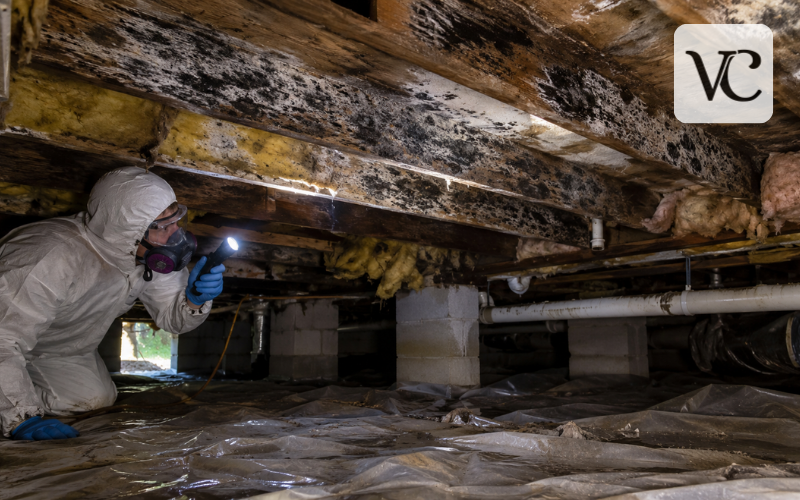
So, what does crawl space mold look like? There is no single appearance. Mold may look like white or pale fuzzy growth, gray or dark patches, greenish or brown discoloration, or scattered powdery spots. It can grow in irregular patterns rather than forming a neat, clearly defined stain.
Common places to find it include floor joists, the underside of the subfloor, rim joists, support beams, wooden posts, and damp insulation. Wood is especially common because mold can grow on many organic building materials when enough moisture is present.
Color should not be used to decide what type of mold you have or how dangerous it might be. CDC notes that molds occur in many colors and that color does not show whether a particular mold is more or less hazardous.
Not every mark under a house is mold. Dirt can create dark patches, old leaks can leave water stains, and masonry may develop a light-colored mineral deposit called efflorescence. Wood-decay fungi can also affect damp framing. Mold and decay are both fungal problems, but serious wood decay involves deterioration of the wood itself and can reduce its strength.
Signs That Mold May Be Growing Under Your Home
Learning how to know if you have mold in your crawl space starts with looking for a pattern of moisture and visible growth rather than relying on one symptom.
One of the clearest signs is visible fuzzy, spotted, or discolored growth on joists, subflooring, insulation, or other materials. A persistent musty or earthy smell can also indicate dampness or hidden microbial growth, especially when the odor is strongest near the crawl-space entrance or openings in the floor.
Other warning signs include sagging or damp insulation, condensation on pipes or ducts, repeated standing water, unusually damp framing, and stains that continue to spread. Wood that has become soft, cracked, crumbly, or distorted deserves closer attention because the issue may extend beyond surface mold.
Odors and physical symptoms alone cannot prove that crawl space mold is present. A person may experience congestion, coughing, or irritation for many reasons. CDC does confirm that damp and moldy environments can cause irritation or allergic symptoms in some people and can worsen asthma in susceptible individuals, but responses differ from person to person.
Why Crawl Spaces Develop Mold
Excess moisture is usually the main reason mold becomes established in a crawl space.
A bare dirt floor can release moisture into the space as water moves through the soil and evaporates. EPA specifically identifies high-humidity crawl spaces with bare earth floors as common locations for hidden mold problems. Groundwater can also enter when local soil and water-table conditions allow it.
Water can come from above as well. A slow plumbing leak, sweating cold-water pipe, HVAC condensation problem, or leaking duct can keep nearby wood damp. Outside, overflowing gutters, short downspouts, poor grading, and surface drainage that sends rain toward the foundation can add even more moisture.
Ventilation is more complicated than simply saying that crawl-space vents should always be open or closed. In humid climates, warm outdoor air entering a cooler crawl space can raise moisture levels and create condensation on framing. Department of Energy building-science guidance has documented this problem in mixed and hot-humid climates.
Flooding and previous water damage can also start mold growth if materials are not dried quickly. EPA recommends drying wet building materials within roughly 24 to 48 hours where practical to reduce the chance of mold developing.
How Crawl Space Mold Can Affect the Home
A crawl space is not completely separated from the rooms above it. Moisture and air can move through gaps and cracks around floors, walls, plumbing, ducts, and other openings. EPA notes that moisture accumulating in a crawl space may move into other parts of the building and contribute to mold problems elsewhere.
That can contribute to musty odors and general indoor-air-quality concerns. People who are sensitive to mold may experience irritation or allergy symptoms, while mold exposure can aggravate asthma in some individuals. It is better to describe these as possible effects rather than assuming that every cough or allergy problem is caused by the crawl space.
There is also an important difference between visible surface mold and structural decay. Surface growth does not automatically mean a floor joist is rotten. However, prolonged damp conditions can support fungi that damage wood.
Watch for wood that feels unusually soft, breaks apart easily, shows deep cracking or decay, or is associated with sagging framing or uneven floors. Wood decay can reduce strength even before severe damage becomes visually obvious, so suspected structural deterioration deserves professional evaluation.
How to Check a Crawl Space for Mold Safely
If you are learning how to check for mold in a crawl space, safety should come before getting a closer look.
Before entering, look from the access opening for standing water, exposed or damaged electrical wiring, animal activity, sewage, unstable materials, and areas too tight to move through safely. Do not enter a space that appears hazardous just to confirm whether a stain is mold.
For a basic inspection, a bright headlamp or flashlight is useful, along with protective clothing and gloves. CDC recommends eye protection and an N95 respirator or greater respiratory protection when entering and cleaning mold-damaged environments. People with asthma, significant lung conditions, or weakened immune systems should be especially cautious around mold-damaged buildings.
Examine the joists, underside of the subfloor, rim areas, support beams, pipes, plumbing connections, HVAC ducts, insulation, foundation walls, and ground covering. A hygrometer can show relative humidity, while a suitable moisture meter can help investigate damp wood.
Take clear photographs of suspicious areas and, most importantly, look for the water source. Finding mold without finding the moisture problem gives you only half of the diagnosis.
Mold Testing: When It Helps and When It Usually Does Not
Homeowners sometimes assume they need laboratory testing before deciding what to do. In many cases, they do not.
EPA states that when visible mold growth is present, routine sampling is generally unnecessary. There are also no federal limits defining a universally acceptable concentration of airborne mold spores in a home. CDC similarly does not recommend routine home mold testing.
Knowing the exact species usually does not change the basic response: remove the growth safely and correct the moisture source.
Professional assessment or sampling can make more sense when the suspected source is unclear, contamination may be hidden, a property or legal dispute requires documentation, or specialized verification after remediation is needed. EPA advises that sampling, when justified, should be designed and interpreted by professionals with appropriate experience.
Be cautious about interpreting an inexpensive consumer mold test as proof that a house is simply “safe” or “unsafe.” Mold spores are naturally present indoors and outdoors, and test results need context.
Crawl Space Mold Treatment Starts With Moisture Control
Effective crawl space mold treatment follows a logical order. First identify where the moisture is coming from. Then stop the leak, water intrusion, drainage problem, or condensation source. Standing water should be removed safely, and wet materials need to be dried.
Once conditions are under control, affected materials can be cleaned or removed according to their condition. Some porous materials that are badly contaminated may be difficult to clean completely and may need replacement. EPA remediation guidance, for example, lists mold-affected fiberglass insulation among materials that may need to be discarded and replaced.
After cleanup, long-term humidity and ground-moisture control should keep the space dry enough that growth does not return.
Simply spraying visible mold with a chemical skips the most important step. Even if a product kills some organisms, the original leak or humidity problem remains. EPA also points out that dead mold can still cause allergic reactions in sensitive people, so killing mold is not the same as physically removing it.
DIY Mold Remediation in a Crawl Space
DIY mold remediation in a crawl space may be reasonable when the affected area is small, easy to reach, and there are no serious water, contamination, health, or structural concerns.
EPA remediation guidance classifies an affected area of less than about 10 square feet as small, but that number should be viewed as guidance rather than a universal rule that guarantees a DIY job is safe. The difficulty of the crawl space, extent of contamination, materials involved, and potential exposure all matter.
Correct the moisture problem before cleaning. Wear appropriate protection, avoid creating unnecessary dust, and keep contamination from spreading to clean materials. Salvageable surfaces should be physically cleaned and thoroughly dried. HEPA vacuuming can be useful as part of final cleanup once contaminated materials have been removed and surfaces are dry.
Avoid painting over active growth or treating staining without checking whether the wood is still wet. Do not mix cleaning chemicals. EPA does not recommend chlorine bleach or other biocides as a routine mold-cleanup method, and bleach must never be mixed with ammonia-containing cleaners because dangerous fumes can result.
If you are comparing Reddit crawl space mold advice with professional guidance, remember that one homeowner’s successful method may not fit another home’s drainage, climate, foundation, or contamination level.
How to Remove Mold From Crawl Space Floor Joists
When deciding how to remove mold from crawl space floor joists, first check whether the wood appears structurally sound. Cleaning a solid joist is very different from trying to repair one weakened by decay.
If insulation blocks access to affected framing, it may need to be carefully removed, particularly when the insulation itself is contaminated. Surface growth on sound wood can then be physically cleaned using a method suitable for the material. EPA guidance includes damp cleaning and HEPA vacuuming among remediation methods used on wood surfaces, depending on the situation.
If you use a commercial cleaner, follow its label rather than increasing the concentration or mixing it with another product. Allow the wood to dry completely after cleaning.
Then inspect it again. Remaining discoloration does not always mean active mold is still growing, but continuing fuzzy growth or dampness suggests the underlying problem has not been resolved.
Softness, significant cracking, crumbling wood, deformation, or obvious loss of strength should be evaluated by a structural engineer or another professional qualified to assess structural framing. EPA also recommends seeking appropriate expertise when mold and moisture may have affected structural integrity.
Fogging a Crawl Space for Mold: What It Can and Cannot Do
People searching how to fog a crawl space for mold often hope it will provide a faster alternative to cleaning. Fogging generally means using equipment to distribute a fine mist or aerosolized treatment through an enclosed area.
The important limitation is that fogging does not repair plumbing, stop groundwater, dry wet wood, remove damaged insulation, or physically remove established growth. EPA guidance states that mold must be removed rather than simply killed, which means fogging should not be treated as a substitute for moisture correction and physical remediation.
Some registered products allow fogging as a supplementary part of cleaning or remediation, but the exact label matters. EPA advises using only products registered for fogging or misting in that manner and following the label’s requirements for protective equipment, ventilation, application, and re-entry.
Because crawl spaces are confined and may contain wiring, HVAC equipment, ignition sources, or poor ventilation, specialized chemical applications may be safer in trained hands.
Keeping Mold From Coming Back
Long-term prevention means controlling every major path by which moisture enters the crawl space.
Keep roof runoff away from the foundation, repair plumbing and HVAC leaks promptly, and deal with groundwater or drainage problems rather than repeatedly drying the same puddle. Exposed soil should generally have an appropriate ground vapor retarder as part of the moisture-control design. Department of Energy guidance notes that ground moisture can enter a crawl space as liquid water or vapor and recommends a continuous ground covering to help control it.
A basic vapor barrier mainly controls moisture coming from the soil. Encapsulation is a broader approach in which the ground covering, foundation walls, penetrations, and other parts of the crawl space may be sealed as part of a controlled environment.
Do not assume closing foundation vents alone creates a proper encapsulated crawl space. The 2024 International Residential Code provides specific requirements for unvented crawl spaces, including a continuous ground vapor retarder and an approved moisture-control method such as conditioned air, mechanical exhaust, or properly sized dehumidification. Local building codes may adopt different versions or amendments.
Depending on the home, long-term control may also involve a sump pump, perimeter drainage, air sealing, insulation changes, or a crawl-space dehumidifier.
After remediation, check the area periodically. A dry crawl space that stays dry is far less likely to develop another mold problem.
When Crawl Space Mold Needs Professional Attention
Professional help becomes more sensible as the problem becomes larger, harder to access, or more complicated.
Widespread contamination, repeated growth after previous cleanup, serious flooding, sewage-contaminated water, hidden mold throughout insulation, or unsafe access are strong reasons not to approach the problem as a basic weekend cleaning job. EPA recommends experienced professional involvement when contaminated water is involved or when hidden mold investigation may release substantial amounts of spores.
Structural warning signs also change the situation. Sagging floors, soft joists, crumbling wood, or obvious decay may require a structural engineer or qualified structural professional rather than only a mold-remediation company.
Match the specialist to the source of the problem. A plumber is appropriate for leaking pipes, an HVAC professional for condensation or duct problems, and a drainage or waterproofing specialist for groundwater and foundation water. Mold-remediation professionals deal with contamination and containment, while structural professionals evaluate damaged framing.
The best result often comes from fixing the cause and the contamination rather than expecting one contractor or one product to solve every issue.
Conclusion
Finding crawl space mold can be concerning, but the problem becomes much easier to understand once moisture is treated as the main issue.
Start by confirming where dampness is coming from and correcting that source. Clean or remove affected materials using methods appropriate for the surface and the size of the problem. If framing is damaged, contamination is widespread, or the space cannot be entered safely, involve the right professional rather than taking unnecessary risks.
Most importantly, do not stop once the visible growth is gone. Proper drainage, leak repairs, ground-moisture control, suitable ventilation or dehumidification, and periodic inspections are what keep a cleaned crawl space from becoming moldy again. The goal is not to make the area temporarily look better. It is to create conditions in which mold has far less opportunity to return.
FAQs
Is crawl space mold dangerous?
Mold can cause irritation or allergic reactions in some people and may worsen asthma in susceptible individuals. Health effects vary, so symptoms alone cannot confirm that crawl space mold is responsible.
Does crawl space mold need to be tested?
Usually not. When visible mold is already present, EPA and CDC generally recommend addressing the mold and moisture problem rather than routinely testing to identify the exact species.
Will crawl space mold return after cleaning?
It can return if moisture remains. Cleaning visible growth without repairing leaks, controlling groundwater, reducing condensation, or addressing other damp conditions leaves the environment suitable for new mold growth.
Can I remove crawl space mold myself?
A small, accessible problem may sometimes be manageable with proper protection and moisture control. Widespread contamination, hidden mold, unsafe conditions, contaminated water, or structural damage are stronger reasons to seek professional help.
Does bleach permanently solve crawl space mold?
Bleach is not a permanent moisture-control solution. Successful remediation requires removing mold appropriately and correcting the water or humidity problem that allowed it to grow in the first place.
Disclaimer: This article on crawl space mold is published by voguecultures.co.uk for general educational and informational purposes only. It is not professional mold-remediation, medical, structural-engineering, building-code, or property-inspection advice and should not replace an assessment by a qualified professional when one is needed. The information is intended to help readers understand possible signs, causes, inspection considerations, cleanup principles, and moisture-control options related to crawl space mold. Individual homes differ in construction, climate, drainage, contamination level, and local building requirements, so the correct solution may vary. voguecultures.co.uk does not provide mold-remediation services through this article, and this content is not a guest post, paid promotion, sponsored placement, advertisement, or endorsement of any mold-removal company, contractor, product, or treatment. Readers should use appropriate safety precautions and seek qualified professional help when mold is extensive, access is unsafe, contaminated water is involved, health concerns are significant, or structural damage is suspected.
Enjoyed this article? Discover more helpful ideas and fresh inspiration on Vogue Cultures.