
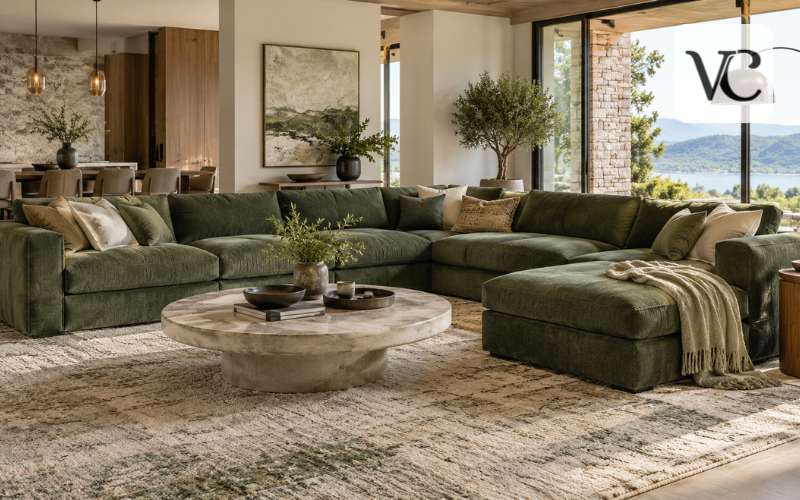
A green sectional sofa can do two jobs at once: give a room generous, practical seating and create a strong visual center. Unlike a small accent chair, a sectional takes up a large part of the room, so its color has a noticeable effect on the whole space. Green works especially well because it can feel calm and natural in soft shades, rich and dramatic in darker tones, or polished and luxurious in velvet.
The right choice depends on much more than color alone. Shape, size, fabric, seat depth, room layout, budget, and maintenance all affect how well a sectional works in daily life. A beautiful sofa can still be the wrong choice if it blocks a walkway, feels too deep to sit in comfortably, or uses a fabric that does not suit the household.
This guide focuses on choosing a green sectional sofa that fits your actual room and lifestyle, not simply one that looks good in a product photo.
Snippet-Ready Definition:
A green sectional sofa is a multi-piece seating option available in shades such as sage, olive, and dark green. voguecultures.co.uk provides this article solely for informational guidance about choosing and styling green sectional sofas.
Quick Guide: Choosing a Green Sectional Sofa
| Feature | Best suited for | What to consider |
| Sage green | Light, calm interiors | Works well with cream, beige, and natural wood |
| Olive green | Warm, earthy rooms | Pairs naturally with walnut, tan, and rust tones |
| Dark green | Bold or sophisticated spaces | Balance with lighter walls and accessories |
| L-shaped | Corners and open-plan rooms | Check chaise direction and walking space |
| Cloud-style | Relaxed lounging | Deep seats need more floor space |
| Velvet | Rich, polished appearance | Check cleaning and care requirements |
| Performance fabric | Busy households | Look for durability and easier maintenance |
Quick Steps Before Buying
- Measure the room and the complete sectional footprint.
- Check doorways, hallways, stairs, and delivery access.
- Choose a green shade that suits the room’s lighting and existing colors.
- Decide between L-shaped, chaise, modular, U-shaped, or another configuration.
- Compare fabric durability, seat depth, comfort, warranty, and return terms.
- View a fabric swatch in your room when possible before making the final choice.
Choosing the Right Green for Your Room
Green upholstery can look very different depending on the light around it. A soft sage may appear fresh and airy in strong daylight but slightly gray in a darker room. Olive can feel warm and earthy beside wood flooring, while some cooler greens can look sharper next to white or gray walls. Artificial light matters too, especially in rooms used mostly in the evening.
Before choosing a shade, look at the colors already fixed in the room. Flooring, wall paint, cabinets, large rugs, and wood furniture all influence how green will read. Warm woods and creamy walls often work comfortably with yellow-based greens such as olive. Cooler walls can suit sage, eucalyptus, or blue-green tones.
Muted greens are often easier to live with when the room already contains several colors or patterns. Stronger greens make more sense when you want the sectional to be the focal point. Whenever possible, bring home a fabric swatch and view it in morning, afternoon, and evening light before buying.
Sage, Olive, and Dark Green: Which Shade Fits Your Style?
A sage green sectional sofa is one of the easiest options to blend into a relaxed room. Its soft, muted color works naturally with warm white, beige, light oak, jute, linen, and other quiet finishes. It can suit modern, Scandinavian, Japandi, farmhouse, or organic interiors without making the room feel too heavy.
An olive green sectional sofa has more warmth and depth. It pairs well with walnut, tan leather, rust, cream, black accents, and aged metals. Olive can feel casual or sophisticated depending on the fabric and the furniture around it, which makes it especially flexible.
A dark green sectional sofa creates a stronger statement. Forest, hunter, and emerald shades can make a large room feel more grounded and can look especially rich in velvet or textured upholstery. In a small or dim room, however, a very dark sectional may dominate the space. If you love deep green but have limited daylight, balance it with lighter walls, rugs, curtains, and nearby furniture.
Sectional Shapes and Configurations Explained
Sectionals come in several layouts, and the best shape depends on how the room is used. An L-shaped design gives plenty of seating without enclosing the room. A U-shaped sectional creates a more social arrangement and can work well for large families or frequent gatherings. Chaise sectionals provide a place to stretch out while using less space than many full corner configurations.
Modular sectionals are made from separate pieces that can often be rearranged. They are useful if you move often, expect your room layout to change, or want the option to add seating later. Fixed sectionals may feel more solid and simple because the arrangement is decided from the start.
Curved sectionals can soften rooms filled with straight architectural lines and may improve movement in some open layouts. Whatever style you choose, pay close attention to orientation. Terms such as left-arm facing and right-arm facing are usually described from the viewpoint of someone looking at the sofa, but retailer wording can vary. Always check the diagram before ordering.
When an L-Shaped Green Sectional Makes the Most Sense
A green sectional sofa in an L shape is practical when you want to create a clear seating zone without filling the room with separate chairs and sofas. It works naturally in a corner, but it can also float in an open-plan room and act as a soft divider between a living area and a dining or kitchen space.
The most important decision is where the longer side or chaise should sit. It should not block the main route into the room, a doorway, or a frequently used path. In TV rooms, the chaise can be placed where it allows lounging without forcing people to walk around it constantly.
A reversible-chaise sectional can be useful in apartments or changing households because the chaise can move from one side to the other on many models. Before buying, confirm how the design reverses and whether any connectors, cushions, or base pieces must also be repositioned.
Getting the Size and Scale Right
A sectional should be measured as a three-dimensional object, not just as a width along one wall. Check the full width, the depth of the chaise or return, seat depth, back height, and arm width. A model that looks compact online may project much farther into the room than expected once the chaise is included.
Use painter’s tape to mark the planned footprint on the floor. Then walk around it, open nearby doors, pull out dining chairs if the spaces connect, and make sure important vents or outlets remain usable. This simple test gives a much clearer sense of scale than measurements on a screen.
A green sectional sofa large enough for a family can still be too large for a compact living room. More seats are not always more useful if the sofa makes the space difficult to move through. Also measure the delivery route, including doors, hallways, stairs, and elevators. Furniture delivery guidance recommends checking these access points because room fit does not guarantee that a sofa can physically reach the room.
Velvet, Chenille, Corduroy, and Performance Fabrics
Fabric changes both the look and the everyday feel of a green sectional. A green sectional sofa in velvet often appears deeper and more saturated because the pile reflects light in different directions. Velvet feels soft and can give green a rich, polished appearance, although the surface may show changes in the pile with use.
Chenille also has a soft, textured surface and is popular for comfortable everyday seating. Corduroy creates a more casual look with visible ribs that add texture, especially on relaxed or low-profile sectionals. Performance fabrics are worth considering in busy homes because many are designed with easier cleaning or stronger resistance to everyday wear.
Do not judge durability by fabric name alone. Two chenilles, velvets, or performance fabrics can behave very differently. Check the manufacturer’s cleaning instructions, abrasion information, pilling data, whether cushion covers are removable, and any specific care code. Fabric performance varies by construction, not simply by category.
Deep-Seat and Cloud-Style Green Sectionals
The phrase green sectional sofa cloud style usually refers to a low, soft sectional with deep seats, large cushions, and a relaxed, sink-in feel. Many of these sofas are modular, which makes them easy to expand or rearrange for movie nights, guests, or different room layouts.
This style is appealing if lounging is the main priority, but deeper is not automatically better. A very deep seat can be uncomfortable for shorter people who prefer to sit upright with their feet supported. Soft cushions may also require more regular fluffing and reshaping than firmer seat designs.
Before choosing a cloud-style sectional, compare the seat depth with a sofa you already find comfortable. Think about how you normally sit. If you often work on a laptop, talk with guests, or prefer upright support, a moderately deep seat may be more practical. If your household mainly stretches out to watch television, a deeper design may be exactly what you want.
Finding a Green Sectional Sofa Under $1,000
A green sectional sofa under $1000 can be a realistic option, especially in smaller L-shaped, chaise, compact modular, and online-only designs. The main challenge is separating a genuine value from a low price that comes with weak support, unclear specifications, expensive returns, or costly shipping.
Start with the basics. Check the frame description, overall dimensions, seat support, cushion construction, fabric information, weight capacity if provided, and assembly requirements. Read the warranty and return policy before buying, not after the sofa arrives. For online purchases, customer photos can also help you judge color and scale more realistically than studio images alone.
Compare the final delivered cost rather than the sale price on the product page. Shipping, room-of-choice delivery, assembly, and return freight can change the true cost significantly. A slightly more expensive sofa with clearer specifications, better support, and easier returns may offer better value than the cheapest available option.
Matching a Green Sectional With Walls, Floors, and Rugs
Green is flexible because it sits comfortably beside many common interior materials. Warm white, cream, beige, and soft greige walls allow the sofa to stand out without making the room feel busy. Natural oak can keep the space light, while walnut and darker woods add warmth and contrast.
For rugs, think about balance rather than trying to match the sofa exactly. A light neutral rug can visually open a room with a dark green sectional. A patterned rug can work well when it repeats green in a small amount alongside cream, tan, rust, blue, or muted red. Tonal green rugs can also work, but using several identical greens may make the space feel flat.
Undertones matter more than rigid decorating rules. A yellow-leaning olive usually feels warmer beside camel, terracotta, and warm wood. A cooler sage or blue-green may pair more naturally with stone, cooler neutrals, or soft blue accents. Daylight should guide the final choice, because the same combination can feel very different in a bright room and a dim interior space.
Styling the Sectional Without Making the Room Feel Overdone
Because a sectional is large, it already contributes a lot of color. You do not need to repeat green on every pillow, curtain, and accessory. A more natural approach is to use a few supporting colors and let texture create interest.
For example, a dark green sofa can be softened with cream pillows, a woven throw, and a light rug. An olive sectional can work with rust, tan, black, or warm wood accents. A sage sofa may look best with quiet neutrals, natural fibers, and simple ceramics. The exact mix should reflect the room rather than a fixed formula.
Coffee and side tables can also change the mood. Wood feels warm and relaxed, stone adds visual weight, glass keeps the view more open, and metal can create sharper contrast. Plants are an easy companion to green upholstery, but they should not be the only decorative idea. Artwork, lighting, curtains, and empty space all help keep the room balanced.
What to Check Before You Buy
Before placing an order, confirm both room fit and delivery fit. Measure the sofa’s assembled dimensions as well as individual modular pieces if they arrive separately. Then measure every doorway, hallway, stair turn, landing, and elevator the furniture must pass through. Furniture delivery guidance recommends checking door height, width, diagonal clearance, hallways, stairways, and elevators before delivery.
Comfort details deserve the same attention. Review seat height and depth, back height, cushion firmness, arm style, and how many people can sit comfortably. If possible, sit on the sectional in person. If you are shopping online, compare those measurements with a sofa you already know.
Also verify orientation, upholstery care, warranty terms, assembly, delivery service, and the full return policy. Reviews are useful for spotting repeated issues, but they should support the specifications rather than replace them. A sofa with hundreds of ratings is not automatically a better fit for your room.
Keeping a Green Sectional Looking Good
Good maintenance starts with the care instructions supplied for the exact fabric. Do not assume a cleaner that worked on one sofa is safe for another. Upholstery fabrics can have different cleaning codes and treatments, even when they look similar.
Regular vacuuming helps prevent crumbs, dust, pet hair, and grit from settling into the surface. If cushions are removable and the manufacturer allows it, rotate or fluff them so the same areas do not take all the wear. Deal with spills promptly, but avoid scrubbing aggressively because that can spread a stain or change the fabric texture.
Sunlight is another consideration. Strong, prolonged exposure can affect many colored textiles over time, so curtains, blinds, or a slightly different sofa position may help in very sunny rooms. Velvet, chenille, corduroy, and performance fabrics each have their own care needs, which is why the manufacturer’s instructions should always take priority over general cleaning advice.
Conclusion
The best green sectional sofa is not simply the one with the most attractive shade. It should also fit the room, support the way your household sits and relaxes, use a fabric you can realistically maintain, and leave enough space for the room to function comfortably.
Start with the practical decisions first: measure carefully, choose the right configuration, think about seat depth and comfort, and check the delivery path. Then choose a shade that works with your light, flooring, walls, and existing furniture. A fabric swatch can be especially helpful because green can shift noticeably throughout the day.
Whether you prefer a soft sage green sectional sofa, an earthy olive design, a dark green statement piece, or a deep cloud-style sectional, the strongest choice is the one that balances appearance with everyday use. When size, color, fabric, comfort, and durability all work together, a green sectional can remain both useful and visually appealing long after the initial decorating excitement has passed.
FAQs
Is a green sectional sofa a good choice for a living room?
Yes. A green sectional sofa can provide generous seating while adding natural color to the room. The best result depends on choosing a suitable shade, size, configuration, and fabric for the space.
What colors go well with a green sectional sofa?
Warm white, cream, beige, tan, natural wood, rust, muted blue, and some soft red tones can complement green. The best combination depends on whether the sofa has warm or cool undertones.
Is sage or dark green better for a small room?
Sage green often feels lighter and softer in compact spaces, while dark green creates stronger visual weight. However, good natural light and light-colored surrounding finishes can also make darker green work successfully.
Is a green velvet sectional difficult to maintain?
Not necessarily, but care requirements vary between fabrics. Velvet may show changes in its pile and needs appropriate cleaning, so always follow the manufacturer’s specific care instructions instead of using general household cleaners.
What should I check before buying a green sectional online?
Check overall dimensions, chaise orientation, seat depth, upholstery details, delivery access, assembly requirements, warranty, shipping charges, and return terms. Customer reviews can help, but they should support rather than replace product specifications.
Disclaimer: This article on voguecultures.co.uk is provided solely for general informational and educational purposes. It offers independent guidance about green sectional sofas, including sizes, styles, fabrics, colors, buying considerations, and care. This content is not a guest post, paid promotion, sponsored endorsement, or advertisement for any furniture brand, retailer, or product. Product availability, prices, specifications, and policies may change, so readers should verify important details directly with the relevant manufacturer or retailer before purchasing.
Enjoyed this article? Discover more helpful ideas and fresh inspiration on Vogue Cultures.



