A coffee maker can become less efficient over time, even when you clean it regularly. If your coffee takes longer to brew, tastes slightly different, or comes out in smaller amounts, mineral buildup inside the machine could be responsible. Learning how to descale coffee maker properly can help restore normal water flow and keep your machine working efficiently.
Descaling is the process of removing mineral deposits, mainly calcium and magnesium compounds, that collect inside a coffee maker when water is heated. These deposits are commonly called limescale. They can gradually affect the machine’s performance, particularly in areas with hard water.
There are two common ways to descale a coffee maker: using white distilled vinegar or a commercial descaling solution. Both can remove mineral buildup when used appropriately, but not every coffee machine supports the same cleaning method.
The safest approach depends on whether you have a drip coffee maker, a Keurig single-serve brewer, or an espresso machine. Following the manufacturer’s instructions helps you choose the right solution, complete the cleaning process correctly, and avoid unnecessary damage.
Snippet-Ready:
To descale a coffee maker, run a manufacturer-approved descaling solution through its cleaning cycle, then rinse thoroughly with fresh water. Some drip machines also allow diluted white vinegar to remove mineral buildup.
Quick Guide / Comparison Table
| Coffee Maker Type | Recommended Method | Important Tip |
| Standard drip coffee maker | Approved descaler or diluted white vinegar | Use vinegar only if the manufacturer allows it |
| Keurig single-serve | Keurig descaling solution | Follow the model’s descaling sequence |
| Keurig K-Duo | Manufacturer-approved descaler | Clean both brewing paths when instructed |
| Espresso machine | Compatible espresso machine descaler | Follow the specific cleaning programme |
| Automatic coffee machine | Manufacturer-approved descaling solution | Complete all automatic rinse cycles |
Step-by-Step Guide
- Identify your coffee maker model. Check the model number so you can follow the correct cleaning procedure.
- Check your water hardness. Hard water contains more minerals that can contribute to limescale buildup. Your water supplier may provide local hardness information.
- Choose a suitable descaler. Use a manufacturer-approved product or white distilled vinegar if your machine specifically allows it.
- Prepare the machine. Remove used coffee grounds, pods, and water filters according to the manufacturer’s instructions.
- Prepare a collection container. Choose a mug or carafe large enough to collect the cleaning solution without overflowing.
- Follow the descaling programme. Allow the machine to complete its required cleaning and soaking stages without unnecessary interruptions.
- Check the machine before brewing coffee. Confirm that rinsing is complete, the water tank contains fresh water, and any required filter has been reinstalled.
Why Your Coffee Maker Needs Descaling
Every time you brew coffee, water travels through the machine’s internal pipes and heating components. Tap water naturally contains dissolved minerals, including calcium and magnesium. When water heats up, some of these minerals can form solid deposits on internal surfaces.
Over time, these deposits build up into limescale. The process usually happens faster in homes with hard water, although machines using softer water may still need occasional descaling.
Mineral buildup can cause several problems. It may restrict water flow, increase brewing time, and interfere with consistent heating. In some machines, it can also reduce the amount of coffee dispensed during a brewing cycle.
These changes may affect coffee quality. If the machine cannot maintain its usual brewing conditions, the resulting coffee might taste weaker or less balanced.
It is also important to understand that descaling and cleaning are different tasks. Regular cleaning removes coffee oils, leftover grounds, and visible dirt from removable parts. Descaling targets mineral deposits inside the water system that ordinary washing cannot reach.
Both are necessary for maintaining a coffee maker, but one does not replace the other.
What You’ll Need Before Descaling
Before starting, gather the necessary supplies and check your coffee maker’s instruction manual. Preparing everything beforehand makes the process easier and reduces interruptions.
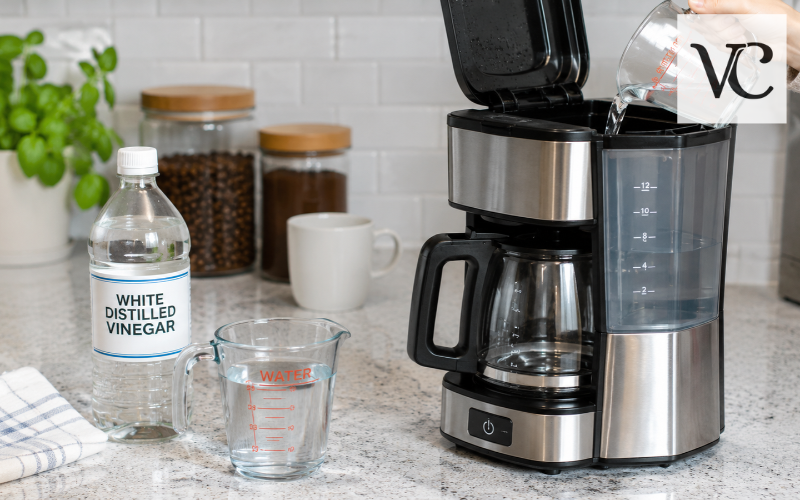
For most coffee makers, you will need fresh water, an empty carafe or large mug, a soft microfiber cloth, and a suitable descaling solution. Depending on your machine, this may be white distilled vinegar or a commercial product specifically designed for coffee makers.
White vinegar is an inexpensive option for certain drip coffee makers. However, some manufacturers recommend dedicated descaling products because their machines contain components that require particular cleaning solutions.
Commercial descalers are available in liquid, powder, and tablet forms. Always choose one that is compatible with your machine and follow its mixing instructions.
Before descaling, empty the coffee grounds, remove used paper filters, and take out any coffee pods. If the manufacturer instructs you to remove a water filter cartridge, do so before adding the solution.
Make sure the carafe or mug is positioned correctly to collect the liquid. Avoid touching hot water or opening parts of the machine during an active brewing cycle.
How to Descale a Coffee Maker With Vinegar
If your drip coffee maker’s manufacturer allows vinegar, this method can remove mineral deposits without requiring a special cleaning product.
Start by switching off the coffee maker and allowing it to cool. Empty the carafe, discard used coffee grounds, and remove the water filter if instructed.
Next, prepare the vinegar solution. Some drip coffee makers allow a mixture of equal parts white distilled vinegar and water, while others require a different ratio. For example, certain Cuisinart models recommend one part vinegar to two parts water. Always use the proportions specified for your machine.
Pour the prepared mixture into the water reservoir without exceeding the maximum fill line. Place the empty carafe beneath the brew basket.
Start the cleaning programme if your machine has one. Otherwise, use the regular brewing cycle if the manufacturer recommends that approach.
Some coffee makers allow you to pause the cycle so the solution can sit inside the water system and loosen stubborn deposits. However, you should only pause or soak the machine when its instructions specifically recommend doing so.
Once the cleaning cycle finishes, discard the used solution and rinse the carafe.
Fill the reservoir with fresh water and run the recommended number of rinse cycles. Many drip machines need at least two full water cycles, although requirements vary.
Continue rinsing if you notice any vinegar smell. The machine should be free of cleaning solution before you brew another cup of coffee.
How to Descale a Coffee Maker Without Vinegar
If your machine does not support vinegar, a compatible commercial descaler is usually the better option.
Coffee machine descalers are designed to break down mineral deposits inside water pathways and heating systems. However, different products contain different ingredients, so choosing the correct solution matters.
Begin by checking the machine’s manual for approved products. Avoid assuming that every universal descaler works with every coffee maker.
Measure the descaling solution according to the product label and the manufacturer’s instructions. Some liquids require dilution with water, while others are supplied in ready-to-use quantities.
Add the prepared solution to the water tank and position an empty container beneath the coffee outlet.
If your machine has an automatic descaling programme, select it and follow the displayed instructions. For simpler drip brewers, the manufacturer may recommend running the solution through a normal brewing cycle.
Allow the programme to finish without interrupting it unless prompted.
Afterward, empty and rinse the reservoir, refill it with clean water, and complete every required rinse cycle.
This method is particularly useful for machines whose manufacturers advise against vinegar. It also avoids the strong vinegar smell that some users find unpleasant.
How to Descale a Keurig Coffee Maker
Keurig machines require particular attention because their cleaning procedures differ between models.
If you are learning how to descale coffee maker Keurig models, the first step is identifying your exact brewer. A K-Mini, K-Supreme, K-Express, and K-Duo may use different controls and cleaning sequences.
Begin by removing any K-Cup pod and emptying the water reservoir. Remove the water filter cartridge if your model’s instructions require it.
Keurig recommends its own descaling solution for its brewers. Using the manufacturer’s recommended product is the safest choice, especially when the machine’s warranty and internal components are considered.
Add the solution and water in the quantities specified for your model. Place a large ceramic mug on the drip tray to collect the liquid.
Next, start the appropriate descaling procedure. Some Keurig machines use a dedicated mode, while others require a sequence of button presses or regular brewing cycles without a pod.
Empty the mug between dispensing cycles and follow any instructions to let the solution remain inside the machine.
After descaling, rinse the reservoir and complete the required fresh-water brewing cycles.
Although vinegar is sometimes discussed as an alternative for Keurig cleaning, it should not be treated as suitable for every model. Follow Keurig’s instructions rather than substituting vinegar without confirmation.
Using the Descale Button on a Keurig
Some Keurig coffee makers have a dedicated descaling function that guides users through the cleaning process.
Before beginning, check whether your machine has a physical descale button, a descale indicator light, or a button combination used to activate the programme.
For example, certain Keurig models enter descaling mode when the machine is powered off but still plugged in and the 8 oz and 12 oz buttons are held together for approximately three seconds. This sequence does not apply to every Keurig brewer.
Once descaling mode begins, the machine may display flashing lights to indicate the next action.
Follow the prompts to dispense the descaling solution into a mug, emptying it whenever necessary. Some models include a waiting period before the fresh-water rinse stage.
When prompted, rinse and refill the reservoir with clean water. Continue the required brewing cycles until the machine completes its programme.
If the descale light remains illuminated, the process may not be finished. Check whether additional rinse cycles are required or whether the machine needs to complete a specific reset procedure.
Avoid repeatedly pressing random buttons, as this can interrupt the cleaning sequence.
How to Descale a Keurig K-Duo
The Keurig K-Duo combines single-cup brewing with a carafe brewing system. Because it supports two brewing methods, its descaling process can differ from that of a standard single-serve machine.
Start by identifying whether you have the original K-Duo, K-Duo Essentials, K-Duo Plus, or a newer version. These machines do not necessarily share the same descaling controls.
Remove any K-Cup pod, discard used coffee grounds, and empty the carafe. Prepare the recommended descaling solution according to your model’s instructions.
Some K-Duo models require the solution to pass through both the single-cup and carafe brewing paths. Others use a dedicated descaling sequence.
Place the appropriate mug or carafe beneath the outlet before beginning each stage.
Follow the machine’s prompts carefully, emptying the collected liquid between cycles.
Once descaling is complete, rinse the reservoir and run fresh water through each brewing path specified in the manual.
Do not assume that cleaning only the single-cup side is sufficient. Following the exact K-Duo instructions helps ensure that the required internal water pathways receive proper treatment.
Descaling Espresso and Automatic Coffee Machines
Espresso machines often require a different descaling method because they use more complex heating systems, pumps, and internal water pathways.
Some espresso makers also contain materials that are sensitive to certain cleaning chemicals. For this reason, vinegar is not a suitable universal option.
Before descaling, consult the manufacturer’s instructions and choose an approved product. Brands such as De’Longhi, Philips, and Breville may have different requirements depending on the model.
For an automatic espresso machine, begin by emptying the water tank and preparing the recommended descaling mixture.
Place a sufficiently large container beneath the coffee outlet and any additional outlets identified in the manual.
Select the descaling programme through the machine’s menu or dedicated control. The machine may release liquid in stages, with pauses between cycles to help dissolve mineral deposits.
Allow the programme to run until the machine requests fresh water.
Rinse the tank, refill it, and complete the entire rinsing procedure.
For manual espresso machines, follow the specific instructions for the boiler and water system. Some machines require professional servicing rather than routine user descaling.
How Often Should You Descale Your Coffee Maker?
There is no single descaling schedule that works for every coffee maker. The ideal frequency depends on water hardness, how often you brew coffee, and the manufacturer’s recommendations.
If you use hard tap water, mineral deposits may accumulate more quickly. A coffee maker used several times daily may also require more frequent descaling than one used occasionally.
Some manufacturers recommend descaling approximately every three to six months under typical conditions. Others provide different schedules or use automatic alerts based on usage and water hardness settings.
Always follow the guidance for your specific model rather than relying on a general timetable.
You may also notice warning signs before the recommended cleaning date. These can include slower brewing, reduced water output, unusual operating noises, or a persistent descale notification.
However, these symptoms can have other causes, so descaling will not solve every brewing problem.
Using appropriately filtered water may help reduce mineral buildup, depending on the filter’s ability to remove hardness minerals. Regular maintenance can also help keep the machine operating consistently.
Common Descaling Mistakes to Avoid
One common mistake is using vinegar without checking whether the manufacturer recommends it. Although vinegar works for some drip coffee makers, it may be unsuitable for certain espresso and single-serve machines.
Another mistake is adding too much descaling solution. A stronger mixture does not necessarily provide better results and may be difficult to rinse away.
Always follow the correct dilution instructions.
Never mix vinegar with bleach or other household cleaning chemicals. Such combinations can release dangerous fumes. Avoid using ordinary bathroom descalers or unrelated household cleaners inside coffee machines.
Skipping the rinse stage is another problem. Leftover descaling solution can affect the taste of coffee and may be unsafe to consume.
Some users also forget to remove water filter cartridges before descaling. Depending on the machine, the solution may damage the filter or prevent the cleaning process from working as intended.
Finally, avoid forcing a cleaning programme to stop halfway through. Allow the machine to complete its required sequence unless the manufacturer instructs otherwise.
Taking these precautions makes descaling safer and helps protect the coffee maker’s internal components.
Troubleshooting Problems After Descaling
Sometimes a coffee maker continues to show problems even after descaling. The next step is identifying whether the issue involves remaining mineral deposits or something unrelated.
If the machine still brews slowly, check that the water reservoir is seated correctly and that the accessible outlet and removable parts are clean. Persistent mineral buildup may require another approved descaling cycle.
If the coffee smells or tastes like vinegar, the machine probably needs additional rinsing. Run fresh water through the system according to the manufacturer’s instructions until the smell disappears.
A Keurig descale light that remains on may indicate an incomplete descaling programme. Some models require a specific number of rinse cycles before the indicator clears.
Check the model’s instructions before attempting another cycle or reset.
If the machine leaks, stops dispensing water, displays an error message, or makes unusual noises, switch it off and consult the troubleshooting guide.
Do not repeatedly operate a machine that appears blocked or damaged.
If the problem continues after the recommended maintenance steps, contact the manufacturer or an authorised repair service.
Conclusion
Learning how to descale coffee maker properly is an important part of keeping your machine clean and working efficiently. Mineral deposits can gradually restrict water flow, slow brewing, and affect the consistency of your coffee.
The best cleaning method depends on the type of machine you own. Vinegar may be suitable for certain drip coffee makers, while Keurig, espresso, and automatic machines often require manufacturer-approved descaling solutions.
Whatever method you choose, preparing the solution correctly, completing the cleaning programme, and rinsing thoroughly are essential steps.
Regular descaling, combined with ordinary cleaning, can help maintain reliable performance and reduce avoidable mineral buildup. Always follow your coffee maker’s manual to ensure the process is safe and suitable for your particular model.
Frequently Asked Questions
What happens if you never descale your coffee maker?
Mineral deposits can gradually restrict water flow and affect heating performance. Over time, your coffee maker may brew more slowly, dispense less water, or require maintenance to restore normal operation.
Can I use apple cider vinegar instead of white vinegar?
White distilled vinegar is generally preferred when a manufacturer permits vinegar descaling. Apple cider vinegar contains additional compounds that may leave unwanted residue or odours. Avoid substituting it unless your machine’s instructions specifically allow it.
Does filtered water prevent limescale buildup?
Filtered water may reduce limescale if the filter removes calcium and magnesium. However, ordinary carbon filters do not necessarily remove these minerals, so regular descaling may still be necessary.
Can I make coffee immediately after descaling?
Yes, once the complete descaling and rinsing process has finished. Make sure no cleaning solution remains, reinstall any required water filter, and check that the machine is ready for normal brewing.
Why is my coffee maker making more noise than usual?
Mineral buildup can sometimes affect water movement and cause unusual operating sounds. However, noise may also result from trapped air, low water levels, or mechanical problems. Check the manufacturer’s troubleshooting instructions if it continues.
Disclaimer: This article is provided for general informational and educational purposes. Descaling procedures vary by coffee maker brand and model. Always follow the manufacturer’s instructions and use compatible cleaning products. The methods described may not suit every machine, and specific cleaning results cannot be guaranteed.
Enjoyed this article? Discover more helpful ideas and fresh inspiration on Vogue Cultures.