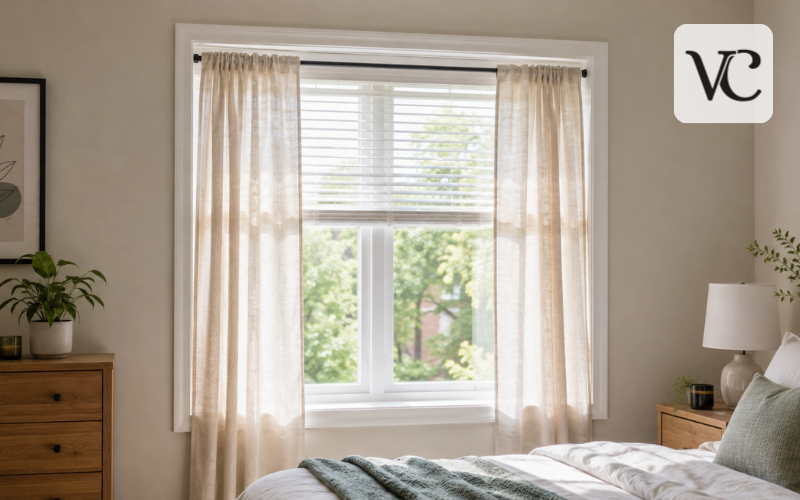
A renter friendly curtain rod lets you hang curtains while avoiding, or greatly reducing, permanent changes to the walls, trim, or window frame. Instead of using traditional screws and wall anchors, these systems may rely on tension, removable adhesive, existing blind hardware, or magnetic mounting.
This is especially useful in apartments, dorms, and rental homes where drilling holes may be restricted by a lease. Common choices include tension rods, adhesive curtain rod holders, removable hooks, brackets that attach to blind headrails, magnetic rods for metal surfaces, and other compression-based designs.
However, “renter-friendly” does not mean that every no-drill rod is completely risk-free. Adhesive products may not suit textured or delicate paint, tension rods need firm surfaces to press against, and lightweight holders may not support heavy blackout curtains. The window shape and curtain weight also affect what works.
Before installing anything, read your lease or ask your landlord if the rules are unclear. The best solution is one that provides enough support while being appropriate for the actual wall, window, or blind system.
Snippet-Ready Definition:
A renter friendly curtain rod is a curtain-hanging solution designed to avoid permanent wall damage, usually using tension, removable adhesive hooks, magnetic mounts, or blind-mounted brackets instead of screws and drilling.
Quick Guide: Renter Friendly Curtain Rod Options
| Type | Best For | Drilling Needed? | Best Curtain Weight |
| Tension rod | Recessed windows | No | Light to medium |
| Adhesive holders | Smooth walls | No | Light curtains |
| Removable hooks | Standard windows | No | Light to medium |
| Blind-mounted brackets | Windows with blinds | No | Light to medium |
| Magnetic rod | Metal doors/frames | No | Lightweight curtains |
How to Choose a Renter Friendly Curtain Rod
- Measure the window before choosing a rod.
- Check whether you need inside-frame or outside-frame installation.
- Match the rod and holder to your curtain weight.
- Confirm adhesive products are safe for your wall surface.
- Use blind-mounted brackets when suitable existing blinds are available.
- Choose magnetic rods only for compatible metal surfaces.
- Follow the manufacturer’s weight, installation, and removal instructions.
What Makes a Curtain Rod Truly Renter-Friendly?
A truly renter-friendly curtain setup should avoid unnecessary drilling, screws, and permanent anchors. It should also be reasonably easy to install and remove without leaving large holes, damaged trim, or difficult repairs.
Removability is only part of the picture. A good renter friendly curtain rod also needs to be compatible with the mounting surface and strong enough for the curtain being used. A removable hook that works well on smooth painted drywall, for example, may not be recommended for wallpaper or a heavily textured surface. 3M specifically lists several suitable surfaces for its Command curtain rod products while also warning against surfaces such as wallpaper, fabric, textured walls, brick, and rough surfaces.
Reusable tension and clamp-style systems can be especially convenient because they do not depend on adhesive. Adhesive holders, on the other hand, can offer more placement flexibility when the surface is appropriate.
Whatever system you choose, check the manufacturer’s installation, surface, rod-size, and load instructions instead of relying only on a “damage-free” or “renter-friendly” label.
Main Types of Renter Friendly Curtain Rods
Tension rods are one of the simplest choices. They fit between two opposing surfaces and stay in place through spring or compression pressure. They often work best inside window recesses where both ends have firm surfaces.
Adhesive curtain rod holders attach to the wall without screws. They can be useful when you want curtains outside the window frame, but the mounting surface must be compatible with the adhesive.
Removable curtain rod hooks work in a similar way but allow a conventional lightweight rod to rest on hooks installed above or beside a window. Some current Command curtain rod hooks, for example, are designed for tool-free installation and removable mounting.
Blind-mounted brackets attach to an existing blind headrail rather than the wall. They are useful for renters who already have blinds and want to add curtains over them. NoNo Bracket, for instance, currently sells several no-drill designs made to attach to compatible blind headrails.
Magnetic rods are another option for steel doors and other suitable metal surfaces. Finally, twist-and-fit or compression rods offer variations on the tension-rod idea.
IKEA’s FJÄDRANDE is a current example of a spring-mechanism rod that installs without drilling in markets where the product is sold.
Choosing the Best Renter Friendly Curtain Rod for Your Window
There is no single best renter friendly curtain rod for every home. The right option depends mainly on where the rod needs to sit.
An inside-mounted tension rod can be an easy solution for a recessed window with strong side surfaces. If you want curtains to extend beyond the window opening, removable wall-mounted holders may offer better coverage. Homes with existing blinds may benefit from headrail-mounted brackets, while magnetic rods make more sense on compatible metal doors or frames.
Use this quick comparison as a starting point:
| Window situation | Renter-friendly option to consider | Main point to check |
| Recessed window | Tension rod | Inside width and grip |
| Curtains outside frame | Adhesive/removable holders | Wall surface and weight |
| Existing blinds | Headrail-mounted brackets | Blind compatibility |
| Metal door/frame | Magnetic rod | Magnetic surface |
| Small privacy window | Lightweight tension rod | Curtain weight |
| Wide window | Stronger no-drill system | Span and support |
Do not choose by appearance alone. A stylish adhesive bracket is not useful if it cannot safely adhere to your wall, just as a tension rod is unsuitable if there are no solid opposing surfaces.
Measuring Before Buying a Renter Friendly Curtain Rod
Correct measuring can prevent many common curtain problems.
For an inside-mounted tension rod, measure the horizontal distance between the two surfaces where the rod ends will sit. Do not simply use the overall window size. The chosen rod’s adjustment range must include that actual opening.
For a rod mounted outside the frame, measure the window width and decide how far you want the curtains to extend beyond each side. Also check the space above the window so the holders or brackets can sit properly.
Remember that finials can make the complete rod wider than the adjustable tube itself. Curtain fullness matters too. A rod that barely covers the glass may leave gaps when the panels are closed.
Check the rod diameter as well. Curtain rings, grommets, rod pockets, hooks, and no-drill holders may only accommodate certain diameters. For example, current NoNo Bracket products specify compatible headrail and curtain-rod dimensions for individual models rather than offering one universal fit.
Taking a few careful measurements before shopping is much easier than dealing with a rod that slips, cannot extend far enough, or does not fit its holders.
Renter Friendly Curtain Rod No-Drill Installation
A renter friendly curtain rod no-drill installation should begin with the manufacturer’s instructions because tension, adhesive, and clamp systems are installed differently.
For adhesive holders, first confirm that the surface is approved for the product. Clean and dry it as instructed before attaching anything. Do not assume that all-purpose household cleaners are suitable. Command’s curtain rod hook instructions, for example, specify preparing the surface with rubbing alcohol, pressing the mounting components firmly, and allowing time for the adhesive to build its hold before loading the hooks.
With a tension rod, adjust the length until both ends make firm contact with the sides of the window recess. The rod should feel secure without applying excessive force that could mark or damage a delicate surface.
When using two separate holders, place them at the same height and confirm the rod is level before adding curtains.
Finally, test the setup gently. If a holder moves, the rod bows noticeably, or the mounting surface shows stress, remove some weight and reconsider the installation rather than forcing it to work.
Using a Renter Friendly Curtain Rod Over Blinds
Adding curtains over existing blinds is often possible without removing the blinds or drilling into the wall.
One approach is a curtain bracket designed to attach to the blind headrail. These systems use the existing blind structure as the mounting point. Current products are available for different types of inside- and outside-mounted blinds, but compatibility varies by headrail design and size.
Before buying a renter friendly curtain rod over blinds, inspect the blind headrail. Determine whether it is rectangular, how wide and deep it is, and whether the existing blind mounting is secure. The manufacturer of NoNo Bracket specifically advises users not to attach its brackets to a loose or damaged headrail.
Projection also matters. There should be enough space between the rod and the blinds for the curtain to hang and move without constantly catching.
A limitation is that headrail-mounted curtains usually follow the position and width of the existing blind assembly. If you want a rod placed much higher or significantly wider than the blinds, another no-drill system may provide more flexibility.
Renter Friendly Curtain Rod Holders and Brackets
The renter friendly curtain rod holder is just as important as the rod itself.
Adhesive holders are designed for certain surfaces and usually work best when the wall is clean, dry, smooth, and approved by the manufacturer. Removable curtain rod hooks provide a similar option while allowing the rod to rest in an open hook.
Tension-rod support cups can help keep the ends of some rods positioned, although adding adhesive cups changes the installation method. Blind-mounted brackets avoid the wall entirely by using existing blind hardware.
Always check what rod diameter a holder accepts. A holder designed for a slim rod may not safely accommodate a thick decorative rod.
Load capacity deserves equal attention. Current Command product information illustrates why the exact model matters: some decorative curtain rod hook listings state capacities of up to 10 pounds, while 3M’s separate weight-reference material includes a 7.5-pound curtain-rod-hook category. Check the specifications for the exact product you purchase rather than applying one weight limit to every holder.
Also remember that the total load includes the rod and curtain hardware, not only the fabric.
Renter Friendly Curtain Rod DIY Ideas
A simple renter friendly curtain rod DIY project does not need complicated hardware.
For a small window, a properly sized tension rod with lightweight curtain panels can create privacy without touching the surrounding wall. This setup is especially useful for café curtains, sheer panels, or other light window treatments.
Another DIY approach is combining a lightweight curtain rod with removable holders made specifically for curtain rods. Follow the holder manufacturer’s stated surface and load requirements rather than attaching a rod to ordinary hooks that were never designed for it.
If blinds are already installed, using compatible headrail-mounted hardware can be simpler than creating a homemade wall attachment.
DIY should not mean improvising with weak adhesives, tape, or unsuitable hooks. Blackout curtains and long decorative rods can create much more load than lightweight sheers. A removable setup is only useful if it remains secure and does not damage the surface when it falls.
Keep the design simple, reversible, and within the limits of the mounting system.
Curtain Weight, Wall Surface, and Rod Stability
Curtain weight can completely change which no-drill system is appropriate.
Lightweight sheers put relatively little strain on a rod. Lined curtains, thermal panels, and blackout curtains can be much heavier, particularly when covering a large window. Heavier fabric therefore requires a mounting method with enough rated capacity.
Surface condition matters too. Smooth finished wood, glass, tile, metal, and properly prepared painted surfaces may suit certain adhesive systems, depending on the product. Rough, dusty, damp, textured, freshly painted, or delicate surfaces may create problems. Command, for example, identifies approved and excluded surfaces for its own curtain rod products rather than claiming universal compatibility.
Rod length also affects stability. A long rod can flex more than a short one and may require additional support depending on its design and load.
Never assume that one no-drill product’s weight rating applies to another. The current market includes everything from slim spring-tension rods to stronger compression systems, so capacity varies widely. Home Depot’s current no-drill tension-rod category alone includes products in multiple lengths and constructions.
Renter Friendly Curtain Rod IKEA Options
People searching for a renter friendly curtain rod IKEA should distinguish between IKEA’s ordinary curtain rods and products specifically designed for no-drill installation.
Traditional curtain rods that rely on screwed wall brackets are not automatically renter-friendly simply because the rod itself is removable. What matters is how the supporting hardware is attached.
One relevant example is IKEA’s FJÄDRANDE. Current IKEA listings in several markets describe it as a curtain rod with a spring mechanism that allows installation without drilling. An Australian listing shows a 70–120 cm version, for example.
That makes it suitable for certain recessed spaces where a tension-style rod can press securely between two surfaces. It should not be treated as a replacement for every conventional curtain rod, particularly where curtains need to extend beyond the window.
IKEA’s range and product availability vary by country. Before planning around a specific model, check your local IKEA site and verify the rod’s current dimensions, mounting method, and intended use.
Finding Renter Friendly Curtain Rods on Amazon and Nearby
When searching renter friendly curtain rod Amazon listings, focus first on specifications rather than ratings or promotional wording.
Check the adjustment range, rod diameter, installation method, stated capacity, required mounting surface, and whether brackets or adhesive parts are included. Look closely at whether “no drill” means tension, adhesive, clamping to blinds, or another method.
Amazon currently carries examples of brackets designed to attach directly to compatible blind headrails without drilling, but dimensions differ from one design to another.
If you prefer finding a renter friendly curtain rod nearby, check home-improvement stores, department stores, furniture retailers, curtain shops, and stores specializing in window treatments. Major retailers currently list no-drill tension rods and adhesive-mounted curtain hardware, showing that several different mounting approaches are widely available.
Shopping locally can be useful because you can compare rod thickness and hardware size in person. Whether buying online or nearby, avoid choosing solely because a product is inexpensive or described as “damage-free.” Compatibility is more important.
Common Renter Friendly Curtain Rod Mistakes and Safe Removal
One of the most common mistakes is buying the wrong size. A tension rod that does not match the window opening may not generate enough pressure, while an oversized outside-mount rod may be difficult to support without stronger hardware.
Another mistake is using adhesive hardware on an unsuitable surface. Even a well-reviewed product can fail if it is installed on texture, dust, moisture, wallpaper, or another surface excluded by the manufacturer.
Overloading holders is equally risky. Consider the combined weight of the rod, finials, rings, and curtain panels.
With tension rods, more pressure is not always better. The goal is a secure fit, not forcing the rod against fragile trim.
When curtains are installed over blinds, check that the rod and fabric do not interfere with normal blind operation.
Removal deserves care as well. Do not pull adhesive hardware straight away from the wall unless the instructions specifically say to do so. For products such as Command curtain rod hooks, follow the brand’s prescribed removal method so the adhesive releases as intended.
Before moving out, remove the system carefully and inspect the window area for residue, marks, or minor cleaning needs.
Conclusion
A renter friendly curtain rod can make a rental feel more private and comfortable without automatically requiring permanent wall holes. The main choices include tension rods, removable adhesive holders, curtain rod hooks, blind-mounted brackets, magnetic rods, and other compression-based systems.
The best choice depends on the window rather than on a single product label. A tension rod may be ideal inside a recessed opening, while compatible blind-mounted brackets can work well when curtains need to hang over existing blinds. Adhesive holders can provide more freedom in rod placement, but the surface and weight limits must be suitable.
Measure the window carefully, consider the combined weight of the rod and curtains, and check the mounting surface before buying anything. Most importantly, follow the exact manufacturer’s instructions for installation, loading, and removal.
A well-chosen renter-friendly setup should give you the privacy and appearance you want while keeping unnecessary changes to your rental to a minimum.
Frequently Asked Questions
What is the best renter friendly curtain rod?
The best option depends on your window. Tension rods are convenient for recessed windows, while removable hooks, adhesive holders, blind-mounted brackets, or magnetic rods may work better in other situations.
Can I hang curtains without drilling holes?
Yes. Tension rods, removable adhesive curtain hooks, magnetic rods, and certain blind-mounted brackets can hang curtains without drilling. Always check their surface compatibility and stated weight limits before installation.
Can a renter friendly curtain rod hold blackout curtains?
Some stronger no-drill systems can support blackout curtains, but many adhesive or lightweight tension rods cannot. Check the combined weight of the rod and curtains against the manufacturer’s rated capacity.
Can I use a renter friendly curtain rod over blinds?
Yes. Certain no-drill brackets attach directly to compatible blind headrails, allowing curtains to hang over existing blinds. Measure the headrail carefully and confirm bracket compatibility before buying.
Do renter friendly curtain rods damage walls?
They are designed to reduce permanent damage, but no system is completely risk-free. Incorrect adhesive removal, unsuitable wall surfaces, excessive tension, or too much weight can still cause marks or damage.
Disclaimer: This article provides general information about renter-friendly curtain rods and no-drill installation methods. Product weight limits, surface requirements, and installation instructions vary by manufacturer. Always check your lease, product instructions, wall condition, and window measurements before installation.
Enjoyed this article? Discover more helpful ideas and fresh inspiration on Vogue Cultures.