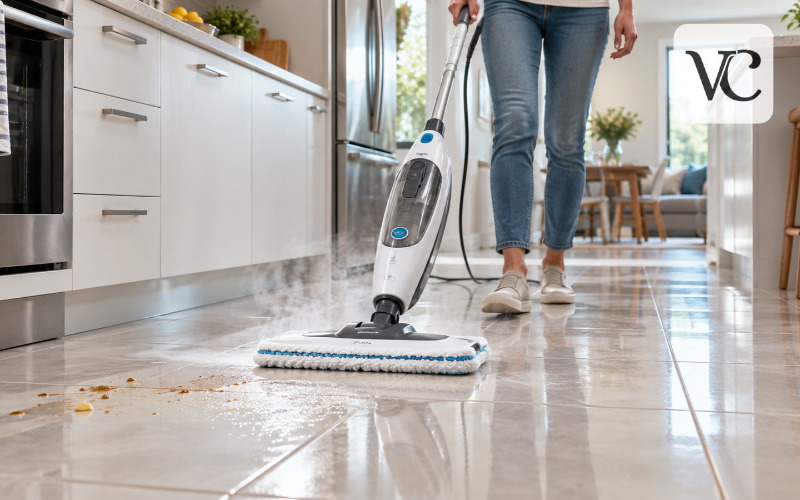
If you have ever struggled to remove sticky footprints or dried food from a kitchen floor, you may have wondered whether steam cleaning would make the job easier. So, what is a steam mop? It is an electric floor cleaner that heats water to produce steam, which helps loosen dirt from suitable hard floors. A reusable fabric pad then picks up much of the loosened grime.
Unlike a traditional mop, a steam mop normally cleans without floor detergent. That makes it appealing to people who prefer a simpler cleaning routine with fewer products. However, steam is not suitable for every type of flooring, and it cannot replace every cleaning tool. Understanding how it works will help you decide whether it belongs in your home.
Snippet-Ready Definition:
A steam mop is an electric floor-cleaning device that uses heated water and a washable pad to remove dirt from suitable surfaces. This article on VogueCultures.co.uk provides educational information only.
Quick Comparison Table
| Feature | Steam Mop | Regular Mop |
| Cleaning method | Hot steam and washable pad | Water and manual wiping |
| Cleaning products | Usually water only | Water or floor cleaner |
| Sticky marks | Heat helps loosen grime | May need extra scrubbing |
| Drying time | Often relatively quick | Depends on water used |
| Floor suitability | Limited to steam-approved floors | Suitable for more floor types with correct care |
| Cost | Higher initial cost | Generally affordable |
How to Use a Steam Mop: Quick Steps
- Check the flooring: Make sure the manufacturer allows steam cleaning.
- Remove loose dirt: Sweep or vacuum the floor first.
- Fill the tank: Add the water recommended in the appliance instructions.
- Start cleaning: Attach a clean pad, select the correct setting and move steadily across the floor.
- Finish safely: Switch off, unplug, allow the appliance to cool and wash the used pad.
How Does a Steam Mop Work?
A steam mop has a water tank, an electric heating element and a floor head fitted with a cleaning pad. After you add water and switch it on, the heater warms the water until the appliance can produce steam. Depending on the model, steam reaches the floor through openings beneath the mop head or through the pad itself.
The combination of heat and moisture softens marks that might otherwise need repeated scrubbing. For example, steam can help loosen dried splashes around a cooker or muddy footprints near a doorway, provided the flooring is suitable. Moving the mop over the area lets the pad collect softened dirt and some moisture. The pad needs washing because the dirt does not disappear when heated.
Some models release steam continuously, while others use a trigger or a pumping movement. Most standard steam mops do not vacuum up crumbs, hair or grit. You will usually need to sweep or vacuum first.
What Is a Steam Mop Good For?
A steam mop is most useful for routine cleaning of hard floors that the flooring manufacturer approves for steam. It can help with light grease, everyday footprints and dried marks in busy rooms. Kitchens, hallways and some tiled bathrooms are common places where people find steam cleaning convenient.
Because many machines use only water in the tank, you do not normally have to measure out floor cleaner or rinse away soap afterwards. A clean microfibre pad can also leave a tiled floor looking refreshed.
There are limits. A steam mop is not a carpet washer, and an ordinary model will not pick up a puddle or a pile of crumbs. It may also struggle with deeply stained grout, thick grease or dirt trapped in damaged flooring. Those jobs can require a suitable brush, a specialist cleaner or another method entirely. For the best results, treat it as one useful tool rather than a solution for every mess.
Different Types of Steam Mops
Basic steam mops are usually lightweight appliances with a simple pad and one main steam setting. They are designed for straightforward cleaning on compatible hard floors. If your home has a small area of suitable tile, this type may be enough without paying for extra features.
Adjustable steam mops let you choose between different output levels. A lower setting may be appropriate for some manufacturer-approved surfaces, while a stronger setting can help with stubborn marks on suitable tile. Adjustable steam does not make an otherwise unsuitable floor safe, though. Flooring instructions still come first.
Scrubbing steam mops have moving or rotating pads that add mechanical action to the steam. Multi-purpose steam cleaners can include attachments for certain above-floor jobs. Check what each attachment is designed to clean: a removable handheld unit does not mean every surface in the home can safely be steamed.
Steam Mop vs Regular Mop: Understanding the Differences
A regular mop uses water, sometimes mixed with an approved floor cleaner, and the movement of your hands to wipe away dirt. A steam mop adds heat to help loosen grime before the pad collects it. Neither method automatically cleans better in every situation. The result depends on the type of dirt, the floor finish and how thoroughly you mop.
Steam cleaning can leave less visible water behind than a heavily soaked string mop, so some floors dry relatively quickly. However, drying time varies with the steam level, room ventilation and pad condition. A well-wrung microfibre mop may also dry fast and is often more suitable for moisture-sensitive floors.
In a steam mop vs regular mop comparison for tile floors, both can work well. Steam is convenient for certain sticky marks, while a regular mop makes it easier to use a tile-safe cleaning solution when needed. Traditional mops also cost less initially and do not need electricity. Steam mops require power, replacement pads and occasional maintenance. The better choice is the one that matches your flooring and cleaning habits.
Using a Steam Mop on Tile Floors
People often ask what a steam mop is for tile because ceramic and porcelain floors are common in kitchens and bathrooms. Many fully finished ceramic and porcelain tiles can tolerate steam cleaning, provided the tile and grout manufacturers allow it.
Start by removing loose dirt, especially grit that could scratch the finish when dragged under a pad. Use the setting recommended for the floor and move the mop steadily rather than holding it over one mark. Steam can soften food splashes and surface grime, but it cannot repair stained, cracked or missing grout.
Grout deserves particular care. Damaged joints may let moisture reach the material beneath the tiles. Some decorative, porous, unglazed or specially coated tiles also need gentler treatment. If you do not know what finish your floor has, check the manufacturer’s guidance or choose a less aggressive cleaning method until you are sure.
Are Steam Mops Good for Laminate Floors?
Laminate flooring can look waterproof from above, yet its joints and inner layers may still be vulnerable to heat and moisture. If steam enters a gap, it can contribute to swelling, raised edges or lasting damage. For that reason, it is sensible to avoid steam cleaning laminate unless its manufacturer clearly says that your particular product is suitable.
There are exceptions. Some manufacturers permit carefully controlled steam cleaning on selected water-resistant laminate ranges, often with a low setting and a cloth that spreads the heat evenly. Other ranges from the same manufacturer may forbid steam completely. The phrase “sealed laminate” on a steam mop box is not enough to settle the question.
For flooring without specific approval, vacuum using a hard-floor attachment and clean marks with a lightly damp microfibre mop and an approved product. Avoid leaving water around the joins, and dry any wet patches promptly. This slower-looking approach can save you from expensive damage later.
Which Other Floor Types Can You Steam Mop?
Floor compatibility is about more than whether a surface looks hard or sealed. Solid hardwood and engineered wood can be affected by moisture entering joints or by changes in heat. Many wood-floor manufacturers therefore advise against steam cleaning. Unfinished, unsealed or waxed wood is especially unsuitable unless the flooring maker expressly provides different guidance.
Vinyl and luxury vinyl plank flooring also need care. Some appliance makers describe sealed vinyl as compatible with their machines, but flooring brands may give different instructions. For example, certain luxury vinyl manufacturers advise against steam mops because heat or moisture may affect the floor and its installation. Follow the flooring manufacturer’s rules, particularly if a warranty is involved.
Linoleum should not be assumed steam-safe either, especially where seams or finishes might be affected. Natural stone such as marble or limestone may have sealers and sensitive finishes that react poorly to excessive heat or moisture. Sealed concrete varies according to its coating. In every case, identify the exact flooring and approved cleaning method first. “Sealed” is useful information, but it is not permission on its own.
How to Use a Steam Mop Properly
First, confirm that both your flooring and your steam mop instructions allow the intended use. Clear the room of small objects, then sweep or vacuum away hair, sand and crumbs. This prevents loose grit from being rubbed across the surface and helps the cleaning pad deal with marks rather than debris.
Next, attach a clean pad before heating the appliance, following its instructions. Fill the tank with the recommended water, taking care not to overfill it. Some machines need a brief warm-up period before they are ready. If your model has settings, choose one suitable for the approved floor rather than automatically selecting the strongest steam.
Move the mop slowly and continuously over small sections. Use overlapping passes so you do not miss strips of flooring, but do not leave hot steam resting in one spot. Change the pad when it becomes dirty instead of spreading the same grime around. For a stubborn mark, use the method recommended in the appliance manual rather than repeatedly soaking the area.
When finished, switch off and unplug the mop, let it cool, and remove the pad as directed. Allow the floor to dry before walking on it, especially where slipping could be a problem. Keep children and pets away from the hot mop and the freshly cleaned area until it is safe.
Can a Steam Mop Kill Germs and Bacteria?
Steam heat can reduce certain germs on a surface when the appliance delivers enough heat for long enough. That is why some manufacturers advertise sanitising performance. However, the claim does not mean that a quick pass with any steam mop will kill every germ in your home.
Some models claim to remove or kill up to 99.9% of particular tested bacteria under specified laboratory conditions. The test may require a certain steam setting, clean pad and repeated passes over a small area. Real homes differ from a laboratory, so the exact instructions and limits of a claim matter. Steam cleaning is not the same as sterilising a floor.
Ordinary cleaning removes visible dirt and some germs. Sanitising means reducing specified germs to a tested level, while disinfecting has its own product and use requirements. If someone in your household needs targeted disinfection, follow appropriate public-health and surface-care advice instead of assuming steam alone is enough. Never add disinfectant to a mop’s tank unless its manufacturer explicitly allows it.
Benefits and Limitations of Using a Steam Mop
A main benefit of a steam mop is its simple water-based cleaning method. With suitable floors, it may loosen sticky marks without conventional floor detergent, and washable pads can be used again instead of being thrown away after each clean.
Still, it takes time to prepare the floor, heat the machine and wash the pads afterwards. A steam mop also needs electricity and may be awkward around furniture or tight corners. Running costs are generally modest, but the purchase price, electricity use and replacement pads should all be considered. No machine guarantees a particular drying time or result.
Safety matters as much as convenience. The steam, mop head and used pad can cause burns, even after the appliance is switched off. Store the unit out of reach, avoid directing steam towards people or animals, and never let children operate it unsupervised. Water-only cleaning avoids adding conventional detergent, but it does not make a hot appliance harmless to pets or children.
Choosing the Best Steam Mop for Your Home
The best steam mop is not necessarily the most expensive one. Start with the type of flooring you have and check whether steam cleaning is approved. If you have only a small tiled kitchen, a simple, easy-to-carry model might be more practical than a heavy machine with several attachments.
Consider the weight when filled, how comfortably the handle moves, and whether the head can reach along edges. Tank size affects how often you refill it, while cable length determines how easily you can move between rooms. Adjustable steam, easy-to-remove pads and clear safety instructions are often more useful than a long list of extra features.
A Shark steam mop, for example, may offer basic steam cleaning, adjustable output or powered scrubbing, depending on the specific model. Compare the actual instructions and features rather than relying on the brand name alone. If you frequently clean stubborn marks on approved tiles, a scrubbing model might be worthwhile.
Steam Mop Maintenance and Common Mistakes to Avoid
Looking after a steam mop helps it clean effectively and can prevent avoidable problems. Once the appliance is unplugged and cool, empty any remaining water if the instructions say to do so. Remove the pad carefully, then wash it according to its label. Many microfibre pads can go in the washing machine, but fabric softener or bleach may reduce their performance.
Check the instructions for the correct water. Some machines accept ordinary tap water, while distilled or demineralised water is recommended in hard-water areas to reduce mineral build-up. Follow the manufacturer’s cleaning or descaling process if the steam output drops. Do not pour vinegar, fragrance, essential oils or floor cleaner into the tank unless the manual expressly permits them.
Several mistakes are easy to avoid. Never park an operating steam mop on one section of flooring, because trapped heat and moisture can damage the surface. Replace a dirty pad before it leaves streaks, and do not assume that a higher steam setting is always better. Using a mop on floors with unknown finishes or damaged joints is another unnecessary risk. Let the appliance dry and cool before storing it with the cable arranged safely.
Conclusion
A steam mop is an electric cleaning tool that uses heated water and a reusable pad to loosen and lift everyday dirt from suitable hard floors. It can be particularly useful for approved tile surfaces and sticky household marks, without the routine addition of floor detergent.
The important question is not simply whether steam cleans well, but whether your floor can safely handle it. Check the flooring manufacturer’s instructions before using steam on laminate, wood, vinyl, stone or other sensitive finishes. If your surfaces are compatible, a steam mop may make regular cleaning more convenient. If they are not, a well-wrung regular mop remains a reliable and often safer option.
Frequently Asked Questions
What is a steam mop mainly used for?
A steam mop is mainly used to clean compatible hard floors, especially some ceramic and porcelain tiles. It loosens sticky marks using hot steam, while a reusable pad collects the dirt.
Can you use a steam mop on laminate flooring?
Only if the laminate flooring manufacturer clearly allows steam cleaning for your particular floor. Heat and moisture can damage joints and inner layers, so a lightly damp microfibre mop is often safer.
Does a steam mop clean without chemicals?
Most steam mops are designed to work with water alone, so you usually do not need floor detergent. Never add cleaning liquids, vinegar or fragrances unless the appliance manual explicitly permits them.
Can a steam mop kill bacteria and germs?
Some steam mops have tested sanitising claims, but results depend on the appliance, settings and contact time. A quick pass cannot be assumed to disinfect a floor or kill every kind of germ.
Is a steam mop better than a regular mop?
Neither is always better. Steam can help lift sticky marks on approved floors, while a regular mop is less expensive and often safer for flooring that cannot tolerate heat or moisture.
Disclaimer: This article on VogueCultures.co.uk is published solely for general informational and educational purposes. It is not a guest post, sponsored article, paid promotion, advertisement or product endorsement. The information is intended to help readers understand steam mops, their uses, benefits and safety considerations. Always follow your appliance and flooring manufacturer’s instructions before steam cleaning. VogueCultures.co.uk does not guarantee specific cleaning results or accept responsibility for damage caused by improper use.
Enjoyed this article? Discover more helpful ideas and fresh inspiration on Vogue Cultures.