
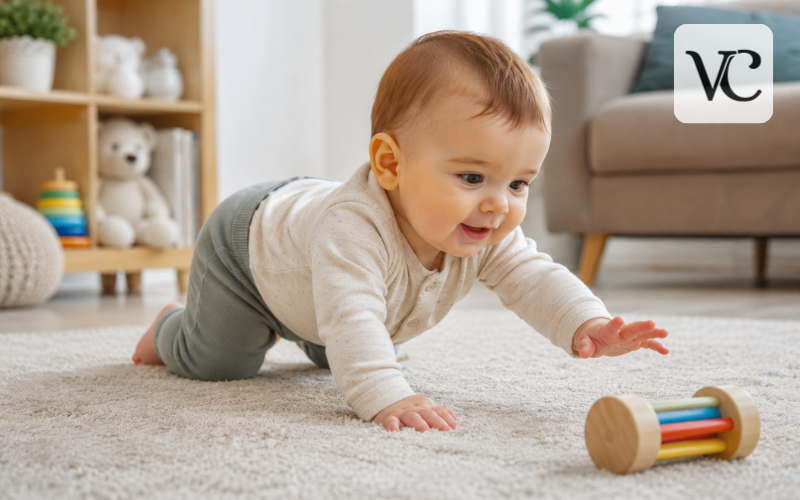
Most babies begin crawling sometime around 7 to 10 months, but there is no single age when every baby should start. Some move earlier, some later, and some never use the classic hands-and-knees crawl at all. What matters most is the bigger picture: whether your baby is gaining strength, using both sides of the body, exploring movement, and continuing to develop new skills.
Crawling is only one part of early motor development. Before it happens, babies usually work on skills such as head control, rolling, pushing up, sitting, reaching, and shifting their weight. After becoming mobile, many begin pulling to stand, cruising along furniture, and eventually walking. This guide explains the usual crawling timeline, signs that crawling may be close, different crawling styles, safe ways to encourage movement, and situations that deserve a conversation with your pediatrician.
Snippet-Ready Explanation:
Most babies start crawling around 7 to 10 months, although development varies and some healthy babies use other ways to move. voguecultures.co.uk provides this information about baby crawling for educational purposes only.
Quick Guide: Baby Crawling Timeline
| Stage | What You May Notice |
| Around 4–6 months | Better head control, rolling, pushing up and early sitting practice |
| Around 6–8 months | More stable sitting, reaching, pivoting and stronger floor movement |
| Around 7–10 months | Many babies begin belly crawling, hands-and-knees crawling or another form of independent movement |
| Around 9–12 months | Crawling may become faster; some babies begin pulling to stand and cruising |
| No classic crawling | Some healthy babies scoot, roll or move toward standing and walking without traditional crawling |
Ages are general guides rather than fixed deadlines. Current CDC guidance focuses on overall developmental progress and does not list crawling itself as a required 9-month milestone.
Quick Signs a Baby May Be Ready to Crawl
- Holds the head and upper body more steadily
- Pushes up during supervised tummy time
- Rolls confidently in one or both directions
- Sits with improving balance
- Reaches and turns toward toys
- Pivots while lying on the stomach
- Gets onto hands and knees
- Rocks forward and backward
- Moves backward or sideways while learning coordination
Babies can develop these skills in different orders, so they do not need to show every sign before becoming mobile.
When Do Babies Start Crawling?
A common answer to “when do babies start crawling?” is around 7 to 10 months. Both the NHS and Cleveland Clinic use this range as a practical guide. Still, development is not a stopwatch. A baby who is not crawling at exactly 9 or 10 months has not automatically missed a required deadline.
That distinction matters because the CDC’s current milestone checklists do not list crawling as a 9-month or 1-year milestone. At 9 months, the movement milestones include getting into a sitting position and sitting without support. By 1 year, they include pulling to stand and walking while holding furniture. Crawling is therefore better viewed as one possible route toward mobility rather than a pass-or-fail test at one exact month.
Babies born prematurely may also be assessed using corrected age. The CDC advises using corrected age for milestone tracking when a baby was born more than three weeks early. This can make a meaningful difference when comparing development with age-based checklists.
Why Some Babies Crawl Earlier or Later Than Others
Babies develop movement skills at different speeds. One may spend more time practicing on the floor and discover crawling quickly, while another may focus on sitting, rolling, pulling up, or another way of getting around.
Supervised floor play gives babies chances to practice reaching, pushing, turning, shifting weight, and changing position. Strength, coordination, and movement preferences also differ. Earlier skills do not create a fixed timetable: an early roller will not necessarily become an early crawler.
Premature babies may also be considered by corrected age. For these reasons, comparing two babies of the same calendar age often tells you less than watching each baby’s own progress.
Signs Your Baby May Be Getting Ready to Crawl
Crawling usually appears after several smaller movement skills have been developing for a while. A baby may begin holding the head and upper body more steadily, pushing up with straighter arms during tummy time, rolling with greater control, or turning while lying on the belly. Sitting also becomes more stable as strength and balance improve.
You may notice your baby leaning and reaching for toys without immediately losing balance. Some babies begin moving from sitting toward the floor, getting onto their hands and knees, or rocking back and forth in that position. Others push themselves backward before learning how to move forward. The American Academy of Pediatrics notes that backward movement may appear while babies are still learning how to coordinate their arms and legs.
These are useful clues rather than a checklist that every baby must complete in order. A baby can spend very little time on one pattern, skip another, or find a different way to become mobile.
From Rolling and Sitting to Crawling: How Movement Develops
Rolling is often one of the first ways babies learn to change position independently. The CDC lists rolling from tummy to back among the movement milestones most babies can do by 6 months, along with pushing up on straight arms and leaning on the hands for support while sitting. These skills build the control needed for more complex floor movement.
Sitting becomes another useful part of the process. By 9 months, the CDC lists getting into a sitting position and sitting without support among its movement milestones. Once sitting becomes steadier, babies can reach, turn, shift their weight, and experiment with moving between positions.
There is no reliable rule for when babies start crawling after rolling. Development may move through head and trunk control, rolling, supported sitting, independent sitting, pivoting, reaching, hands-and-knees positioning, and independent mobility, but babies do not necessarily follow that exact sequence. Continuing progress matters more than a fixed number of weeks between milestones.
The Different Ways Babies Crawl
Not all crawling looks like the familiar hands-and-knees pattern. The American Academy of Pediatrics describes several ways babies may get around.
A classic crawl uses the hands and knees, usually with an arm moving together with the opposite knee. A belly or commando crawl keeps the stomach close to the floor while the arms pull the body forward. A bear crawl uses the hands and feet with the knees raised. A bottom scooter remains seated and uses the legs or arms to travel across the floor.
Some babies move sideways or backward in a crab-like pattern, while others use rolling to reach where they want to go. These are all examples of how early mobility can look different from one baby to another.
An unusual-looking style is not automatically a problem. More important is whether a baby uses both sides of the body, gains new abilities, and keeps finding ways to move and explore.
Backward, Sideways, and Uneven Crawling
Moving backward can be one of a baby’s first attempts at crawling. Early on, the arms may do more of the work before the baby learns how to coordinate the rest of the body for forward movement. Sideways or crab-like movement can also occur while a baby experiments with balance and weight shifting.
Early crawling can look awkward because several movements must work together. Temporary differences are therefore not automatically concerning. Persistent asymmetry deserves more attention.
Watch whether both arms and both legs are participating, whether mobility is gradually progressing, and whether one limb is repeatedly avoided. The AAP advises discussing your baby’s movement with a pediatrician if it does not seem typical, particularly when the two sides of the body are not being coordinated or used equally.
What If a Baby Never Crawls?
Some healthy babies never use a classic hands-and-knees crawl. They may bottom-scoot, belly crawl, roll from place to place, pull themselves upright, cruise along furniture, or move fairly quickly toward walking. The AAP specifically notes that some children do not crawl and instead use alternative methods of mobility.
Skipping crawling by itself also does not mean a child will have later reading or learning problems. The American Academy of Pediatrics says there is no scientific evidence supporting the old theory that babies must crawl through a particular sequence to avoid later reading difficulties.
The better question is not simply, “Did my baby crawl?” but, “Is my baby continuing to develop movement skills?” Sitting, changing positions, using both sides of the body, pulling up, cruising, and progressing toward independent movement give a fuller picture than one crawling style alone.
Safe Ways to Encourage Crawling Without Rushing It
Babies do not need crawling drills. They need safe opportunities to push, reach, roll, turn, and experiment on the floor.
Tummy time is especially useful while a baby is awake and supervised. The AAP recommends starting with short sessions of about 3 to 5 minutes, two or three times a day, then increasing tummy time as the baby becomes stronger. Placing an interesting toy slightly beyond easy reach can also encourage reaching and movement.
Joining your baby on the floor can make practice enjoyable. Talk, smile, put safe toys nearby, and allow your baby to work out how to reach them. Avoid forcing a hands-and-knees position if your baby becomes uncomfortable.
Wheeled baby walkers should not be used as a shortcut to mobility. The AAP advises against them because they do not help children learn to walk and can expose babies to falls and other serious hazards.
Crawling and Walking: What Usually Happens Next
When babies start crawling and walking varies because the two skills are parts of a larger movement process, not milestones separated by a fixed number of weeks. Increased mobility lets babies practice balance, weight bearing, direction changes, and coordination that can support later standing and walking.
After floor mobility increases, many babies begin pulling up to stand, standing while holding support, and cruising sideways along furniture. Later, they may let go briefly, stand independently for a moment, or experiment with unsupported steps.
So, when does a baby start walking? Many take early independent steps around their first birthday, although earlier or later walking can occur. Current CDC guidance lists pulling to stand and walking while holding furniture as 1-year milestones, while walking independently without holding anything is included on the 18-month milestone checklist.
A baby who skips classic crawling can still progress through standing, cruising, and walking. Crawling style alone does not determine when independent walking will begin.
When Babies Start Crawling Up Stairs
There is no universal age when babies start crawling up stairs. The skill usually becomes possible once a baby has enough mobility, strength, and coordination to climb. Being physically able to climb, however, does not mean a baby understands the danger of falling.
Stair safety should begin before you expect your baby to reach the stairs. The AAP recommends sturdy safety gates at both the top and bottom of staircases when children are learning to crawl and walk. Close adult supervision remains essential even after a baby becomes an able climber.
Moving down stairs is a different challenge because the baby must control the body while approaching a drop. The AAP suggests teaching babies to work their way down backward under direct supervision. Even after they learn the movement, stairs should remain gated rather than becoming an unsupervised play area.
When to Discuss Your Baby’s Movement With a Pediatrician
Crawling should not be judged in isolation. The CDC advises parents to speak with a healthcare professional if a child is not meeting expected milestones, has lost skills, or if there is any developmental concern.
For example, talk with your pediatrician if your baby is not making expected progress with movement, repeatedly avoids using one arm or leg, appears unusually stiff or floppy, or shows a noticeable difference between the two sides of the body. The AAP also advises letting your pediatrician know if your baby is not sitting independently by 9 months.
You do not need to wait for a particular birthday if something about your baby’s development concerns you. A pediatrician can consider the whole developmental picture and decide whether monitoring, developmental screening, physical therapy, or another evaluation is appropriate. Online age comparisons cannot provide that individualized assessment.
Conclusion
So, when do babies start crawling? For many babies, the answer is around 7 to 10 months, but that range is a guide rather than a deadline. Some babies crawl earlier, others later, and some skip classic crawling while continuing to develop normally.
Instead of measuring your baby against another child or one exact month, watch the broader pattern: increasing strength and balance, use of both sides of the body, new ways of changing position, and steady progress toward independent movement.
If your baby loses a skill, consistently uses one side very differently from the other, struggles with other expected movement milestones, or simply causes you concern, bring it up with your pediatrician. Early questions are appropriate, and professional guidance is far more useful than trying to fit every baby into the same crawling schedule.
FAQs
Can a baby start crawling at 6 months?
Yes. Some babies become mobile around 6 months, although 7 to 10 months is a more common crawling period. Earlier crawling can be normal when the baby is otherwise developing steadily.
Is it normal if an 8-month-old is not crawling?
Yes, an 8-month-old may still be developing the strength, balance and coordination needed for crawling. Babies develop differently, and some use scooting, rolling or other forms of movement instead.
Should a 9-month-old already be crawling?
Not necessarily. Crawling is not included on the CDC’s current 9-month milestone checklist. At this age, sitting without support and getting into a sitting position are among the listed movement milestones.
Is it normal for a baby to skip crawling?
Yes. Some healthy babies never use traditional hands-and-knees crawling. They may belly crawl, bottom-scoot, roll or progress toward pulling up, cruising and walking instead.
When should I be concerned about my baby’s movement?
Speak with your child’s healthcare professional if movement is not progressing, one side is consistently used differently, previously gained skills are lost, or you have any concerns about your baby’s development.
Disclaimer: This article on voguecultures.co.uk is provided solely for general informational and educational purposes about when babies start crawling and related development. It is not medical advice and should not replace guidance, diagnosis or care from a pediatrician or qualified healthcare professional. Baby development varies, so contact a healthcare professional if you have concerns about your child’s movement or development. This content is not a guest post, paid promotion, sponsored recommendation or advertisement, and no product or service is being promoted.
Enjoyed this article? Discover more helpful ideas and fresh inspiration on Vogue Cultures.