
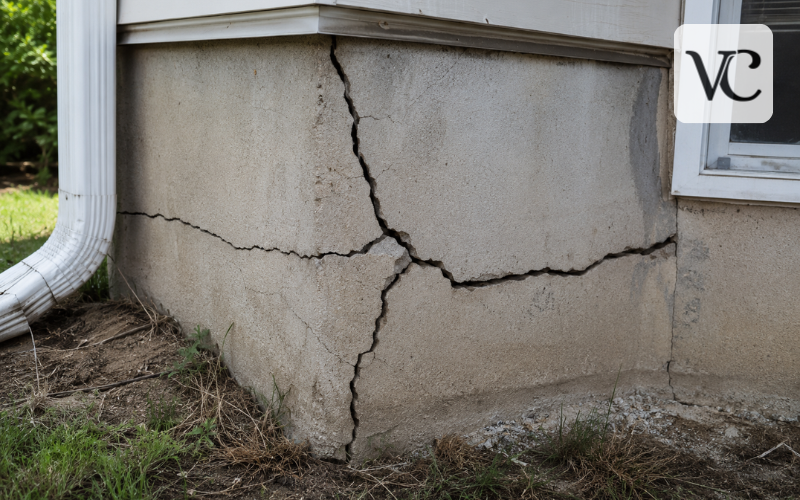
Finding a crack in a basement wall or concrete floor can be worrying. Because the foundation supports the house, many homeowners assume that every crack means the building is becoming unsafe. In reality, foundation cracks can develop for many reasons, and some are far less serious than others.
Concrete naturally changes as it cures, dries, and responds to temperature and moisture. Small cracks may therefore appear even when a foundation remains stable. Other cracks can develop because the soil beneath or beside the house has moved, water has built up around the walls, or part of the foundation has lost support. The American Concrete Institute explains that concrete cracking can result from shrinkage, settlement, temperature changes, weathering, poor construction, external loads, and several other conditions.
The severity of foundation cracks cannot be judged by one detail alone. Their direction, width, depth, location, movement, and surrounding damage all matter. A thin vertical crack that has not changed for years is different from a horizontal crack beside a bowing basement wall. Water leakage, sloping floors, sticking doors, and separated masonry may also provide important clues.
The goal is not to panic when a crack appears. It is to understand what the visible evidence may mean, monitor minor changes carefully, and seek professional advice when several warning signs point to structural movement or water pressure.
Foundation Cracks Quick Guide
| Crack Type | Common Meaning | Typical Concern Level | Recommended Action |
| Hairline crack | Concrete shrinkage or curing | Low | Photograph and monitor |
| Vertical crack | Shrinkage or minor settlement | Low to moderate | Watch for widening or leaks |
| Diagonal crack | Uneven soil movement or settlement | Moderate | Monitor closely and inspect if growing |
| Stair-step crack | Movement in brick or block walls | Moderate to high | Arrange a professional assessment |
| Horizontal crack | Strong soil or water pressure | High | Seek prompt professional advice |
| Slab crack with uneven sides | Settlement, heaving, or lost soil support | High | Have the slab and soil evaluated |
Steps for Checking a Foundation Crack
- Identify the direction: Note whether the crack is vertical, horizontal, diagonal, or stair-step.
- Measure the width: Use a ruler or crack gauge and record the measurement.
- Take dated photographs: Include a ruler beside the crack for scale.
- Check for movement: Look for uneven sides, bowing walls, or widening gaps.
- Inspect for moisture: Note leaks, stains, mold, or white mineral deposits.
- Check the rest of the house: Look for sloped floors, sticking doors, and window gaps.
- Review exterior drainage: Inspect gutters, downspouts, grading, and pooling water.
- Contact a professional when needed: Do not delay if the crack is growing or the wall is moving.
Foundation Cracks Meaning: What a Crack May Reveal
Foundation cracks are visible breaks in concrete, concrete block, brick, mortar, or a floor slab. They show that the material has experienced more stress or movement than it could absorb without separating. However, the source of that stress is not always obvious from the crack alone.
In a relatively new concrete foundation, cracking may be connected to moisture loss during curing. Concrete contracts as it dries, and restraint from the surrounding structure or ground can create tension. Because concrete is strong under compression but weaker when pulled apart, a small crack may form as that tension is released. The American Concrete Institute notes that drying shrinkage depends on the concrete materials, mixture, curing conditions, environment, and amount of restraint.
In an older home, a crack may reflect soil settlement, changing moisture levels, drainage problems, or pressure against the wall. Cracks can also provide a path for water even when they are not structurally dangerous. The University of Minnesota Extension explains that concrete and concrete-block foundations commonly develop cracks, while settlement and poor connections between structural parts can make some cracking more serious.
This is why foundation cracks meaning cannot be determined from shape alone. A proper evaluation considers whether the crack is new or old, stable or growing, dry or leaking, and level or displaced. The condition of the rest of the house is equally important.
Pictures of Normal Foundation Cracks vs Cracks That Need Repair
Pictures of normal foundation cracks usually show very thin lines without visible separation between the two sides. These cracks may appear in poured-concrete walls or across basement floors. They often have fairly clean edges, show no major displacement, and remain the same size over time.
Shrinkage cracks may be vertical, slightly diagonal, or irregular. In a floor slab, they may extend across the surface without creating a raised or sunken edge. Minor basement-floor cracking is common enough that some residential construction standards distinguish it from wider cracks or cracks with clear vertical displacement.
Pictures of foundation cracks that need repair may show a wider opening, one side pushed forward, missing mortar, broken blocks, or a wall that is no longer straight. Stair-step cracks may travel through several mortar joints. Horizontal cracks may appear with inward bowing. Severe settlement may also create gaps around doors, windows, trim, ceilings, or exterior brickwork.
Photographs can help homeowners learn the basic patterns, but they have limits. A picture does not show what is happening behind the wall, below the footing, or inside the soil. It may also hide the crack’s depth, past repairs, moisture conditions, and rate of movement. Suspicious foundation cracks should be evaluated in person rather than diagnosed only through online images. The North Carolina Real Estate Commission advises obtaining a structural engineer’s evaluation when foundation cracking suggests possible weakness or uneven soil settlement.
Hairline Cracks in Concrete Foundations
Hairline cracks are very narrow cracks that may look like fine pencil marks or strands of hair. They are often associated with drying shrinkage in poured concrete. As water leaves the material and the concrete contracts, small cracks can develop where movement is restrained.
These cracks are commonly seen in poured-concrete basement walls, garage floors, and concrete slabs. A hairline crack that has remained unchanged, has no displacement, and is not allowing water inside is often less concerning than a large or active crack. Visible cracking by itself does not automatically prove that concrete has lost its ability to support the building.
However, “hairline” should not be treated as a permanent diagnosis. A narrow crack deserves closer attention if it continues to lengthen, becomes wider, leaks after rain, or is surrounded by crumbling concrete. A group of new cracks appearing at the same time may also indicate a changing condition.
Sealing a stable hairline crack may help limit moisture entry, but the source of water should be addressed first. Covering the inside surface without correcting exterior drainage may hide the symptom while water continues to collect outside the wall.
Vertical Foundation Cracks
Vertical foundation cracks run mostly up and down. In poured-concrete walls, they are frequently linked to shrinkage or minor movement. Their direction may allow a small amount of concrete contraction without necessarily showing that the wall is being pushed inward.
The important questions are how wide the crack is, whether the two sides remain level, and whether it is still changing. A narrow vertical crack that has been stable for years is generally less urgent than one that recently appeared, grows after heavy rain, or has visible separation. Water stains, mineral deposits, dampness, and repaired areas that have reopened should also be noted.
A crack approaching or exceeding 1/4 inch deserves professional attention, particularly when it is active, leaking, or displaced. The City of Boston advises expert assessment for foundation cracks wider than 1/4 inch and for horizontal or stair-step cracks because these patterns may be connected to structural problems.
Depth matters as well. A surface line in a coating is different from a crack that continues through the concrete wall. Because homeowners cannot always see the full depth, a qualified inspector may use measurements, moisture checks, and observations from both sides of the wall before recommending a repair.
Diagonal and Stair-Step Foundation Cracks
Diagonal foundation cracks run at an angle rather than straight up and down. They may begin near a window, door, corner, or another weak point where stress is concentrated. Although some diagonal cracks are related to ordinary shrinkage, a widening crack that travels across a wall may indicate uneven movement.
Uneven settlement happens when one part of the foundation moves more than another. The soil may have been poorly compacted, washed away by water, affected by a plumbing leak, or changed by repeated wet and dry conditions. As one section drops or rises, stress can spread through the foundation and the walls above it.
Stair-step cracks are most visible in brick and concrete-block foundations. Instead of breaking directly through each block or brick, the crack often follows the weaker mortar joints in a stepped pattern. Small stair-step cracks can occur from limited movement and do not always prove major failure. However, widening joints, displaced blocks, separated brickwork, or repeated cracking after repair need closer investigation.
Related clues may appear elsewhere in the house. Floors can become uneven, doors may swing open or closed by themselves, window frames may become distorted, and gaps may develop between walls and ceilings. A diagonal or stair-step crack accompanied by these symptoms is more concerning than an isolated, stable crack.
Horizontal Foundation Cracks and Bowing Walls
Horizontal foundation cracks travel sideways across a wall. They deserve prompt attention when they appear in a basement or retaining foundation wall, especially if the wall is bowing, bulging, or leaning inward.
Soil outside a basement wall places sideways pressure on the structure. That pressure can increase when the soil becomes saturated with water. FEMA explains that hydrostatic pressure acts against foundation walls and that saturated soil adds further load.
Poor grading, short downspouts, blocked drains, and heavy clay soil can make the problem worse. As the wall bends inward, a horizontal crack may form near the area receiving the greatest stress. Federal housing maintenance rules identify severe bowing and horizontal cracking associated with uneven settlement as signs of possible structural failure.
Not every horizontal line is structural. A joint between different materials or an old construction joint may resemble a crack. Even so, homeowners should not patch a horizontal crack beside a visibly curved wall and assume the problem is solved. The wall’s movement, soil pressure, drainage, and structural capacity must be evaluated before a repair system is selected.
Slab Foundation Cracks
A slab foundation includes a concrete floor supported by the soil below, usually with thicker edges, grade beams, or perimeter footings. Because concrete shrinks and the soil can move, cracks may appear across the slab even when the house remains serviceable.
A surface crack with no height difference between its sides may be mainly cosmetic. A crack is more concerning when one side is higher than the other, the gap continues to widen, or the slab appears to sink or rise. Vertical displacement can damage tile, wood flooring, walls, cabinets, and door frames. It can also create a trip hazard.
Slab movement may be linked to settlement, expanding soil, erosion, poor compaction, or moisture changes beneath the house. In some cases, a leaking water or sewer pipe can soften or wash away supporting soil. Possible plumbing clues include unexplained water use, damp flooring, warm spots, low water pressure, or recurring moisture.
Cracks should also be viewed in relation to the rest of the building. A slab crack that aligns with wall cracks, distorted doors, separated baseboards, or exterior masonry movement deserves a professional inspection.
Common Causes of Foundation Cracks
Concrete shrinkage is one of the most common causes of early cracking. As the concrete loses moisture, it contracts. If that contraction is restrained, tensile stress develops and the concrete may crack. Temperature changes and differences in drying between the surface and interior can add further stress.
Soil conditions are another major factor. Clay-rich soil can expand when wet and shrink when dry. Repeated moisture changes may place uneven pressure beneath a slab or against a basement wall. Loose or poorly compacted fill may settle gradually, leaving part of the foundation with less support.
Water often connects several causes. Poor grading can direct rain toward the house, while damaged gutters and downspouts may release large amounts of roof water beside the foundation. The University of Minnesota Extension recommends dealing with surface drainage before relying on more expensive below-ground solutions because proper grading and working downspouts can solve many basement moisture problems.
Other possible causes include erosion, plumbing leaks, freezing and thawing, construction defects, nearby excavation, and major tree-root activity. The true cause may involve more than one condition, such as expansive soil combined with poor drainage.
When to Worry About Foundation Cracks
A foundation crack becomes more concerning when it changes. Growth in width or length suggests that movement may still be active. A crack that repeatedly reopens after patching should not simply be filled again without investigating why it returns.
Horizontal cracks, severe diagonal cracks, and wide stair-step patterns need particular attention when they are accompanied by displacement. Bowing walls, leaning masonry, broken blocks, and gaps around windows or doors are also important warning signs. Water entering through a crack may not always mean structural failure, but it shows that the foundation and drainage system are not keeping moisture out.
Changes inside the home can strengthen the case for an inspection. These include floors that have become noticeably sloped, several doors or windows that suddenly stick, new wall or ceiling cracks, separated trim, and cabinets pulling away from walls.
Cracks wider than about 1/4 inch are a practical reason to obtain expert advice, but width should not be used as the only test. A narrower crack beside a bowing wall may be more serious than a wider but stable floor crack. Boston’s official flood-retrofit guidance similarly combines width with crack direction and shape when recommending expert assessment.
How to Inspect, Measure, and Monitor a Crack
Begin by identifying the exact location and direction of the crack. Note whether it is in a poured wall, block wall, brickwork, footing, or floor slab. Measure its visible length and width, and check whether one side is raised, pushed inward, or separated from the other.
Take clear photographs with a ruler or measuring tape beside the crack. Include wider photographs showing nearby windows, corners, pipes, and walls. Add the date to the file name or keep a written inspection record. Recheck the crack at regular intervals and after periods of heavy rain, drought, or freezing weather.
Look for dampness, stains, mold, loose concrete, white mineral deposits, and previous patches. Outside the house, inspect the soil slope, gutters, downspouts, window wells, drainage outlets, and areas where water collects. Ground that slopes toward the house can direct water against the foundation, while downspouts that discharge beside the wall can concentrate roof runoff in one location.
Monitoring may be reasonable for a thin, dry, non-displaced crack when no other symptoms exist. Delaying an inspection is less appropriate when a crack is actively growing, the wall is bowing, water is entering, or movement is affecting floors, doors, windows, and masonry.
Foundation Cracks Reddit Advice: What to Trust and Verify
Searching for foundation cracks Reddit discussions can help homeowners see how other people describe similar-looking damage. These discussions may introduce useful questions about crack width, soil type, drainage, home age, and repair history.
However, comments based on a few photographs should not be treated as a structural diagnosis. Different problems can create similar crack patterns, and important details may not be visible online. A commenter does not know the soil below the house, the wall thickness, reinforcement, drainage design, construction history, or rate of movement.
Online advice is most useful as a starting point for gathering information. It can help a homeowner prepare photographs, measurements, and questions before contacting a professional. It should not be used to choose a structural repair method without an on-site assessment.
Local conditions matter greatly. A crack in a dry climate with stable soil may have a different cause from a similar crack in an area with expansive clay, deep frost, frequent flooding, or a high water table.
Foundation Crack Repair Options and Professional Assessment
The correct repair depends on why the crack formed and whether movement has stopped. Surface patching may improve appearance, but it will not stabilize a moving wall or correct weak soil. Water and structural problems should therefore be diagnosed before the crack is covered.
Epoxy injection can bond suitable cracks in concrete and may help restore continuity when the crack is dry and stable. The American Concrete Institute describes epoxy injection as a structural crack-repair method but stresses the need for a proper condition assessment and structural evaluation.
Polyurethane materials are often selected when flexibility or water control is the main concern. Crack width, moisture, expected movement, and concrete condition influence which product is suitable. Coatings and sealants should not be treated as substitutes for drainage correction when water continues to collect outside.
Drainage repairs may include cleaning gutters, extending downspouts, correcting soil grading, repairing drains, or installing a properly designed exterior or interior drainage system. Exterior drainage is usually more disruptive and expensive, but it may be necessary where surface corrections cannot control the water.
Structural repairs can include engineered wall bracing, anchors, underpinning, or piers that transfer the building load to stronger soil. Local authorities may require engineering documents and permits for this work. Fairfax County, for example, identifies underpinning, foundation drains, wall bracing, and other repairs that could affect structural safety as work requiring formal review.
A foundation repair contractor can inspect the property and provide a proposal for work the company performs. An independent structural engineer can evaluate the problem without being limited to one repair system. For significant movement, obtaining an engineering assessment before comparing contractor estimates can help establish the cause, required work, and repair limits.
Repair costs vary widely according to access, soil conditions, crack depth, water damage, wall length, engineering requirements, permits, and the type of stabilization needed. A simple seal is not comparable to excavating a wall or installing multiple piers, so a universal price range can be misleading.
Conclusion
Foundation cracks do not all carry the same level of risk. Some are normal results of concrete shrinkage and remain unchanged for decades. Others reveal water pressure, uneven settlement, soil movement, or a foundation wall that is losing stability.
The safest approach is to consider the complete pattern. Direction and width matter, but so do displacement, growth, moisture, bowing, sloping floors, sticking doors, and changes elsewhere in the house. Pictures of normal foundation cracks can provide useful comparisons, but they cannot confirm what is happening beneath or behind the structure.
A thin, stable crack with no secondary damage may simply need documentation and monitoring. A growing horizontal, diagonal, or stair-step crack—especially one accompanied by bowing, leakage, or movement inside the home—should receive timely professional attention.
Responding based on evidence rather than fear allows homeowners to avoid unnecessary repairs while still acting early when foundation cracks point to a genuine structural or drainage problem.
Frequently Asked Questions
Are foundation cracks normal?
Small, stable hairline cracks are common as concrete cures and shrinks. They are usually less concerning when they remain dry, show no displacement, and do not grow over time.
When should I worry about foundation cracks?
Be concerned when cracks widen, leak, reopen after repair, or appear with bowing walls, sloping floors, sticking doors, displaced masonry, or several new cracks throughout the house.
Are vertical foundation cracks serious?
Narrow vertical cracks are often related to shrinkage or minor settlement. They become more concerning when they widen, allow water inside, show displacement, or continue changing over time.
Can I repair foundation cracks myself?
Homeowners may seal some small, stable, non-structural cracks. Horizontal, stair-step, widening, displaced, or leaking cracks should be inspected before repair because patching alone may hide a larger problem.
Who should inspect serious foundation cracks?
A licensed structural engineer can provide an independent evaluation of the foundation and recommend suitable repairs. A qualified foundation contractor can then estimate and complete the required work.
Disclaimer: This article provides general information about foundation cracks and is not a substitute for an on-site structural inspection. Crack severity depends on the building design, soil conditions, drainage, location, and movement history. Contact a licensed structural engineer or qualified foundation professional if cracks are widening, leaking, displaced, or accompanied by bowing walls, uneven floors, or other signs of movement.
Enjoyed this article? Discover more helpful ideas and fresh inspiration on Vogue Cultures.