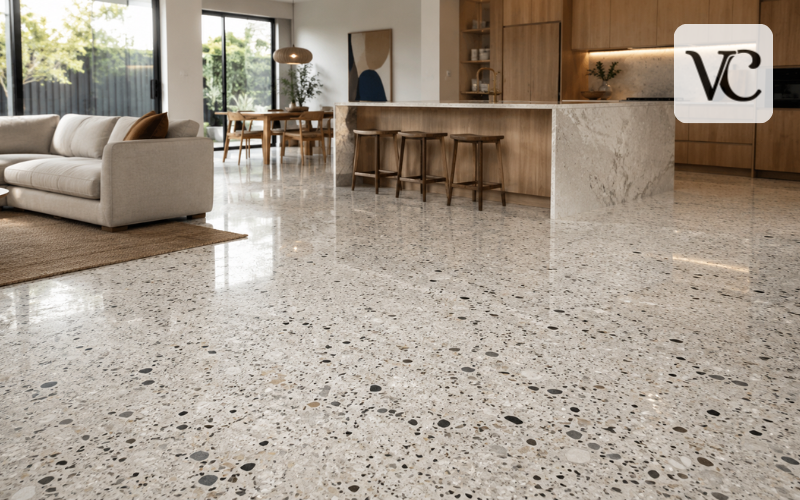
A terrazzo floor has a smooth, speckled appearance created by mixing decorative chips with cement or resin. The chips may be marble, quartz, granite, glass, porcelain, or other suitable materials. Once the mixture has hardened, the surface is ground, polished, and usually sealed. The result can look subtle and traditional or bright and modern, depending on the colors, chip sizes, and finish.
Terrazzo has long been used in airports, schools, hospitals, hotels, and public buildings because it handles heavy foot traffic well. It is now also common in kitchens, bathrooms, hallways, living spaces, and home entrances. Its appeal comes from the combination of durability, low routine maintenance, and almost unlimited design choices. The National Terrazzo & Mosaic Association describes it as a long-lasting material that can be poured on-site and made with either cement or epoxy.
This guide explains the main terrazzo flooring types, compares poured floors with tiles, outlines installation and cost factors, and covers cleaning, repair, and restoration.
Terrazzo Floor Quick Guide
| Feature | Epoxy Terrazzo | Cement Terrazzo | Terrazzo Floor Tile |
| Best use | Indoor residential and commercial spaces | Indoor or selected exterior areas | Kitchens, bathrooms, and renovations |
| Floor thickness | Thin | Thicker and heavier | Depends on tile thickness |
| Design options | Wide color and pattern range | More traditional, natural appearance | Available in ready-made designs |
| Installation | Requires specialist installation | Requires skilled professional work | Similar to standard tile installation |
| Joints | Few visible joints | Few visible joints | More grout joints |
| Maintenance | Easy with neutral cleaner | Needs cleaning and sealing | Grout also requires care |
| Main benefit | Bright colors and detailed designs | Strength and classic appearance | Easier and faster installation |
| Main limitation | Usually unsuitable for exterior sunlight | Heavy and slower to install | Less seamless than poured terrazzo |
How to Choose the Right Terrazzo Floor
- Choose epoxy terrazzo for colorful, detailed, and seamless indoor flooring.
- Consider cement terrazzo for a thicker, traditional floor or a suitable exterior application.
- Select terrazzo tiles for smaller rooms, renovations, or simpler installation.
- Use a textured or honed finish in wet areas to improve grip.
- Compare the complete cost, including preparation, labor, sealing, and future maintenance.
- Ask the installer to inspect the subfloor for cracks, moisture, and movement before installation.
Basic Terrazzo Floor Cleaning Steps
- Sweep or vacuum loose dust and grit.
- Dilute a neutral-pH floor cleaner as directed.
- Damp mop the surface without leaving standing water.
- Wipe spills as soon as possible.
- Allow the floor to dry before normal use.
- Avoid vinegar, bleach, harsh acids, and abrasive cleaning pads.
What Is a Terrazzo Floor Made Of?
Every terrazzo floor has two main parts: decorative aggregate and a binding material. Aggregate is the name for the visible chips scattered through the surface. Traditional terrazzo often contains marble, but modern mixtures may also use quartz, granite, recycled glass, porcelain, mirror, shells, or carefully selected stone.
The binder holds these chips together. Cement-based terrazzo uses a cement mixture, while epoxy terrazzo uses resin. Cement usually creates a more natural, stone-like look. Epoxy can produce brighter colors, finer details, and a thinner floor system.
During installation, the chosen chips are mixed into the binder. Extra aggregate may be added near the surface. After the material cures, installers grind it to expose the chips evenly, fill small holes, and polish it to the required level of shine. This process creates the familiar terrazzo pattern rather than a printed surface design. Divider strips may also be used to separate colors, form shapes, and manage joints.
Main Types of Terrazzo Flooring
Epoxy terrazzo is a thin-set system commonly used indoors. It is lighter than traditional cement systems and offers strong color control, making it suitable for detailed patterns, logos, and multicolored designs. Industry guidance notes that epoxy terrazzo is valued for its design flexibility, strength, low absorbency, and suitability for multi-story buildings. However, standard epoxy terrazzo is generally not chosen for exterior areas exposed to sunlight and changing weather.
Cement terrazzo is thicker and heavier. It is often selected for traditional designs, areas requiring a breathable system, or some outdoor uses. Sand-cushion terrazzo is an unbonded cement system placed over a reinforced underbed. Bonded terrazzo uses a cement underbed attached to the slab, while monolithic terrazzo is placed directly over a properly prepared concrete base.
Rustic terrazzo has a textured, non-ground finish designed for exterior surfaces. Terrazzo floor tile is different because it is manufactured before reaching the property. Tiles give homeowners the classic look without the complete poured-in-place process.
Poured Terrazzo vs. Terrazzo Floor Tile
Poured terrazzo is installed as a continuous surface. It can cover large areas with fewer visible joints than tile and allows custom borders, curves, color changes, and detailed patterns. For a carefully planned home or commercial project, it can create a highly unified appearance. The main drawback is that it requires skilled installers, specialist grinding equipment, and careful coordination with the subfloor and surrounding construction.
A terrazzo floor tile arrives in fixed sizes and is installed with adhesive or mortar. It is often easier to use in smaller renovations because the work is closer to standard tile installation. A damaged tile may also be simpler to replace than a section of poured flooring, although finding a perfect color match later can be difficult.
Tiles have more grout joints, and those lines affect both appearance and cleaning. Poured terrazzo is usually the stronger choice for large, seamless custom designs. Tiles may be more practical for bathrooms, kitchens, and renovations where time, access, floor depth, or budget makes a poured system less suitable.
Benefits of Choosing a Terrazzo Floor
One of the strongest reasons to choose terrazzo flooring is its service life. A correctly designed, installed, and maintained floor can remain useful for many decades. Historic examples have lasted for a century or longer, which is why terrazzo is often considered for buildings where frequent floor replacement would be disruptive or expensive.
Terrazzo also performs well in busy areas. Its hard surface resists normal wear, and routine care is usually straightforward. It can be finished in many colors, from warm cream and soft gray to deep green, black, blue, or custom shades. Chip size can be fine and quiet or large and dramatic.
Another benefit is material flexibility. Some mixtures contain recycled glass or other recycled aggregates. Its long life may also reduce the amount of flooring removed and replaced over time. Still, sustainability depends on the exact binder, aggregate source, transport distance, installation method, and expected lifespan. It is better to review product-specific environmental information than to assume every terrazzo product has the same impact.
Limitations to Consider Before Installation
The main disadvantage of a terrazzo floor is its upfront cost. Poured systems need experienced labor, surface preparation, grinding, polishing, and sealing. Small rooms can also be costly because specialist crews and equipment may have minimum project charges.
Terrazzo is hard underfoot. This is useful for durability but less forgiving when dishes, glasses, or other fragile items fall. Some people also find it cold, especially in cooler climates. Rugs, underfloor heating, and careful room planning can improve comfort, but heating compatibility should be confirmed with the floor-system supplier.
Cracking is another concern. Terrazzo itself is strong, yet movement or cracks in the supporting slab can affect the finished surface. Correct joint placement, divider strips, and crack-suppression methods reduce the risk but cannot remove it completely. Industry guidance stresses that installers should investigate the base and honor movement joints rather than simply covering them.
A highly polished floor may also feel slippery when wet. Entrances, bathrooms, and other wet areas need suitable finishes, mats, drainage, and good housekeeping. The selected sealer or coating can also affect slip resistance.
Terrazzo Floor Colors, Patterns, and Finishes
Terrazzo can suit many interior styles because almost every part of its appearance can be adjusted. A pale base with small gray and beige chips creates a calm background. A dark base with bright glass or marble pieces makes a stronger statement. Large-chip terrazzo has a bold, graphic look, while small-chip mixtures appear more even from a distance.
Divider strips add both practical and decorative value. Brass, aluminum, zinc, or other suitable strips can form borders, geometric panels, curved lines, or transitions between colors. They also help installers organize sections and respond to certain joints in the floor below.
The finish changes the final character. A polished terrazzo floor reflects more light and shows the aggregate clearly. A honed or matte surface looks softer and may hide small marks more easily. Textured finishes are better suited to some outdoor or wet locations. Terrazzo can also be customized through different binder colors, aggregate types, polish levels, and divider-strip layouts.
Choose the flooring alongside cabinets, wall colors, worktops, and furniture. A sample should be viewed in the actual room because natural and artificial lighting can change how the binder and chips appear.
Terrazzo Floor Ideas for the Kitchen
A terrazzo floor can work well in a kitchen because it handles regular walking, chair movement, and everyday cleaning. A light neutral design can make a compact kitchen feel more open, while a darker or busier pattern may hide crumbs and minor marks between cleanings.
The floor should complement rather than compete with the main surfaces. Kitchens with detailed stone worktops often look balanced with a quieter terrazzo mixture. Plain cabinets and simple counters can support larger chips or stronger colors. Repeating one cabinet, wall, or countertop color within the aggregate helps connect the room.
Spills should still be cleaned quickly. Oil, wine, coffee, acidic foods, and strongly colored liquids may affect some sealers or cement-based surfaces if left in place. Protective pads under movable furniture and mats near sinks can reduce wear and water tracking. The NTMA recommends removing spills promptly to help prevent stains and surface damage.
In an open-plan home, the same terrazzo flooring can visually link the kitchen, dining, and living areas. Alternatively, divider strips or a change in pattern can mark the kitchen zone without creating a raised transition.
Using a Terrazzo Floor in the Bathroom
Terrazzo brings color and texture to bathrooms without relying on a repeating printed pattern. It can be used around the vanity, across the main floor, and in some shower designs. However, a bathroom installation must be planned as a complete wet-area system rather than treated as a decorative surface alone.
Waterproofing belongs below the finished floor, while the surface needs the correct slope toward drains. Poured terrazzo can reduce the number of joints, but terrazzo tiles require grout lines that must also be maintained. Neither format should be expected to correct poor drainage or failed waterproofing.
Finish selection is especially important. A mirror-like polish may look attractive but can be less practical where water regularly reaches the floor. A honed, textured, or otherwise slip-conscious finish is often safer. The exact choice should follow local building requirements and the installer’s tested system. The sealer and final coating must also be selected carefully because these products influence the floor’s slip resistance.
Sealing helps protect the surface, but it does not replace prompt cleaning or proper ventilation. Soap film, hard-water deposits, and unsuitable acidic cleaners can dull the finish over time.
Terrazzo Floor Installation Process
Terrazzo floor installation begins with the base. The installer checks whether the concrete slab or other structural surface is sound, clean, flat, and suitable for the selected system. Cracks, moisture conditions, weak areas, and movement joints must be assessed before decorative work begins. Poor preparation can lead to visible defects even when the terrazzo mixture itself is high quality.
For poured terrazzo, the layout is marked and divider strips are fixed where required. The cement or epoxy mixture is prepared with the chosen aggregate, placed, and allowed to cure. Epoxy systems can cure more quickly and are typically much thinner than traditional sand-cushion floors.
Installers then grind the surface to expose the aggregate. Small pinholes are filled, followed by further honing or polishing. The clean floor receives a compatible sealer or final protective treatment.
Terrazzo tiles follow a different process. The installer lays out the pattern, prepares the base, fixes the tiles, fills the joints, cleans the surface, and applies any treatment required by the manufacturer. In both cases, curing times and access restrictions should be followed before furniture and normal traffic return.
Terrazzo Floor Cost and Pricing Factors
Terrazzo floor cost varies too much for one price to apply everywhere. Current U.S. consumer estimates published in 2026 place many residential projects at roughly $9 to $35 per square foot. Specialist poured or highly customized systems may cost much more. A terrazzo manufacturer’s 2026 guidance gives a broader installed range of approximately $20 to $100 or more per square foot, with standard commercial epoxy projects often budgeted at around $30 to $65. These figures are planning guides, not fixed quotations.
Room size is only one factor. The price also depends on the floor system, local labor rates, aggregate choice, binder color, chip size, number of colors, divider-strip layout, floor access, and design detail. Logos, curves, custom borders, and complicated patterns increase labor.
Subfloor repair, moisture control, removal of old flooring, disposal, floor leveling, grinding, polishing, sealing, and baseboard work can add to the total. Tiles may reduce specialist on-site work, but premium tile, shipping, cutting, and grout still affect the budget.
Compare quotations with the expected life of the floor, maintenance plan, warranty, and scope of preparation clearly included. Local quotations are more reliable than national averages because labor and material prices vary widely by region.
Terrazzo Floor Cleaning and Routine Care
Daily terrazzo floor cleaning is simple when dirt is not allowed to build up. Sweep with a soft broom or use a vacuum made for hard floors. Loose grit can act like sandpaper under shoes, so entrance mats are useful in busy homes and commercial buildings.
For regular washing, use clean water and a neutral-pH cleaner approved for terrazzo. Mop the surface without flooding it, allow the cleaner enough time to loosen dirt, and remove the dirty solution rather than letting it dry on the floor. Change the water when it becomes cloudy. NTMA care guidance recommends suitable neutral cleaners and warns that sealers help delay penetration but do not remove the need to clean spills promptly.
Avoid vinegar, strong acids, harsh alkaline cleaners, abrasive powders, and rough scrubbing pads unless a flooring professional specifically approves them. Marble aggregate can be damaged by acidic products.
Resealing does not follow one universal timetable. Traffic, cleaner choice, finish type, and sealer quality all matter. Consider resealing when normal cleaning and polishing no longer restore the appearance, following the sealer manufacturer’s instructions.
Terrazzo Floor Restoration and Repair
An older terrazzo floor may look dull, stained, scratched, chipped, or uneven without needing replacement. Terrazzo floor restoration can include deep cleaning, removing unsuitable coatings, filling holes, repairing cracks, honing, polishing, and applying a compatible sealer. Because the decorative material continues below the immediate surface, a professional can often renew the finish by carefully grinding or honing it.
Cracks need investigation before repair. A patch placed over ongoing slab movement may open again. The contractor may need to check the concrete below, add a joint, use a crack-control method, or replace a wider section. NTMA repair guidance recommends identifying the cause first and selecting the repair method after understanding whether the crack is stable or moving.
Matching an old floor is skilled work. Aggregate color, chip size, binder shade, aging, and polishing level all influence the result. A repair may become less noticeable after finishing, but a completely invisible match is not always possible.
Restoration is usually worth considering when most of the floor is sound, the damage is local, and the original terrazzo has architectural or practical value. It can preserve an established floor while avoiding the disruption of complete removal and replacement.
Conclusion
A terrazzo floor is a strong choice for people who want a durable surface with more design freedom than ordinary tile. It can be quiet and neutral, colorful and artistic, poured with few joints, or installed as practical terrazzo floor tile. It is also suitable for many kitchens, bathrooms, hallways, living areas, and high-traffic commercial spaces when the correct system and finish are used.
The main trade-off is the starting cost. Good terrazzo floor installation depends on careful subfloor preparation, skilled labor, suitable joint treatment, and proper finishing. Comfort, slip resistance, moisture, repair access, and cleaning needs should all be discussed before work begins.
For long-term success, choose the system for the location rather than appearance alone. Request samples, compare detailed quotations, confirm how the floor will be sealed and maintained, and use neutral products for routine terrazzo floor cleaning. With thoughtful design and proper care, terrazzo can provide a distinctive surface that remains attractive and useful for decades.
Frequently Asked Questions
Is a terrazzo floor suitable for a home?
Yes. Terrazzo can work well in kitchens, bathrooms, hallways, entrances, and living areas. The correct binder, finish, sealing method, and subfloor preparation should be selected for each room.
Is terrazzo flooring expensive?
Terrazzo often costs more initially than common vinyl, laminate, or ceramic flooring. The final price depends on the system, room size, labor, subfloor condition, aggregate choice, and design complexity.
Can terrazzo flooring crack?
Terrazzo may crack when the slab below moves, existing joints are ignored, or the subfloor is poorly prepared. Professional inspection and suitable movement-joint or crack-control methods can reduce this risk.
Is a terrazzo floor slippery?
A highly polished terrazzo surface may become slippery when wet. Bathrooms, entrances, and other damp areas should use a suitable textured or honed finish, good drainage, and appropriate floor mats.
Can an old terrazzo floor be restored?
Many old terrazzo floors can be restored through cleaning, crack and chip repair, honing, polishing, and resealing. Restoration is often practical when the main floor remains structurally sound.
Disclaimer: This article provides general information about terrazzo flooring, installation, costs, cleaning, and restoration. Requirements and prices vary by property, location, product, and floor condition. Consult a qualified flooring professional before installation or major repairs.
Enjoyed this article? Discover more helpful ideas and fresh inspiration on Vogue Cultures.