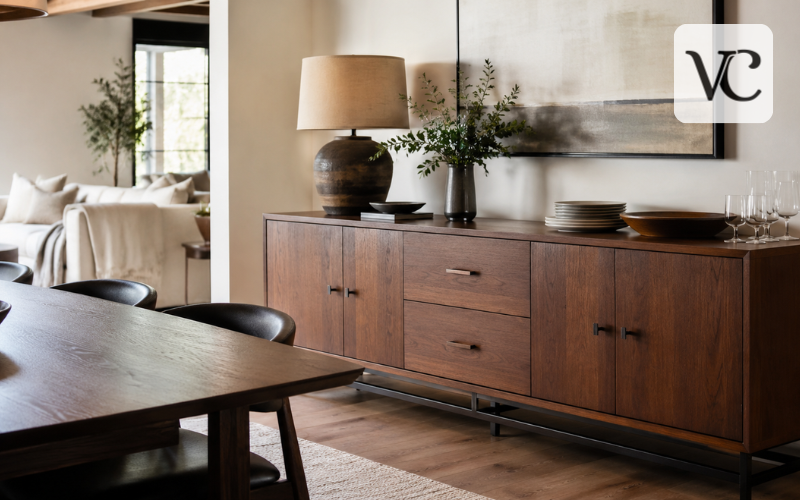
What is a credenza? In simple terms, a credenza is a long, low storage cabinet with a flat top. It usually has doors, shelves, or drawers underneath, which makes it useful for both storage and display. Depending on the design, it may stand on short legs, sit directly on the floor, or be mounted to a wall.
The word often causes confusion because credenzas can look very similar to sideboards, buffets, media consoles, and storage cabinets. In modern furniture stores, these names are sometimes used for the same type of piece. The biggest difference is usually how the furniture is used and where it is placed rather than a strict difference in shape.
A credenza can serve many purposes around the home or office. In a dining room, it can hold dishes and serving items. In a living room, it may support a television and hide electronic equipment. In an office, it can store files, supplies, or a printer. Its simple shape and flexible storage make it one of the most practical pieces of furniture for rooms that need organization without looking crowded.
Quick Guide: Credenza vs Similar Furniture
| Furniture Type | Main Purpose | Typical Design | Common Placement |
| Credenza | Storage, display, media, or office use | Long, low cabinet with doors or drawers | Dining room, living room, or office |
| Sideboard | Storage and serving | Cabinet with more visible or longer legs | Dining or living room |
| Buffet | Storing dishes and serving food | Similar to a sideboard, often dining-focused | Dining room |
| Console Table | Display and light storage | Narrow, open design with legs | Entryway, hallway, or behind a sofa |
| Credenza Desk | Extra workspace and office storage | May include file drawers, cable access, or knee space | Home or professional office |
How to Choose the Right Credenza
- Measure the available wall, floor space, and nearby walking area.
- Decide whether you need storage for dishes, electronics, files, or general household items.
- Check the cabinet’s width, height, depth, shelf layout, and weight capacity.
- Choose sliding doors when there is limited space for hinged doors.
- Look for ventilation and cable openings when using it as a TV or media cabinet.
- Match its material and finish with the general style of the room.
- Leave enough space for doors and drawers to open comfortably.
- Avoid overcrowding the top with too many decorations.
Credenza Meaning in English
The basic credenza meaning in English is a low, wide cabinet used for storage. Most credenzas have a broad top surface and enclosed storage below. The top may be used for serving food, displaying lamps and artwork, supporting a television, or holding office equipment.
The word “credenza” comes from Italian. It is connected to an older practice in which food and drink were tested before being served to an important person. Over time, the word became linked to the furniture used to hold or present that food. Its meaning later expanded to describe a dining-room storage cabinet.
Today, the term is much broader. A modern credenza does not have to be used for dining. It may be found in a living room, hallway, bedroom, conference room, or home office. Designers and retailers now use the word for many long, low cabinets, especially those with a clean, horizontal shape and closed storage.
What a Credenza Looks Like
A credenza is usually wider than it is tall. Its long, horizontal form helps it sit neatly against a wall without taking up too much visual space. Many models are around waist height or lower, although exact sizes vary. The flat top is one of its most useful features because it creates an easy place for serving, display, or equipment.
Storage is normally hidden behind cabinet doors. Some credenzas also include drawers for smaller items, adjustable shelves for flexible organization, or open sections for books and electronics. Sliding doors are common because they do not need extra space to swing outward, but hinged doors are also widely used.
Traditional credenzas often have short legs or a solid base that reaches the floor. Modern versions may stand on slim metal legs, use a recessed base, or appear to float above the floor. Wall-mounted credenzas are especially popular in modern interiors because they leave the floor visible and can make a room feel more open.
What Is a Credenza Used For?
A credenza is mainly used to add storage while also providing a useful top surface. It is more decorative than a basic utility cabinet, so it can organize a room without making the space feel like a storage area. This balance between function and appearance is the main reason credenzas work in so many settings.
In a dining area, a credenza may store plates, bowls, table linens, serving trays, and glassware. In a living room, it can hold media devices, game systems, books, board games, or cables. In a bedroom, it may store clothing, bedding, or personal items. In an entryway, it can provide a surface for keys, lamps, baskets, or artwork.
The function changes with the room, but the basic idea remains the same: a credenza keeps items close by while hiding clutter. It is especially helpful in open-plan homes, where storage furniture needs to look polished from different angles and blend with nearby living and dining spaces.
Common Credenza Materials and Styles
Wood remains the most common material for credenzas. Oak, walnut, teak, mango wood, and engineered wood are popular because they offer warmth and work with many decorating styles. Solid wood can feel substantial and age well, while wood veneer and engineered materials often provide a similar look at a lower price.
Modern credenzas may also include metal frames, glass doors, lacquered surfaces, stone tops, or cane panels. Metal can give the piece an industrial or contemporary appearance. Glass makes it easier to see displayed items, although it may require more frequent cleaning. Lacquer creates a smooth, polished finish, while woven cane adds texture and a lighter, more relaxed feel.
Style also changes the overall effect. Mid-century designs often use warm wood, simple lines, and tapered legs. Traditional pieces may include carved details and darker finishes. Minimalist credenzas focus on flat fronts and hidden hardware. Industrial styles may combine wood with black metal, while modern luxury designs may use glossy finishes, brass handles, or stone surfaces.
What Is a Credenza in a Dining Room?
In a dining room, a credenza works as both storage furniture and a serving surface. It keeps dinnerware and table items close to the dining table, which can make meals and gatherings easier to manage. Plates, bowls, glasses, napkins, placemats, serving utensils, and seasonal table decorations can all be stored inside.
The top can be used as a temporary buffet during meals. Food, drinks, desserts, or extra plates can be placed there so the dining table stays less crowded. When it is not being used for serving, the surface may hold a lamp, mirror, artwork, vase, or a few simple decorative objects.
This is where the terms credenza, sideboard, and buffet often overlap. A buffet is usually understood as dining-room furniture used for serving food. A sideboard is also commonly used in dining rooms but may have taller legs. A credenza often has a lower profile and more enclosed storage. In modern shopping, however, the names may describe very similar products, so size and features matter more than the label.
Using a Credenza in the Living Room
A living-room credenza can function as a media console, TV stand, or general storage cabinet. Its low shape makes it suitable for supporting a television without placing the screen too high. The cabinets below can hide streaming devices, game consoles, remotes, movies, speakers, and other accessories.
Before using a credenza as a TV stand, check its width and weight capacity. The furniture should be wider than the television base, and the top should be strong enough to support the screen safely. If the television is wall-mounted, the credenza can still help balance the wall visually and provide storage below.
Ventilation is also important. Electronic devices can produce heat, so tightly closed cabinets may need vents, open backs, or enough space around the equipment. Cable openings make it easier to route wires neatly. A credenza without built-in cable management can still work, but adding simple grommets or organizing cables behind the unit may improve both safety and appearance.
What Is a Credenza in an Office?
An office credenza is a low storage unit placed near a desk or along a wall. It provides extra room for files, office supplies, documents, technology, and equipment that would otherwise crowd the main work surface. In professional offices, it may also help create a neat background for meetings or video calls.
A printer is often placed on top, while paper, folders, ink, and stationery are stored inside. Locking drawers may be useful when documents need more privacy. Some office credenzas include filing drawers, adjustable shelves, sliding doors, or spaces designed for computer equipment.
The usual placement is behind or beside the main desk. Behind-desk placement is common in executive offices because it keeps frequently used items within reach while presenting a clean appearance to visitors. In a home office, a credenza can stand against any open wall and act as shared storage for work materials, household records, and technology.
What Is a Credenza Desk?
A credenza desk is different from a standard storage credenza because it is designed to support office work. It may include a knee space, a pull-out writing surface, file drawers, cable access, or a section large enough for a computer. Some models look like a cabinet when closed but open to create a compact workstation.
In larger offices, the term may describe a secondary work surface positioned behind or beside the main desk. This setup gives the user more room for paperwork, equipment, or meetings without making the primary desk feel overloaded. It is often seen in executive furniture collections.
A credenza desk can also form part of an L-shaped arrangement. The main desk creates one side of the work area, while the credenza provides the second side. When shopping, it is important to check whether the item is intended only for storage or is built for regular desk use. A standard credenza may be too low, too shallow, or uncomfortable for sitting and working.
Credenza Table: What the Term Really Means
“Credenza table” is a common shopping phrase, but it is not always precise. People often use it when they are looking for a long piece of furniture with a flat top. In most cases, a true credenza is a cabinet rather than a table because it includes enclosed storage below the surface.
A console table is usually narrower and more open. It may have legs, a shelf, or one or two small drawers, but it does not normally provide the deep cabinet storage found in a credenza. Console tables are often placed behind sofas or in entryways, while credenzas are more likely to store dishes, electronics, or office supplies.
When shopping, look beyond the product name. Check the depth, height, door style, internal shelves, drawer layout, and intended use. If you need hidden storage, search for a credenza, sideboard, or storage cabinet. If you mainly need a slim surface for décor, an open console table may be the better choice.
Credenza vs Sideboard
The difference between a credenza and a sideboard is not always clear because modern furniture brands often use the names interchangeably. Traditionally, a sideboard was a dining-room cabinet with noticeable legs and storage cabinets that started above the floor. It was used to hold dishes and support food service.
A credenza usually had a lower profile, shorter legs, or a solid base. It often included sliding doors and a long, smooth front. In many modern designs, however, these features overlap. A sideboard may be low and legless, while a credenza may stand on tall legs.
The best way to choose between them is to focus on the furniture itself. Compare the dimensions, storage layout, door clearance, shelf strength, and style. A taller sideboard may provide easier access in a dining room, while a lower credenza may work better under artwork or a television. The product name is less important than how well the piece fits your room and storage needs.
Credenza vs Buffet
A buffet is closely related to a sideboard and is usually connected with dining and serving food. Traditionally, the word “buffet” referred to both the furniture and the method of presenting food for self-service. A buffet cabinet often stores plates, glasses, linens, and serving pieces, with a top surface used during meals.
A credenza can perform the same job, but its use is not limited to dining rooms. It may also serve as an office cabinet, media console, hallway unit, or general storage piece. This wider range of uses is one of the main differences between the terms today.
In practice, a dining-room credenza and a buffet may look almost identical. Retailers may label the same type of cabinet differently based on style or marketing. When comparing a credenza vs buffet, consider where it will go and what it needs to hold. For dining service, either may work. For electronics or office equipment, a credenza may be the more common name.
How to Choose and Place the Right Credenza
Start by measuring the wall and the available floor space. Leave enough room for doors and drawers to open fully, and make sure people can walk past the furniture comfortably. The piece should feel balanced with the wall rather than looking too small or extending into doorways, vents, or busy paths.
Height and depth matter as much as width. A dining-room credenza should be comfortable for serving, while a TV credenza should keep the screen at a suitable viewing height. A deep unit offers more storage but may make a narrow room feel crowded. In a small space, sliding doors or a wall-mounted design can reduce the clearance needed.
Think carefully about what will be stored. Adjustable shelves are useful for mixed items, drawers help organize small objects, and cable openings are valuable for electronics. Match the material and finish with nearby furniture, but do not worry about making every piece identical. A similar wood tone, hardware finish, or design line can create a connected look.
Keep styling simple. A lamp, artwork, mirror, vase, or small group of objects is often enough. Leave some open space on the surface so the credenza remains practical and does not look overloaded.
Conclusion
A credenza is a long, low cabinet that combines hidden storage with a useful display or serving surface. It can hold dishes in a dining room, electronics in a living room, files in an office, or everyday items in almost any part of the home. Its simple shape allows it to fit into both traditional and modern interiors.
The differences between a credenza, sideboard, buffet, and credenza desk are mostly based on traditional use and design. A sideboard often has more visible legs, a buffet is strongly linked with dining, and a credenza desk is built to support office work. Modern furniture names overlap, so the actual size, storage features, and construction should guide your choice.
When deciding whether a credenza is right for your space, consider what you need to store, how much wall space is available, and how the top will be used. Chosen carefully, it can improve organization, reduce clutter, and add a clean, finished look without taking over the room.
Frequently Asked Questions
What is the main purpose of a credenza?
A credenza provides hidden storage and a flat surface for serving, displaying decorations, supporting a television, or holding office equipment. Its exact purpose depends on the room where it is placed.
Is a credenza the same as a sideboard?
A credenza and sideboard can serve similar purposes. Traditionally, credenzas are lower with short legs or solid bases, while sideboards often have longer legs. Modern retailers frequently use both terms interchangeably.
Can a credenza be used as a TV stand?
Yes, a credenza can work as a TV stand when it is wide, stable, and strong enough. Choose one with cable openings and proper ventilation for media devices stored inside.
What is a credenza in an office?
An office credenza is a low cabinet placed behind or beside a desk. It provides storage for files, stationery, printers, paper, and equipment while offering an additional work or display surface.
What should be stored in a dining-room credenza?
A dining-room credenza can hold plates, bowls, glassware, serving dishes, cutlery, tablecloths, and napkins. Its top may also be used for serving food or displaying lamps, artwork, and decorations.
Disclaimer: This article provides general information about credenzas, their uses, and common furniture differences. Product names and designs may vary between manufacturers, so always check the dimensions, materials, weight capacity, and features before purchasing or installing furniture.
Enjoyed this article? Discover more helpful ideas and fresh inspiration on Vogue Cultures.