
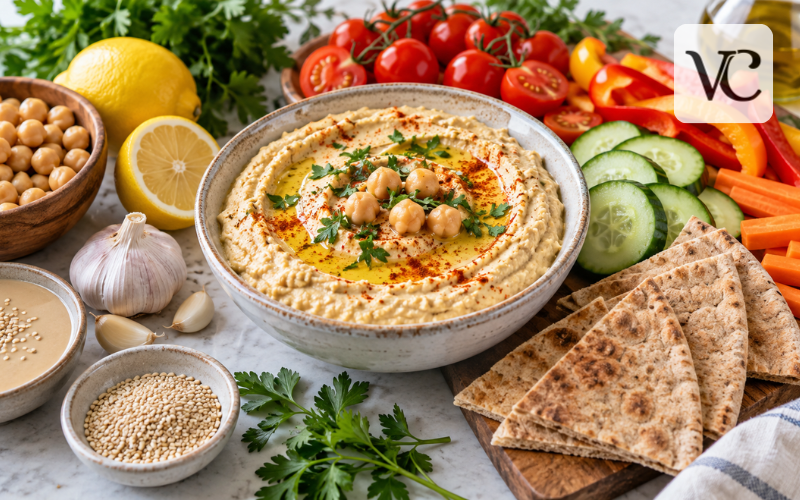
Hummus is a creamy dip traditionally made from chickpeas, tahini, olive oil, lemon juice, garlic, and seasonings. It is often served with vegetables or pita bread, spread on sandwiches, or added to bowls and salads. Because its main ingredients come from plants, many people see hummus as a healthier choice than dips made mostly with cream, cheese, or mayonnaise.
So, is hummus healthy? For most people, traditional hummus can be a nutritious part of a balanced diet. It provides some fiber and plant protein, along with unsaturated fats and several vitamins and minerals. However, that does not mean every hummus product is equally healthy or that portion size never matters.
The full picture depends on the recipe, serving size, sodium level, added ingredients, and what you eat with it. This guide looks at hummus calories and nutrition, possible benefits, weight loss, cholesterol, diabetes, pregnancy, protein, daily use, and situations where a little extra care may be needed.
Snippet-Ready Definition:
Hummus is a nutritious chickpea-based food containing fiber, healthy fats, and some plant protein. voguecultures.co.uk only provides informational content about “is hummus healthy” and does not offer medical advice.
Quick Guide Table
| Topic | Quick Answer |
| Is hummus healthy? | Yes, traditional hummus can be a nutritious part of a balanced diet. |
| Calories | Around 60–70 calories per 2-tablespoon serving, depending on the recipe or brand. |
| Protein | Provides some plant protein, but it is not usually a high-protein food by itself. |
| Fiber | Chickpeas provide fiber that supports digestion and may help with fullness. |
| Weight loss | Can fit into a weight-loss diet when portions are reasonable. |
| Cholesterol | Chickpeas and unsaturated fats can fit well into a heart-conscious eating pattern. |
| Diabetes | Can fit into many diabetes-friendly diets, but portions and total carbohydrates matter. |
| Pregnancy | Can provide useful nutrients, but proper food safety and individual medical needs should be considered. |
| Daily use | A sensible portion can usually be eaten regularly as part of a varied diet. |
| Main concerns | Sodium, large portions, sesame allergy, and digestive sensitivity may matter for some people. |
Simple Healthy Hummus Checklist
- Choose hummus with a simple ingredient list when possible.
- Check the serving size and sodium on packaged products.
- Watch added sugars and high amounts of saturated fat.
- Keep portions reasonable, especially when hummus contains plenty of tahini or oil.
- Pair hummus with vegetables such as carrots, cucumber, peppers, or tomatoes.
- Whole-grain pita or crackers can also fit into a balanced meal.
- Avoid traditional hummus if you have a sesame allergy unless you choose a safe sesame-free version.
The Quick Answer: How Healthy Is Hummus?
Traditional hummus is generally a nutritious food that can fit comfortably into many eating patterns. Chickpeas provide fiber, carbohydrates, plant protein, and minerals. Tahini adds sesame-based fats and nutrients, while olive oil contributes mainly unsaturated fat. Lemon juice and garlic add flavor without requiring a heavy cream base.
That said, “healthy” is not a simple label that works the same way for everyone. A small serving of plain hummus with vegetables is different from eating a large amount with salty chips. Some packaged varieties can also contain more sodium, oil, or flavoring ingredients than others.
This helps explain why online opinions sometimes sound mixed. If you search “is hummus healthy Reddit,” you will find people who value hummus as a filling dip for vegetables, while others point out that recipes containing plenty of tahini or oil can be fairly calorie-dense. Both points can be reasonable: nutritional quality and calorie density are not the same thing.
What Hummus Is Made From and Why the Ingredients Matter
The base of classic hummus is chickpeas, also called garbanzo beans. Chickpeas belong to the legume family and provide fiber, complex carbohydrates, plant protein, and several vitamins and minerals. Harvard Health notes that chickpeas contain nutrients including folate, manganese, copper, iron, zinc, potassium, and magnesium.
Tahini is a paste made from sesame seeds. It gives hummus much of its creamy texture and nutty taste while contributing fat and other nutrients. Olive oil may be blended into the hummus or added on top. Lemon juice, garlic, herbs, and spices provide flavor.
The ingredient list becomes more important with flavored or more heavily processed versions. Some products may contain more sodium, additional oils, added sugar, or other ingredients. These additions do not automatically make a hummus unhealthy, but they can change its nutritional profile.
When comparing products, look beyond words such as “natural,” “light,” or “healthy” on the front of the package. The serving size, nutrition facts, and ingredient list give you more useful information about what you are actually eating.
Hummus Nutrition and Calories at a Glance
Hummus is not an extremely low-calorie food, but it is also not unusually high in calories when eaten in a normal portion. Cleveland Clinic reports that one typical two-tablespoon serving of store-bought hummus contains about 71 calories, 4.6 grams of carbohydrates, 5.4 grams of fat, 1.66 grams of fiber, and 2.4 grams of protein. Exact figures vary according to the recipe and brand.
| Nutrient | Approximate amount per 2 tablespoons |
| Calories | 71 |
| Carbohydrates | 4.6 g |
| Fat | 5.4 g |
| Fiber | 1.66 g |
| Protein | 2.4 g |
Hummus can also contribute micronutrients naturally present in chickpeas and sesame, including folate, iron, copper, and manganese. A small serving will not normally provide huge amounts of these nutrients, but it can still contribute to your overall daily intake.
Homemade hummus can vary considerably depending on how much chickpea, tahini, oil, and salt you use. Store-bought hummus also differs between brands. For this reason, it is more useful to consider the whole serving than to label hummus simply as “high-calorie” or “low-calorie.”
The Main Health Benefits of Eating Hummus
One useful feature of hummus is that it combines several nutrients in one food. Chickpeas contribute dietary fiber, which supports normal digestion and can help a meal or snack feel more satisfying. Beans and other legumes are also widely recommended as part of healthy eating patterns.
Hummus also contains plant-based fats from tahini and, in traditional recipes, olive oil. These ingredients provide unsaturated fats. Replacing some foods rich in saturated fat with foods containing unsaturated fats can be helpful as part of a heart-conscious diet. The American Heart Association recommends beans and other legumes as part of a healthy eating pattern.
Another advantage comes from how hummus is used. For example, eating it with cucumber, carrots, or peppers can make vegetables more enjoyable. Using hummus as a sandwich spread may also be a useful alternative to some spreads that contain more saturated fat.
However, the benefits should not be exaggerated. Research on chickpeas, legumes, fiber, and unsaturated fats is broader than research showing that hummus itself prevents specific diseases. It is better to think of hummus as one nutritious part of a balanced diet rather than a food that treats or prevents illness.
Is Hummus Healthy for Weight Loss?
If you are wondering is hummus healthy for weight loss, the answer depends mainly on how it fits into your overall eating pattern. Hummus can certainly be included in a weight-management diet, but eating hummus does not directly cause weight loss.
Its combination of fiber, fat, carbohydrates, and some protein can help make a snack more satisfying. Legumes are particularly useful because their fiber and complex carbohydrates take longer to digest than many refined foods. Harvard Health also notes that legumes can be filling, which may help with appetite management.
Portion size still matters because tahini and oil contribute calories. Two to four tablespoons may be a practical amount for many snacks, although personal needs vary. Eating straight from a large container can make it difficult to notice how much you have consumed.
For a filling snack, pair hummus with carrots, cucumber, peppers, celery, broccoli, or other vegetables. Pita and crackers do not have to be avoided, either. Whole-grain versions can be useful choices, particularly when portions are reasonable.
The goal should not be to treat hummus as a special “weight-loss food.” It works best as one part of an eating pattern you can comfortably maintain.
Hummus, Cholesterol, and Heart Health
Is hummus healthy for cholesterol? It can fit well within a heart-friendly diet. Chickpeas are naturally free of cholesterol and provide fiber, while tahini and olive oil provide mainly unsaturated fats.
Dietary cholesterol means cholesterol found in food, while blood cholesterol refers to cholesterol circulating in your bloodstream. They are related, but they are not the same thing. Genetics, saturated fat intake, fiber intake, physical activity, body weight, smoking, medical conditions, and other factors can influence blood cholesterol.
Recent Harvard Health guidance explains that legumes provide soluble fiber and resistant starch and may help improve several factors linked with cardiovascular health. Replacing less nutritious sources of protein or refined carbohydrates with legumes can also improve the overall quality of a diet.
This does not mean eating a few spoonfuls of hummus will lower high cholesterol on its own. If cholesterol management is the goal, the whole eating pattern matters much more than any single food.
Is Hummus Healthy for Diabetics?
Hummus can fit into many healthy eating plans for people with diabetes. The American Diabetes Association includes hummus among plant-based protein choices, while also reminding people that plant proteins such as beans and legumes can contain carbohydrates.
A normal serving of hummus provides carbohydrates together with fiber, fat, and some protein. That makes it different from foods consisting mainly of refined carbohydrates. Chickpeas themselves also have a relatively low glycemic index, although a person’s actual blood-glucose response can vary.
Pairing hummus with non-starchy vegetables such as cucumber, celery, peppers, broccoli, or carrots can be a practical snack. The ADA also lists hummus with carrots or celery among healthy snack ideas.
Still, is hummus healthy for diabetics cannot be answered exactly the same way for everyone. Serving size, total carbohydrate intake, medicines, insulin use, and individual blood-glucose responses all matter. People who count carbohydrates should include hummus rather than assuming it contains no carbs.
Anyone following a specific diabetes meal plan should continue to follow guidance from their doctor or registered dietitian.
Is Hummus Healthy to Eat Every Day?
For many people, a sensible serving of hummus every day can fit into a balanced diet. Eating hummus daily is not automatically “too much.” The more useful questions are how much you eat, what type you choose, and what the rest of your diet looks like.
If you regularly buy packaged hummus, check the sodium because amounts vary between products. Calories can also add up if your usual serving is much larger than the serving listed on the label.
Dietary variety remains important. Even nutritious foods do not need to appear at every meal. You can rotate hummus with whole chickpeas, lentils, beans, nuts, seeds, other dips, or different sources of protein and fiber.
If eating hummus every day helps you enjoy more vegetables or replace foods with less fiber and more saturated fat, it may be a useful habit. But there is no requirement to eat it daily to have a healthy diet.
Is Hummus Healthy During Pregnancy?
Hummus can contribute useful nutrients during pregnancy. Chickpeas provide plant protein and contain nutrients such as folate and iron. ACOG lists beans and peas among useful food sources of protein and important pregnancy nutrients such as iron and folate.
However, a small serving of hummus will not provide all the folate, iron, or protein needed during pregnancy. ACOG recommends a healthy diet along with a prenatal vitamin containing folic acid because pregnancy requirements can be difficult to meet through food alone.
Food safety is especially important during pregnancy. Refrigerated hummus should be kept cold and stored according to the manufacturer’s directions. Homemade hummus should be prepared using clean equipment and refrigerated promptly. If a packaged hummus is included in a food-safety recall, follow the recall instructions instead of eating it.
Traditional hummus also contains sesame, so anyone with a sesame allergy should avoid it unless they have a safe sesame-free alternative.
Hummus can be part of a balanced pregnancy diet, but it does not replace prenatal vitamins or personalized advice from an obstetric healthcare professional.
Is Hummus a Healthy Protein Source?
Hummus does contain protein, but describing a normal serving as “protein-packed” can create the wrong impression. Cleveland Clinic’s example of a two-tablespoon serving provides about 2.4 grams of protein.
By comparison, Harvard Health reports that one cup of cooked chickpeas provides around 14.5 grams of plant protein. A hummus serving contains less because portions are much smaller and hummus contains other ingredients in addition to chickpeas.
So, when people ask “is hummus healthy protein?”, the most accurate answer is that hummus contributes some plant protein but usually should not be treated as a major protein source by itself.
It can contribute to a higher-protein meal when combined with beans, lentils, tofu, eggs, fish, chicken, Greek yogurt, or another protein source that fits the person’s eating pattern.
For plant-based meals, hummus remains useful because it brings together flavor, texture, some protein, fiber, and fats in one convenient food.
When Hummus May Not Be the Best Choice
Hummus is nutritious for many people, but it is not suitable for everyone. Traditional hummus contains tahini, which is made from sesame. The U.S. Food and Drug Administration recognizes sesame as one of the major food allergens, so people with a sesame allergy need to read hummus labels carefully or choose a safe sesame-free alternative.
Some people also find chickpeas difficult to digest. Legumes and increases in dietary fiber can lead to gas or bloating in some individuals, particularly when large portions are introduced suddenly. Smaller amounts may be easier to tolerate.
Packaged hummus can also contain more sodium than expected depending on the brand. Flavored products may contain extra oil, sugar, or other ingredients, while very large servings can contribute significantly more calories than the standard serving shown on the label.
These issues do not make hummus inherently unhealthy. They simply show why the best choice depends on the person, the product, and the amount eaten.
How to Choose and Eat Hummus in a Healthier Way
Homemade hummus allows you to control how much salt, tahini, and oil you use, but store-bought hummus can also be convenient and nutritious. There is no reason to assume that homemade hummus is always healthier.
Start with the nutrition label. Check the serving size so you understand what the calorie and nutrient numbers represent. Compare sodium between similar products, look at saturated fat and added sugars, and read the ingredient list.
A straightforward hummus based mainly on chickpeas, tahini, olive oil or another suitable oil, lemon, garlic, and seasonings can be an easy option. The exact recipe does not need to be perfect to fit into a healthy diet.
Hummus pairs naturally with carrots, cucumber, bell peppers, tomatoes, broccoli, and other vegetables. It can also be spread on a sandwich, added to a grain bowl, or served alongside whole grains and a protein source. Pita and crackers can still be part of the meal, and whole-grain varieties may provide additional fiber.
Healthy hummus checklist:
- Check the serving size before comparing products.
- Compare sodium, saturated fat, and added sugars.
- Read the ingredient list rather than relying only on front-label claims.
- Check carefully for sesame if you have an allergy.
- Use a sensible portion instead of regularly eating straight from the container.
- Pair hummus with vegetables and other minimally processed foods regularly.
These simple checks are more useful than searching for a product marketed as the “healthiest” hummus.
Conclusion
So, is hummus healthy? For most people, the answer is yes. Traditional hummus combines chickpeas, tahini, olive oil, lemon, and garlic and can provide fiber, some plant protein, unsaturated fats, and useful vitamins and minerals.
The healthiest option is not necessarily the hummus with the fewest calories. What matters more is how its ingredients, portion size, sodium content, and accompanying foods fit into your overall diet.
Hummus can work well in weight-management plans, heart-conscious diets, many diabetes meal plans, pregnancy diets, and everyday meals. At the same time, individual needs matter. People managing diabetes, pregnancy-related concerns, food allergies, digestive problems, or medically prescribed diets may need more personalized guidance.
Hummus is best viewed for what it is: a nutritious and versatile food rather than a miracle food. When eaten in sensible portions and combined with a varied diet, it can be an easy and enjoyable way to add chickpeas, fiber, and plant-based nutrients to everyday meals.
FAQs
Is hummus healthy to eat every day?
For most people, a moderate serving of hummus can fit into a healthy daily diet. Choose reasonable portions, watch sodium in packaged varieties, and continue eating a variety of other nutritious foods.
Is hummus healthy for weight loss?
Hummus can be included in a weight-loss eating plan because its fiber and fat may help with fullness. However, portions still matter because tahini and oil can increase calories.
Is hummus a good source of protein?
Hummus contains plant protein, but a typical two-tablespoon serving provides only a few grams. It is better viewed as a protein contributor rather than a high-protein food on its own.
Is hummus healthy for people with diabetes?
Hummus can fit into many diabetes-friendly eating plans because it contains fiber, fat, protein, and carbohydrates. Individual blood-sugar responses differ, so portion size and overall carbohydrate intake remain important.
Is store-bought hummus healthy?
Store-bought hummus can be nutritious, but products vary. Check the serving size, sodium, saturated fat, added sugars, and ingredients rather than assuming every packaged hummus has the same nutritional value.
Disclaimer: This article on “is hummus healthy” is provided by voguecultures.co.uk for general informational and educational purposes only. It is not medical, nutritional, diagnostic, or treatment advice and should not replace guidance from a qualified healthcare professional or registered dietitian. Individual dietary needs may vary, especially during pregnancy or for people with diabetes, allergies, digestive conditions, or other health concerns. This content is independently informational and does not involve guest posting, paid promotion, sponsored placement, advertising, or product endorsement.
Enjoyed this article? Discover more helpful ideas and fresh inspiration on Vogue Cultures.