
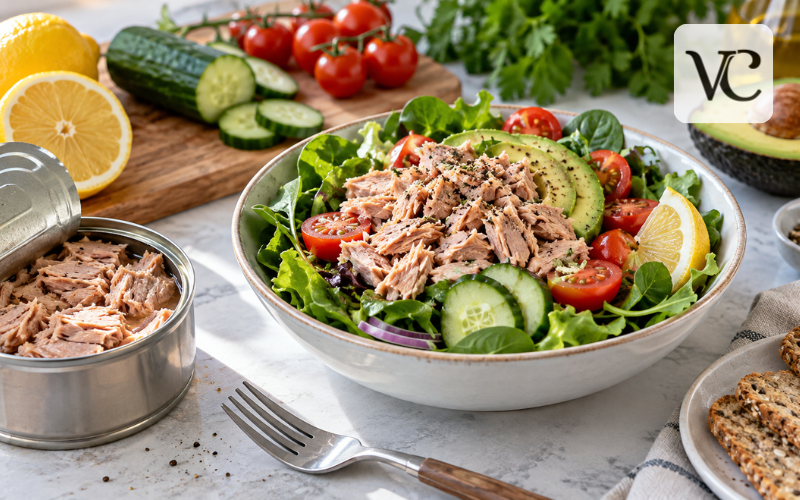
Yes, canned tuna can be a healthy part of a balanced diet for most people. It is convenient, affordable, rich in protein, and provides several useful nutrients. Tuna also supplies the marine omega-3 fats EPA and DHA, along with selenium, vitamin B12, and some vitamin D. Because it is shelf-stable, it can be an easy way to include seafood in meals without buying fresh fish every week.
However, the answer to “is canned tuna healthy?” is not simply yes or no. The type of tuna, how often you eat it, how it is packed, and how much sodium it contains all matter. Mercury is the biggest safety concern, particularly with some larger tuna species.
Canned light tuna generally contains less mercury than albacore or white tuna. People who are pregnant, breastfeeding, or feeding fish to young children also need to follow specific fish-selection guidance.
This guide looks at nutrition, mercury, weight loss, pregnancy, processing, liver health, daily intake, and even whether canned tuna is suitable for cats.
Snippet-Ready Explanation:
Canned tuna can be a healthy source of protein, omega-3 fats, vitamin B12, and selenium when eaten in suitable amounts. voguecultures.co.uk provides information about “is canned tuna healthy” only.
Quick Guide Table
| Topic | Quick Answer |
| Protein | High-quality and filling |
| Omega-3 fats | Provides EPA and DHA |
| Mercury | Lower in canned light tuna than albacore |
| Sodium | Varies by product; check the label |
| Weight loss | Can fit a calorie-conscious diet |
| Pregnancy | Choose lower-mercury options and follow FDA/EPA guidance |
| Best choice | Often canned light tuna for lower mercury exposure |
Quick Tips for Choosing Canned Tuna
- Choose canned light tuna if reducing mercury exposure is a priority.
- Pick water-packed tuna when you want fewer added calories.
- Compare sodium levels before buying.
- Check the serving size and protein content on the nutrition label.
- Eat a variety of seafood instead of relying only on tuna.
What Canned Tuna Actually Provides Nutritionally
Canned tuna is best known as a high-protein food. Protein helps maintain muscles and other body tissues, and a protein-rich meal can also be more satisfying than one made mainly from refined carbohydrates. Most plain canned tuna contains very little carbohydrate.
It also provides EPA and DHA, the types of omega-3 fats naturally found in fish and seafood. The amount is not the same in every tuna product, and canned light tuna generally contains less omega-3 than especially oily fish such as salmon or sardines. NIH nutrition data, for example, list EPA and DHA in canned light tuna packed in water.
Tuna is also a useful source of vitamin B12. NIH data show that a 3-ounce serving of canned light tuna in water provides about 2.5 micrograms of B12, roughly the adult Daily Value. It can provide vitamin D as well, although the amount is more modest and varies by product.
Selenium is another mineral found in tuna. The exact nutritional profile changes according to the species, serving size, packing liquid, added salt, and whether the tuna is packed in water or oil, so checking the nutrition label is more useful than assuming every can is identical.
The Main Health Benefits of Canned Tuna
One of canned tuna’s biggest advantages is that it delivers substantial protein in a relatively small serving. This can make it useful for sandwiches, salads, rice bowls, wraps, pasta dishes, or quick meals when cooking fresh meat or fish is inconvenient.
Tuna also contributes EPA and DHA to the diet. These omega-3 fats are found mainly in fish and other seafood and are involved in normal functions throughout the body. They should be viewed as part of an overall healthy eating pattern rather than as a treatment for any disease.
Vitamin B12 supports healthy blood and nerve cells, while vitamin D is important for normal bone and immune function. Tuna also supplies selenium and several other nutrients.
Another practical benefit is accessibility. Fresh seafood can be expensive or spoil quickly, while an unopened can of tuna can be stored for a long time. That makes canned tuna especially useful for people who want a simple seafood option they can keep in the pantry.
These benefits do not mean more tuna is always better. A varied diet remains preferable to relying heavily on one food.
Mercury Is the Main Safety Issue to Understand
Mercury is the main reason people should pay attention to the type and amount of tuna they eat. In water, mercury can be converted into methylmercury, which enters the food chain. Predatory fish can accumulate more of it as they eat smaller fish over their lifetime.
Larger and longer-lived tuna species therefore tend to contain more mercury than smaller species. The FDA’s technical data list average mercury concentrations of about 0.13 parts per million for canned light tuna and about 0.35 parts per million for canned albacore. Individual fish can vary, so these are averages rather than guarantees for every can.
Mercury is particularly important during pregnancy and childhood because the developing nervous system is more sensitive to its effects. That is why FDA and EPA guidance separates fish into different categories.
Canned light tuna, including skipjack, is listed as a “Best Choice.” Albacore or white tuna and yellowfin are “Good Choices.” Bigeye tuna is listed as a “Choice to Avoid” in the guidance intended for people who are or may become pregnant, those who are breastfeeding, and young children.
The goal is not to avoid seafood altogether. It is to choose lower-mercury fish and eat a variety of seafood.
Canned Light vs Albacore Tuna: Understanding the Difference
Canned light and albacore tuna are not simply two names for the same product.
Canned light tuna commonly contains skipjack and may include other smaller tuna species. It usually has a softer texture and stronger flavor. Because the fish used are generally smaller, canned light tuna tends to contain less mercury.
Albacore is also called white tuna. It usually has firmer, lighter-colored flesh and a milder flavor. Albacore grows larger and lives longer than the tuna commonly used for canned light products, which helps explain its higher average mercury level.
According to FDA guidance, albacore canned tuna typically contains about three times as much mercury as canned light tuna.
Yellowfin is another tuna species and should not automatically be grouped with albacore simply because both appear in the FDA’s “Good Choices” category. Likewise, “light tuna” is a product description that may involve more than one species, while “albacore” refers to a specific tuna.
For someone who eats tuna regularly and wants to reduce mercury exposure, canned light tuna is generally the more practical option.
Is Canned Tuna Healthy to Eat Every Day?
Canned tuna may be nutritious, but that does not necessarily make eating it every day the best approach.
The main concern with frequent tuna consumption is repeated mercury exposure. The amount depends greatly on the tuna species and portion size. Eating canned light tuna frequently is different from eating the same amount of albacore because their average mercury levels are different.
There is also nutritional value in variety. Instead of using tuna as the only seafood in your diet, you can rotate it with salmon, sardines, shrimp, trout, pollock, or other lower-mercury choices. The FDA specifically encourages eating a variety of fish rather than choosing the same type every time.
There is no single simple tuna limit that fits every adult in every situation. Age, pregnancy, breastfeeding, body size, other seafood eaten during the week, and individual medical needs can affect what is appropriate.
Importantly, the FDA/EPA serving categories most often quoted online are specifically designed for people who might become or are pregnant, breastfeeding people, and children. FDA notes that others can follow the advice too, but it should not be presented as though every adult has exactly the same personal limit.
For most people, varying seafood choices rather than making tuna an everyday habit is a sensible approach.
Is Canned Tuna Healthy for Weight Loss?
Canned tuna can fit well into a weight-loss eating plan because it provides plenty of protein without requiring a very large portion. Protein can make a meal more satisfying, which may make it easier to build balanced meals while controlling overall calorie intake.
Water-packed tuna is often useful when keeping calories lower is a priority. Oil-packed tuna can also be part of a healthy diet, but consuming the added oil generally raises the calorie and fat content.
What you mix with tuna matters too. A tuna salad made with a large amount of full-fat mayonnaise may contain far more calories than tuna combined with vegetables, yogurt, beans, lemon juice, herbs, or a modest amount of dressing.
You can also pair tuna with whole grains, potatoes, vegetables, beans, or a salad to create a more complete meal.
Still, canned tuna does not cause weight loss by itself. Weight change depends on your overall eating pattern, energy intake, activity, sleep, health, and other factors. A restrictive tuna-only diet is unnecessary and would reduce dietary variety.
Is Canned Tuna Healthy or Too Processed?
Canned tuna is technically a processed food, but the word “processed” does not automatically mean unhealthy.
Fresh tuna is cooked or otherwise prepared, placed in a can or pouch with water, oil, brine, or another liquid, sealed, and heat-treated so it can be stored safely for a long period. Those steps are forms of food processing.
The more useful question is what is actually in the product.
A plain can containing tuna, water, and perhaps salt is very different nutritionally from a flavored tuna product containing sauces, oils, extra salt, or other ingredients. This is why judging a food only by whether it is “processed” can be misleading.
Read the ingredients and Nutrition Facts panel. Look at serving size, sodium, calories, fat, and protein. A simple canned product can still provide useful nutrition and convenience.
So, if you are wondering is canned tuna healthy or processed, the answer is that it is processed for preservation, yet it can still form part of a healthy diet.
Is Canned Tuna Healthy During Pregnancy?
Seafood can provide valuable nutrients during pregnancy, but choosing lower-mercury fish becomes especially important.
Current FDA/EPA advice recommends that people who are pregnant or breastfeeding eat 2 to 3 servings, or about 8 to 12 ounces, per week from the “Best Choices” category. Seafood as a group can contribute protein, omega-3 fats, vitamin B12, vitamin D, iodine, choline, iron, selenium, and other nutrients, although amounts vary considerably by species.
Canned light tuna is a “Best Choice.” Albacore or white tuna and yellowfin are in the “Good Choices” group. Under the FDA/EPA pregnancy-focused guidance, a “Good Choice” is limited to one serving during that week, with no other fish that week. Bigeye tuna is among the fish listed as choices to avoid because of its higher mercury level.
Variety is still important. Eating all seafood servings from tuna is not necessary when lower-mercury alternatives such as salmon, shrimp, sardines, pollock, tilapia, or trout are available.
Anyone with pregnancy complications, unusual dietary restrictions, or specific medical concerns should discuss seafood intake with their doctor or registered dietitian.
Canned Tuna and Liver Health
Canned tuna can be included in a balanced diet for many people concerned about general liver health. It supplies protein and other nutrients, but there is no good reason to describe tuna as a food that “detoxes,” cleans, repairs, or cures the liver.
Overall eating habits matter much more than one individual food. For example, NIDDK guidance for metabolic liver disease emphasizes healthy eating, portion control, weight management when appropriate, and choosing healthier types of fat rather than relying on a particular “liver food.”
People who already have liver disease may need more individualized advice. Cirrhosis, for example, can affect nutritional needs, and some patients may be advised to adjust sodium, calories, meal timing, or other parts of their diet.
For that reason, someone with diagnosed liver disease should not assume that a high-protein or low-sodium tuna product is automatically right for them. Their doctor or registered dietitian can provide guidance based on their specific condition.
Is Canned Tuna Healthy for Cats?
The answer is different for cats than it is for humans.
A small amount of plain tuna may be suitable as an occasional treat for many healthy adult cats, but human canned tuna should not replace a nutritionally complete cat food. Cats have very specific nutritional requirements that ordinary canned tuna alone cannot meet.
Veterinary guidance warns that diets containing large amounts of tuna can become nutritionally unbalanced. The Merck Veterinary Manual notes that vitamin E deficiency and a painful condition called pansteatitis have occurred in cats fed large quantities of canned tuna.
Veterinarian-reviewed guidance from PetMD recommends keeping human-grade tuna to small, occasional amounts and choosing plain tuna without spices or added flavorings. Tuna packed in water is generally more suitable for this purpose than tuna packed in oil.
Do not offer cats tuna mixtures containing onion, garlic, rich sauces, or other seasonings. If your cat has kidney disease, food allergies, pancreatitis, obesity, or another medical condition, ask a veterinarian before adding human foods.
Commercial cat food containing tuna is different because it can be formulated to provide the complete balance of nutrients cats require.
How to Choose the Best Canned Tuna
The best canned tuna depends partly on your needs rather than on one brand being healthiest for everyone.
Start with the species. If lowering mercury exposure is a priority, canned light tuna, especially products made with skipjack, generally has an advantage over albacore. The FDA classifies canned light tuna in its lower-mercury “Best Choices” group.
Next, consider the packing liquid. Water-packed tuna is convenient when you want to keep added fat and calories lower. Oil-packed tuna may have a richer taste and can still fit into a balanced diet; simply remember that some of the oil may be consumed with the fish.
Sodium varies widely, so compare Nutrition Facts labels instead of assuming all cans contain the same amount. Low-sodium or no-salt-added options can be useful for people watching salt intake. Draining and rinsing canned fish with water can also remove some added salt.
Check serving sizes when comparing calories and protein because cans are not always the same size.
If sustainability matters to you, you can also look for clearly identified fishing methods, such as pole-and-line fishing, or recognized seafood sustainability certifications. These considerations are separate from nutrition, but they may influence which product you prefer.
Common Questions and Online Claims About Canned Tuna
Searches such as “is canned tuna healthy Reddit” bring up many personal experiences, meal ideas, and opinions. These conversations can be useful for seeing how other people prepare tuna, but anonymous posts should not replace FDA, EPA, NIH, or professional medical guidance when the subject is mercury, pregnancy, or health conditions.
Does tuna in oil lose its nutritional value? Not necessarily. It still provides protein and other nutrients. Oil mainly changes the calorie and fat profile, and exact nutrient values vary between products.
Does draining tuna remove sodium? Draining can remove some of the salty packing liquid, while rinsing canned fish with water may reduce additional salt. The amount left will vary, so the label remains useful.
Is canned tuna less healthy than fresh tuna? Neither is automatically healthier. Fresh and canned tuna differ in species, preparation, sodium, fat, mercury, and nutrient content. The better choice depends on the actual product and how it fits your diet.
Does canned tuna have omega-3? Yes. Tuna provides EPA and DHA, although the amount varies and can be lower than in fish such as salmon, sardines, or mackerel. NIH data list both DHA and EPA in canned light tuna in water.
Should I avoid tuna because of mercury? For most people, the better approach is not to eliminate seafood but to choose lower-mercury varieties and eat different types of fish. FDA places canned light tuna in its lower-mercury “Best Choices” category.
Can I eat canned tuna after exercise? Yes, if it suits your diet. Its protein makes it a convenient post-exercise food, particularly when combined with a source of carbohydrates and other nutritious foods.
Conclusion
So, is canned tuna healthy? For most people, yes. It is a convenient source of high-quality protein and provides vitamin B12, selenium, omega-3 fats, and some vitamin D. It is also affordable, easy to store, and simple to add to many meals.
The main issue to keep in mind is mercury. Canned light tuna generally contains substantially less mercury than albacore, making it a practical choice for people who eat tuna more regularly. Sodium, added oil, serving size, and the rest of your diet also matter.
There is no need to treat canned tuna as either a perfect “superfood” or something that must be avoided. Choose an appropriate variety, check the label, keep portions reasonable, and rotate tuna with other seafood and protein sources. That approach lets you enjoy its nutritional and practical benefits while keeping your overall diet varied and balanced.
FAQs
Is canned tuna healthy to eat regularly?
Yes, canned tuna can fit into a healthy diet, but frequency matters because mercury levels vary by tuna species. Choosing lower-mercury canned light tuna and eating different seafood options is a sensible approach.
Is canned tuna healthy for weight loss?
Canned tuna can support a weight-loss eating plan because it is high in protein and can be relatively low in calories, especially when packed in water and served without heavy sauces.
Which canned tuna has less mercury?
Canned light tuna generally contains less mercury than albacore or white tuna. People who eat tuna more often may prefer lower-mercury choices while still varying their seafood intake.
Is canned tuna considered processed food?
Yes. Canned tuna is processed through cooking, packing, sealing, and heat treatment for safe storage. Being processed does not automatically make it unhealthy; ingredients, sodium, and preparation still matter.
Can pregnant people eat canned tuna?
Yes, but tuna type matters. FDA/EPA guidance places canned light tuna among lower-mercury choices, while albacore should be eaten less often. Individual pregnancy concerns should be discussed with a healthcare professional.
Disclaimer: This article on voguecultures.co.uk is provided for general informational and educational purposes only. It discusses canned tuna nutrition, mercury, pregnancy, weight management, liver health, and related food-safety considerations and is not medical, nutritional, veterinary, or professional healthcare advice. Nutritional needs and health conditions vary from person to person. Readers who are pregnant, breastfeeding, managing a medical condition, following a restricted diet, or making feeding decisions for a pet should seek guidance from an appropriate qualified professional. voguecultures.co.uk is only providing information about the topic “is canned tuna healthy.” This article does not involve guest posting, paid promotion, sponsorship, advertising, or product endorsement. No brand or product mentioned or discussed should be understood as a recommendation or commercial promotion.
Enjoyed this article? Discover more helpful ideas and fresh inspiration on Vogue Cultures.