
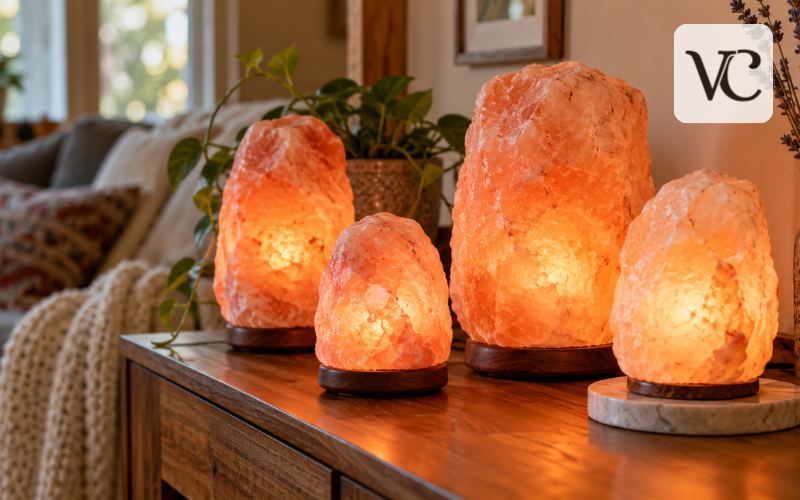
Himalayan salt lamps are decorative lights made from pieces of pink or reddish rock salt. A cavity is created inside the salt so a small bulb or another light source can illuminate the crystal from within. Once switched on, the lamp usually gives off a soft orange, pink, or amber glow rather than the strong light you would expect from a normal table lamp.
Their natural shape and warm appearance have made Himalayan salt lamps popular in bedrooms, living rooms, offices, yoga areas, and other spaces where people want softer lighting. Each piece of rock salt is different, so variations in shape, shade, texture, and mineral patterns are normal.
These lamps are also surrounded by many wellness claims. You may hear that they clean indoor air, release helpful negative ions, ease allergies, improve sleep, or reduce stress. However, those claims should be separated from the lamp’s genuine decorative value. Medical sources including Cleveland Clinic and WebMD say there is not enough scientific evidence to show that ordinary Himalayan salt lamps provide the major health benefits often advertised.
That does not make the lamps useless. It simply means they are better understood as decorative mood lights rather than medical or air-cleaning devices. Knowing how they work, how to recognize a genuine lamp, and how to use one safely can help you make a more informed choice.
Snippet-Ready Definition:
Himalayan salt lamps are decorative lights made from pink rock salt that produce a warm amber glow. VogueCultures.co.uk provides this article for informational purposes only, covering their use, safety, authenticity, and care.
Quick Guide: Himalayan Salt Lamps
| Feature | Quick Guide |
| Main purpose | Decorative and ambient lighting |
| Typical appearance | Pink, peach, orange, red, or off-white rock salt |
| Common light source | Low-watt bulb, LED, or USB light |
| Claimed health benefits | Not supported by strong scientific evidence |
| Authenticity clue | Transparent Pakistani sourcing and natural variations |
| Main safety concerns | Moisture, electrical quality, falling lamps, and pet access |
| Best placement | Stable, dry surface away from pets and excess humidity |
| Care | Keep dry, unplug before cleaning, and wipe gently |
Quick Safety Checklist
- Place the lamp on a stable, moisture-resistant surface.
- Keep it away from sinks, showers, and very humid areas.
- Do not allow cats or dogs to lick the salt.
- Check cords, plugs, sockets, and dimmer switches for damage.
- Unplug the lamp before cleaning or changing the bulb.
- Do not rely on a salt lamp as an air purifier or medical treatment.
- Verify Pakistani sourcing if buying a genuine Himalayan salt lamp matters to you.
What Himalayan Salt Lamps Are and Where the Salt Comes From
A traditional Himalayan salt lamp starts as a large piece of rock salt. The center or lower part is hollowed out to make room for a bulb and electrical fitting, while the outside is usually left in a rough, natural shape. Some manufacturers also carve the salt into smooth spheres, pyramids, bowls, or other decorative forms.
Despite the name, Himalayan pink salt used for these products is associated mainly with the Salt Range in Pakistan’s Punjab region rather than being mined from high Himalayan mountain peaks. The famous Khewra Salt Mine is the source most often connected with Himalayan pink salt.
Khewra is not the only Pakistani salt mine where pink rock salt occurs. The Pakistan Mineral Development Corporation, or PMDC, also identifies pink crystalline salt at Warcha Salt Mines. PMDC lists Khewra salt in colors ranging from white to pink and red, while Warcha produces both white and pink salt.
This natural variation helps explain why genuine lamps do not all look alike. One may be pale peach, another deep orange-red, and another may contain lighter or darker bands. Differences in texture, mineral deposits, small cracks, and uneven surfaces are part of the appeal of natural rock salt.
How Himalayan Salt Lamps Actually Work
The basic working principle is very simple. A light source sits inside or underneath the salt crystal. When switched on, the light passes through the semi-translucent rock, creating the warm glow associated with Himalayan salt lamps.
Traditional versions often use a small incandescent bulb. These bulbs create both light and heat. The heat can help keep the surface of the salt warmer and may reduce some of the moisture that collects on it.
Salt is somewhat hygroscopic, which means it can take up moisture from the surrounding air. Sodium chloride becomes more affected by moisture as humidity rises, which helps explain why a lamp can feel damp or appear to “sweat” in a humid room.
Some newer lamps use LEDs or USB-powered lights. LEDs normally produce less heat than traditional incandescent bulbs. That may make them less effective at drying surface moisture, but an LED does not automatically mean the salt itself is fake. The light source and the authenticity of the rock are separate issues.
Claims about large amounts of negative ions are another matter. The small bulb inside a household salt lamp does not provide the conditions needed to create negative ions in quantities shown to have meaningful health effects.
Himalayan Salt Lamps Benefits: What Is Supported and What Is Not
The clearest benefits of Himalayan salt lamps are visual. Their warm color can create softer lighting than a bright ceiling fixture, and many people enjoy their natural appearance. A dim lamp may make a bedroom, reading corner, living room, or meditation space feel more comfortable.
That personal experience is valid, but it should not be confused with a medical effect. A person may feel calmer in a softly lit room because they enjoy the atmosphere, not because the lamp is treating stress or changing the chemistry of the air.
Some sellers claim Himalayan salt lamps purify indoor air by attracting moisture and trapping dust, allergens, or pollutants. Others claim that the lamps release negative ions capable of improving air quality. Current evidence does not support those claims at the level produced by a normal household lamp. WebMD notes that there is no evidence that salt lamps provide the filtering effect of a real air-cleaning system.
Claims relating to allergies and asthma should also be treated carefully. There is no good evidence that using a salt lamp can replace an air purifier, asthma treatment, allergy medicine, or other medically recommended care.
Sleep and mood claims are also uncertain. Soft, warm lighting may be pleasant in the evening, and someone who enjoys the appearance of the lamp may find the setting relaxing. However, Cleveland Clinic reports that evidence does not show that salt lamps themselves significantly improve sleep, mood, respiratory health, or indoor air quality.
The most sensible approach is to enjoy a Himalayan salt lamp for its appearance and gentle illumination without expecting it to function as a health device.
Side Effects of Himalayan Salt Lamps and Important Warnings
Himalayan salt lamps are generally simple products, but they are not completely free from practical risks.
Moisture is one of the most common concerns. Because salt can attract moisture, the surface may become damp in humid conditions. Water can run down toward the base, leave salt residue, or damage wooden tables and other moisture-sensitive furniture. A protective coaster or tray can reduce this problem.
Large salt lamps are also heavy and relatively fragile. A lamp placed close to the edge of a shelf or on an unstable table could fall and cause injury or damage. Chips and small pieces can also break away if the salt is knocked or scraped.
Electrical quality deserves particular attention. The U.S. Consumer Product Safety Commission has documented salt-lamp recalls involving plugs and dimmer switches that could overheat and create fire or electric-shock hazards. CPSC staff also reviewed 226 salt-lamp incident reports from 2014 through early 2019 involving problems such as overheating, smoke, sparks, cords, switches, bulbs, and plugs.
These reports do not mean every salt lamp is dangerous. They do show why buyers should pay attention to cord condition, socket quality, plugs, switches, and electrical safety rather than choosing a lamp only for its appearance.
A salt lamp should also never be used as a replacement for medical treatment or a proper air purifier.
Using a Salt Lamp Safely Around Pets and Children
Salt lamps require extra thought in homes with pets. Cats are a particular concern because they can climb onto shelves and furniture that may appear inaccessible.
The problem is not simply being close to the lamp. The concern is licking or eating the salt. Himalayan rock salt contains sodium chloride, and consuming too much sodium can cause serious poisoning in cats and dogs.
Pet Poison Helpline lists possible signs of excessive salt exposure in cats such as vomiting, diarrhea, reduced appetite, unusual thirst or urination, dehydration, tiredness, tremors, and seizures. Severe sodium poisoning can be life-threatening.
If you believe a pet has eaten a significant amount of salt, repeatedly licked the lamp, or begins showing unusual symptoms, contact a veterinarian or animal poison service promptly rather than trying to treat the problem yourself.
For children, the main concerns are somewhat different. Place the lamp where it cannot easily be pulled down, and keep electrical cords away from small hands. Traditional bulbs can become hot, so children should not be allowed to handle the bulb or electrical fitting.
A stable location that is truly inaccessible to both pets and young children is safer than simply placing the lamp on the nearest table.
Real Himalayan Salt Lamp vs Fake: Signs Worth Checking
There is no perfect home test that can prove a lamp’s authenticity, so it is better to look at several clues together.
Start with the seller’s sourcing information. Genuine Himalayan pink rock salt should be connected with Pakistan’s Punjab Salt Range. A trustworthy seller should be willing to state where the salt was sourced rather than relying only on vague labels such as “natural crystal” or “Himalayan inspired.”
Color can provide another clue, but genuine salt does not have one exact shade. Natural pieces can range from pale pink and peach to orange, red, off-white, or mixed mineral tones. PMDC documents several natural color variations in Pakistani rock salt.
A real salt crystal will normally have irregularities. Natural bands, rough patches, small cracks, uneven color, and slight differences in shape are expected. It should also feel dense and heavy for its size.
The glow is usually soft because thick rock salt does not transmit light evenly. A natural lamp may have brighter areas near the bulb and darker areas where the salt is thicker. Perfectly uniform brightness can be a reason to look more closely, although brightness by itself is not proof of a fake.
Moisture can also appear on real salt in humid conditions. Still, sweating should not be used as a single authenticity test. Environmental humidity, surface finish, lamp temperature, and how long the lamp has been switched off can all affect moisture.
Be cautious of painted surfaces, suspiciously identical products, unclear sourcing, and extravagant health claims presented as proof of authenticity.
Choosing the Right Size, Shape, Bulb, and Base
Choosing a Himalayan salt lamp should be based mainly on where you plan to place it and how much decorative light you want.
Small lamps work well on desks, shelves, or bedside tables. Larger lamps can become a stronger visual feature in a living room or spacious bedroom, but their extra weight requires a solid surface. There is no scientifically established room-size formula showing that a heavier lamp provides greater health or air-purifying “coverage.”
Natural rock shapes offer the classic look, while carved balls, bowls, towers, and other designs can suit different interiors. The shape is largely a matter of personal taste.
Traditional low-watt incandescent bulbs create more warmth, while LED or USB designs use less power and usually produce less heat. If moisture is common where you live, the lower heat of an LED lamp may mean you need to pay more attention to keeping the salt dry.
A stable base, secure bulb fitting, sound cord, and well-made switch are more important than decorative extras.
Best Himalayan Salt Lamps: What Makes One Worth Buying
The best Himalayan salt lamps are not necessarily the largest or most expensive. A better way to judge quality is to focus on features you can actually check.
Look for clear information about Pakistani sourcing, the lamp’s dimensions and weight, its electrical components, bulb type, and base construction. A good base should sit evenly without wobbling. The cord and switch should feel properly assembled rather than loose or flimsy.
Adjustable brightness can be useful if the lamp will be used beside a bed or in a relaxing space. It is also helpful if bulbs and other replaceable parts can be accessed easily.
Seller transparency matters too. A reliable listing should explain basic care, moisture precautions, and electrical requirements instead of relying on dramatic claims about detoxification or healing.
Before buying, check the return policy, warranty information, and recent customer feedback. Reviews are most useful when they discuss practical details such as packaging, actual size, stability, brightness, moisture, and electrical quality.
No product should be described as personally “tested” unless it has genuinely been tested under stated conditions.
Where Himalayan Salt Lamps Work Best in the Home
A salt lamp works best where its gentle light can be appreciated without exposing the lamp to unnecessary moisture or physical damage.
Bedrooms are popular because the soft glow can be less harsh than bright room lighting. Living-room side tables and shelves can also display the natural texture well. On a home-office desk, a smaller lamp can serve as decorative background lighting rather than the main light needed for reading or detailed work.
Meditation or yoga spaces are another common choice because the warm appearance can contribute to a calm visual setting.
Avoid placing the lamp close to sinks, showers, open windows during wet weather, or other areas where it may become very damp. An unstable shelf or narrow table edge is also a poor choice.
If the furniture underneath could be damaged by moisture or salt residue, use a suitable coaster or tray.
Sweating, Cleaning, and Caring for a Himalayan Salt Lamp
If your salt lamp becomes damp, it does not mean the rock is melting. Salt can attract moisture from humid air, which may collect on the surface and eventually run downward.
Humidity control is often the best solution. Keep the lamp away from very damp rooms and avoid placing it beside an open window in wet weather. Traditional bulbs may provide enough warmth to help some surface moisture evaporate while the lamp is operating.
For routine cleaning, unplug the lamp first. Allow hot components to cool and then wipe the salt gently with a dry or only slightly damp cloth. Do not immerse the lamp in water or rinse it under a tap. Water can dissolve the salt and should never come into contact with the electrical fitting.
Check the area around the base for accumulated moisture or salt residue and keep the surface underneath protected.
If you plan to store the lamp for a long period, make sure it is completely dry and keep it in a dry environment. Some owners wrap the salt portion securely to reduce exposure to humid air.
A cracked cord, damaged socket, loose plug, scorched switch, or other electrical problem should be taken seriously. Stop using the lamp rather than attempting an unsafe temporary repair.
Where to Buy Himalayan Salt Lamps — Online and Near You
If you are wondering where to buy Himalayan salt lamps, both online and local stores can be reasonable options. Specialist salt retailers, established home décor stores, gift shops, and reputable online marketplaces may all carry them.
The seller matters more than the type of store. Before ordering, look for a clear description of the salt’s origin, actual product measurements, weight, bulb or light type, cord information, and photographs showing the item realistically.
Do not assume that words such as “genuine,” “natural,” or “authentic” are proof on their own. Transparent information linking the rock salt to Pakistan is more useful than marketing language.
For online purchases, also consider packaging and returns. Salt is brittle, so good protective packaging matters. A clear return policy is useful if the lamp arrives cracked or the electrical components appear damaged.
People searching for **Himalayan salt lamps near me** can check local home décor stores, wellness shops, gift stores, and specialist salt retailers. Buying locally offers one useful advantage: you may be able to inspect the lamp’s actual size, color, texture, base, cord, and construction before paying.
Whether shopping online or locally, electrical safety and seller transparency should carry more weight than dramatic health promises.
What to Know Before Buying a Genuine Himalayan Salt Lamp
Before spending money on a genuine Himalayan salt lamp, decide what you actually want from it.
If your goal is warm mood lighting or an unusual piece of natural décor, a good-quality salt lamp may fit that purpose very well. If you are buying one because you expect it to remove allergens, treat asthma, purify an entire room, or produce major health improvements, current evidence does not support those expectations.
Consider practical issues as well. Is the table strong enough for the lamp? Is the room humid? Can pets reach it? Will young children have access to the cord? Is the electrical fitting well made?
Remember that genuine natural salt is not perfectly uniform. Differences in shade, texture, and shape can actually be reassuring rather than a defect.
A sensible purchase balances appearance, genuine sourcing, construction quality, safe electrical components, and realistic expectations.
Conclusion
Himalayan salt lamps have earned their popularity largely because they are unusual, natural-looking lights with a distinctive warm glow. A genuine lamp made from Pakistani pink rock salt can add character and softer lighting to a bedroom, living room, office, or relaxation space.
What Himalayan salt lamps should not be expected to do is replace an air purifier, allergy treatment, asthma care, or another health intervention. Scientific evidence for the major wellness claims surrounding them remains limited.
If you decide to buy one, focus on trustworthy sourcing, a stable base, safe electrical construction, proper placement, and simple moisture care. Keep the lamp away from pets that may lick it, protect furniture from dampness, and stop using it if the electrical parts become damaged.
With those practical expectations, a Himalayan salt lamp can be enjoyed for what it genuinely does well: providing a soft, warm glow and a distinctive piece of natural décor.
FAQs
Are Himalayan salt lamps actually good for your health?
There is not enough reliable scientific evidence to show that Himalayan salt lamps significantly purify air, improve allergies, boost mood, or provide medical benefits. Their main proven value is decorative, ambient lighting.
How can I tell if a Himalayan salt lamp is real?
Check for transparent Pakistani sourcing, natural color variations, irregular texture, a dense feel, and a soft uneven glow. No single home test can guarantee authenticity, so seller information is also important.
Why does my Himalayan salt lamp sweat or become wet?
Salt can attract moisture from humid air. This may make the lamp feel damp or cause droplets around the base. Keep it in a dry location and protect furniture with a suitable tray.
Are Himalayan salt lamps safe around cats and dogs?
They can present a risk if pets repeatedly lick or eat the salt. Excessive sodium intake may cause serious poisoning, so place the lamp somewhere pets cannot realistically reach it.
Where is the best place to put a Himalayan salt lamp?
Choose a stable, dry surface such as a bedroom table, living-room shelf, or office desk. Avoid very humid locations, unstable furniture, and areas accessible to pets or young children.
Disclaimer: This article on Himalayan salt lamps is published by VogueCultures.co.uk for general informational and educational purposes only. It does not provide medical, veterinary, electrical, or professional advice and should not replace guidance from a qualified professional. Any health-related claims discussed are presented for informational context and should not be treated as proven medical benefits. This article is not a guest post, paid promotion, sponsored placement, or advertisement, and VogueCultures.co.uk is not promoting any specific salt-lamp product, seller, or brand.
Enjoyed this article? Discover more helpful ideas and fresh inspiration on Vogue Cultures.



