Microfiber upholstery uses very fine synthetic fibres, often polyester, to create a soft, suede-like surface. Although generally hard-wearing, it collects dust, oils, crumbs and spills. Incorrect cleaning can leave visible rings or change the texture.
If you are wondering how to clean microfiber couch, the safest approach begins before you pick up a sponge. First, find the manufacturer’s cleaning code. That label tells you whether the upholstery can handle water-based products, needs a special solvent or should only be vacuumed. Once you know what is permitted, remove loose dirt, test your cleaner and tackle marks gently without soaking the fabric.
This guide explains practical ways to freshen your couch at home, deal with common stains and avoid mistakes that can make a small spill more noticeable.
Snippet-Ready:
Learn how to clean a microfiber couch safely using suitable cleaning methods and products. voguecultures.co.uk provides informational guidance about microfiber couch cleaning only, not professional cleaning services, product sales, or promotions.
Quick Guide Table: How to Clean a Microfiber Couch
| Cleaning Method | Best For | Important Tip |
| Vacuuming | Dust, crumbs and pet hair | Use a soft upholstery attachment. |
| Water-based cleaner (W) | General dirt and light stains | Avoid soaking the fabric. |
| Solvent-based cleaner (S) | Stains on solvent-only upholstery | Use an approved product. |
| Water or solvent (WS/SW) | Compatible stains and dirt | Test the cleaner first. |
| Dry brushing (X) | Loose dirt and surface dust | Avoid liquids and cleaning foam. |
| Baking soda | Mild surface odours | Use only if manufacturer-approved. |
| Soft brushing | Flattened, dry microfiber | Brush gently to restore softness. |
Step-by-Step Guide to Cleaning a Microfiber Couch
- Check the care label: Identify whether the couch has a W, S, WS/SW or X cleaning code.
- Vacuum thoroughly: Remove dust, crumbs and pet hair from cushions, corners and seams.
- Choose the right cleaner: Use a water-based or solvent-based upholstery product only when permitted.
- Test a hidden area: Apply a little cleaner and check for changes after it dries.
- Clean gently: Work in small sections with a clean white cloth without soaking or scrubbing the fabric.
- Allow proper drying: Improve airflow and avoid sitting on damp upholstery.
- Restore softness: Once completely dry, gently brush the surface if the manufacturer permits.
Check Your Microfiber Couch’s Cleaning Code First
Look under the seat cushions, along the underside of the frame or on a fabric label attached to the furniture. Read the full label because manufacturers may give additional restrictions.
The common upholstery codes are straightforward. W means you can use a suitable water-based upholstery cleaner. S means use an approved water-free cleaning solvent, not water. SW or WS means either type may be suitable. X means vacuum or lightly brush only; do not use liquid or foam cleaning products.
The letters do not guarantee every cleaner in that category is safe. Always test the exact product on an inconspicuous spot and wait until it is fully dry before checking for colour or texture changes.
If the tag is missing, search for the couch model’s care instructions or contact the retailer or manufacturer. Do not guess that the couch is S-coded or try alcohol just because you have seen it recommended online. The wrong solution may spread dye, leave water rings or damage a delicate finish.
What Is the Best Cleaner for a Microfiber Couch?
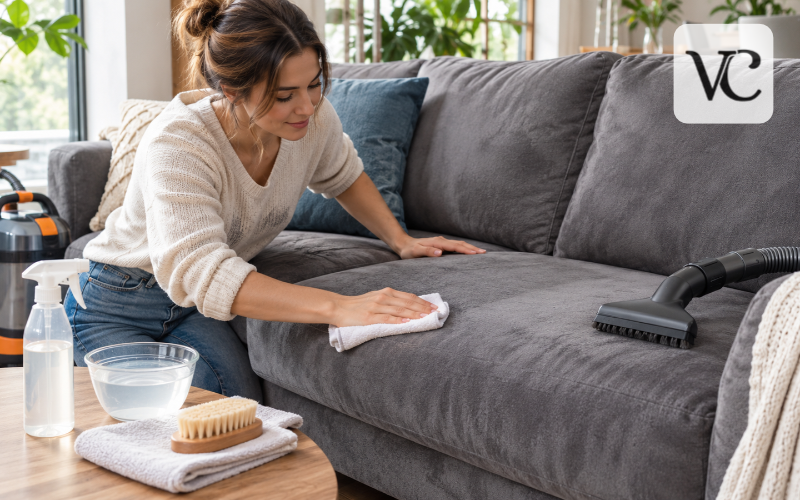
The best cleaner matches the care code and leaves no sticky or visible residue. Start by gathering a vacuum with an upholstery attachment, clean white cloths, a soft upholstery brush and the appropriate cleaner.
For W-coded furniture, a mild water-based upholstery product may be enough. Some manufacturers permit foam made with a small amount of gentle soap and water. Use that homemade option only if the couch instructions allow it. For S-coded furniture, choose a fabric-safe, water-free upholstery solvent and follow its label exactly. SW or WS fabrics give you more flexibility, but still require care.
Rubbing alcohol is often mentioned as a microfiber cleaning shortcut, yet it is not automatically an approved substitute for a dry-cleaning solvent. It can affect dyes or finishes and is flammable. Only use it if the furniture maker and product instructions confirm suitability. Avoid bleach, strong detergents and random mixtures of household chemicals.
Prepare Your Couch Before You Start Cleaning
Preparation keeps dirt from being rubbed into the fabric. Take off throws and removable cushions if the design allows it. Use the upholstery attachment to vacuum the seat, back, arms and cushion edges. A crevice tool is useful for seams, where crumbs and pet hair collect.
Check the surface for sticky spills or dried food. Lift solid pieces carefully with a spoon or another blunt edge instead of pushing them into the upholstery. For a fresh liquid spill, press a clean white towel against the spot to absorb as much as possible. Do not rub from side to side; that can enlarge the mark.
Before using any cleaner, try it on a hidden section, such as the back edge of a cushion. Allow the test area to dry completely and inspect it in good light. If you notice fading, stiffness or a ring, stop and choose a different manufacturer-approved approach. Open windows if the cleaning product calls for ventilation, and keep children and pets away from the working area.
How to Clean a Microfiber Couch Without a Machine
Basic microfiber couch cleaning needs no machine. Hand cleaning also gives you control over moisture. Once you have checked the code and vacuumed thoroughly, dampen a clean white cloth with the permitted cleaner, or apply the product to the cloth as directed. For X-coded upholstery, stop after vacuuming and gentle dry brushing.
Work on one small section at a time. Blot stained areas first, moving from the outside towards the centre. If the care instructions allow gentle wiping, use light strokes rather than heavy scrubbing. Switch to a fresh part of the cloth whenever it becomes dirty so you do not spread grime back onto the couch.
Follow the cleaner’s directions for removing residue. A water-safe couch may allow a second, barely damp cloth; an S-coded couch must not be rinsed with water. Press with a dry towel where appropriate and leave the surface undisturbed until fully dry. Check it again before deciding whether another treatment is necessary.
Cleaning a W-Code Microfiber Couch With Water-Based Products
A W code allows a suitable water-based cleaning method, but it does not mean the couch can be soaked. For light soil, use a mild upholstery cleaner according to its instructions. If the manufacturer allows gentle soap, mix a very small amount with water and work up some suds. Test the mixture in a hidden area before treating the visible fabric.
Apply a little foam or solution with a clean white cloth, keeping the padding underneath as dry as possible. Gently blot or wipe the dirty section without pressing hard. Try to clean evenly across a visible area, such as a cushion face, if the manufacturer’s advice permits; treating only a tiny circle can sometimes leave an obvious boundary.
Where the product directions require rinsing, lift remaining soap with another cloth lightly moistened with clean water. Blot away surface moisture and let the couch air-dry. Too much detergent can leave stiffness, while too much water can produce rings and slow drying. A W code also does not automatically approve steam cleaning, hot-water extraction or putting cushion covers in a washing machine.
How to Dry Clean an S-Code Microfiber Couch Safely
An S-coded couch calls for a water-free upholstery cleaning solvent. Here, “dry cleaning” describes the product type, not a moisture-free process. Ordinary water and soap are unsuitable because they can leave marks or affect the fabric’s finish.
Choose a product specifically intended for upholstery and compatible with your couch’s instructions. Read both labels carefully, especially any warning about ventilation, colourfastness or flammability. Test a small hidden area and let it dry fully. If the result looks unchanged, apply a limited amount as directed, treating the stain from the outer edge inward. Blot gently with a clean white cloth rather than saturating the cushion or scrubbing it hard.
Do not assume rubbing alcohol is safe just because it evaporates quickly. Use it only when the furniture manufacturer explicitly allows that method. Keep all solvent products away from flames, sparks, heaters and smoking materials, and follow their safety directions. For extensive soiling, stubborn stains or uncertain fabric care, a professional upholstery cleaner is a safer choice than repeated home treatments.
How to Remove Common Stains From a Microfiber Couch
Stain treatment depends on the cleaning code. Begin by lifting any loose material and blotting fresh moisture with a white cloth. Treat the edge of a spot first to prevent it from spreading. Resist the urge to pour a cleaner directly onto the fabric.
Food and drink stains often respond to prompt, careful treatment with the permitted upholstery product. On W or WS fabric, a compatible water-based cleaner may help remove spills such as juice or sauces. On S fabric, use only an approved solvent method. Allow the spot to dry before judging the result, since damp microfiber can temporarily look darker.
Grease, cooking oil and some makeup marks are more difficult because they contain oils. A product suitable for oily upholstery stains may work better than plain soap, but it must still match the care code. Ink requires extra caution: scrubbing can spread the pigment, and some stain removers may remove the upholstery dye along with the mark.
For pet accidents, blot immediately and use only a code-compatible product approved for that type of mess. Recurring odours may mean liquid reached the padding. If a stain remains after one careful attempt, or if the fabric starts changing colour or texture, stop before making it worse and consider professional help.
How to Clean Microfiber Couch Water Stains and Rings
Water rings appear when upholstery dries unevenly. Water may move dissolved dirt or minerals towards the edge of the damp spot, leaving a visible outline. That is why a small splash can sometimes look worse after it dries.
If the couch is W or WS coded, begin by checking that the mark really is a water ring rather than damaged dye. Test the approved cleaner in a hidden area. Where the manufacturer’s instructions allow it, clean the complete affected panel or cushion face lightly and evenly instead of repeatedly wetting only the ring. Remove any permitted residue, blot excess moisture and encourage even air-drying.
Avoid adding more and more water when the first attempt does not work. On an S-coded couch, never try to erase a ring with water; an X-coded couch should not be wet-cleaned at all. Old rings, colour changes or marks caused by previous cleaning products may require a professional assessment and are not always fully removable.
How to Clean and Freshen a Microfiber Couch With Baking Soda
Baking soda may reduce mild smells but cannot replace upholstery cleaning. If your couch’s manufacturer allows dry powder treatments, first vacuum thoroughly and test a small amount in an out-of-sight area. Fine powder can become trapped in dense upholstery, seams and cushion gaps.
For a permitted dry treatment, apply a light dusting rather than a thick layer. Leave it only for the period recommended by the furniture-care guidance, then vacuum slowly and completely with an upholstery attachment. Check carefully for white residue, especially on dark fabric. Do not add water or vinegar to make a paste unless the manufacturer specifically permits that treatment.
If the couch smells strongly of urine, mildew or another persistent source, baking soda may temporarily mask the problem without reaching the cause. Find and address the source of the odour instead of repeatedly covering the furniture with powder. For X-coded fabric, follow the vacuum-and-brush-only restriction rather than experimenting with household ingredients.
Can You Clean a Microfiber Couch With Vinegar?
Vinegar appears often in homemade cleaning tips. However, this does not make it a universal microfiber cleaner. Its acidity may affect certain dyes, finishes or upholstery treatments, and an overly wet vinegar mixture can leave rings even if it removes some dirt.
If the couch is W or WS coded, diluted vinegar should only be considered when the manufacturer specifically recommends or allows it. Test the exact dilution on a hidden area and follow the care directions. Do not use a vinegar-and-water solution on S-coded upholstery, and never apply liquid cleaner to X-coded fabric.
When there is no clear approval for vinegar, choose a suitable upholstery cleaner instead. A water-based cleaner designed for the fabric is generally a more predictable option for W-coded couches; an approved solvent is the relevant choice for S-coded upholstery. Never mix vinegar with bleach or other cleaners in an attempt to make a stronger solution.
How to Clean Microsuede Couch Stains and Restore Softness
Microsuede is microfiber upholstery with a suede-like surface. Its short fibres have a direction, called the nap. After cleaning, those fibres can become flattened or feel slightly stiff, especially when soap residue remains or the fabric has been rubbed too hard.
To clean microsuede couch stains, begin with the care tag just as you would for any microfiber couch. Vacuum loose soil, blot fresh spills and use only a compatible cleaning product after a hidden-area test. Avoid abrasive pads and hard brushes that may roughen the surface or make one patch look different from the rest.
Let the cleaned area become completely dry before trying to restore its texture. If the manufacturer permits brushing, use a clean, soft upholstery brush with gentle strokes. Move lightly along the fabric and then smooth the fibres in a consistent direction. This can improve the look and feel of flattened areas, although it cannot repair fibres that have been permanently damaged.
Drying, Common Cleaning Mistakes and Long-Term Couch Care
Drying is part of cleaning, not an optional final step. Keep the room ventilated and allow air to move around the couch. A fan placed nearby may help, provided it does not blow dust onto the damp surface. Avoid sitting on cleaned cushions until they are fully dry, and do not use high heat from a hairdryer or place the couch next to a heater to speed things up.
One mistake is adding liquid when a stain remains. This can push dirt deeper into the cushion and leave the fabric unevenly damp. Harsh scrubbing is another problem: it may flatten the soft surface and make a cleaned patch stand out. Strong detergents, bleach and unapproved DIY mixtures can create fresh damage instead of removing the original mark.
Removable cushion covers deserve special care. A zip is not proof that fabric is machine washable. Unless separate care instructions clearly allow laundering, leave the covers in place and use the permitted upholstery method. Machine washing can cause shrinking or distort the fit, even when the fabric itself seems sturdy.
To keep the couch looking good, vacuum approximately once a week or more often if pets use it. Deal with spills as soon as possible, rotate reversible cushions where the manufacturer allows and check heavily used arms and seats for grime. For deep odours, widespread stains or uncertain cleaning codes, professional advice is often better than another round of home cleaning.
Conclusion
Learning how to clean a microfiber couch starts with one simple habit: check the cleaning label before reaching for a product. A W-coded couch needs a different approach from an S-coded one, while X-coded upholstery should only be vacuumed or lightly brushed. Choosing the right method prevents many avoidable problems.
For everyday care, begin with a thorough vacuum, test any approved cleaner and work gently without soaking the fabric. Allow plenty of drying time and restore softness with light brushing only when recommended. Regular attention to crumbs and spills can reduce the need for stronger treatments later. Above all, follow the manufacturer’s instructions rather than assuming that a popular household cleaning trick will suit every couch.
Frequently Asked Questions
Can I clean a microfiber couch with dish soap and water?
Yes, if your couch has a W or WS/SW cleaning code and the manufacturer permits mild soap. Use a small amount, avoid soaking the fabric and test a hidden area first.
Is rubbing alcohol safe for cleaning a microfiber couch?
Rubbing alcohol may be suitable for certain microfiber fabrics, but not all. Check the manufacturer’s instructions before using it. Avoid excessive application, provide ventilation and keep it away from heat or flames.
How can I remove water stains from a microfiber couch?
For W or WS/SW-coded upholstery, an approved cleaner and careful, even cleaning may reduce water rings. Avoid excessive moisture. Never use water on S or X-coded fabric.
Can baking soda remove bad smells from a microfiber couch?
Baking soda may help reduce mild surface odours when the manufacturer permits its use. However, it cannot remove deep stains or contamination inside cushions. Vacuum thoroughly to prevent powder residue.
How often should I clean my microfiber couch?
Vacuum your microfiber couch approximately once a week, especially if you have pets. Treat spills promptly and perform deeper cleaning only when necessary, using products approved for your upholstery’s care code.
Disclaimer: This article on voguecultures.co.uk is published solely for general educational and informational purposes. It is not a guest post, sponsored article, paid promotion, or advertisement. The cleaning methods discussed are general guidance, and results may vary depending on the couch’s fabric, condition and manufacturer instructions. Always check the upholstery care label and test approved products before cleaning. voguecultures.co.uk does not provide professional upholstery-cleaning services or guarantee specific cleaning results.
Enjoyed this article? Discover more helpful ideas and fresh inspiration on Vogue Cultures.