Asbestos siding is a type of exterior wall covering made by mixing asbestos fibers with cement. It was used on many American homes because it was strong, fire-resistant, and able to copy the look of wood shingles without rotting or attracting insects. It is most often found on houses built or re-sided from the 1920s through the 1970s, although installation dates vary. Homeowners may discover it while buying an older house, replacing windows, repairing storm damage, or planning new siding. EPA guidance lists roofing and siding shingles among building materials that may contain asbestos.
Finding asbestos siding does not automatically mean that a home is unsafe or that the material must be removed immediately. The main concern is whether the siding is intact and likely to remain undisturbed. This article explains how to recognize possible asbestos siding, understand the health risk, arrange testing, maintain it safely, and compare repair, covering, replacement, and professional removal.
Asbestos Siding Quick Guide
| Topic | Quick Explanation |
| Common installation period | Frequently installed on homes from the 1920s through the 1970s |
| Typical appearance | Hard, cement-like shingles with straight, wavy, or scalloped lower edges |
| Main health concern | Fibers may become airborne when siding is cut, drilled, sanded, broken, or removed |
| Risk when intact | Generally lower because asbestos fibers remain bound within the cement |
| Reliable identification | Professional sampling and laboratory testing |
| Maintenance | Use gentle cleaning and avoid pressure washing, sanding, and scraping |
| Repair option | Replace isolated damaged shingles with matching asbestos-free fiber-cement products |
| Management choices | Leave intact, encapsulate, cover, repair, or professionally remove |
| Removal cost | Often calculated per square foot and affected by access, condition, labor, and disposal |
| Best professional to contact | Accredited asbestos inspector or licensed asbestos-abatement contractor |
Steps to Manage Suspected Asbestos Siding
- Do not disturb the panels. Avoid drilling, cutting, sanding, scraping, pressure washing, or breaking the siding.
- Check the condition from a safe distance. Look for cracks, missing shingles, loose panels, powdery edges, and storm damage.
- Review the property’s history. Building records, renovation dates, invoices, and old inspection reports may provide useful clues.
- Arrange professional testing when necessary. Testing is especially important before remodeling, replacing windows, installing new siding, or removing damaged panels.
- Compare suitable management options. Depending on the condition, the siding may be left in place, repaired, encapsulated, covered, or professionally removed.
- Check local requirements. Asbestos handling, permits, transportation, disposal, and contractor rules vary between states and local authorities.
What Asbestos Siding Is and Why It Became Popular
Asbestos siding is usually an asbestos-cement product. Cement forms the hard body of each shingle, while asbestos fibers were added to improve its strength and resistance to heat. The finished product is rigid and dense rather than soft or fluffy. Federal guidance generally treats asbestos-cement siding as a Category II nonfriable material when it is in sound condition. This means it cannot normally be crushed into powder by hand pressure.
The material became popular because it solved several common exterior problems. It did not rot like untreated wood, insects could not eat it, and it resisted fire and harsh weather. Manufacturers also pressed patterns into the surface so the shingles could resemble painted wood grain. These qualities made asbestos siding attractive for new construction and for covering the older wood siding found on many houses.
Use declined as the health dangers of airborne asbestos became widely understood and manufacturers moved toward asbestos-free products. It is more accurate to describe old asbestos siding as a legacy building material than to claim that every asbestos product was banned at the same time.
EPA’s 1989 rule banning many asbestos products was partly overturned by a federal court in 1991. Later rules restricted new and continuing uses. In 2024, EPA finalized a ban on the remaining ongoing uses of chrysotile asbestos, but siding already installed on older homes remains a legacy-use concern.
What Does Asbestos Siding Look Like?
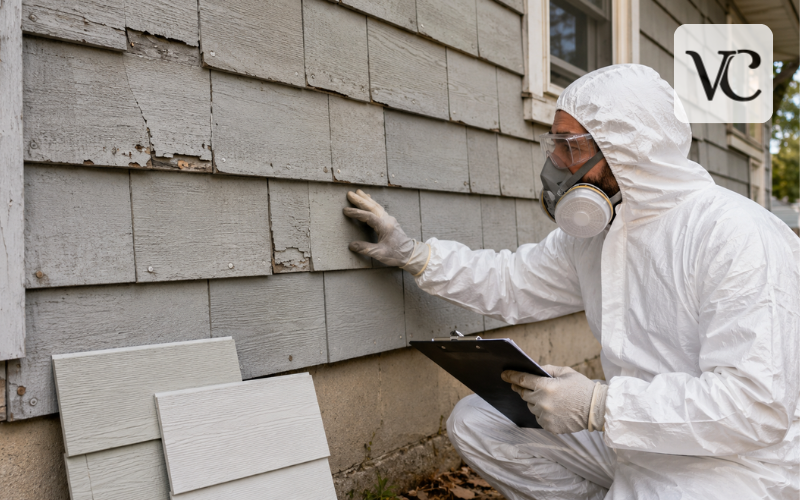
Older asbestos-cement siding commonly appears as individual rectangular shingles installed in overlapping horizontal rows. Many pieces are approximately 12 by 24 inches, although other sizes exist. Some have straight lower edges, while others have wavy, scalloped, or thatched profiles. Surfaces may be smooth, lightly striped, or pressed with a wood-grain pattern.
Modern asbestos-free replacement shingles are still manufactured in similar 12-by-24-inch styles because this size matches many older installations. However, size alone cannot confirm what a shingle contains.
Possible identification clues include a hard, cement-like feel, exposed nails near the lower edge, uniform repeating patterns, and shingles that chip instead of bending. Weathered areas may appear pale, chalky, or slightly fibrous around damaged edges.
Homeowners should not break, lift, scrape, or remove a panel to inspect its back. Some asbestos-free cement shingles look almost identical. The Consumer Product Safety Commission states that a material cannot be confirmed as asbestos simply by looking at it unless it carries a reliable product label.
The age of the house is only a clue. A nineteenth-century house may have received asbestos siding during a renovation in the 1940s or 1950s, while a mid-century home may have another type of siding. Building records, old invoices, packaging, manufacturer markings, and previous inspection reports may help, but laboratory analysis is the only dependable way to confirm the material.
Asbestos Siding vs. Fiber-Cement Siding
Asbestos siding and modern fiber-cement siding can look very similar because both use cement as a main ingredient and both may copy the appearance of wood shingles. The important difference is the reinforcing fiber.
Older asbestos-cement products used asbestos minerals. Modern fiber-cement products generally use cellulose and other non-asbestos materials. Asbestos-free replacement shingles are specifically manufactured to match the shape and texture of older asbestos siding.
Manufacturing dates and markings can provide useful hints. A newer panel may have a brand name, product code, safety information, or installation details printed on the back. An old unmarked shingle may raise suspicion, but the absence of a code does not prove that it contains asbestos.
Texture, thickness, nail patterns, and brittleness can also overlap between old asbestos-cement siding and newer fiber-cement products. This is why visual checks should be treated as preliminary observations rather than proof.
An asbestos siding vs. cement fiber siding comparison based only on photographs can easily produce the wrong answer. Do not rely on a contractor’s quick glance, an online image match, or the appearance of a broken edge. When a planned project could disturb the material, EPA recommends sampling by a properly trained and accredited asbestos inspector, followed by analysis at a qualified laboratory.
Is Asbestos Siding Dangerous?
Asbestos is dangerous when tiny fibers become airborne and are inhaled. Exposure can lead to serious diseases, including asbestosis, lung cancer, and mesothelioma. These illnesses often develop many years after exposure, and the risk generally rises with the amount, frequency, and length of exposure. Smoking further increases the risk of lung cancer among people who have been exposed to asbestos.
Intact asbestos siding usually presents a lower exposure risk because the fibers are tightly bound inside cement. EPA’s final evaluation of legacy asbestos uses states that undisturbed legacy asbestos does not pose an unreasonable risk, while disturbing and handling it can create an unreasonable risk.
This does not mean asbestos siding is completely safe in every situation. It means the practical danger is mainly connected to releasing fibers through damage, deterioration, or construction work.
Sawing, sanding, drilling, grinding, cutting, breaking, or careless removal can release fibers from asbestos-cement products. Demolition and repeated construction work create particular concern. Homeowners should therefore avoid treating old siding like ordinary wood or modern vinyl, even when the panels appear solid.
Warning Signs That Asbestos Siding Needs Attention
Minor fading or an old layer of paint does not always mean that asbestos siding is failing. More serious warning signs include cracked or missing shingles, loose panels, powdery edges, impact damage, and broken pieces lying on the ground.
Areas around windows, doors, utility lines, decks, vents, outdoor lights, and additions deserve special attention. Previous construction work may have involved drilling, cutting, or breaking the siding in these locations.
Storms, falling branches, ladders, lawn equipment, and high-pressure washing can chip brittle shingles. Repeated water entry behind broken panels may also damage the wall, insulation, and wood framing even when the asbestos itself remains outdoors.
State enforcement cases have documented unsafe power washing that spread asbestos-containing dust and debris. This is one reason aggressive cleaning methods should be avoided.
If pieces have recently broken, keep people and pets away from the debris. Do not sweep, vacuum, crush, or carry the material through the house. Contact a qualified asbestos professional or the appropriate state or local environmental agency for instructions because disposal and handling rules differ by location.
Safe Inspection and Asbestos Testing
The safest first inspection is visual and non-destructive. Note the siding’s condition from the ground, photograph damaged areas without touching them, and check property records for renovation dates.
If the siding is in good condition and no work will disturb it, EPA generally does not recommend testing simply to satisfy curiosity. Sampling creates a new opening in the material and can be more hazardous than leaving sound siding alone.
Testing becomes useful when the siding is damaged or when a renovation, window replacement, addition, demolition, or new-siding project may disturb it. EPA recommends that a trained and accredited asbestos inspector collect the sample.
The inspector can choose a suitable sampling location, control the work area, send the material to a qualified laboratory, and explain what the result means. NIST’s National Voluntary Laboratory Accreditation Program accredits laboratories for asbestos fiber analysis using methods such as polarized light microscopy.
Ask for a written report that identifies the sampled material, laboratory result, present condition, and recommended next steps. While waiting for the results, do not drill, scrape, pressure wash, or begin demolition. Inform every contractor who may work on the exterior that asbestos is suspected so the siding is not disturbed accidentally.
Benefits and Limitations of Keeping Asbestos Siding
Asbestos siding can remain useful for decades when it is sound. It does not feed termites, rot like wood, or burn easily. Its dense surface may also hold paint well.
Leaving sound material in place avoids the immediate cost, disruption, and exposure risk created by unnecessary removal. CPSC’s general advice is that asbestos material in good condition is usually best left alone.
Its main weakness is brittleness. A relatively small impact can crack a shingle, and ordinary exterior jobs may require holes that should not be drilled through asbestos-containing material without proper controls.
Exact replacement profiles can also be difficult to match. Some homebuyers may worry about future renovation expenses, while contractors may charge more when they must work carefully around the old siding.
Keeping asbestos siding makes the most sense when most panels are intact, the exterior is weather-tight, no major remodel is planned, and the owner can arrange careful maintenance. Widespread cracking, repeated repairs, water entry, or a large renovation may make encapsulation or professional removal more practical.
Maintaining Asbestos Siding Without Disturbing It
Maintenance should focus on preserving the hard surface rather than stripping it. Avoid pressure washing, power sanding, wire brushing, dry scraping, and abrasive cleaning. These methods may crack panels or create contaminated dust.
Use a contractor who understands asbestos-cement products and can choose a low-disturbance cleaning and coating method. Some state regulations specifically prohibit breaking, sanding, sawing, or drilling asbestos-cement siding during removal and handling.
Painting may be possible when the siding is sound, but surface preparation is the most important concern. Loose paint should not be removed through aggressive sanding or scraping.
A knowledgeable contractor may use gentle wet cleaning, careful hand methods, and a compatible exterior coating while containing paint chips and residue according to local regulations. EPA describes operations and maintenance programs as planned inspection, cleaning, safe work practices, and surveillance designed to keep asbestos-containing materials in good condition.
Inspect the exterior periodically and after severe weather. Watch for new cracks, loose corners, missing fasteners, damaged trim, leaking gutters, and moisture stains. Keep a written record of confirmed asbestos locations so future painters, electricians, window installers, and remodelers are warned before beginning work.
Leave It, Encapsulate It, or Remove It
Leaving the siding alone is often the simplest choice when it is intact and unlikely to be disturbed. This approach should include routine monitoring and clear property records. It avoids creating dust and preserves a durable exterior, but it may not suit a planned addition or complete exterior redesign.
Encapsulation means sealing or enclosing the asbestos-containing surface so fibers are less likely to escape. It may involve an approved coating or a professionally designed new-siding system installed over the existing material.
Covering is not a universal solution. Installers may need to address fastening methods, trim depth, wall flatness, drainage, flashing, and trapped moisture. Some jurisdictions discourage installing new siding over asbestos-cement panels, so local approval and professional planning are important.
Professional removal is usually considered when the siding is badly damaged, cannot be repaired, will be heavily disturbed by renovation, or must be removed to correct hidden wall problems.
EPA warns that improper removal can increase exposure rather than reduce it. Complex removal work should be completed by trained and accredited professionals who understand containment, worker protection, cleanup, transportation, and disposal rules.
Repairing Damaged or Missing Asbestos Siding
A single broken shingle does not always require complete siding removal. An asbestos professional can assess whether limited repair or replacement can be completed without damaging nearby panels.
The work should be planned to avoid snapping, sawing, sanding, or dropping the old material. Some state regulations specifically require asbestos-cement shingles to remain unbroken during removal and later handling.
Modern asbestos-free fiber-cement shingles are available in profiles designed to resemble old asbestos siding. Matching the exact grain, lower edge, thickness, and exposed area may take time. The replacement piece may also need paint to blend with the surrounding wall.
Searching for asbestos siding for sale should lead homeowners toward these non-asbestos replacement products, not salvaged asbestos shingles. Old asbestos-containing panels create handling, shipping, installation, and disposal concerns and are not a sensible repair material.
When many panels are failing, repeated spot repairs may cost more and leave an uneven exterior. At that point, compare the cost and long-term value of repairing a larger area, installing an approved covering system, and removing all the old siding.
Asbestos Siding Replacement Options
Full removal exposes the exterior wall so contractors can inspect the sheathing, weather barrier, flashing, insulation, and hidden moisture damage before installing new siding. It also removes the need to manage old asbestos panels during future exterior work.
The disadvantages are higher cost, stricter handling and disposal requirements, and greater short-term disturbance. The old siding may also be hiding original wood shingles that require repair before the new exterior can be installed.
Installing new siding over intact asbestos siding may reduce removal work, but it is not simply a matter of attaching vinyl panels to the old shingles. The design must avoid unnecessary drilling and breaking, maintain drainage, fit properly around windows and doors, and prevent the added wall thickness from interfering with trim and flashing.
A siding contractor and an asbestos professional may need to coordinate the plan. Local rules should be checked before choosing this option because covering is treated differently among jurisdictions.
Common replacement choices include vinyl, modern fiber cement, engineered wood, metal, and traditional wood. The best material depends on climate, appearance, maintenance, fire performance, budget, and the structure behind the old siding.
Before signing a contract, confirm permit requirements and asbestos regulations with the local building department and environmental agency. Federal asbestos requirements do not cover every small residential project in the same way, and state laws may be stricter. Minnesota, for example, removed a previous residential exemption for asbestos-containing siding work.
Asbestos Siding Removal Cost and Project Planning
Asbestos siding removal cost varies too much for one national figure to fit every house. Important factors include the amount of exterior wall area, number of stories, accessibility, panel condition, containment needs, local labor rates, disposal fees, permits, and whether the house remains occupied.
Testing, temporary protection, cleanup, wall repairs, insulation, and new siding may appear as separate charges. Minimum contractor fees can also make a small repair expensive on a per-square-foot basis.
Current 2026 consumer estimates show why homeowners should treat online prices as broad planning ranges. Angi lists approximately $3 to $15 per square foot for asbestos siding removal. HomeGuide gives about $7 to $10 per square foot and estimates $14,000 to $20,000 for removal on a 2,000-square-foot home.
These sources may calculate the work area and included services differently, so their figures are not directly interchangeable.
The complete project may cost considerably more once new siding, insulation, sheathing repairs, trim, and painting are included. Angi’s 2026 estimate for asbestos siding replacement places many complete projects between approximately $16,000 and $22,000, although large, tall, damaged, or complex homes can fall outside this range.
Obtain at least two or three written quotes that clearly separate inspection, removal, disposal, wall repairs, and new installation. Confirm contractor licensing, insurance, worker training, permits, cleanup procedures, and the approved disposal location before work begins.
Buying, Selling, and Researching Homes With Asbestos Siding
Asbestos siding does not automatically make a house unlivable or impossible to finance. Buyers should focus on confirmed identification, current condition, planned renovations, and realistic future expenses.
A general home inspector may note suspected asbestos siding, but an accredited asbestos inspector is better suited to sampling and condition assessment. Insurance and mortgage decisions vary by company, especially when the siding is damaged or an immediate repair is required.
Disclosure duties differ by state. Several state disclosure forms specifically ask about known asbestos or hazardous materials, while exemptions and wording vary. Sellers should not assume that one national disclosure rule applies everywhere.
Buyers and sellers should ask a local real estate professional or attorney how the law applies to their transaction. Test reports, repair invoices, warranties, and contractor records should be retained and shared when required.
Asbestos siding Reddit discussions can help readers discover questions to ask, such as whether to paint, cover, repair, or remove the material. However, forum advice frequently includes unsafe do-it-yourself suggestions and prices from unrelated markets.
Use personal stories as background only. Verify safety, legal, and disposal advice with an accredited inspector, licensed contractor, and local agency. EPA’s 2024 evaluation specifically identified do-it-yourself renovation involving legacy asbestos as a possible exposure concern.
Conclusion
The right response to asbestos siding depends on its condition and what you plan to do with the home. Intact, undisturbed panels generally present a lower exposure risk and may remain in place with careful monitoring.
Damaged siding or material that will be drilled, cut, sanded, broken, or removed requires greater caution because those actions can release harmful fibers.
Do not make a final decision based on appearance alone. Arrange professional testing when damage or planned renovations make confirmation necessary. Then compare limited repair, encapsulation or covering, and licensed removal.
Local regulations, moisture control, total project cost, and future remodeling plans should all shape the choice. A calm and informed approach protects the people living in the home while avoiding unnecessary disturbance of a durable but hazardous legacy material.
Frequently Asked Questions
What does asbestos siding look like?
Asbestos siding often appears as rigid cement shingles installed in overlapping rows. Common clues include exposed nails, repeating wood-grain patterns, brittle edges, and straight, wavy, or scalloped lower profiles.
Is asbestos siding dangerous if it is intact?
Intact asbestos-cement siding generally presents a lower exposure risk because its fibers remain bound within cement. The risk increases when panels are damaged, drilled, cut, sanded, broken, or improperly removed.
Can asbestos siding be covered with new siding?
New siding may sometimes be installed over intact asbestos siding, but the project requires careful planning. Fastening, moisture drainage, flashing, trim depth, building codes, and local asbestos regulations must be considered.
How can I confirm that my siding contains asbestos?
Appearance cannot provide a definite answer because modern fiber-cement shingles may look similar. A trained asbestos inspector can safely collect a sample and send it to a qualified laboratory for analysis.
How much does asbestos siding removal cost?
Removal costs depend on the home’s size, number of stories, siding condition, accessibility, local labor rates, containment needs, permits, and disposal fees. New siding and hidden wall repairs add separate expenses.
Disclaimer: This article provides general educational information about asbestos siding and should not be treated as professional inspection, medical, legal, construction, or asbestos-removal advice. Asbestos regulations, licensing rules, disclosure duties, and disposal requirements vary by location. Do not cut, drill, scrape, sand, break, sample, or remove suspected asbestos siding yourself. Contact an accredited asbestos inspector, licensed abatement contractor, local building department, or environmental authority before beginning repairs, renovations, or removal. Seek medical advice from a qualified healthcare professional if you believe you have experienced significant asbestos exposure.
Enjoyed this article? Discover more helpful ideas and fresh inspiration on Vogue Cultures.