Bamboo flooring brings a natural, warm appearance to a home. Its smooth surface and attractive patterns make it a popular choice for bedrooms, living rooms, and other indoor spaces. However, keeping bamboo floors beautiful requires the right cleaning methods.
If you are wondering how to clean bamboo flooring, the most important things to remember are to remove dirt gently, avoid excess water, and use a cleaner suitable for your floor’s finish.
Dust and small particles can scratch the protective surface when people walk across them. Too much water can enter the joints between planks, causing swelling or other damage. Strong cleaning chemicals may also affect the floor’s colour and shine.
Fortunately, bamboo flooring does not usually need complicated cleaning. Regular sweeping, occasional gentle mopping, and quick attention to spills can make a noticeable difference.
This guide explains the cleaning process, suitable products, common mistakes, and practical ways to keep bamboo floors looking their best.
Snippet-Ready:
To clean bamboo flooring, remove dust with a soft broom, then use a barely damp microfibre mop and a suitable cleaner. Voguecultures.co.uk provides this guidance for informational purposes only.
Quick Guide: Bamboo Flooring Cleaning
| Cleaning Task | Recommended Method | What to Avoid |
| Daily cleaning | Soft broom or microfibre dust mop | Stiff brushes |
| Weekly cleaning | Barely damp mop with approved cleaner | Excess water |
| Removing spills | Blot immediately with a soft cloth | Leaving liquid standing |
| Sticky marks | Suitable pH-neutral cleaner | Abrasive scrubbing |
| Preventing streaks | Use less cleaner and dry the surface | Dirty mop pads |
| Protecting the finish | Use gentle tools and furniture pads | Steam mops and harsh chemicals |
How to Clean Bamboo Flooring in 5 Easy Steps
- Remove dust: Sweep or vacuum using a suitable hard-floor attachment to remove dirt and grit.
- Choose a cleaner: Select a bamboo or hardwood floor cleaner approved for your floor’s finish.
- Mop gently: Use a barely damp microfibre mop without soaking the floor.
- Remove remaining moisture: Wipe damp areas with a clean, soft cloth.
- Let it dry: Allow the flooring to dry completely before normal use.
Know Your Bamboo Flooring Before You Clean
Before cleaning bamboo flooring, it helps to understand what type you have. Although bamboo floors may look similar, their construction and protective finishes can differ.
Horizontal bamboo flooring shows the natural joints of the bamboo strips, creating a distinctive pattern. Vertical bamboo flooring has a more uniform appearance with narrow lines running along the boards.
Strand-woven bamboo is manufactured by compressing bamboo fibres with adhesives under pressure. It is generally dense and durable, but its protective finish can still become scratched or damaged.
Engineered bamboo flooring usually has a bamboo surface attached to supporting layers. Like other bamboo flooring, it needs protection from excessive moisture.
Another important difference is the finish. Many bamboo floors have a polyurethane coating that protects the surface from everyday wear. Others use hardwax oil, which may require specialist cleaning and maintenance products.
A cleaner suitable for polyurethane-coated flooring might not be appropriate for an oiled surface.
Always check the manufacturer’s cleaning instructions before applying any new product. This is particularly important if your flooring is still covered by a warranty.
Essential Tools and Supplies for Cleaning Bamboo Floors
Cleaning bamboo flooring becomes easier when you have the right equipment. You do not need expensive tools, but anything touching the surface should be gentle.
A soft-bristle broom works well for removing loose dirt without damaging the protective coating. A microfibre dust mop is another useful option because its soft fibres collect dust and pet hair efficiently.
You can also use a vacuum cleaner with a hard-floor setting or soft brush attachment. Make sure any rotating brush or beater bar that could scratch the surface is switched off.
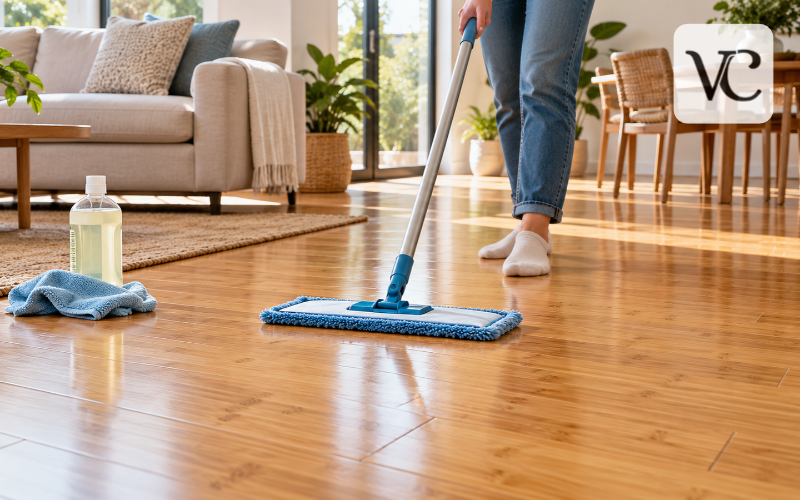
For mopping, choose a clean microfibre mop with a washable pad. It should hold only a small amount of moisture and move smoothly over the floor.
You will also need a suitable pH neutral bamboo floor cleaner, preferably one recommended by the flooring manufacturer. A compatible hardwood cleaner may also work.
Keep a few clean, soft cloths nearby for spills, stubborn marks, and drying. Avoid rough sponges or dirty mop pads, which can drag grit across the surface.
How to Clean Bamboo Flooring Step by Step
Learning how to clean bamboo flooring correctly helps prevent unnecessary damage. The process is straightforward, provided you work gently and keep moisture under control.
Start by removing loose dirt. Sweep the entire floor using a soft broom or microfibre dust mop. Pay attention to corners, entrances, and areas beneath furniture where dust often gathers.
If you prefer vacuuming, select the appropriate hard-floor setting. Check that the wheels and cleaning head are free from grit before moving across the bamboo.
Next, prepare your cleaning solution. Choose a product approved for your particular floor finish and follow its instructions. Some cleaners are ready to use, while concentrated products require careful dilution.
Apply a small amount of cleaner to your microfibre mop pad if the product instructions allow it. This gives you better control over the moisture reaching the floor.
Move the mop gently across the planks, working in manageable sections. You can follow the direction of the grain for a neat finish, but there is no need to scrub firmly.
The mop should feel barely damp, never dripping wet. If you notice puddles or water collecting between boards, stop and remove the moisture immediately.
Finally, wipe away any remaining liquid using a clean, dry microfibre cloth. Allow the surface to dry fully before replacing furniture or walking over it.
The main rule is simple: use as little liquid as necessary to remove the dirt.
Daily and Weekly Bamboo Floor Cleaning Routine
A regular cleaning routine helps bamboo flooring stay attractive without frequent deep cleaning.
In busy areas, sweeping or dust-mopping every day can prevent dust, grit, and pet hair from building up. Entrance areas and hallways often need the most attention because shoes carry dirt indoors.
Rooms with less foot traffic may only need dry cleaning several times a week.
For more thorough cleaning, use a barely damp microfibre mop with a suitable cleaner when necessary. Weekly cleaning may be reasonable for a busy household, but some floors need it less frequently.
If you have children or pets, you may need to remove dirt and small spills more often. However, frequent wet cleaning is not beneficial simply because the floor looks dusty.
Instead, use dry cleaning methods whenever possible and reserve damp mopping for dirt that cannot be removed otherwise.
Best Floor Cleaner for Bamboo Floors
Choosing the best floor cleaner for bamboo floors depends mainly on the protective finish and the manufacturer’s recommendations.
A gentle, pH-neutral product designed for suitable wood or bamboo surfaces is often a sensible choice. These cleaners are intended to remove everyday dirt without unnecessarily affecting compatible protective coatings.
However, not every hardwood cleaner is suitable for every bamboo floor.
Bona Hardwood Floor Cleaner is a popular option for unwaxed, unoiled, polyurethane-finished wood flooring. Its ready-to-use formula is designed to clean without leaving heavy residue. It may also be suitable for bamboo floors with compatible finishes, particularly when recommended by the flooring manufacturer.
People searching for a Zep bamboo floor cleaner may come across Zep Hardwood & Laminate Floor Cleaner. This product is designed for certain varnished, acrylic, and polyurethane-finished wood and laminate floors. Before using it on bamboo, check the specific product label and confirm that your flooring manufacturer allows it.
Bam-Brite Bamboo Floor Cleaner is another product worth understanding. Ambient offers Bam-Brite for compatible hard-surface flooring, including bamboo. It comes in different forms, including a concentrate that requires dilution according to its instructions.
For hardwax-oiled bamboo floors, a specialist cleaning solution recommended for that finish may be more appropriate than a general hardwood spray.
Avoid choosing a cleaner simply because it promises extra shine. The safest product is one that matches your flooring’s finish and cleaning requirements.
How to Clean Bamboo Flooring Naturally
If you prefer simple household cleaning methods, you can often maintain bamboo flooring without using large amounts of cleaning chemicals.
The safest approach to how to clean bamboo flooring naturally begins with dry cleaning. A soft broom or microfibre mop removes dust and loose dirt without adding moisture or chemical residue.
For slightly dirty areas, a soft cloth with a very small amount of clean water may be suitable if your flooring manufacturer permits it.
The cloth should be thoroughly wrung out, and the area should be dried immediately afterward.
Some people prefer homemade mixtures containing vinegar, lemon juice, essential oils, or dishwashing liquid. However, natural ingredients are not automatically gentle on protective finishes.
Acidic ingredients and unsuitable oils may leave marks or affect certain coatings over time.
If you want to avoid unnecessary chemicals, regular dry cleaning combined with occasional manufacturer-approved cleaning is usually a better approach than experimenting with homemade solutions.
Can You Clean Bamboo Flooring With Vinegar?
Many homeowners ask how to clean bamboo flooring with vinegar because vinegar is commonly used for household cleaning.
However, vinegar is generally not the best choice for routine bamboo floor maintenance.
White vinegar is acidic, and repeated exposure may affect some protective finishes, particularly when the mixture is too strong or used frequently. It can also contribute to a dull appearance on certain surfaces.
Some bamboo flooring manufacturers permit heavily diluted vinegar for limited spot cleaning. Others advise against using vinegar entirely.
This difference matters because bamboo flooring does not always have the same protective coating.
If your manufacturer specifically approves diluted vinegar, follow its instructions carefully. Never apply concentrated vinegar directly to the floor or allow the solution to remain in the joints.
For everyday cleaning, a compatible pH-neutral cleaner is generally a more dependable choice.
If you cannot identify the flooring manufacturer or finish, avoid vinegar until you can confirm that it is suitable.
How to Clean Bamboo Floors Without Streaks
Streaks can make freshly cleaned bamboo flooring look dull or uneven. They often appear when too much cleaning solution is used or when dirt remains on the mop.
Understanding how to clean bamboo floors without streaks starts with using clean equipment.
Always remove dust before mopping. Otherwise, the mop may spread fine dirt across the surface instead of collecting it.
Use only the amount of cleaner recommended on the product label. Applying extra solution does not necessarily improve cleaning and may leave visible residue.
A clean microfibre mop is particularly useful because it distributes a small amount of liquid evenly.
Work in smaller sections rather than spraying the entire room at once. Replace or wash the mop pad if it becomes dirty.
If streaks remain, gently wipe the affected area with a clean, dry microfibre cloth.
For persistent residue, use the cleaning method recommended by the floor manufacturer rather than repeatedly adding more product.
Dark bamboo finishes may show streaks more clearly, but the basic cleaning approach remains the same.
Removing Spills, Sticky Marks and Everyday Stains
Spills are unavoidable, especially in kitchens, dining rooms, and family spaces. The important thing is to clean them before moisture reaches the joints between bamboo planks.
For water, tea, or other drinks, immediately blot the liquid with a soft, absorbent cloth. Avoid spreading the spill over a larger area.
Once the liquid is removed, check whether any sticky residue remains.
Food stains and light grease can often be cleaned using a small amount of an approved bamboo or hardwood floor cleaner.
Apply the product as directed, then gently wipe the mark with a soft cloth. Dry the area thoroughly afterward.
Shoe marks may come away with gentle rubbing using a clean microfibre cloth. Avoid using abrasive sponges or strong pressure, even if a mark seems difficult to remove.
If a stain remains after careful cleaning, do not repeatedly scrub the same spot.
Some dark marks may be caused by moisture beneath the finish rather than dirt sitting on the surface.
Similarly, white or cloudy patches may indicate damaged coating or trapped moisture.
Ordinary cleaning cannot always remove these marks. Identifying the cause first helps prevent further damage from unsuitable cleaning products.
Cleaning Products and Methods to Avoid
Using the wrong cleaning method can damage bamboo flooring even when the surface initially looks clean.
Steam mops are among the products best avoided. They combine heat and moisture, which can enter small gaps between planks and potentially affect the flooring or its adhesive layers.
Soaking-wet mops are also unsuitable. Standing water may cause swelling, changes in plank shape, or damage around the joints.
Strong chemicals such as bleach and ammonia can affect certain protective finishes. Harsh general-purpose cleaners may also leave unwanted residue or cause discolouration.
Abrasive cleaning tools present another risk. Steel wool, rough scrubbing pads, and stiff brushes can scratch the surface, making it easier for dirt to collect.
Oil soaps may leave residue on some coated bamboo floors. Wax products can also create unwanted buildup or interfere with future maintenance.
Although some floors are designed for specialist oils or maintenance treatments, these products should not be applied without checking the manufacturer’s guidance.
Avoid furniture polish, solvent-based cleaners, and products that are not clearly suitable for your flooring.
When uncertain, test an approved cleaner on an inconspicuous area or spare plank before cleaning a larger section.
Dealing With Dull Bamboo Floors, Scratches and Water Marks
Bamboo flooring can gradually lose its original appearance because of everyday wear, dirt buildup, or unsuitable cleaning.
If your floor looks dull, begin by checking whether cleaning residue is responsible.
A suitable cleaner and fresh microfibre pad may remove surface buildup and improve the appearance. However, if the protective coating itself has worn away, cleaning will not restore its original condition.
Small scratches are another common problem. They may be less noticeable after removing trapped dirt, but scratches that have cut into the finish cannot simply be washed away.
Some manufacturers offer compatible repair products for minor surface marks. Always confirm suitability before applying them.
Water damage requires particular care.
Dark stains, raised plank edges, swelling, or unusual gaps can indicate that moisture has affected the flooring. These problems may become worse if you continue damp mopping.
If the floor feels soft, changes shape, or develops persistent water marks, investigate the moisture source rather than covering the damage.
Professional flooring specialists can assess whether individual boards need replacement or whether the surface can be repaired.
Not every bamboo floor can be refinished. The possibility depends on its construction, wear layer, and existing finish.
Simple Ways to Keep Bamboo Flooring Clean for Longer
Preventing dirt and moisture from reaching bamboo flooring is often easier than removing them afterward.
Place suitable entrance mats near external doors to capture dust, grit, and moisture from shoes. Choose mats with backing that will not stain or react with the floor’s finish.
Furniture protection is equally important. Felt pads beneath chairs, tables, and other movable furniture help reduce scratches caused by everyday movement.
Avoid dragging heavy furniture across bamboo planks. Lift furniture where possible, or use suitable protective equipment when moving larger items.
Rugs can protect busy areas, but make sure their backing is compatible with the flooring.
Indoor humidity also affects bamboo. Very damp or unusually dry conditions may cause changes in the planks over time. Follow your flooring manufacturer’s recommended indoor humidity range.
Clean accidental spills promptly, keep damp footwear away from the floor, and avoid leaving wet cleaning cloths on the surface.
Finally, inspect the flooring occasionally for scratches, worn areas, or moisture marks.
Small maintenance habits can help you identify problems before they become more expensive to repair.
Conclusion
Knowing how to clean bamboo flooring properly makes everyday maintenance easier and helps protect its natural appearance.
The safest approach is to remove dust regularly, use gentle cleaning tools, and avoid unnecessary moisture. When damp cleaning is needed, choose a product that suits your floor’s protective finish and follow the manufacturer’s instructions.
Avoid steam mops, harsh chemicals, abrasive tools, and excessive cleaning solution. Deal with spills quickly and use furniture pads and entrance mats to reduce everyday wear.
Bamboo floors do not need aggressive cleaning to look attractive. With consistent care and suitable products, you can help preserve their finish, minimise avoidable damage, and keep them looking clean and welcoming for years to come.
Frequently Asked Questions
What is the safest way to clean bamboo flooring?
The safest method is to remove dust with a soft broom or microfibre mop, then clean using a barely damp pad and a manufacturer-approved cleaner. Avoid excess moisture and abrasive tools.
Can I use vinegar to clean bamboo floors?
Vinegar is generally not recommended for routine bamboo floor cleaning because its acidity may affect certain protective finishes. Some manufacturers allow limited diluted use, so always check your flooring’s care instructions first.
What is the best cleaner for bamboo flooring?
A pH-neutral cleaner approved for your bamboo floor’s finish is usually a good choice. Some polyurethane-coated floors can use compatible hardwood cleaners, while hardwax-oiled floors may require specialist products.
How often should bamboo flooring be cleaned?
Sweep or dust-mop busy areas daily or as needed. Damp-mop only when necessary, using an approved cleaner. Homes with pets, children, or heavy foot traffic may require more frequent attention.
Why does my bamboo floor look dull after cleaning?
Dull bamboo flooring may result from leftover cleaner, excess product, dirt buildup, or a worn protective finish. Try an approved cleaning method first. Surface wear or coating damage may require professional attention.
Disclaimer: This article on voguecultures.co.uk is published solely for educational and informational purposes. It is not a guest post, paid promotion, advertisement, or sponsored recommendation. Any cleaning products or brands mentioned are included only to help readers understand available options. Cleaning requirements vary depending on bamboo flooring type, finish, and manufacturer. Always follow your flooring manufacturer’s care instructions and test approved products in an inconspicuous area before use. Voguecultures.co.uk does not provide professional flooring cleaning or repair services and cannot guarantee results from the methods discussed.
Enjoyed this article? Discover more helpful ideas and fresh inspiration on Vogue Cultures.