A leather couch can make a living room feel comfortable, stylish, and welcoming. However, keeping it clean requires more care than simply wiping it with an ordinary household cleaner. Dust, food crumbs, accidental spills, and everyday use can gradually affect its appearance. Using the wrong cleaning method may also cause stains, fading, or damage to the leather’s protective finish.
Learning how to clean leather couch surfaces properly can help you maintain their appearance without unnecessary damage. The key is to use gentle cleaning methods, suitable products, and as little moisture as possible.
Not every leather couch needs the same treatment. Some have a protective coating that makes everyday cleaning easier, while others have a more natural, absorbent surface that needs special attention.
This guide explains how to identify your leather, remove everyday dirt, handle common stains, and maintain your furniture safely. Whether you are cleaning a new couch or refreshing an older one, understanding the correct approach can help you avoid expensive mistakes.
Quick Answer:
To clean a leather couch, gently remove dust, use a leather-safe cleaner, and wipe with a soft cloth. Voguecultures.co.uk provides informational guidance only about leather couch cleaning and care.
Quick Guide: Leather Couch Cleaning Methods
| Cleaning Situation | Recommended Method | What to Avoid |
| Everyday dust | Dry microfiber cloth | Rough brushes |
| Light surface dirt | Manufacturer-approved leather cleaner | Harsh detergents |
| Fresh liquid spills | Blot gently with a clean cloth | Rubbing or soaking |
| Grease or oil stains | Blot and use approved specialist treatment | Unapproved DIY powders |
| Ink marks | Suitable leather ink remover or professional care | Rubbing alcohol |
| Delicate leather | Specialist cleaning instructions | Excess water |
| Routine conditioning | Approved conditioner, if recommended | Household oils |
| Stubborn stains | Professional leather cleaning | Repeated scrubbing |
Step-by-Step Guide: How to Clean a Leather Couch Safely
- Identify the leather: Check the manufacturer’s label to understand the correct cleaning method.
- Remove loose dirt: Vacuum gently using a soft brush attachment.
- Test the cleaner: Apply a small amount of an approved product to a hidden area.
- Clean carefully: Use a soft microfiber cloth and clean one small section at a time.
- Avoid excess moisture: Never soak the leather or scrub aggressively.
- Dry naturally: Remove residue as directed and allow the surface to dry away from direct heat.
- Condition if needed: Apply a suitable leather conditioner only when recommended by the manufacturer.
Know Your Leather Couch Before You Start Cleaning
Before cleaning your couch, identify the type of leather used. Different leather finishes react differently to water, cleaning solutions, and conditioners. A method that works on one couch could permanently mark another.
Protected or pigmented leather has a surface coating that helps resist everyday dirt and spills. It is commonly used for family furniture because it is relatively easy to maintain. However, harsh cleaners can still damage its finish.
Aniline leather has a more natural appearance, often showing the hide’s original markings. Because it has little or no protective pigment coating, it can absorb liquids and develop stains more easily.
Semi-aniline leather usually has a light protective finish while retaining some natural character. It may offer better resistance than fully aniline leather, but its cleaning requirements still depend on the manufacturer’s instructions.
Suede and nubuck have soft, textured surfaces. They require specialist care because ordinary wet cleaning can leave marks or change their texture.
Faux leather is a manufactured material designed to resemble real leather. It usually needs different cleaning products and should not automatically receive conditioners intended for genuine leather.
Check the manufacturer’s care label, product manual, or original purchase information before proceeding. If you cannot identify the material, contact the retailer or manufacturer.
Avoid guessing based only on colour, softness, or appearance. Understanding the material is the safest starting point.
Essential Supplies for Cleaning a Leather Couch
Cleaning leather furniture does not require a large collection of expensive tools. A few suitable supplies are usually enough for routine maintenance.
You may need:
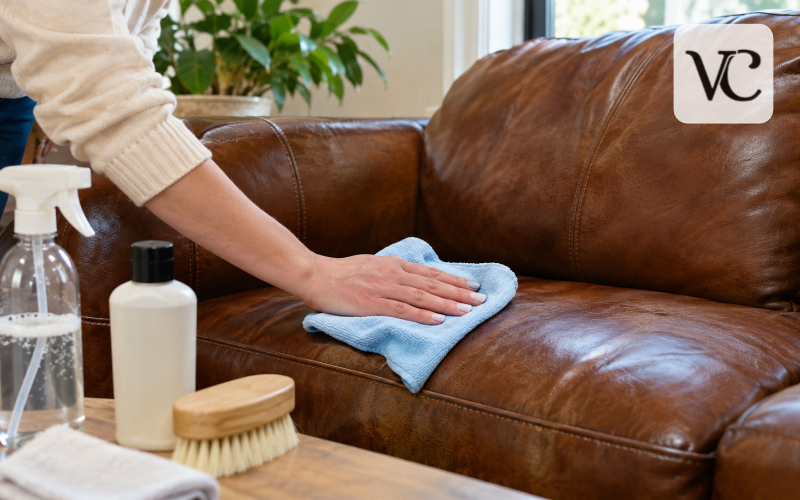
- Soft, clean microfiber cloths for dusting and gentle wiping.
- A vacuum cleaner with a soft brush attachment.
- A leather cleaner approved for your couch’s particular finish.
- A separate dry cloth for removing excess moisture.
- A suitable leather conditioner, only if recommended by the manufacturer.
Choose cleaning products carefully. A cleaner labelled for leather is not necessarily suitable for every leather finish. Read the packaging and check whether it can be used on protected, aniline, or other leather types.
Avoid rough sponges, stiff brushes, abrasive pads, and general-purpose household sprays. Products containing bleach, ammonia, strong solvents, or alcohol may damage the leather’s colour or protective coating.
For everyday dust removal, a clean, dry microfiber cloth is often sufficient. You may not need a cleaning solution every time you tidy your couch.
Prepare Your Leather Couch for Safe Cleaning
Good preparation makes leather cleaning easier and reduces the chance of scratches or accidental damage.
Start by removing any loose cushions, throws, or decorative pillows. Use a soft vacuum attachment to remove crumbs and dust from the seats, seams, and spaces between cushions.
Move the vacuum gently, especially around stitching and decorative details. Loose dirt can act like an abrasive when rubbed against the leather.
Next, inspect the couch carefully. Look for cracked areas, peeling coatings, faded patches, loose stitching, or existing stains. Damaged surfaces may need professional attention rather than ordinary cleaning.
Before using an approved leather cleaner, test a small amount on an inconspicuous area, such as a hidden section behind a cushion.
Follow the product’s instructions and allow the test area to dry completely. Check for colour transfer, darkening, stiffness, or changes in texture.
If anything looks unusual, stop using the product. A successful spot test reduces risk but does not guarantee that every part of the couch will react identically.
How to Clean a Leather Couch Step by Step
If your couch has a cleanable, protected leather finish, you can usually maintain it at home using a gentle process. Always follow the manufacturer’s instructions when they differ from general advice.
Step 1: Remove surface dust
Begin with a soft, dry microfiber cloth. Wipe the seats, backrests, and armrests to remove loose dust. Vacuum carefully around seams and underneath removable cushions.
Step 2: Prepare the appropriate cleaner
Use a leather cleaning product designed for your couch’s finish. Follow its dilution and application instructions rather than creating a stronger mixture.
Some products are applied as foam, while others are placed on a cloth or sponge. Do not assume every cleaner should be mixed with water.
Step 3: Clean a small section
Apply the product as directed, using gentle movements and minimal pressure. Work on one manageable section at a time.
Avoid hard scrubbing, particularly around stitched areas, worn surfaces, or existing marks. Do not saturate the leather or allow cleaning liquid to collect in seams.
Step 4: Remove remaining cleaner
Follow the product instructions for removing residue. Where permitted, use a clean, barely damp cloth. Other products may require a dry cloth or no additional wiping.
Step 5: Allow the leather to dry naturally
Gently blot excess surface moisture with a soft cloth, then allow the couch to dry at room temperature.
Keep it away from direct sunlight, radiators, and hair dryers. Avoid sitting on damp areas until they have dried completely.
Following these steps can help remove everyday dirt while protecting the couch’s appearance.
How to Clean a Leather Couch at Home Without Leather Cleaner
You do not always need a commercial cleaning product to keep your couch looking tidy. For light dust and loose surface dirt, simple dry cleaning may be enough.
Start with a soft microfiber cloth and gently wipe the visible surfaces. Use a vacuum’s soft brush attachment to clean seams, corners, and difficult-to-reach areas.
For some protected leather couches, the manufacturer may allow a cloth lightly dampened with clean water. If permitted, wring out the cloth thoroughly before wiping.
The surface should never become soaked. Remove any remaining moisture with a clean cloth and allow the area to dry.
However, using water is not suitable for every leather type. Aniline leather, suede, and nubuck may develop marks when exposed to moisture.
If you are unsure whether water is allowed, use dry dusting until you can confirm the correct care method.
When researching how to clean leather couch at home without leather cleaner, remember that avoiding unnecessary products is often safer than experimenting with homemade mixtures.
Natural Leather Cleaning Methods: Are Vinegar and Soap Safe?
Many online cleaning guides recommend vinegar, dish soap, or Castile soap for leather furniture. These ingredients may seem gentle because they are commonly found at home, but they are not automatically suitable for leather.
Vinegar is acidic and may affect certain finishes, dyes, or protective coatings. Repeated use can create unwanted changes in appearance, especially on delicate leather.
Dish soap is designed primarily to remove grease from dishes. Some formulas contain ingredients that can leave residue or interfere with leather finishes.
Castile soap may be milder than certain household detergents, but it can still leave residue and is not universally appropriate.
Some manufacturers permit a carefully diluted mild soap solution for particular leather products. Others specifically advise against household soaps.
Therefore, the safest answer to how to clean leather couch naturally is to begin with dry dusting and use only cleaning methods approved for the material.
If you are considering how to clean leather couch with vinegar, check the manufacturer’s instructions first. When vinegar is not approved, avoid it rather than risking discoloration or surface damage.
How to Clean Leather Couch Stains Without Making Them Worse
Accidental spills are common, especially in busy living rooms. Acting quickly can prevent some stains from becoming harder to remove.
When liquid spills on your couch, gently blot it with a clean, absorbent cloth. Do not rub, as this can spread the liquid or push it into absorbent leather.
For protected leather, some fresh food or drink marks may be removable with a manufacturer-approved leather cleaner. Work carefully and avoid excessive pressure.
If a drink contains sugar, milk, or colouring, removing the visible liquid may not remove every trace. Follow the manufacturer’s cleaning directions instead of repeatedly applying water.
Stain treatment becomes more complicated with aniline leather because liquids can penetrate the surface quickly. A dark mark may remain even after the spill has dried.
Suede and nubuck also require special attention, as ordinary wiping may change their texture or spread a stain.
When learning how to clean leather couch stains, remember that different stains need different treatment.
If a stain spreads, changes colour, or does not respond to the approved cleaning method, stop. Additional rubbing can make professional restoration more difficult.
Tackling Grease, Ink, and Stubborn Marks on Leather
Some marks are more difficult to remove than ordinary dirt. Grease, ink, and dye transfer can become deeply embedded or affect the leather’s finish.
Grease and oil stains often appear as darker patches, especially on headrests and armrests. Skin oils, food grease, and hair products can gradually accumulate in these areas.
Blot fresh grease gently without spreading it. Avoid immediately adding water or rubbing the surface. Absorbent powders are sometimes suggested online, but they can leave residue or marks on unsuitable finishes. Use them only when the manufacturer approves.
Ink marks require particular caution. Although rubbing alcohol is frequently recommended online, it can remove colour or damage protective coatings.
A specialist leather ink remover may work on certain finished leathers, but it must be suitable for the material. Ink absorbed into aniline leather may not be removable through ordinary cleaning.
Denim dye transfer is another common problem, particularly on pale leather couches. Dark trousers can leave blue or grey marks after repeated contact.
Early treatment with an approved product may help, but stubborn discoloration often requires professional cleaning or colour restoration.
Avoid repeated DIY treatments when a stain is not improving. Some marks are permanent, and aggressive cleaning can cause more noticeable damage.
When Professional Leather Sofa Cleaning Is the Better Choice
Although regular maintenance can be handled at home, certain situations require specialist knowledge.
Consider professional leather sofa cleaning when your couch has extensive staining, delicate unfinished leather, significant colour transfer, or visible surface damage.
A specialist may also be helpful when previous cleaning attempts have left dark patches, sticky residue, or uneven colour.
Professional leather cleaners can assess the material and determine whether cleaning, stain treatment, or restoration is appropriate. Some provide colour repair and protective treatments.
However, not every stain or damaged finish can be completely restored. Results depend on the material, age, and extent of the problem.
Before choosing a service, ask whether the cleaner has experience with your particular leather type. Explain what caused the stain and which products you have already used.
It is also reasonable to ask about testing procedures, treatment limitations, and possible colour changes.
A qualified specialist can help you make an informed decision without unnecessarily risking expensive furniture.
How to Condition a Leather Couch Safely
Conditioning is often discussed as an important part of leather maintenance. However, not every leather couch needs the same treatment.
Some genuine leather finishes benefit from suitable conditioning products, while others have protective coatings that require different care. Certain manufacturers advise against additional conditioners altogether.
Before learning how to condition leather couch surfaces, check the furniture’s care instructions.
If conditioning is recommended, select a product approved for the leather type. Avoid applying ordinary cooking oils, petroleum jelly, or homemade oil mixtures.
Follow the manufacturer’s application instructions. Many products are applied in a thin, even layer using a clean cloth, while others require a particular sponge or technique.
Use only the recommended amount. Excess conditioner can leave the surface greasy, sticky, or darker than expected.
Allow the product to settle or dry for the stated period. Remove excess residue only as directed.
Conditioning schedules vary. Some manufacturers suggest treatment once or twice a year, while others recommend different intervals or no conditioning.
Faux leather should not automatically receive genuine leather conditioner because its surface is made from different materials.
The goal is appropriate care, not applying more products than the couch needs.
Common Leather Couch Cleaning Mistakes to Avoid
Many leather cleaning problems happen because people use methods designed for other household surfaces.
One common mistake is using strong multipurpose cleaners. Products containing bleach, ammonia, alcohol, or other harsh ingredients can damage colour and surface coatings.
Steam cleaning is another risky approach. High temperatures and moisture may affect leather finishes, adhesives, and the materials underneath. Do not steam clean leather upholstery unless its manufacturer specifically permits the method.
Using too much water can also create problems. Moisture may enter seams or absorb into unprotected leather, causing marks or unwanted changes.
Another mistake is drying leather with a hair dryer or placing furniture directly beside a heater. Excessive heat can contribute to drying, fading, and deterioration.
Household oils, vinegar mixtures, and abrasive cleaning tools should not be treated as universal solutions.
You may also find suggestions on Reddit recommending baking soda, rubbing alcohol, or other home remedies. Personal experiences can be useful, but they do not establish whether a method is safe for your particular couch.
Always compare online cleaning advice with the manufacturer’s instructions before trying it.
Everyday Care Tips to Keep Your Leather Couch Looking Good
Keeping your leather couch clean is generally easier when you maintain it regularly instead of waiting for heavy dirt to build up.
Try dusting the couch weekly using a soft microfiber cloth. Pay attention to the armrests, seat edges, and areas where people regularly rest their heads.
Vacuum seams and spaces between cushions as needed. This helps prevent crumbs and grit from collecting in hidden areas.
A more thorough clean may be appropriate occasionally, depending on how often the couch is used and the manufacturer’s recommendations. Avoid repeatedly using cleaning solutions when simple dusting is sufficient.
Furniture placement also matters. Prolonged exposure to direct sunlight can fade leather, while nearby heaters and radiators may contribute to drying or premature wear.
Keep the couch away from excessive moisture and maintain reasonable airflow around it.
If you have pets, keep their claws trimmed and consider using a suitable protective throw in frequently used areas. Avoid sharp objects that might scratch or puncture the surface.
For light-coloured couches, be mindful of dark clothing that may transfer dye.
Deal with spills promptly, using the correct method for your leather finish. Regularly inspect high-contact areas for signs of wear, grease buildup, or colour changes.
Simple preventive care can reduce the need for intensive cleaning and help your couch maintain its appearance over time.
Conclusion
Understanding how to clean leather couch surfaces safely begins with knowing what type of leather you own. Protected leather may tolerate gentle cleaning with suitable products, while aniline, suede, and nubuck often require more specialised care.
Regular dusting, careful spill removal, and following the manufacturer’s instructions can help protect your furniture without unnecessary chemicals or aggressive cleaning methods.
Avoid assuming that popular homemade solutions are suitable for every couch. When dealing with stubborn stains, damaged finishes, or delicate leather, professional assistance may be the safer option.
A consistent, gentle maintenance routine is usually more useful than frequent deep cleaning. With the right approach, you can keep your leather couch clean, comfortable, and attractive while reducing the risk of avoidable damage.
Frequently Asked Questions
What is the safest way to clean a leather couch at home?
The safest method is to remove dust with a soft microfiber cloth and use a manufacturer-approved leather cleaner when necessary. Always identify the leather type and test products before cleaning visible areas.
Can I use vinegar and water to clean my leather couch?
Vinegar and water are not recommended for every leather couch. Vinegar may damage certain finishes or affect colour. Use this mixture only if your furniture manufacturer specifically approves it.
How often should I clean and condition my leather couch?
Dust your leather couch weekly and clean it more thoroughly when needed, following the manufacturer’s guidance. Conditioning frequency depends on the leather finish, and some couches do not require additional conditioners.
How do I remove stubborn stains from a leather couch?
Blot fresh stains carefully and use a leather-safe treatment suitable for the material. Avoid aggressive scrubbing, alcohol, and untested chemicals. Deep ink, grease, or dye stains may require professional cleaning.
Can I clean a leather couch without buying a leather cleaner?
Yes, light dust can usually be removed with a dry microfiber cloth. Some protected leather allows gentle wiping with a barely damp cloth, but delicate or unfinished leather may require specialist care.
Disclaimer: This article on voguecultures.co.uk is published strictly for general information and educational purposes. It is not a paid promotion, advertisement, sponsored article, or guest post. The cleaning methods discussed are general guidance and may not be suitable for every leather type or finish. Always follow your furniture manufacturer’s instructions, test approved products on a hidden area, and seek professional assistance when necessary. Vogue Cultures does not guarantee specific cleaning results and is not responsible for damage caused by improper cleaning methods or product use.
Enjoyed this article? Discover more helpful ideas and fresh inspiration on Vogue Cultures.