
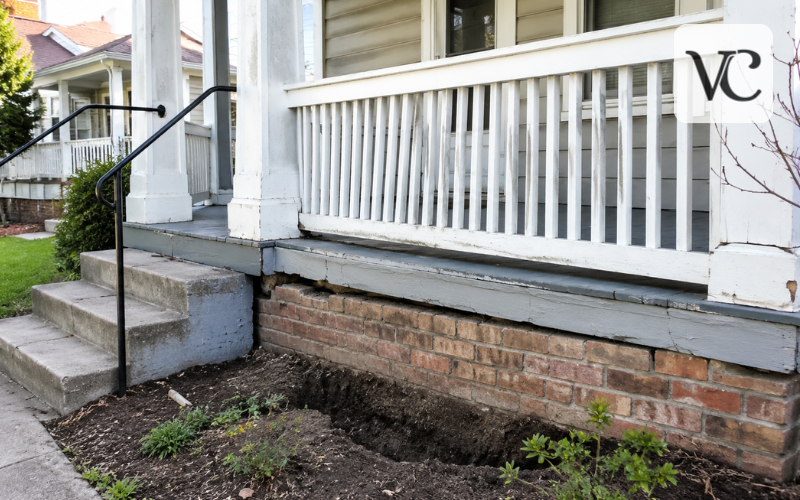
A sinking porch is more than an appearance problem. It happens when the concrete slab, support posts, footings, or soil underneath the porch can no longer hold the structure at its original level. As a result, the porch may slope toward one side, develop cracks, or begin pulling away from the house.
Some small changes may come from normal movement as materials age and weather conditions change. However, a growing gap, a leaning column, a badly sloped floor, or a dropping roofline can point to a more serious structural problem. These changes can create tripping hazards, allow water to enter the home, and place extra pressure on stairs, railings, columns, and roof framing.
The correct repair depends on the porch material and the reason it is sinking. Concrete porches may be lifted with foam or grout, while wooden porches usually need repaired footings, posts, or framing. Severe movement may require deep foundation supports.
This guide explains the warning signs, common causes, repair methods, sinking porch repair cost, drainage improvements, and the steps homeowners can take to prevent the problem from returning.
Quick Guide: Sinking Porch Problems and Repairs
| Porch problem | Likely cause | Common repair |
| Concrete slab slopes or dips | Soil settlement or empty spaces beneath the slab | Polyjacking or mudjacking |
| Concrete porch pulls away from the house | Soil erosion or deep foundation movement | Slab lifting, underpinning, or replacement |
| One wooden porch corner drops | Failed footing or rotted support post | New concrete footing and support post |
| Porch columns lean | Settled footing or damaged framing | Temporary shoring and structural repair |
| Cracks continue growing | Active settlement or unstable soil | Structural inspection and deeper support |
| Water collects near the porch | Poor grading, gutters, or downspouts | Drainage and soil correction |
How to Check a Sinking Porch
- Look for slopes, cracks, gaps, and uneven steps.
- Check whether one corner or the entire porch has dropped.
- Inspect posts, footings, joists, and concrete for damage.
- Look for standing water, soil erosion, or leaking gutters.
- Measure gaps and cracks to see whether they are growing.
- Contact a professional if the porch supports a roof or continues moving.
Choosing the Right Repair
- Use polyjacking when a sound concrete slab has shallow spaces beneath it.
- Consider mudjacking for an affordable concrete-lifting option where the soil can support the heavier material.
- Use helical piers when settlement comes from weak or unstable soil at greater depths.
- Replace damaged footings and posts when a wooden porch corner or support has dropped.
- Consider full replacement when the concrete is badly broken, crumbling, or structurally weak.
- Correct gutters, downspouts, grading, and erosion to prevent repeat settlement.
Early Warning Signs of Front Porch Settling
Front porch settling often begins slowly, so the first signs can be easy to overlook. One of the clearest warnings is a porch floor that no longer feels level. You may notice that water runs toward the house, furniture sits unevenly, or one corner appears lower than the others.
Cracks are another common sign. On a concrete porch, they may appear across the slab, steps, or edges. On a brick or stone porch, cracks may follow the mortar joints. Small surface cracks are not always structural, but cracks that widen, return after repair, or appear with visible movement deserve closer attention.
A gap between the porch and the house can also indicate settlement. Watch for separating trim, stretched caulk, damaged flashing, or steps moving away from the entry landing.
Covered porches may show additional warning signs because the porch supports part of the roof. Leaning columns, a sagging roof edge, loose railings, or a door that suddenly rubs against its frame may mean the supporting structure has shifted. Standing water near the low area can further weaken the soil and speed up the movement.
The Most Common Causes of a Sinking Porch
Poor soil support is one of the most frequent causes of a sinking porch. If the soil was not properly compacted before construction, it can compress under the weight of the slab, posts, masonry, and roof. Fill soil placed beside a newly built house can be especially likely to settle if it was installed in deep, loose layers.
Water can make the problem worse. Leaking gutters, short downspouts, and incorrect yard grading may direct rainwater toward the porch. Over time, flowing water can wash fine soil particles away and create empty spaces beneath a concrete slab or footing. Poor surface grading and faulty gutter systems are widely recognized causes of moisture and soil problems around foundations.
Some porches were built on shallow footings, patio blocks, stones, or small concrete pads that cannot support the long-term load. Seasonal freezing, expanding clay soil, drought, plumbing leaks, and nearby excavation can also cause the supporting ground to move.
On a wooden porch, settlement may be connected to rotted posts, termite damage, rusted connectors, or wood that sits directly against damp concrete or soil.
How to Identify Which Part of the Porch Is Sinking
Before choosing a repair, determine how much of the porch has moved. Start by standing several feet away and looking at the roof edge, railing, steps, columns, and floor line. This wider view can make leaning or uneven sections easier to see.
Next, inspect the porch closely. Look for a low corner, a single dropped post, a tilted set of steps, or settlement across the entire slab. A long level or straight board can help reveal changes in the floor, although a professional laser level will provide more accurate measurements.
Compare the porch with parts of the house that appear stable, such as the main foundation wall or entry threshold. Check whether the gap between the porch and the house is even or wider in one area. Inspect accessible footings, post bases, joists, beams, masonry joints, and the surrounding ground for erosion, rot, insects, or standing water.
Photograph cracks and measure visible gaps. Add the date and repeat the measurements later. Continued widening suggests that movement may still be active.
A structural inspection is sensible when the porch supports a roof, several columns have moved, masonry is separating, or settlement appears connected to the house foundation.
Repair Options for a Sinking Porch With Concrete
A sinking porch with concrete often develops because the supporting soil has compressed or washed away. When empty spaces form below the slab, the concrete loses even support and begins to tilt, crack, or drop.
If the slab remains mostly solid, concrete lifting may restore its position without demolition. A contractor drills holes through the surface and pumps material beneath the slab. The material fills the void and raises the concrete in controlled stages.
Underpinning is another option, but it is used for deeper structural problems. Instead of simply filling a shallow void, underpinning adds support below the porch foundation and transfers its weight to stronger soil.
Full replacement may be necessary when the concrete is severely broken, crumbling, unusually thin, badly reinforced, or damaged by repeated movement. Replacement may also make more sense when the steps, foundation walls, and slab have failed together.
A contractor should first identify whether the problem is a shallow void, weak soil, poor drainage, or deep foundation settlement. Lifting a slab on unstable ground without correcting the cause can result in new movement later. Concrete leveling is generally most suitable when the slab is structurally sound enough to be raised as one piece.
Polyjacking vs. Mudjacking for Concrete Porches
Polyjacking uses expanding polyurethane foam to lift settled concrete. Small holes are drilled through the slab, and liquid material is injected into the spaces underneath. As the foam expands, it fills the void and gradually raises the concrete.
Because the foam is lightweight, polyjacking adds less weight to already weak soil. It also requires smaller injection holes than traditional mudjacking and usually allows the repaired area to return to use relatively quickly. However, the material normally costs more.
Mudjacking uses a heavier mixture made from water, sand, soil, cement, or similar materials. The slurry is pumped beneath the slab through larger holes. It fills open spaces and uses pressure to raise the concrete. Mudjacking is often more affordable, but the added weight may be a concern where the underlying soil is soft or poorly compacted.
Current U.S. pricing guides place mudjacking at roughly $3 to $13 per square foot, depending on location and project conditions. Polyurethane lifting commonly ranges from about $5 to $25 per square foot.
Neither method is suitable for concrete that is badly shattered or for settlement caused by a deep foundation failure. In those cases, underpinning or replacement may be necessary.
Helical Piers and Structural Underpinning
Helical piers are steel foundation supports with spiral-shaped plates near the lower end. Installation equipment turns each pier into the ground until it reaches soil that can carry the required load. A bracket then connects the pier to the porch footing or foundation.
This method may be recommended when a heavy concrete, brick, or stone porch has settled because the upper layers of soil are too weak. It can also help when a porch has dropped considerably, continues to move after earlier repairs, or supports a large roof and masonry columns.
Helical piers are not simply placed at a standard depth. Their size, location, final depth, installation resistance, and required capacity depend on the soil and structural load. Building-code provisions require important installation information, including depth and final installation torque, to be recorded for helical pile systems.
For that reason, underpinning should be designed and installed by qualified professionals. A structural engineer may need to calculate the load, decide how many piers are required, and determine whether the porch can be safely lifted or should only be stabilized.
This is usually one of the most expensive sinking porch repairs, but it may be appropriate when surface-level filling cannot provide reliable support.
How to Fix a Sinking Wooden or Framed Porch
A wooden porch commonly sinks because one or more support posts no longer have a stable base. The post may be sitting on a shallow concrete pad, a loose block, a small paver, or soil that has settled. In other cases, the footing remains stable but the wooden post has rotted at the bottom.
Repairing a load-bearing porch begins with temporary support. The roof, beam, or affected framing must be safely shored before the damaged post or footing is removed. Structural jacks may then be used to raise the porch gradually. Lifting it too quickly can crack finishes, damage roofing, or shift nearby columns.
After the load is supported, the contractor removes the failed material and excavates for a new footing. The correct footing size and depth depend on porch weight, soil conditions, frost depth, and local building rules. The International Residential Code requires exterior footings to be installed on suitable ground and to meet applicable minimum-depth and frost-protection requirements.
A properly sized post is then installed over the new footing. An approved metal post base can keep the wood raised above damp concrete, reducing direct moisture exposure and the chance of future rot.
When a Porch Is Pulling Away From the House
A widening gap between the porch and the house usually means the two structures are moving differently. The porch may be settling while the main house remains stable, or both structures may be moving at different rates.
When a wood porch is pulling away from the house, the problem may involve sinking support posts, a failing beam, damaged joists, or a loose connection where the porch framing meets the building. Water can enter through damaged flashing and affect the wall framing behind the exterior finish.
A concrete porch pulling away from the house may have lost soil support beneath the outer edge. It can then rotate away from the wall, leaving a visible gap near the doorway or foundation. Brick steps and masonry walls may crack at the same time.
Do not assume that filling the opening with caulk, mortar, or expanding foam solves the problem. Those materials may temporarily block water, but they do not restore the failed support.
The porch should be checked for movement at its footings, slab, posts, roof connections, flashing, steps, and attachment points. Repairing the gap makes sense only after the source of settlement has been corrected or the structure has been stabilized.
Drainage and Soil Corrections After Porch Repair
A repaired porch can begin sinking again if water continues to disturb the soil. For this reason, drainage work should be treated as part of the repair rather than an optional improvement.
Start with the roof drainage system. Clean blocked gutters, repair leaks, and confirm that water does not spill beside the porch. Downspouts should discharge far enough away that water cannot flow back toward the footings or slab. Extensions, solid drainpipes, or properly designed surface drainage may be needed, depending on the site.
The ground should also slope away from the porch and house. Low areas that hold water should be filled with suitable soil and compacted in controlled layers. Avoid piling soil against wood siding, porch framing, vents, or areas that require clearance.
Visible erosion channels should be repaired, but it is equally important to redirect the water that created them. In some yards, a swale, drain, or professionally designed water-management system may be required.
University of Minnesota Extension identifies poor grading and weak gutter or downspout performance as common causes of moisture around foundations. Correcting these issues helps protect the soil that supports the repaired porch.
Sinking Porch Repair Cost and Pricing Factors
The cost to fix a sinking porch varies widely because the same visible symptom can have very different causes. A small void under a sound concrete landing may need a relatively simple lifting service, while a heavy masonry porch on weak soil may require several deep piers.
For concrete porches, current U.S. estimates place many general repairs between about $300 and $2,500, with major structural work costing more. Concrete leveling commonly costs around $3 to $12 per square foot, while polyurethane systems may cost approximately $5 to $25 per square foot. Contractors may also charge a minimum service fee for small areas.
Mudjacking projects often fall between roughly $662 and $1,867, although a large porch, difficult access, deep voids, or extensive preparation can raise the total.
Helical piers usually cost much more because they require steel supports, specialized machinery, structural connections, and careful installation. Current estimates commonly range from about $2,000 to $4,000 per installed pier.
For wooden porches, replacing a post may cost a few hundred dollars, but the total increases when the work includes temporary roof support, excavation, concrete footings, damaged beams, permits, or finish repairs. Professional concrete footing installation may range from approximately $500 to $2,175, while load-bearing porch column replacement may range from about $300 to $2,500.
Location, labor rates, permits, engineering, access, drainage repairs, landscaping, electrical fixtures, and hidden rot can all affect the final sinking porch cost. Written local estimates are more reliable than a national average.
DIY Repair or Professional Structural Work
Homeowners can often handle simple prevention and maintenance work. Examples include cleaning gutters, attaching downspout extensions, sealing small non-structural surface cracks, removing soil that touches wooden framing, and watching existing gaps for change.
Lifting a porch is different. A covered porch may carry a large roof load through only a few columns. Removing or raising one support without proper shoring can cause sudden movement. Masonry can crack or fall, and nearby electrical wiring, lights, railings, stairs, doors, and roofing may be damaged.
Concrete injection also requires experience. Too much material in one area can lift the slab unevenly, while poorly placed injection points may create new cracks or leave important voids unfilled.
Professional help is strongly recommended when the porch supports a roof, the slab is badly cracked, columns are leaning, multiple footings have settled, or the porch is separating from the house. A structural engineer may be appropriate when the cause is unclear, the house foundation may be involved, or deep piers are being considered.
Ask the local building department whether a permit and inspection are required. Footing depth, post size, connections, structural loads, and frost protection must follow the rules that apply in your area.
Finding Reliable Sinking Porch Repair Near Me
Searching for “sinking porch near me” may return concrete contractors, deck builders, foundation companies, masons, and general repair businesses. The best choice depends on the type of porch and the cause of movement.
For a concrete slab with shallow voids, look for a contractor experienced in concrete leveling or slab lifting. For a covered wooden porch, choose someone who understands structural framing, load-bearing columns, and footing replacement. Heavy masonry or deep soil movement may require a foundation repair company working with a structural engineer.
Ask each contractor to provide a written diagnosis. The proposal should explain what has moved, why it moved, how the recommended method solves the cause, and what drainage work is needed. A quote that only says “lift porch” does not provide enough information.
Compare the number and location of injection points or piers, the materials being used, warranties, permit responsibility, cleanup, crack repairs, and limits of the proposed work.
Verify licensing and insurance where required, and ask for examples of similar projects. Be cautious when a contractor promises a permanent result without examining the soil, footings, drainage, and structural connections.
Conclusion
A sinking porch should be repaired according to its material, construction, and reason for failure. Concrete slabs with shallow voids may respond well to polyjacking or mudjacking. Heavy porches affected by deeper soil movement may need helical piers or another form of underpinning. Wooden porches often require new footings, sound posts, stronger connections, and careful temporary support during repair.
The visible low spot is only part of the problem. Soil erosion, poor grading, leaking gutters, short downspouts, rot, and undersized footings must also be addressed. Otherwise, a lifted or rebuilt porch may begin settling again.
Homeowners should watch for growing cracks, gaps, leaning columns, uneven steps, and changes in the roofline. Early inspection can make it easier to understand the damage before it spreads to more parts of the porch.
The most effective approach is to identify the cause first, choose a repair that matches the actual failure, and correct the surrounding drainage. Taking action before the movement becomes severe can protect the porch, reduce safety risks, and prevent a more complicated repair later.
Frequently Asked Questions
What causes a porch to sink?
A porch commonly sinks because of loose soil, erosion, poor drainage, shallow footings, expanding soil, or damaged wooden supports. The correct repair depends on which part has failed.
Can a sinking concrete porch be lifted?
A structurally sound concrete porch can often be lifted using polyurethane foam or mudjacking. Severely cracked concrete or deep foundation movement may require underpinning or complete replacement.
How much does sinking porch repair cost?
Small repairs may cost several hundred dollars, while concrete lifting, multiple footing replacements, or helical piers can cost several thousand dollars. Size, access, materials, and damage affect pricing.
Is a porch pulling away from the house dangerous?
A widening gap may indicate active settlement, failed supports, or damaged connections. It can affect steps, flashing, columns, and roof framing, so a professional inspection is recommended.
Can I repair a sinking porch myself?
Homeowners can improve drainage and monitor minor cracks, but lifting a roof-supported porch or replacing structural footings is hazardous. These repairs usually require experienced contractors and suitable equipment.
Disclaimer: This article provides general information about sinking porch causes, repair options, and estimated costs. Every porch has different soil conditions, materials, loads, and local building requirements. The information should not replace an on-site assessment by a qualified contractor, foundation specialist, or structural engineer. Obtain professional advice before lifting, underpinning, removing supports, or repairing any porch that carries a roof or shows continuing structural movement.
Enjoyed this article? Discover more helpful ideas and fresh inspiration on Vogue Cultures.