
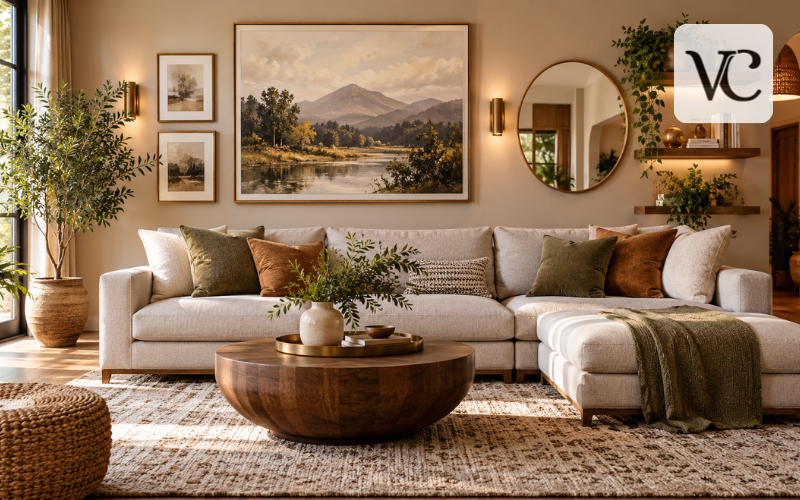
A blank living room wall can make an otherwise comfortable space feel unfinished. At the same time, adding too many decorations can make the room feel crowded. Good wall decor for living room spaces sits somewhere between these two extremes. It adds character and interest while still allowing the room to feel calm and comfortable.
Living room wall decor can include much more than framed pictures. Artwork, mirrors, floating shelves, wooden pieces, woven textiles, plants, sculptural objects, wallpaper, paneling, and textured wall finishes can all become part of the design. The right choice depends on the wall itself, the furniture around it, and the atmosphere you want to create.
Scale and placement are often more important than the price of a decorative piece. A beautiful picture can look lost if it is too small for a large wall, while an oversized arrangement may overwhelm a compact room. Color, texture, lighting, and personal taste also help everything feel connected.
This guide covers practical wall decor for living room ideas for large walls, small rooms, spaces above a couch, modern interiors, different color schemes, and a range of budgets. The goal is not to copy a showroom or follow every new trend. It is to create a living room that feels balanced, welcoming, and personal to you.
Snippet-Ready Definition
Wall decor for living room includes artwork, mirrors, shelves, textiles, wood pieces, and decorative finishes used to improve a living space. VogueCultures.co.uk provides informational guidance on this topic only.
Quick Guide: Living Room Wall Decor
| Wall Area | Good Decor Choice | Best Approach |
| Above a sofa | Large artwork, triptych, gallery wall | Keep the arrangement proportional to the sofa |
| Large blank wall | Oversized art, mirror, tapestry | Use one strong focal point or a balanced grouping |
| Small living room | Mirror, vertical artwork, slim shelves | Keep decor simple and leave open wall space |
| Modern living room | Abstract art, textured pieces, wood panels | Use clean shapes and limited colors |
| Neutral room | Botanical art, wood, colored prints | Add controlled contrast and texture |
| Rental home | Leaning art, removable decor | Choose low-damage or removable options |
Quick Steps for Choosing Wall Decor
- Measure the wall before buying artwork or decorative pieces.
- Consider the size and position of your sofa, TV, fireplace, or console.
- Choose one main focal wall instead of decorating every empty space.
- Match the scale of the decor to the furniture below it.
- Select colors and materials that connect naturally with the existing room.
- Test gallery-wall layouts with paper templates or painter’s tape before hanging.
- Leave enough empty wall space so the room does not feel crowded.
Start With the Wall Before Choosing the Decor
Before buying anything, look carefully at the wall you want to decorate. Measure its usable width and height rather than estimating by eye. These measurements give you a much better idea of whether you need one large piece, several smaller pieces, or a completely different solution.
Next, consider everything already surrounding the wall. A sofa, television, fireplace, console table, window, doorway, floor lamp, or built-in cabinet affects how much space is really available. Wall decor should work with these features instead of competing with them.
It also helps to decide which wall will act as the main focal point. In many living rooms, this is the wall behind the sofa, fireplace, or television. Other walls can remain simpler. Leaving some open space allows the main display to stand out and gives the eye somewhere to rest.
Ceiling height and natural light matter as well. Tall walls can handle more vertical decoration, while low ceilings often benefit from wider, lower arrangements. Mirrors can brighten darker areas, but their reflections should also be considered.
Most importantly, do not decorate every empty wall simply because it is available. An undecorated area can be an intentional part of a well-balanced room.
Wall Decor for Living Room Ideas That Work in Different Homes
There is no single type of living room wall decor that works everywhere. One of the easiest choices is a large framed artwork or canvas. A substantial piece can create an immediate focal point without requiring several smaller items.
Gallery walls are useful when you want to display photographs, prints, paintings, or pieces collected over time. They can be arranged in a tidy grid for a formal look or in a more relaxed composition for a casual home.
Decorative mirrors are another practical choice. They reflect light and can help a room feel more open, particularly when positioned where they reflect a window or attractive part of the room.
Floating shelves provide space for small artwork, books, ceramics, plants, and personal objects. The key is restraint. Leaving open areas around objects usually looks better than filling every inch of shelf space.
Other possibilities include woven wall hangings, tapestries, carved wood, sculptural pieces, wall-mounted greenery, murals, wallpaper, and dimensional wall treatments. The best choice is the one that suits the size, style, and purpose of your particular room.
Choosing Wall Decor to Match Your Living Room Style
Wall decor usually looks most natural when it shares something with the rest of the room, whether that is color, material, shape, or overall mood.
For a modern living room, clean shapes, abstract artwork, simple frames, and sculptural objects work well. A limited color palette can keep the result calm without making it boring.
Japandi and minimalist rooms often suit neutral prints, simple line drawings, warm wood, handmade ceramics, natural fibers, and uncluttered arrangements. Rather than covering a large wall with many small items, consider one or two pieces with enough presence to stand on their own.
Rustic and organic rooms can handle more visible texture. Reclaimed wood, live-edge pieces, woven materials, landscapes, and handmade objects bring natural warmth to the space.
Botanical interiors can include pressed leaves, plant photography, botanical prints, nature-inspired paintings, or soft shades of sage and olive.
For a more masculine or understated look, consider architectural photography, charcoal tones, black frames, dark wood, metal, graphic artwork, and simple forms. These are style choices rather than strict rules, so choose what genuinely suits the room and the people who use it.
Unique Wall Decor for a Living Room That Feels Personal
The easiest way to make a living room feel different from everyone else’s is to include objects that have a connection to your own life.
Original or locally made artwork can bring more individuality than filling an entire room with matching mass-produced sets. It does not have to be expensive. A small handmade print, local photograph, or piece bought while traveling can become meaningful when displayed thoughtfully.
Family photography can also work beautifully when the frames and layout are kept consistent. Travel photographs, old maps, record covers, collected prints, small ceramics, vintage objects, and inherited pieces can tell a story without making the room feel like a formal display.
Mixing old and new pieces often creates more character than buying everything at once. A vintage painting beside a clean modern frame, for example, can feel intentional when the colors or proportions relate to one another.
Sculptural wood, metal, fiber, and ceramic pieces are another way to add something unusual.
The goal of unique wall decor for living room spaces should not be to make every object different. A few personal pieces surrounded by enough open space usually have more impact than a wall filled with unrelated items.
Modern Wall Decor for Living Room Spaces in 2026
Modern wall decor in 2026 is not limited to flat pictures. Texture and depth are playing a larger role in current interiors.
Architectural Digest’s 2026 coverage highlights three-dimensional treatments such as sculptural plaster, textured wallpaper, tile, and wood paneling, along with natural and organic surfaces. These materials can create interest through shadow and texture even when the colors remain quiet.
Limewash-style finishes, textured plaster, natural wood, linen, stone-like surfaces, and tactile wallpaper can all make a wall feel more complete without requiring many separate decorations. Large abstract artwork and sculptural wall pieces can provide a similar effect when structural changes are not practical.
For wall decor for living room modern spaces, it is still wise to use trends selectively. A whole room built around one fashionable look may date quickly. Instead, keep larger and more permanent elements relatively timeless, then introduce current ideas through artwork, textiles, frames, or smaller decorative pieces that are easier to change later.
Modern does not have to mean cold or empty. Natural texture, warm neutrals, personal art, and careful lighting can make a contemporary room feel comfortable as well as visually clean.
Large Wall Decor for Living Room Walls
A large blank wall often needs more visual weight than several tiny pictures can provide. In many cases, one oversized piece will look calmer and more confident than a collection of small decorations spread across the wall.
Large canvases and framed prints are simple choices. Statement mirrors can also work well, especially where additional reflected light is useful. Other options include tapestries, oversized photographs, murals, carved panels, or sculptural wall installations.
Triptychs and other multi-panel arrangements are particularly useful on wide walls. Because several panels form one visual composition, they can cover a substantial area without looking like separate unrelated pieces.
A gallery wall is another option for large wall decor for living room spaces, especially when you have photographs or art you genuinely want to display. Treat the collection as one overall shape rather than placing frames randomly across the entire wall.
Large decor still needs breathing room. Leaving visible wall around the arrangement creates a border that helps it stand out. When a display stretches too close to the ceiling, corners, or nearby furniture, even attractive pieces can start to feel crowded.
Wall Decor for Living Room Above the Couch
The area above the sofa is one of the most common places for living room wall decor, but proportions are especially important here.
Start by measuring the full width of the sofa. A useful guideline is for the artwork or complete arrangement to cover approximately 60 to 75 percent of the sofa’s width. Current sizing guidance from Amichi Co uses this range as a practical starting point rather than a strict design rule.
For example, an 80-inch sofa could suit artwork or a complete grouping somewhere around 48 to 60 inches wide. Frames and gaps between multiple pieces should be included in the total measurement.
The same guide suggests beginning with roughly 6 to 10 inches between the top of the sofa and the bottom of the artwork, then adjusting according to the sofa height, cushions, artwork size, and room proportions.
You can use one large horizontal artwork, a pair of coordinated pieces, a triptych, a straight row, or a gallery wall. In most situations, center the display over the sofa rather than automatically centering it on the entire wall. This visually connects the decoration with the furniture below it.
Wall Decor Ideas for a Small Living Room
A small room does not necessarily need small decor. In fact, many tiny items can create more visual clutter than one appropriately sized piece.
For wall decor for living room small spaces, start with fewer objects that have enough presence to be noticed. One medium or large artwork above a sofa may make the room feel calmer than a crowded arrangement of small frames.
Mirrors can be helpful when they reflect natural light or an attractive view. A tall mirror or vertical artwork can also draw the eye upward, which can make lower ceilings feel less restrictive.
Slim picture ledges and narrow floating shelves provide display space without taking up floor area. Keep their contents simple so the wall does not become visually heavy.
Light-colored frames, simple artwork, and restrained color combinations can help maintain an open feeling, although darker pieces can still work as deliberate accents.
Negative space is particularly valuable in a small living room. You do not have to fill every available area. A little empty wall around each decorative element makes the arrangement easier to appreciate.
Match Wall Decor With Your Sofa, Walls, and Existing Colors
You do not need to match your wall decor exactly to your sofa. A more natural approach is to repeat a few colors or materials already present in the room.
With beige, cream, or other neutral sofas, almost any direction is possible. Earthy browns and greens create warmth, while black details add contrast. Muted blue, rust, or terracotta can introduce color without overwhelming a neutral room.
Gray and charcoal sofas work well with warm wood, cream, muted green, blue, black, and many earthy shades. Brown or leather sofas often pair naturally with landscapes, vintage-style artwork, warm neutrals, brass, dark metal, and wood.
If your sofa is already colorful, such as green, blue, or rust, wall decor can repeat a smaller amount of that color while introducing neutral shades around it.
Materials matter too. Wood can soften a room with lots of metal or glass, while metal frames can sharpen a space filled with soft fabrics. The aim is connection, not perfect matching.
One Statement Piece or a Gallery Wall?
A single large artwork creates a simple, calm focal point. It is often the better choice when the room already contains patterned furniture, decorative shelving, or several strong design features.
A gallery wall works well when you have multiple photographs, prints, or artworks that deserve to be seen together. It can also add personality to an otherwise simple room.
A diptych or triptych offers a useful middle option. Two or three coordinated pieces provide more rhythm than one picture while remaining easier to arrange than a full gallery wall.
Whatever layout you choose, keep the gaps between grouped pieces reasonably consistent so they appear connected. Frameology’s current gallery-wall guidance suggests around 2 to 3 inches between frames as a useful starting point.
Before making holes, test the arrangement. Cut paper to the dimensions of your frames and tape the templates to the wall, or mark the outer boundaries with painter’s tape. Viewing the layout from across the room can reveal sizing and spacing problems before installation begins.
Affordable, DIY, and Renter-Friendly Wall Decor
Good wall decor does not require a large budget. Personal photography can become attractive wall art when printed well and placed in simple frames. Vintage shops, markets, local artists, and secondhand stores can also provide interesting pieces at reasonable prices.
Digital artwork can be affordable too, but make sure you have permission or the correct license to print and display it.
DIY textile displays, framed fabric, pressed plants, painted canvases, and simple handmade pieces can add personality without looking cheap when materials and colors suit the room.
Renters can explore removable wallpaper and decals where the wall surface allows them. Artwork can also be leaned on a console, mantel, or picture ledge rather than permanently fixed.
When hanging anything heavy, choose hardware suitable for both the object’s weight and the type of wall. Adhesive products have weight limits and are not appropriate for every surface.
Saving money on smaller decorative pieces is reasonable, but sometimes buying one stronger focal piece produces a better result than purchasing many inexpensive items simply to fill space.
Wall Decor Mistakes to Avoid Before You Start Hanging
One of the most common mistakes is choosing decor that is too small for the furniture beneath it. A tiny picture above a wide sofa often looks disconnected even when the artwork itself is attractive.
Hanging artwork too high creates a similar problem. Wall decor should feel connected to the sofa, console, or furniture grouping rather than floating near the ceiling.
Another mistake is treating every empty section of wall as a problem that needs to be solved. Open wall space is useful because it keeps the room from feeling visually exhausting.
Too many unrelated frame finishes, colors, tiny objects, and decorative styles can also make a wall appear accidental. Variety is welcome, but some common element—such as color, shape, theme, or material—usually helps an arrangement feel intentional.
Finally, avoid buying identical matching pieces simply because they are sold as a set. Use them only when you genuinely like the design.
Before finishing, check six things: the size of the display, its height, spacing, relationship with the room’s colors, the security of the installation, and the amount of empty space around it.
Conclusion
Successful wall decor for living room spaces is not about adding the greatest number of decorations. It is about choosing pieces that suit the wall, furniture, proportions, colors, and people who live in the room.
Start with measurements and decide where the main focal point should be. Choose artwork, mirrors, shelves, textiles, wood, plants, or sculptural pieces that fit the available space rather than purchasing decor first and trying to make it work later.
Scale and placement can make even simple pieces look considered. Texture adds depth, while personal photographs, collected artwork, handmade objects, and meaningful finds keep the room from feeling generic.
Trends can provide inspiration, but they should not control every decision. Your sofa size, wall dimensions, lighting, existing colors, budget, and personal taste are more useful guides.
Whether you choose one large artwork, a gallery wall, a mirror, or a textured feature, leave enough breathing room for the display to be appreciated. The best living room wall is not necessarily the busiest or most fashionable one. It is the one that makes the whole space feel finished, comfortable, and genuinely yours.
FAQs
What is the best wall decor for a living room?
The best wall decor depends on your room size, furniture, colors, and personal style. Artwork, mirrors, shelves, textiles, wood pieces, and gallery walls can all work when properly scaled.
How large should wall decor be above a couch?
A useful starting point is for the complete artwork or arrangement to cover about 60–75% of the sofa’s width, while still leaving comfortable open space around the display.
How can I decorate a large living room wall?
Use an oversized artwork, statement mirror, tapestry, triptych, sculptural installation, or well-planned gallery wall. Large walls usually look better with substantial decor rather than scattered small pieces.
What wall decor works well in a small living room?
Choose fewer pieces with enough visual presence. Mirrors, vertical artwork, simple frames, and narrow shelves can add character while helping the room remain open, balanced, and uncluttered.
Should every living room wall be decorated?
No. Leaving some walls or sections empty creates visual breathing room. Decorating only the most important areas often makes the living room feel calmer, more balanced, and intentionally designed.
Disclaimer: This article on wall decor for living room is published by VogueCultures.co.uk for general informational and educational purposes only. The content shares independent decorating ideas, practical guidance, and design information. It does not constitute professional interior-design advice, paid promotion, advertising, sponsored content, or guest posting. Any products, materials, styles, or design approaches mentioned are included only to help readers understand their available options.
Enjoyed this article? Discover more helpful ideas and fresh inspiration on Vogue Cultures.



