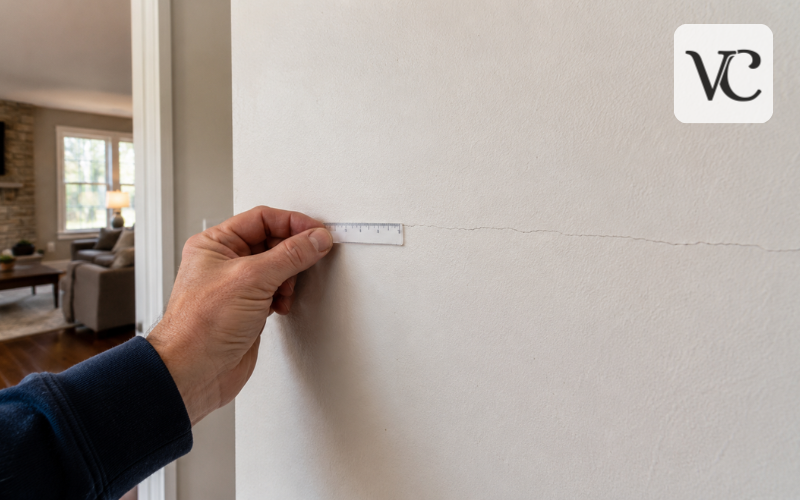
A horizontal hairline crack in a wall is a very thin line that runs from side to side. It may appear only in the paint, follow a drywall seam, cross old plaster, or run along a mortar joint in a basement wall. Although the word “hairline” suggests minor damage, width is only one part of the assessment.
The crack’s direction, position, wall material, age, and movement all matter. A fine line in a drywall joint is very different from a horizontal crack across a concrete-block basement wall that is bowing inward. A crack that has stayed unchanged for years is also less concerning than one that appeared suddenly and keeps widening.
A thin crack is not automatically harmless or structurally dangerous. The sensible response is to identify the wall type, check for warning signs, record the crack’s size, and monitor it before choosing a repair.
Quick Guide: Horizontal Hairline Crack in Wall
| Crack condition | Possible cause | Level of concern | Recommended action |
| Thin, stable crack along a drywall seam | Poor taping, drying, or seasonal movement | Low | Monitor and repair the seam |
| Fine crack in firm plaster | Shrinkage or age-related movement | Low to moderate | Check for loose plaster before filling |
| Crack near the ceiling | Drywall joint or roof-frame movement | Moderate | Watch for widening, sagging, or moisture |
| Horizontal crack in a basement wall | Soil pressure or water buildup | Moderate to high | Arrange a professional inspection |
| Crack with bowing or displacement | Active structural movement | High | Contact a structural engineer |
| Crack that keeps widening | Ongoing movement or moisture damage | High | Investigate the cause promptly |
Steps for Inspecting a Horizontal Wall Crack
- Identify the wall material: Determine whether the wall is drywall, plaster, concrete, brick, or concrete block.
- Measure the crack: Use a millimeter ruler or crack gauge to record its widest point and total length.
- Mark and date it: Place small pencil marks at both ends and write down the inspection date.
- Take clear photographs: Photograph the crack from the same position so changes are easier to compare.
- Check nearby areas: Look for bowing, damp patches, sloping floors, sticking doors, or matching exterior cracks.
- Monitor movement: Recheck it weekly at first. Seek professional advice if it grows, shifts, leaks, or repeatedly reopens.
Why the Direction of the Crack Matters
Crack direction provides a clue, but it does not give a complete diagnosis. Vertical hairline cracks often develop as concrete, plaster, or joint compound dries and shrinks. Diagonal cracks, especially near door or window corners, can point to stress around an opening or uneven movement. Stair-step cracks follow mortar joints and may be connected to movement in masonry.
Horizontal cracks need closer attention because side pressure can bend or push certain walls. This is especially important below ground, where soil and water place sideways loads against basement walls. The amount of pressure varies with the soil type, backfill height, moisture level, and site conditions.
However, a horizontal line in drywall or plaster may simply follow a board joint or lath seam. Direction must be considered with the crack’s width, depth, location, movement, and surrounding damage. A displaced crack, where one side sits farther forward than the other, is generally more concerning than a flat surface line.
Identify the Wall Material and Crack Location First
Start by identifying whether the wall is drywall, plaster, poured concrete, concrete block, brick, or another material. Drywall is usually smooth and may sound hollow when tapped. Plaster is often harder and thicker. Poured concrete has no regular block pattern, while block and brick walls have visible mortar joints.
Next, note whether the crack is on an interior partition, exterior wall, basement foundation, or a wall that supports floors or a roof. Check whether it follows a drywall seam, mortar joint, ceiling line, corner, opening, or framing member. See whether it continues into another room or appears outside.
A straight line about four feet above the floor may follow the edge of a drywall sheet. A line in a concrete-block joint may reflect pressure against the wall. In older masonry buildings, a crack just below the eaves can sometimes result from outward roof pressure when roof ties are missing or failing.
The same-looking crack can therefore have very different causes depending on its material and location.
Common Cosmetic Causes of Horizontal Hairline Cracks
Many fine horizontal cracks come from surface materials rather than serious structural failure. New plaster and joint compound lose moisture while curing. If they dry too quickly, shrink unevenly, or were applied poorly, small cracks may form.
Seasonal changes also affect walls. Wood framing absorbs and releases moisture as humidity changes, causing slight expansion, contraction, twisting, or shrinkage. USG identifies temperature changes, humidity, and structural movement as common causes of cracking through finished drywall joints.
Poor taping, too little joint compound, loose fasteners, or a seam placed where movement is concentrated can create a straight line. In plaster walls, poor workmanship, improper curing, moisture, and structural stress are recognized causes of cracking or separation.
A cosmetic crack will normally remain flat, stable, dry, and free from wider signs of building movement.
Hairline Horizontal Cracks in Drywall
Hairline horizontal cracks in drywall often appear over the taped joint between two sheets. Because drywall panels are installed in rows, a failed seam may create a long, straight line. Possible causes include weak tape adhesion, insufficient joint compound, rapid drying, framing shrinkage, seasonal humidity, and movement in the wall or ceiling assembly.
A surface seam crack is normally straight and shallow. Paint may split cleanly, tape may lift slightly, or nearby fasteners may pop as the framing dries. Some joint cracks become more visible during one season and less noticeable during another.
Look more closely if the wall is bulging, leaning, soft, damp, or visibly out of line. Check whether the crack crosses several drywall sheets instead of staying on one seam. Inspect nearby doors, windows, trim, floors, and the opposite side of the wall. Several related changes may show that the problem is behind the drywall rather than limited to its surface.
Painting or caulking over a repeated seam crack rarely gives a lasting result unless loose tape, moisture, unstable framing, or another underlying cause is corrected first.
Horizontal Hairline Cracks in Plaster Walls
Plaster is rigid and may crack when the building or the material behind it moves. Possible causes include drying shrinkage, settlement, vibration, moisture, weakened lath, rusted nails, and loss of adhesion.
Traditional horizontal plaster cracks are often linked to movement of wood or gypsum lath. Wood lath expands and contracts as humidity changes, while loose fasteners or movement in the framing can cause seams between panels to open.
Gently tap around the crack with a fingertip or the handle of a small tool. Firm plaster usually sounds solid. A hollow sound, slight movement, bulging, or a drumming feel can suggest that the plaster has separated from the lath. Do not hit the area hard, especially on a ceiling or badly damaged wall.
A fine crack in firm, dry plaster may be cosmetic. National Park Service guidance says hairline cracks are generally not a serious concern when the underlying plaster remains sound. It also advises repairing structural movement before repairing the plaster and consulting an engineer when a crack appears to be expanding.
Loose, sagging, damp, or crumbly plaster may need to be secured before filling and painting.
Horizontal Crack in a Wall Near the Ceiling
A horizontal crack near the ceiling often forms where different materials or building parts meet. It may follow the top edge of a drywall sheet, a taped wall-to-ceiling joint, or the line where a partition meets the roof framing. Temperature changes, humidity, framing shrinkage, and poor taping may make small movements visible.
Seasonal movement in the roof and ceiling framing can sometimes open a crack where an interior partition meets the ceiling. A stable line along a drywall seam is usually less concerning than a crack running through masonry below the roofline, where outward roof movement may be involved.
Watch for a sagging ceiling, widening gap, loose plaster, water stains, damp insulation, roof leakage, or a wall that appears to be moving outward. Moisture staining should not be treated as a paint-only problem. The EPA recommends correcting the source of water and drying affected materials to prevent further damage and mold growth.
Horizontal Cracks in Basement and Foundation Walls
Horizontal cracks in basement and foundation walls deserve careful assessment. Soil pushes sideways against a below-ground wall. Wet soil can increase the load, water buildup can add pressure, and expansive clay can swell when it absorbs moisture. Frost and poor drainage may also contribute to movement.
Concrete-block walls are especially important to inspect because pressure from outside can bend them inward. Fairfax County guidance notes that bowing block walls commonly develop one or more horizontal cracks around the middle of the wall, sometimes together with vertical cracks near the corners.
Look along the wall from one end rather than standing directly in front of it. This can make bowing easier to notice. Check whether the mortar joint is opening, one course of blocks has shifted, or water is entering. White deposits, peeling paint, damp patches, and musty smells suggest moisture, although they do not prove structural failure by themselves.
Painting or filling the crack cannot remove soil pressure, water buildup, or active wall movement. New Castle County’s published warranty appendix treats horizontal masonry foundation cracks as uncommon and calls for larger cracks to be investigated so the cause can be addressed before reinforcement or repair. Its measurements are local warranty standards rather than universal safety limits, but the cause-first principle remains useful.
Is a Horizontal Hairline Crack in a Wall Dangerous?
A horizontal hairline crack in a wall may be cosmetic, repairable, or an early sign of a larger problem. Width alone cannot decide which. A narrow crack that is actively widening across a bowed basement wall may be more serious than a wider drywall seam that has stayed unchanged for years.
Risk depends on the crack’s age, speed of change, depth, wall material, location, and nearby symptoms. Sudden appearance after heavy rain, flooding, excavation, impact, or structural alteration deserves attention. So do visible displacement, repeated reopening after repair, or a matching crack on the outside of the building.
Some building and warranty standards use about 1/8 inch, or roughly 3 millimeters, as a point at which certain cracks require repair or investigation. This measurement is not a universal dividing line between safe and dangerous. Structural trouble can exist at a smaller width, while some stable nonstructural cracks may be wider.
The more useful question is not simply, “How wide is the crack?” It is, “What caused it, and is the wall still moving?”
When to Worry About Cracks in Walls
Seek a timely professional inspection when a crack is growing longer, wider, or deeper, repeatedly returns after repair, or has visible displacement. Bowing, bulging, leaning, or separation between the wall and ceiling are also important warning signs.
Other concerns include floors that have developed a noticeable slope, doors or windows that suddenly stick, trim pulling away, several new cracks appearing together, or matching cracks outside. Water entering through a foundation crack, crumbling masonry, and movement near gas, water, or sewer lines require quick attention.
A new crack is not always an emergency, but active change should not be ignored. Keep people and stored items away from a basement wall that is visibly bowing or shedding material. If the wall appears unstable, movement is rapid, or utility lines may be affected, leave the area and contact the appropriate emergency or utility service.
For possible structural problems, an independent licensed structural engineer can examine the building, identify the likely cause, and recommend a suitable repair.
How to Inspect and Monitor the Crack
Photograph the whole wall and take close-up images with a millimeter ruler or crack gauge beside the line. Record the date, room, floor level, wall material, crack length, and widest point. Lightly mark both ends with a pencil so new growth is easier to notice.
Repeat the photographs from the same position every week at first. Measure again after heavy rain or major seasonal changes if the crack is in a basement. Avoid covering it with rigid filler while monitoring because that may hide small changes.
Inspect the surrounding area in good light. Run a straightedge across the crack to check whether one side has moved forward. Look at nearby ceilings, floors, corners, doors, windows, plumbing, and exterior surfaces. Note dampness, loose material, or recent building work, such as removing an interior wall or digging beside the foundation.
Searching for “horizontal hairline crack in wall Reddit” may show similar photographs, but an image cannot reveal hidden framing, the depth of the crack, soil conditions, or movement over time. Online opinions cannot replace an in-person assessment when warning signs are present.
Horizontal Hairline Crack in Wall Treatment Options
The correct treatment must match the cause. If the crack is in new plaster or joint compound, allow the finish and building to stabilize before making a final repair. Patching too soon may lead to another visible line as drying continues.
For drywall, remove loose compound and failed tape, then rebuild the seam with compatible tape and joint compound. For firm plaster, a stable hairline crack may be filled, while a recurring crack may need reinforcing tape. Loose plaster should be secured to the lath before the surface is finished. National Park Service guidance describes filling sound hairline cracks and reinforcing more persistent plaster cracks.
Where moisture is present, correct the leak, condensation, drainage, or grading problem first. Dry the area completely and replace material that is too damaged to save.
Foundation treatment may involve drainage improvements, wall reinforcement, anchors, braces, rebuilding, or another engineered solution. The appropriate treatment depends on the type of wall, the amount of movement, and the pressure causing it. Avoid permanent cosmetic repairs while movement is still active.
How to Fix Horizontal Cracks in Walls Safely
A confirmed cosmetic drywall seam crack can often be repaired by a careful homeowner. Protect the room and wear eye and dust protection. Scrape away loose paint and weak joint compound without cutting deeply into sound drywall. Remove failed tape, apply suitable compound, embed new paper tape or the tape required by the product, and smooth out trapped air.
After the first layer sets or dries, add wider and thinner finishing coats, feathering their edges into the surrounding wall. Sand lightly when the material is fully dry, remove the dust, apply primer, and repaint. Follow the manufacturer’s instructions for temperature, tape type, coat thickness, and drying time.
Caulk spread over a failed flat seam may leave a visible ridge and rarely provides the strongest repair. The joint may reopen when the wall moves again.
Plaster, brick, concrete block, and poured concrete require material-specific products and methods. Drywall filler is not a structural masonry repair. Similarly, injecting or pointing a foundation crack without correcting the pressure behind the wall may only hide the visible symptom.
Stop DIY work when the wall is bowed, displaced, wet, crumbling, or actively moving; when the crack crosses structural masonry; or when several warning signs appear together. Expanding plaster cracks and possible foundation movement should be assessed before surface repair begins.
Conclusion
A horizontal hairline crack in a wall should be judged by its material, location, depth, movement, moisture, and surrounding changes—not by width alone.
Many stable cracks in drywall and sound plaster can be monitored and repaired with ordinary finishing materials. Horizontal basement cracks, bowing, displacement, and continued growth deserve professional assessment before they are covered.
Measure and photograph the crack, inspect the surrounding building, and correct moisture problems promptly. When the line stays flat and unchanged with no other symptoms, cosmetic repair may be reasonable. When movement is active, correcting the cause matters more than hiding the crack.
Frequently Asked Questions
Is a horizontal hairline crack in a wall always dangerous?
No. Many thin cracks result from drywall seams, plaster shrinkage, or seasonal movement. However, a horizontal crack in a basement wall, especially with bowing or growth, deserves professional assessment.
How wide can a wall crack be before I should worry?
There is no universal safe width. Even a narrow crack may matter if it is growing or displaced. Cracks around 2–3 millimeters or accompanied by other symptoms should be inspected.
Can I repair a horizontal drywall crack myself?
You can usually repair a stable cosmetic drywall seam by removing loose material, replacing failed tape, applying joint compound, sanding, priming, and repainting. Do not patch it while movement continues.
Why is there a horizontal crack near my ceiling?
It may follow a drywall joint or result from seasonal roof-frame movement, temperature changes, or poor taping. Widening gaps, sagging, moisture stains, or wall separation require closer investigation.
Who should inspect a suspicious horizontal wall crack?
A licensed structural engineer is usually the best choice when the wall is bowing, shifting, or actively cracking. A qualified plasterer or drywall contractor may assess clearly cosmetic surface damage.
Disclaimer: This article provides general information about horizontal hairline cracks in walls and is not a substitute for an on-site structural assessment. Crack severity cannot be determined from width or photographs alone. Building materials, soil conditions, moisture, wall movement, and local construction methods can all affect the diagnosis. Consult a licensed structural engineer or appropriately qualified building professional if a crack is growing, displaced, leaking, associated with bowing, or accompanied by sticking doors, sloping floors, or other signs of movement.
Enjoyed this article? Discover more helpful ideas and fresh inspiration on Vogue Cultures.