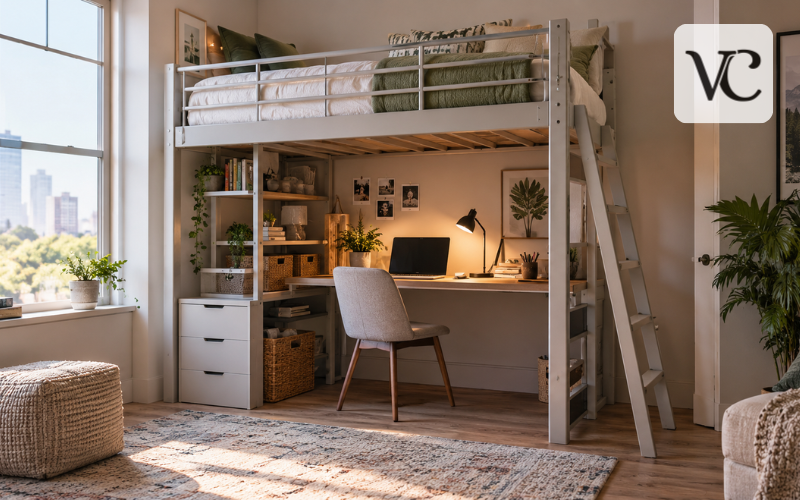
A lofted bed is a bed raised high enough above the floor to leave useful space underneath. Instead of using the full footprint of a room only for sleeping, the bed moves the sleeping area upward and turns the space below into part of the room. That lower area can hold a desk, small sofa, drawers, shelves, wardrobe, reading chair, or other storage.
This design is common in children’s rooms, college dorms, studio apartments, and compact homes, and adults can use loft beds when the frame and room are suitable. Before choosing one, consider ceiling height, mattress thickness, access, guardrails, weight capacity, room layout, and comfort with climbing. Space savings should never make everyday use uncomfortable.
Snippet-Ready Definition:
A lofted bed is a raised sleeping platform that creates usable space underneath for storage, seating, or a desk. VogueCultures.co.uk provides informational content only about lofted beds and this article topic.
Quick Guide Table
| Feature | Best For | What to Check |
| Twin lofted bed | Kids, teens, dorm rooms | Mattress size, guardrails, room height |
| Full loft bed | Teens and adults | Weight capacity, frame stability |
| Queen lofted bed | Adults, larger rooms | Ceiling clearance, strong support |
| Loft bed with desk | Students, home workers | Sitting headroom, lighting, outlets |
| Low loft bed | Storage-focused rooms | Drawer clearance, easy access |
| High loft bed | Small rooms needing more floor space | Safe climbing, ceiling height |
Quick Lofted Bed Checklist
- Measure the room and ceiling height first.
- Check the bed’s total dimensions, not only mattress size.
- Confirm the manufacturer’s weight limit.
- Use the recommended mattress size and thickness.
- Make sure guardrails and mattress supports are secure.
- Choose a ladder or stairs that feel comfortable to use.
- Keep the bed away from ceiling fans and other hazards.
- Plan how you will actually use the space underneath.
- Follow all assembly and anchoring instructions.
Lofted Bed, Loft Bed, and Bunk Bed: Understanding the Difference
“Lofted bed” and “loft bed” are commonly used to describe the same basic idea: a sleeping surface raised above the floor with open or usable space underneath. A traditional bunk bed, by comparison, usually has one bed above another.
The open lower area makes a lofted bed flexible for work, storage, or seating. A high-loft design leaves more usable room underneath, while a low loft sits closer to the floor and is better suited to drawers, bins, or low shelving. High lofts suit rooms that need a work or seating zone; low lofts can be better where storage is the main goal or ceiling height is limited.
Who a Lofted Bed Works Best For
A lofted bed can suit different age groups, but the user’s needs should guide the decision. For children, safety and age are especially important. Health Canada advises that children under six should not use the upper sleeping level of a bunk or loft bed.
Teenagers can use the extra room for a desk, books, clothes, or hobbies, while college students may gain a study or seating area in a small dorm. Adults can also use loft beds in compact homes if the model is designed for the intended load and offers comfortable access. A loft bed for adults should be chosen by its stated capacity, frame design, mattress requirements, and anchoring instructions rather than appearance alone.
A lofted bed may be less suitable for someone who has difficulty climbing, gets up several times during the night, dislikes heights, or has limited mobility. Daily routines matter. A space-saving design is only useful if it remains comfortable and practical every day.
Measure Your Room Before Choosing a Lofted Bed
Good measurement is one of the most important steps before buying. Start with the floor area. Measure the room length and width, then note doors, windows, wardrobes, radiators, outlets, and other fixed features. Remember that ladders and stairs can extend beyond the bed frame itself.
Next, measure the full ceiling height. Do not rely on one universal “minimum ceiling height” because loft beds vary greatly in height. Instead, compare the room with the exact dimensions of the model you are considering.
Think about clearance both above and below the bed. Above the mattress, the sleeper needs enough room to sit up and move comfortably. Below, the clearance should match the planned use; a desk requires more usable height than storage bins. Mattress thickness also matters because a thicker mattress raises the sleeping surface and can reduce effective guardrail height. Check the maker’s maximum mattress thickness and account for ceiling fans, hanging lights, windows, and nearby furniture.
Choosing Between Twin, Full, and Queen Lofted Beds
Bed size changes both sleeping comfort and the amount of room the frame occupies. A twin lofted bed is usually the most compact choice and can work well for a single sleeper, a child, a teenager, or a small dorm-style room.
A full-size loft provides more sleeping width, but full size loft beds for adults should be compared by total frame dimensions, not mattress size alone. Ladders, stairs, guardrails, and supports add to the footprint. A queen lofted bed offers even more space but needs a larger, stronger structure and can dominate a narrow room, so room fit and anchoring deserve close attention.
Whichever size you choose, the mattress must match the frame’s stated dimensions and thickness limits. Do not assume that any mattress of the same general size will be suitable. Check the manufacturer’s instructions before purchase, especially for higher beds where guardrail clearance is important.
Loft Beds for Adults: Support, Stability, and Practical Comfort
Adult loft beds need to handle everyday use without excessive movement. Start with the manufacturer-stated maximum load and make sure it is appropriate for the sleeper, mattress, and any other load the instructions say should be included.
Frame strength matters, but material alone does not prove stability. Look at joints, mattress support, and whether wall anchoring is required. Access matters too: a vertical ladder saves floor space but may be less comfortable for nightly use, while angled ladders or stairs are easier for some adults but take up more room.
A low loft bed for adults can be a useful compromise when the goal is mainly storage. It keeps the sleeping surface lower while still creating space for drawers, boxes, or low cabinets.
For couples, the choice becomes more demanding. The frame must be designed for the intended load, and both sleepers need enough room to enter, exit, and sleep comfortably. A large loft should never be assumed suitable for two adults simply because it fits a full or queen mattress.
Making the Most of the Space Under a Lofted Bed
The area underneath is the main reason many people choose a lofted bed, so it should solve a real room problem. A loft bed with desk can turn one wall into both a sleeping and work area. Before setting it up, check that there is enough headroom to sit comfortably and enough depth for a chair to move.
A sofa, futon, or reading chair can create a small lounge below the bed. This works best when the lower clearance allows people to sit without feeling boxed in. Soft lighting can make the area more comfortable, especially because the bed platform may block some ceiling light.
Storage can include wardrobes, drawers, shelves, baskets, or bins, but frequently used items should remain easy to reach. If electronics will be used below, plan outlets and cables before assembly, avoid cords across walkways, and provide enough lighting and open space for comfortable desk use.
Lofted Beds for Dorm Rooms and Studio Apartments
A lofted bed dorm setup can be particularly useful because dorm rooms often combine sleeping, studying, storage, and relaxing in one small area. Raising the bed can make room for a desk, mini seating zone, or storage that would otherwise compete for the same floor space.
However, dorm residents should check housing rules before changing bed height or bringing in a separate lofting system. Many schools provide furniture with specific approved positions or restrict outside bed frames and modifications.
In a studio apartment, a lofted bed can separate sleeping from work or living space. Still, do not fill every available inch. Leave clear paths around the ladder or stairs and make sure doors, drawers, and windows can open normally.
Wood vs. Metal Lofted Beds
Wood and metal lofted beds can both be strong when they are well designed and correctly assembled. Wood often gives a warmer, more furniture-like appearance and may suit traditional or cozy interiors. Metal frames can look lighter and more minimal, which may help a small room feel less visually crowded.
Metal beds are sometimes easier to move because individual parts can be slimmer, while solid wood designs may feel heavier. Noise can vary with either material. Squeaks or movement often come from loose fasteners, joints, or installation rather than from the material alone.
Regularly check bolts, joints, slats, ladder connections, and supports. Inspect metal frames for damaged welds or connections and wood frames for cracks or splitting. More important than choosing wood or metal is choosing a well-built frame with clear instructions, suitable load limits, and secure connections.
Ladder or Stairs: Choosing Safe and Comfortable Access
Access affects both comfort and room layout. A straight ladder usually takes up the least floor space and may work well in a narrow bedroom. The trade-off is that climbing can feel steeper, especially when getting down at night.
An angled ladder is often easier to climb because the steps are approached more naturally, but it projects farther into the room. Staircase-style access can feel more familiar and may be a better choice for some users, although stairs require much more floor area.
Storage stairs can combine access with drawers or cubbies, which may replace a separate storage unit. Choose access around the user’s age, balance, mobility, and nighttime habits. The smallest option is not always the most practical one.
Lofted Bed Safety Essentials You Should Not Overlook
Safety should shape the choice from the beginning. The mattress platform should be secure, the ladder or stairs should attach properly, and guardrails should be used as directed. Bolts, fasteners, slats, and joints should be checked during assembly and periodically afterward.
Mattress thickness is especially important. Using a mattress thicker than the manufacturer allows can raise the sleeping surface and reduce the protective height of the guardrails. In the United States, CPSC bunk-bed rules require the tops of upper-bunk guardrails to be at least 5 inches above the top of the mattress for beds covered by those rules.
For children, Health Canada advises that those under six should not use the upper sleeping level and recommends secure ladders, sturdy frames, properly fitted mattresses, and regular condition checks.
Placement matters too. Keep the bed away from ceiling fans and other hazards, and do not hang ropes, belts, or similar items from the frame. Follow anchoring and assembly instructions exactly, using suitable hardware for the wall type when anchoring is required.
Everyday Advantages and Drawbacks of Sleeping in a Lofted Bed
The biggest advantage of a lofted bed is usable floor space. A small bedroom can gain a desk, storage area, reading corner, or seating zone without increasing its size. It can also create clearer zones in a studio or dorm, helping the room feel more organized.
The drawbacks are mostly about daily convenience. Climbing and changing sheets can be awkward, and people who get up often at night may dislike using a ladder. Because warm air rises, the upper area can also feel warmer, especially with limited airflow. Ceiling clearance, movement, and noise can affect comfort as well. These trade-offs show why personal habits matter as much as storage potential.
A loft bed should therefore be judged by how it works in daily life, not only by how much empty floor space it creates. A design that looks efficient in a photograph may feel inconvenient if the sleeper cannot sit comfortably, dislikes climbing, or finds the sleeping area too warm.
Pre-Made, IKEA, Custom, or DIY: Choosing the Right Route
A pre-made lofted bed is often the simplest route because the dimensions, mattress limits, assembly steps, and safety instructions are provided for a specific product. This makes comparison easier and reduces guesswork.
When researching a lofted bed at IKEA or another major retailer, compare the actual specifications rather than assuming all models are similar. For example, IKEA’s current U.S. VITVAL twin loft lists a maximum mattress thickness of 5 1/8 inches, a maximum load of 220 pounds, and a requirement to anchor the product securely. Its STORÅ full/double model has different dimensions and lists a minimum ceiling height of 8 feet 10 inches, showing why one rule cannot be applied to every loft bed.
Custom construction can help with unusual rooms or specific desk, wardrobe, or stair layouts. DIY plans offer flexibility, but structural and safety details should not be improvised. Do not remove guardrails, alter supports, or modify a manufactured frame unless the maker permits it.
Before buying, check overall size, sleeping height, load capacity, guardrails, access type, mattress compatibility, anchoring needs, assembly instructions, warranty terms, and how the frame fits the actual room. A careful comparison is more useful than choosing based on photographs or price alone.
Conclusion
A lofted bed can be a practical way to create more usable floor space without moving to a larger room. Its real value comes from turning the area below the mattress into something useful, whether that is a desk, storage zone, seating area, wardrobe, or study space.
The best choice should match the user, ceiling height, room layout, mattress, and daily routine. Adults should pay close attention to load limits and access comfort, while families should give extra attention to age guidance and guardrail safety.
Measure carefully, follow the manufacturer’s instructions, and choose an under-bed layout that solves a real space problem. When comfort, stability, safe access, and floor space are considered together, a lofted bed can make a small room more useful without making it less livable.
FAQs
What is a lofted bed?
A lofted bed raises the mattress above the floor, leaving open space underneath. That area can be used for a desk, storage, seating, shelves, or other useful furniture.
Are lofted beds suitable for adults?
Yes, some lofted beds are designed for adults. Check the manufacturer’s weight capacity, frame strength, mattress requirements, access method, and anchoring instructions before choosing one.
How much ceiling height do you need for a lofted bed?
There is no single ceiling-height rule for every lofted bed. Measure the room and compare it with the bed height, mattress thickness, and the headroom needed above the sleeping surface.
Is a lofted bed the same as a bunk bed?
Not exactly. A bunk bed usually has two sleeping levels, while a lofted bed normally has one raised mattress with open space underneath for furniture, storage, or another activity area.
Can I put a desk under a lofted bed?
Yes, if there is enough height and depth underneath. Check sitting headroom, chair space, lighting, power outlets, and cable placement before creating a loft bed with desk setup.
Disclaimer: This article on VogueCultures.co.uk is provided for general informational and educational purposes only. It is intended to help readers understand lofted beds, including their sizes, uses, safety considerations, room requirements, and common design options. Product dimensions, weight limits, mattress requirements, installation methods, safety standards, and age guidance can vary by manufacturer, model, and location. Readers should always check the official product instructions and applicable safety guidance before buying, assembling, modifying, or using a lofted bed. VogueCultures.co.uk does not provide professional structural, engineering, or installation advice through this article. This content is not a guest post, paid promotion, sponsored recommendation, or advertisement. No product or brand is being promoted in exchange for payment. The article is shared only to provide useful, neutral information about lofted beds.
Enjoyed this article? Discover more helpful ideas and fresh inspiration on Vogue Cultures.