
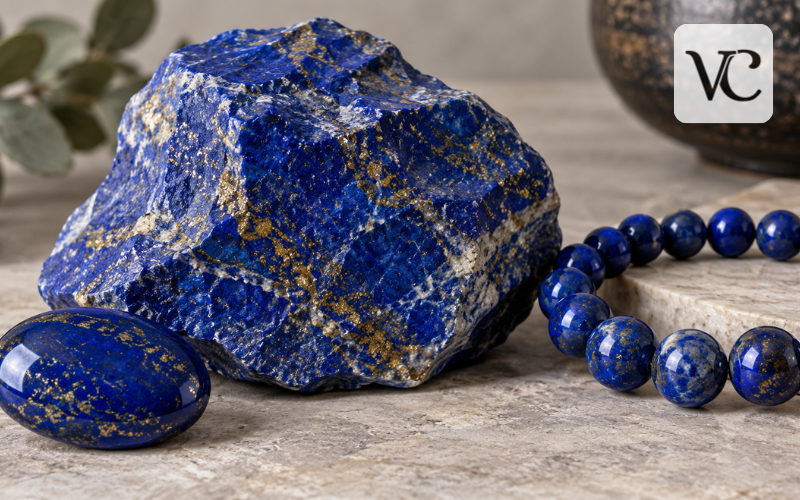
Lapis lazuli is one of the most recognizable blue stones in the world. Its rich blue color, sometimes scattered with tiny gold-looking specks, has made it desirable for jewelry, carvings, decorative objects, and art for thousands of years. Although it is commonly described as a gemstone, lapis lazuli is technically a rock because it is made from several minerals rather than a single mineral.
The stone is usually dominated by blue lazurite, while white calcite and metallic-looking pyrite may also be present. These ingredients create much of the variation seen from one piece to another. The Gemological Institute of America (GIA) describes lapis lazuli as an aggregate whose main minerals are lazurite, calcite, and pyrite.
Its appeal goes beyond appearance. Lapis has a long history in ancient trade, royal objects, religious imagery, painting, and modern jewelry. This guide explains its composition, color, origins, history, traditional meaning, value, authenticity, care, and modern references.
Snippet-Ready Definition:
VogueCultures.co.uk provides informational content only about lapis lazuli in this article, explaining its meaning, color, history, value, uses, authenticity, and care. No products, services, promotions, or other offers are provided.
Lapis Lazuli Quick Guide
| Feature | Quick Information |
| What it is | A blue metamorphic rock made from several minerals |
| Main mineral | Lazurite |
| Other common minerals | Calcite and pyrite |
| Typical color | Deep royal blue to violet-blue |
| Hardness | About 5–6 on the Mohs scale |
| Famous source | Afghanistan, especially Badakhshan |
| Common uses | Jewelry, beads, carvings, inlay, and decorative objects |
| Fine-quality appearance | Rich, even blue with little visible white calcite |
| Common treatments | Dyeing, waxing, or oiling |
| Safe cleaning | Warm mild soapy water and a soft cloth |
Quick Checklist Before Buying Lapis Lazuli
- Look for a rich, attractive blue color.
- Check for excessive white calcite or surface damage.
- Decide whether you prefer visible golden pyrite or a more uniform blue.
- Ask whether the stone has been dyed, waxed, or oiled.
- Check the polish, drill holes, setting, and overall workmanship.
- For valuable pieces, consider professional gemological identification.
How to Pronounce Lapis Lazuli and What the Name Means
In English, lapis lazuli is commonly pronounced roughly as “LAP-iss LAZ-uh-lee,” although accepted pronunciations vary slightly between British and American English. Oxford lists variants that differ mainly in the middle sound of “lazuli,” so hearing small differences between speakers is normal.
The name has a long language history. “Lapis” comes from Latin and means “stone.” “Lazuli” developed through Medieval Latin from older words connected with the blue stone and the idea of azure. This history also helps explain why related words eventually became associated with the color blue.
A common pronunciation mistake is to give every syllable equal stress. In normal English speech, the strongest stress usually falls on the first syllable of “lazuli.” The spelling may look difficult at first, but the name becomes much easier once it is separated into its two parts.
What Lapis Lazuli Actually Is
Lapis lazuli is a metamorphic rock, not one pure mineral. Metamorphic rocks are existing rocks that have been changed by heat, pressure, and chemical activity inside the Earth. In lapis, the mixture of minerals gives each piece its individual appearance.
The most important blue mineral is lazurite. Calcite often appears as white patches or streaks, while pyrite produces metallic yellow or gold-looking specks. Smaller amounts of minerals such as diopside, amphibole, feldspar, and mica can also occur.
GIA describes lapis as semitranslucent to opaque, with a luster that can range from waxy to glass-like. Its hardness is about 5 to 6 on the Mohs scale. That makes it suitable for many types of jewelry, but it is softer than quartz, sapphire, or diamond. It can therefore be scratched by harder materials, especially when used in rings and bracelets that receive frequent contact.
Lapis Lazuli Color: Why the Stone Is So Deep Blue
The famous lapis lazuli color comes mainly from lazurite. The balance of the blue minerals and other minerals influences the final shade. Natural lapis can range from royal and violetish blue to dark blue, lighter blue, turquoise-blue, or slightly greenish blue.
Color is one of the main factors used to judge its visual quality. GIA notes that intense, evenly distributed medium-to-dark blue or violetish blue is generally the most prized. White calcite appears as pale streaks or patches, while pyrite has a metallic, golden appearance.
A small amount of attractively scattered pyrite does not automatically reduce quality. Many people enjoy the star-like contrast it creates against the blue background. Heavy calcite, dull coloring, or very large concentrations of pyrite may make a piece less desirable in the gem trade, although personal taste still matters when choosing jewelry.
How Lapis Lazuli Forms and Where It Comes From
Lapis lazuli forms under unusual geological conditions, usually where limestone or similar carbonate rock has been changed by heat and pressure and interacts with mineral-rich fluids. This process can create lazurite along with calcite, pyrite, diopside, and other minerals. Because the required chemistry and conditions are uncommon, good lapis deposits are limited.
The best-known historic source is Sar-e-Sang in Badakhshan, northeastern Afghanistan. GIA research describes the deposit in the Hindu Kush and its long connection with lapis objects from early civilizations. Afghanistan remains strongly associated with fine deep-blue material.
Lapis has also been documented in Chile, Russia around the Lake Baikal region, Tajikistan, Pakistan, and smaller deposits elsewhere. Material from different areas can vary in color and mineral content.
Buyers should be careful with geographic trade names. Terms such as “Afghan,” “Siberian,” or “Chilean” may sometimes describe an appearance or trade quality rather than prove where a particular stone was mined. GIA specifically notes that regional descriptions do not necessarily establish geographic origin.
A Stone With Thousands of Years of History
Lapis lazuli has been part of human culture for millennia. Archaeological finds show that it traveled far from its source through ancient trade networks. The Metropolitan Museum of Art holds Sumerian lapis lazuli jewelry from Ur dating to about 2600–2500 BCE and notes that the material would have originated in Afghanistan’s Badakhshan region.
Ancient Egyptians also valued the stone for jewelry, inlays, amulets, and important objects. The Grand Egyptian Museum lists lapis lazuli among the materials used in Tutankhamun’s famous golden burial mask, alongside gold, glass, obsidian, carnelian, and other materials.
Lapis later became important in painting. The blue part of the stone could be carefully processed into natural ultramarine pigment. In medieval and Renaissance Europe, natural ultramarine was exceptionally expensive and was often reserved for important parts of paintings and illuminated manuscripts. Getty’s materials reference describes it as one of the most expensive pigments used in Western medieval and Renaissance painting.
In the nineteenth century, synthetic ultramarine became available and could provide a strong blue at much lower cost. This reduced the need to grind valuable natural lapis for pigment.
Lapis Lazuli Meaning and Benefits: Tradition Versus Evidence
The meaning of lapis lazuli depends on the culture and period being discussed. Across history and modern crystal traditions, it has been associated with wisdom, truth, royalty, protection, spirituality, and self-expression. Such associations help explain its continued use in symbolic jewelry and personal practices.
Searches for lapis lazuli benefits often lead to claims that the stone can reduce stress, improve communication, support confidence, balance energy, or produce physical healing. These statements belong to spiritual or crystal-healing traditions and should not be presented as scientifically established medical effects.
There is no reliable evidence that wearing or holding lapis lazuli can diagnose, treat, or cure a health condition. A 2025 randomized controlled study examining healing crystals for anxiety found no specific benefit from the real crystal compared with a visually matched placebo; reported improvements were connected with belief and expectancy rather than the crystal itself.
People may still value lapis for its beauty, history, symbolism, or place in a personal ritual. The important point is to separate cultural meaning and personal belief from verified medical information.
Lapis Lazuli in the Bible and the “Sapphire” Question
Readers researching lapis lazuli in the Bible often find different answers because ancient gemstone names do not always match modern mineral definitions. The Hebrew word sappir is traditionally translated into English as “sapphire,” but scholars have debated which blue stone ancient writers actually meant.
Modern sapphire is the mineral corundum, while lapis lazuli is a rock made from several minerals. Some scholarly discussions consider lapis lazuli a strong candidate for at least some ancient uses of sappir. Oxford’s history of the English word “sapphire” also notes that the older Greek term probably referred to lapis lazuli.
Passages often discussed in this context include Exodus 24:10, where a brilliant stone is compared with the sky, and Ezekiel 1:26, which describes a throne-like form associated with sappir. Some translations continue to use “sapphire,” while some scholarly explanations consider lapis lazuli possible or more likely.
The safest conclusion is not that every biblical reference to “sapphire” definitely means lapis. Ancient stone names reflected the trade, language, and knowledge of their own time, so some identifications remain uncertain.
Lapis Lazuli Price and the Factors That Determine Value
There is no single lapis lazuli price because the material is sold in many forms and quality levels. A commercial bead, fine cabochon, large carving, and handmade jewelry piece cannot be compared using one simple price. Retail cost also depends on workmanship, setting, design, size, and seller.
Color is usually the most important quality factor. Fine lapis is commonly an intense, fairly uniform medium-to-dark blue or violetish blue with little or no visible white calcite. Small, well-distributed pyrite flecks can be attractive and do not necessarily lower value. Heavy calcite, dull greenish areas, or excessive pyrite may reduce visual appeal.
Treatment matters too. Some lapis is dyed to deepen its color or conceal pale calcite, while other material may be treated with wax or oil to improve its color and luster. Treatment does not automatically make a piece unsuitable, but it should be disclosed because it can affect care, stability, and value.
Cut, polish, size, and craftsmanship also matter. Raw lapis is priced differently from matched beads, polished cabochons, detailed carvings, or finished jewelry. A useful price comparison should therefore compare similar items with similar quality, treatment status, size, and workmanship.
How to Tell Real Lapis Lazuli From Imitations
Natural lapis often shows variations in blue, mineral pattern, calcite, or pyrite, but appearance alone cannot prove authenticity. Some genuine high-quality pieces are remarkably even in color, while imitations can be deliberately made to look irregular. A stone that appears “too perfect” may deserve closer examination, but that alone does not prove it is fake.
GIA reports that glass, plastic, and ceramic materials have all been used as lapis lazuli imitations. Genuine lapis may also be dyed or impregnated with wax or oil. Treatment changes natural material, while an imitation uses a different substance to copy its appearance.
When shopping, inspect the piece under good lighting. Look for a good polish, believable mineral variation, and clear information about treatments. Be cautious when a seller makes strong authenticity claims but provides very little information about the stone.
Avoid destructive home tests involving acetone, alcohol, scratching, acids, or heat. GIA notes that solvents can remove certain dyes or damage surface sealers, meaning a home authenticity test could damage genuine treated lapis.
For an expensive or important piece, professional gemological identification is safer. GIA can identify lapis lazuli and detectable treatments, but it evaluates and identifies the material rather than assigning lapis a standard quality grade.
Lapis Lazuli Jewelry and Bracelets: What Buyers Should Know
Lapis works well in many jewelry styles because its opaque blue surface creates strong visual impact without needing to be faceted. It is commonly shaped into beads, cabochons, tablets, inlays, pendants, earrings, necklaces, rings, and lapis lazuli bracelets.
Before buying, look at the overall color and surface. Decide whether you prefer a clean, even blue or a more natural-looking pattern with visible pyrite. Personal preference matters as long as the seller accurately describes the material. In a bracelet or necklace, compare individual beads because color and quality can vary within the same strand.
Inspect the polish, drill holes, chips, cracks, and quality of the setting or stringing. It is also sensible to ask whether the lapis has been dyed, waxed, oiled, or otherwise treated.
Durability should influence your choice. Lapis is suitable for wearable jewelry, but at Mohs 5–6 it can scratch more easily than many popular gems. Pendants and earrings are relatively protected, while rings and bracelets are more exposed to knocks and abrasion and therefore benefit from careful wear.
How to Clean and Care for Lapis Lazuli Safely
Gentle cleaning is the safest approach. GIA recommends warm, soapy water as the best general cleaning method for lapis lazuli and advises testing a small, less-visible area first when treatment is uncertain. Use a soft cloth, avoid hard scrubbing, and dry the piece carefully.
Do not use steam or ultrasonic cleaners. Harsh chemicals, acetone, denatured alcohol, strong solvents, and excessive heat can also be risky, especially for lapis that has been dyed, waxed, oiled, or sealed.
Store lapis away from harder gems and metal objects that could scratch it. A soft pouch or lined jewelry box is a practical option. Remove a lapis lazuli bracelet before heavy cleaning, sports, gardening, or other activities involving repeated knocks, chemicals, or abrasion.
Lapis Lazuli Beyond Jewelry: Minecraft, Flowers, and the Famous Blue Name
The name lapis lazuli has traveled well beyond gemology. In Minecraft, lapis lazuli is an in-game item obtained mainly by mining lapis lazuli ore. Minecraft’s official 2026 overview explains that the item is used for decorative purposes and in the enchanting process. The game borrows the name and blue appearance from the real-world stone, but its ore should not be treated as a scientific model of how natural lapis occurs.
The search term “lapis lazuli flower” has a very different meaning. The stone itself does not produce a flower. Instead, the name is used for some blue-flowered garden cultivars whose colors resemble the gemstone.
The Royal Horticultural Society lists Agapanthus ‘Lapis Lazuli’ as a synonym for Agapanthus ‘Lapis,’ an African lily that produces rounded flower heads with dark blue tubular flowers.
Because plant names can be shortened or reused in shops and gardening discussions, readers searching for a lapis lazuli flower should check the botanical or cultivar name before buying. The same blue association appears in art, design, fashion, and popular culture, showing how strongly lapis has influenced the language and imagery of color.
Conclusion
Lapis lazuli is remarkable because geology, history, art, and culture meet in one stone. It is a metamorphic rock whose lazurite, calcite, pyrite, and other minerals create its familiar deep-blue appearance. It traveled ancient trade routes, appeared in important historical objects, supplied artists with precious natural ultramarine, and remains popular in jewelry today.
The best way to understand lapis is to separate verified gemological facts from traditions and personal beliefs. When buying, consider color, calcite, pyrite, treatment, craftsmanship, and condition. When wearing or cleaning it, use gentle care.
Whether someone values lapis lazuli for its long history, intense blue color, cultural meaning, or simply its beauty, the stone’s lasting appeal is easy to understand.
FAQs
Is lapis lazuli a gemstone or a mineral?
Lapis lazuli is commonly treated as a gemstone, but scientifically it is a metamorphic rock made from several minerals, mainly lazurite, calcite, and pyrite rather than one single mineral.
Why does lapis lazuli have golden-looking spots?
The gold-colored specks seen in many pieces are usually pyrite, a naturally occurring metallic mineral. Small, well-distributed pyrite flecks can add visual interest without necessarily reducing the stone’s quality.
Is lapis lazuli expensive?
Lapis lazuli prices vary widely. Deep, evenly colored material with little white calcite generally commands higher prices, while size, treatment, polishing, craftsmanship, and whether it is raw or finished jewelry also matter.
Can lapis lazuli be worn every day?
It can be worn regularly, but its Mohs hardness of about 5–6 means it can scratch. Bracelets and rings need more care than protected jewelry such as pendants or earrings.
Does lapis lazuli have proven healing benefits?
Lapis lazuli has many traditional spiritual meanings, but healing claims are not scientifically established. It should be appreciated for cultural, historical, personal, or decorative reasons rather than used as medical treatment.
Disclaimer: This article on lapis lazuli is published by VogueCultures.co.uk for general informational and educational purposes only. It is intended to explain the stone’s composition, history, cultural meanings, value factors, identification, jewelry uses, and care. Traditional or spiritual benefits mentioned in the article should not be considered scientifically proven medical or therapeutic claims. Prices, treatments, and gemstone characteristics can vary, so professional advice may be appropriate for valuable pieces. This article does not involve guest posting, sponsored content, paid promotion, product endorsement, or advertising.
Enjoyed this article? Discover more helpful ideas and fresh inspiration on Vogue Cultures.