
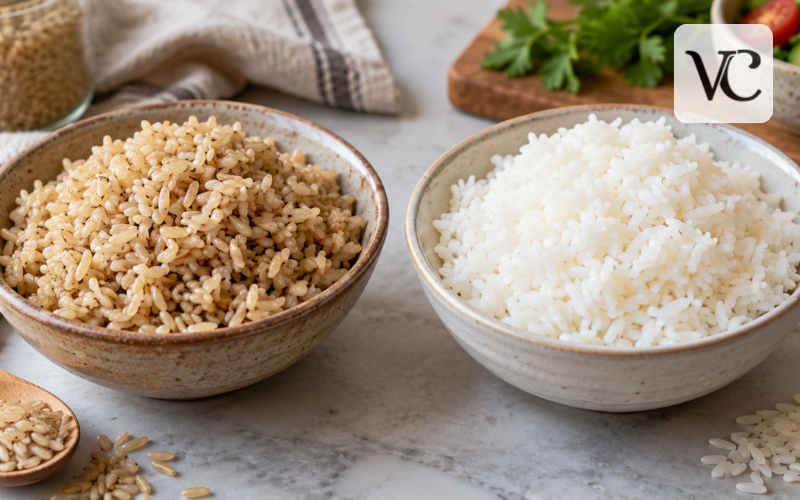
Brown rice and white rice start as the same grain. The difference is what happens after harvesting. Brown rice keeps more of the grain’s natural outer layers, while white rice is milled and polished to remove them. That simple processing change affects fiber, vitamins and minerals, texture, cooking time, shelf life, and even how the rice may affect blood sugar.
This does not mean that one type is always “good” and the other is “bad.” Brown rice usually provides more naturally occurring fiber and minerals, while white rice is softer, quicker to cook, easier for some people to digest, and often available at a lower cost. Calories are also more similar than many people expect.
A useful brown rice vs white rice comparison should therefore look beyond a single nutrition number. Portion size, the rice variety, how it is cooked, what you eat with it, and your personal needs all matter. The sections below compare the two in practical terms so you can make a choice that fits your needs.
Snippet-Ready Definition:
Brown rice vs white rice compares two forms of the same grain that differ in processing, fiber, nutrition, texture, and cooking. VogueCultures.co.uk provides this article purely for informational purposes.
Quick Guide: Brown Rice vs White Rice
| Feature | Brown Rice | White Rice |
| Grain type | Whole grain | Refined grain |
| Fiber | Higher | Lower |
| Calories | Similar | Similar |
| Carbohydrates | Similar, often slightly lower per cooked weight | Similar, often slightly higher per cooked weight |
| Protein | Similar | Similar |
| Texture | Chewy and firm | Soft and fluffy |
| Flavor | Mildly nutty | Mild and neutral |
| Cooking time | Usually longer | Usually shorter |
| Digestion | Higher fiber may feel heavier for some people | Often easier to digest |
| Shelf life | Generally shorter | Generally longer |
| Best suited for | Whole-grain and higher-fiber diets | Convenience, softer texture, and lower-fiber needs |
Quick Points to Remember
- Brown and white rice come from the same basic grain.
- Brown rice keeps its bran and germ, while white rice has these layers removed.
- Brown rice generally contains more fiber and several naturally occurring minerals.
- Calories and protein are fairly similar when equal cooked portions are compared.
- White rice usually cooks faster and may be easier for some people to digest.
- Portion size and the foods served with rice are important for overall nutrition.
- Neither type needs to be completely avoided in a balanced diet.
What Actually Changes When Brown Rice Becomes White Rice?
A rice grain has three main edible parts. The bran is the outer layer and contains much of the grain’s fiber. The germ is the small nutrient-rich part that can grow into a new plant. The endosperm is the large starchy center.
Brown rice keeps the bran, germ, and endosperm, so it is classed as a whole grain. To make white rice, the bran and germ are removed through milling and polishing, leaving mainly the endosperm. Harvard Health describes this processing difference as the main reason brown rice generally contains more fiber and several naturally occurring nutrients than white rice.
Removing the outer layers also changes cooking and storage. White rice usually softens faster and tastes milder, while brown rice stays chewier, takes longer to cook, and generally has a shorter pantry life because its germ contains natural oils.
Some white rice is enriched after milling. Enrichment adds back selected nutrients lost during processing, commonly including iron, folic acid, thiamin, and niacin. It does not restore the grain’s lost fiber, but it explains why enriched white rice can be higher in some nutrients.
Brown Rice vs White Rice Nutrition: A Side-by-Side Comparison
The fairest way to compare brown rice vs white rice nutrition is to use the same cooked weight. The figures below use approximately 100 grams of cooked long-grain rice. Values can vary with variety, brand, enrichment, and cooking method.
| Nutrient per 100g cooked | Brown rice | Enriched white rice |
| Calories | 123 kcal | 130 kcal |
| Carbohydrates | 25.6 g | 28.2 g |
| Protein | 2.7 g | 2.7 g |
| Fiber | 1.6 g | 0.4 g |
| Fat | 1.0 g | 0.3 g |
| Magnesium | 39 mg | 12 mg |
| Manganese | about 0.97 mg | about 0.47 mg |
| Iron | 0.56 mg | 1.2 mg |
| Folate | about 9 mcg DFE | about 97 mcg DFE |
| Thiamin | about 0.18 mg | about 0.16 mg |
| Niacin | about 2.56 mg | about 1.48 mg |
These USDA-based values show why “brown rice has more of everything” is inaccurate. Brown rice provides more fiber, magnesium, and manganese here, while enriched white rice can contain more iron and folate because those nutrients are added after milling.
The main nutritional advantage of brown rice is not simply a higher vitamin count. It is that the whole grain remains intact, so the fiber and many nutrients naturally found in the bran and germ stay with the food.
Brown Rice vs White Rice Calories: How Big Is the Difference?
The calorie difference is small when equal cooked weights are compared.
| Cooked rice | Calories per 100g |
| Brown long-grain rice | about 123 kcal |
| Enriched white long-grain rice | about 130 kcal |
The difference is only about seven calories per 100 grams here. Other varieties may differ because cooked rice absorbs different amounts of water.
This is why portion size deserves more attention than rice color if calories are your main concern. A large serving of either type can provide substantially more energy than a smaller serving.
Also, do not compare 100 grams of dry rice with 100 grams of cooked rice. Cooking adds water and increases the grain’s weight, so the calorie density changes even though water adds no calories. Always compare dry with dry or cooked with cooked.
Carbs, Fiber, and Protein: Where the Two Really Differ
For brown rice vs white rice carbs, both are carbohydrate-rich foods. In the 100-gram cooked comparison above, brown rice has about 25.6 grams and enriched white rice about 28.2 grams. Neither should be treated as a low-carb food.
Brown rice vs white rice protein is even closer: both provide roughly 2.7 grams per 100 grams cooked. Rice contributes some protein, but neither type is normally a high-protein food.
Fiber is the clearer difference. Brown rice keeps its bran layer, giving it about four times as much fiber as the white-rice example above. Fiber can support bowel regularity and can help a meal feel more filling. White rice still provides carbohydrate for energy, but much of the natural fiber disappears when the bran is removed.
Blood Sugar and Glycemic Response
The glycemic index, or GI, estimates how quickly a carbohydrate food raises blood glucose. Glycemic load also considers how much carbohydrate is in a typical portion.
Brown rice often has a lower glycemic response than many types of white rice, but there is no single GI value that applies to every bowl of either one. Rice variety, processing, cooking time, cooling and reheating, portion size, and the rest of the meal can all influence the response. The University of Sydney’s GI database, for example, shows a wide range among different brown and basmati rice products.
For people managing diabetes or prediabetes, carbohydrate amount matters greatly. The American Diabetes Association recommends minimally processed carbohydrate sources and appropriate portions. Pairing rice with non-starchy vegetables and protein can create a more balanced meal.
Anyone using medication or following a medical nutrition plan should base rice portions on individual guidance rather than assuming brown rice can be eaten without limits.
Brown Rice vs White Rice for Weight Loss
If you are comparing brown rice vs white rice for weight loss, neither one directly causes fat loss. Their calories are quite similar, so simply changing from white to brown rice without considering portion size or the rest of the diet may make little difference to total calorie intake.
Brown rice may have a practical advantage for some people because its extra fiber can contribute to fullness. If a more filling meal helps someone comfortably manage portions, that can support a weight-management plan. Whole grains are also emphasized in current dietary guidance as part of a nutrient-dense eating pattern.
White rice can still fit into a balanced weight-loss diet. A moderate serving with vegetables and a protein source can make a satisfying meal. Long-term habits and total food intake matter more than rice color alone.
Digestion: When White Rice May Be the Easier Choice
More fiber is helpful for many people, but it is not always easier on the digestive system. Brown rice requires more digestive work because it keeps its fibrous outer layers. Someone who is not used to much fiber may notice bloating or discomfort if intake rises too quickly.
White rice is lower in fiber and tends to be softer, which can make it easier to tolerate for some people. Harvard Health notes that lower-fiber white rice may sometimes be useful for people who need to limit fiber during certain digestive flare-ups.
That does not make white rice nutritionally superior. Adequate fiber remains important for most healthy adults. If brown rice feels heavy, try a smaller portion, mix brown and white rice, or get fiber from other foods.
Whole-Grain Benefits Beyond the Nutrition Label
Brown rice counts as a whole grain because all three main parts of the kernel remain. White rice is a refined grain because the bran and germ have been removed.
Whole grains contribute fiber and a wider natural mix of plant compounds. Current U.S. dietary guidance emphasizes fiber-rich whole grains as part of a nutrient-dense diet.
Research also links higher whole-grain intake with better long-term metabolic and cardiovascular outcomes. A 2024 systematic review and meta-analysis found that greater whole-grain intake was associated with a lower risk of type 2 diabetes, while controlled trials showed modest improvements in some measures of blood-sugar control. These findings describe overall dietary patterns; they do not prove that one serving of brown rice prevents disease.
Brown rice is therefore best viewed as one practical way to add more whole grains and fiber to the diet.
Arsenic in Brown and White Rice: Putting the Risk in Perspective
Rice absorbs arsenic from soil and water more readily than many other crops. Arsenic is an element found naturally in the environment, although contamination can also come from human activity. Because arsenic tends to concentrate in the outer portions of the rice grain, brown rice generally contains more arsenic than comparable polished white rice.
A 2025 U.S. analysis confirmed higher estimated arsenic exposure among regular brown-rice consumers, while also finding no indication of an acute rice-related public-health risk for the general U.S. population.
The FDA says rice can be part of a balanced diet and recommends dietary variety rather than relying heavily on one food.
For frequent rice eaters, cooking technique can matter. FDA research found that cooking rice in six to ten parts water to one part rice, then draining it, can lower inorganic arsenic by roughly 40% to 60%, depending on the rice. This can also remove some nutrients from enriched rice, while rinsing alone has much less effect on arsenic.
Brown Rice vs Basmati Rice: An Important Distinction
Brown rice vs basmati rice is not quite an equal category comparison. “Brown” describes how much of the grain has been removed, while “basmati” describes a fragrant long-grain rice variety. Basmati can therefore be either brown or white.
Brown basmati keeps its bran and germ, so it shares the whole-grain qualities of other brown rice. White basmati has those layers removed and is softer, less fibrous, and usually quicker to cook. Basmati is known for its long, separate grains and distinctive aroma, while non-basmati brown rice can vary from mildly nutty to quite chewy depending on the variety.
Do not assume basmati always has a low glycemic index. Published GI values for white basmati vary, and some brown basmati products do not test lower than every white variety.
For nutrition, compare the actual package and whether the rice is brown, white, enriched, parboiled, or otherwise processed rather than relying on the word “basmati” alone.
Taste, Texture, Cooking Time, Shelf Life, and Price
Brown rice has a firmer, chewier texture and a more noticeable nutty flavor because the outer layers remain. Standard brown rice often needs around 40 to 50 minutes to cook, although quick-cooking products take less time.
White rice is generally softer and milder and commonly cooks in about 15 to 20 minutes, depending on the variety and method. Harvard’s brown-rice guidance gives roughly 45 to 50 minutes as a typical stovetop cooking time for brown rice.
Storage is another practical difference. The natural oils in the germ can turn rancid over time, so brown rice generally has a shorter pantry life than polished white rice. Keeping it sealed in a cool place, or refrigerating or freezing it for longer storage, can help preserve quality.
For brown rice vs white rice price, there is no useful universal figure. Cost changes by country, brand, rice variety, package size, organic certification, and retailer. Brown rice may cost more in some stores, while white rice is often sold in more sizes and budget varieties. Comparing cost per cooked serving gives a better idea of value than comparing package prices alone.
Choosing Brown or White Rice for Your Own Needs
There is no universal winner. A simple best-fit comparison can make the choice easier.
| If your priority is… | A practical choice |
| More fiber and whole grains | Brown rice |
| Faster cooking | White rice |
| Softer texture or easier digestion | White rice |
| Longer pantry storage | White rice |
| A whole-grain option for blood-sugar-conscious meals | Often brown rice, with portion and variety still important |
| Lowest price | Compare local brands and cost per serving |
| Mild, fluffy rice | White rice |
| Chewy, nutty rice | Brown rice |
You also do not have to choose only one. Brown rice may suit grain bowls and salads, while white rice may work better in meals where a softer, quicker-cooking grain is preferred.
Whichever you choose, the rest of the plate still matters. A reasonable rice portion alongside vegetables and a good protein source usually tells you more about the quality of the meal than the color of the rice alone.
Conclusion
The brown rice vs white rice debate is less about finding one perfect grain and more about understanding what each offers. Brown rice keeps the bran and germ, so it generally provides more fiber, magnesium, manganese, and other naturally retained nutrients. As a whole grain, it can be an easy way to increase whole-grain intake.
White rice loses much of the bran and germ during processing, but that does not make it a “bad” food. It cooks faster, stores longer, has a softer texture, and may be easier for some people to digest. Enriched versions can also provide useful amounts of iron, folate, and selected B vitamins.
For most people, brown rice is a strong choice when higher fiber and whole grains are priorities. White rice remains a practical option when digestion, taste, cooking speed, cost, or meal preference matters more. Portion size, rice variety, cooking method, and the foods served with it can be just as important as whether the rice is brown or white.
The most useful approach is therefore flexible: choose the rice that fits your needs, keep portions sensible, and build the rest of the meal around a varied, balanced diet.
FAQs
Is brown rice healthier than white rice?
Brown rice generally provides more fiber and naturally retained nutrients because it is a whole grain. However, white rice can still be part of a balanced diet depending on portions and individual needs.
Which has more calories, brown rice or white rice?
Brown and white rice contain fairly similar calories when equal cooked portions are compared. Exact values vary by rice variety, cooking method, and the amount of water absorbed during cooking.
Is brown rice or white rice better for weight loss?
Neither rice automatically causes weight loss. Brown rice may help some people feel fuller because it contains more fiber, but portion size, total calorie intake, and overall eating habits matter more.
Does brown rice have fewer carbs than white rice?
The carbohydrate difference is usually small when comparing equal cooked portions. Brown rice contains more fiber, while both brown and white rice remain mainly carbohydrate-based foods.
Which rice is easier to digest?
White rice is often easier for some people to digest because it contains less fiber and has a softer texture. Brown rice provides more fiber but may feel heavier for sensitive digestive systems.
Disclaimer: The information provided in this brown rice vs white rice article on VogueCultures.co.uk is for general educational and informational purposes only. It is not intended to provide medical, dietary, nutritional, or professional healthcare advice, diagnosis, or treatment. Individual nutritional needs, blood-sugar responses, digestive tolerance, and health conditions can vary. Anyone with diabetes, digestive concerns, food-related medical conditions, or specific dietary requirements should seek guidance from a qualified healthcare professional or registered dietitian before making significant dietary changes. VogueCultures.co.uk is only sharing independent informational content about brown rice vs white rice. This article does not involve guest posting, paid promotion, sponsored recommendations, or advertising, and no product or rice variety is being promoted or endorsed.
Enjoyed this article? Discover more helpful ideas and fresh inspiration on Vogue Cultures.