
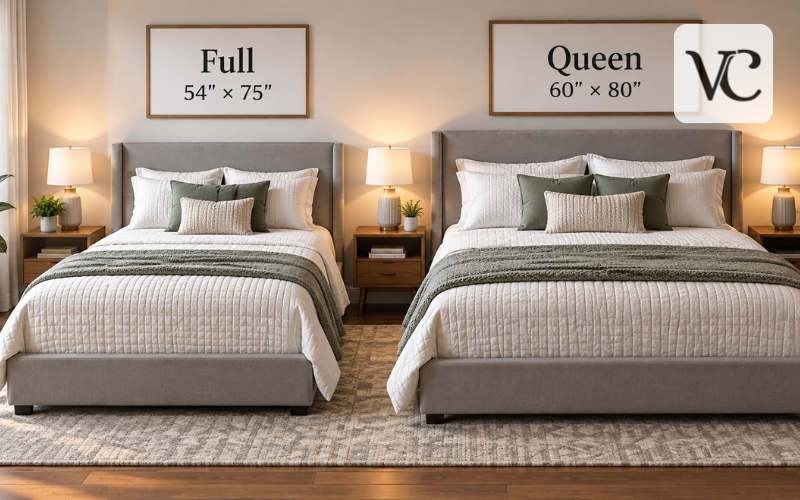
Choosing between a full and queen mattress can look simple until you consider who will use it, how much room you have, and the total setup cost. A full bed, also called a double bed, suits many single sleepers, while a queen is larger and often preferred by couples or people who want more room.
The standard full mattress is about 54 inches wide by 75 inches long, while a standard queen is 60 inches wide by 80 inches long. That means a queen gives you 6 extra inches of width and 5 extra inches of length. Those few inches can make a noticeable difference in everyday comfort, especially for two people or taller sleepers.
A full usually takes up less floor space and often costs less. A queen needs a little more room and normally costs more once you include the mattress, frame, and bedding. Before choosing, think about the number of sleepers, their height, the bedroom dimensions, your budget, the bed frame, bedding, and the amount of open floor space you want to keep. Mattress measurements can vary slightly between manufacturers, so always check the exact product dimensions before buying.
Snippet-Ready Definition:
Full vs queen compares two common mattress sizes: a full is about 54 × 75 inches, while a queen is 60 × 80 inches. Voguecultures.co.uk provides information about this full vs queen topic only.
Quick Full vs Queen Decision Guide
- Choose a full if one person will use the bed, bedroom space is limited, or keeping mattress and bedding costs lower is important.
- Choose a queen if two adults will regularly share the bed, you need more length, or you simply prefer additional sleeping room.
- Measure the actual bedroom and bed frame, not just the mattress area.
- Consider the total cost of the mattress, frame, sheets, protector, topper, and comforter before deciding.
- If children or pets regularly share the bed, the extra space of a queen may be more comfortable.
Full vs Queen Dimensions — Inches, Feet, Centimeters, and Surface Area
The clearest way to understand full vs queen is to compare their measurements. A standard full mattress measures about 54 by 75 inches, or 4.5 by 6.25 feet. In centimeters, that is about 137 by 191 cm. Its sleeping surface is about 4,050 square inches.
A standard queen measures 60 by 80 inches, or 5 by about 6.67 feet. In centimeters, it is roughly 152 by 203 cm. Its sleeping surface is about 4,800 square inches.
| Feature | Full | Queen |
| Width | 54 in / 137 cm | 60 in / 152 cm |
| Length | 75 in / 191 cm | 80 in / 203 cm |
| Approx. size in feet | 4.5 × 6.25 ft | 5 × 6.67 ft |
| Surface area | 4,050 sq. in. | 4,800 sq. in. |
| Common fit | One sleeper | One or two sleepers |
A queen therefore offers about 750 more square inches of mattress surface, or roughly 18.5% more area. Still, these are standard nominal sizes rather than a promise that every mattress will measure exactly the same. Small manufacturing differences can occur, so the mattress and frame specifications should be checked together.
What Full and Queen Bed Sizes Actually Mean
A full and a queen are separate mattress sizes. “Full” and “double” generally describe the same standard size, so a full mattress is not halfway between two other common sizes, and it is not the same as a queen.
The phrase “full/queen” can be confusing because it often appears on comforters, duvets, or other top bedding. In that setting, it usually means the bedding was designed with dimensions that can work on either a full or queen bed. It does not mean there is a standard mattress size called a “full queen.”
This distinction matters while shopping. A comforter may be flexible enough to cover two mattress sizes, but fitted items are different. A queen mattress needs a queen-size frame, and fitted sheets or mattress protectors generally need to match the mattress dimensions and depth. Reading the product label carefully can prevent poor fit and unnecessary returns.
How the Extra Queen-Sized Space Feels When You Sleep
Six inches of extra width may not sound dramatic, but the difference becomes clearer when the bed is shared. One person using a full gets the full 54-inch width. Two people sharing it have about 27 inches of mattress width each if they divide the space evenly. On a queen, two sleepers have about 30 inches each.
That extra three inches per person can make turning over, changing positions, or stretching out feel less restricted. It can also help if a small pet sometimes sleeps on the bed. For one person, both sizes can feel roomy, but an active sleeper may enjoy the extra space of a queen.
The queen also adds 5 inches of length. A full is 75 inches long, or 6 feet 3 inches, before allowing for a pillow or the way a person actually lies on the mattress. A queen is 80 inches long, giving taller sleepers more room near the feet and more flexibility in pillow placement.
Full vs Queen for One Person
For many single adults, a full mattress offers a practical balance between comfort and room efficiency. It is substantially wider than a twin, yet it does not occupy as much bedroom space as a queen. That makes it useful for teenagers, young adults, apartments, smaller bedrooms, and guest rooms.
A full can also make sense for someone who moves often because a smaller mattress and frame are generally easier to carry through stairs, hallways, and doorways. It also leaves more room for a desk, dresser, chair, or storage furniture.
A queen may be more comfortable for a solo sleeper who is tall, changes position frequently, sleeps with a pet, or simply enjoys spreading out. It may also be a better long-term choice if the room is large enough and the sleeper expects the bed to be shared in the future. The better choice is not based only on body size; personal sleeping habits matter just as much.
Full vs Queen for Couples
A full mattress can physically hold two adults, but it may feel tight for regular couple use. At about 27 inches of width per person, each sleeper has less personal space than they would on a queen. This can become noticeable when one partner moves often or both people like to sleep with their arms or legs spread out.
A queen is generally the more practical of the two for couples because its 60-inch width gives each person about 30 inches of space when shared evenly. The extra length also helps when one or both partners are tall.
A full may still work for a couple in a guest room or temporary setup where saving space matters most. However, restless sleepers or couples sharing the bed with children or pets may find even a queen crowded. In that case, a king may be worth considering if the room and budget allow it.
Bedroom Space — How Much Room Does Each Bed Really Need?
There is no single minimum room size that works for every full or queen bed. Generic room-size suggestions can be useful as a starting point, but the real answer depends on the full layout of the bedroom.
The mattress is only one part of the footprint. A bed frame may extend beyond it, and the room may also need space for nightstands, a dresser, drawers, closet doors, the main bedroom door, and comfortable walking paths. A storage bed needs enough clearance for drawers to open, while a large headboard or footboard can add more length.
A full is easier to fit in a compact bedroom because it saves 6 inches of width and 5 inches of length compared with a queen. A queen can still work in many average bedrooms, but measuring first is important.
One practical method is to mark the planned bed dimensions on the floor with painter’s tape. Then check whether doors, storage areas, drawers, and walking routes remain comfortable. This gives a more realistic answer than relying on one universal room-size number.
Full vs Queen Size Bed Frames and Mattress Fit
Full and queen bed frames are designed for different mattress dimensions, so they should not be treated as interchangeable. A queen mattress is wider and longer than a full frame and will not be properly supported by a standard full-size base. A full mattress placed on a queen frame may leave unwanted gaps or fail to line up correctly with the frame’s support points.
The frame itself can also be larger than the mattress. Headboards, footboards, side rails, upholstery, posts, and built-in storage can all add inches to the overall footprint. A platform bed with thick upholstered sides, for example, may need noticeably more floor space than a simple metal frame holding the same mattress size.
For that reason, do not plan a bedroom using mattress dimensions alone. Check the manufacturer’s complete outside dimensions for the exact frame you want. Sleep Foundation notes that a queen frame may add roughly 2 to 5 inches around the standard mattress dimensions, although the amount depends on the frame style.
Full vs Queen Comforters, Sheets, and Bedding
Bedding fit depends on the type of item. Fitted sheets, mattress protectors, and most mattress toppers should match the mattress size because they need to sit closely around the edges. Mattress depth also matters. A very deep mattress may need deep-pocket sheets even when the stated bed size is correct.
Comforters and duvets offer more flexibility because they drape over the sides of the mattress. A queen comforter can often be used on a full bed, although it may hang farther down the sides and foot. A comforter made only for a full mattress may look too narrow or short on a queen.
This is why many companies sell “Full/Queen” comforters. These are usually sized to provide acceptable coverage for both mattress widths. However, comforter measurements are not completely standardized, so compare the listed width and length rather than relying only on the label. Flat sheets can also be somewhat flexible, while fitted sheets should stay size-specific for the best fit.
Full vs Queen Price — Mattress and Ownership Costs
A full mattress usually costs less than the same model in a queen size because it uses less material. However, there is no single full vs queen price difference that applies across all brands. Mattress construction, foam or spring quality, brand, thickness, features, and sales can affect the final price more than size alone.
The mattress is also not the only expense. Moving from full to queen can increase the cost of the frame, foundation, sheets, protector, topper, duvet, and comforter. If you already own full-size accessories, switching to a queen may mean replacing most fitted items.
Still, paying more for a queen can make sense when the added width and length will be useful for years. A couple planning to use the bed every night may get more value from the larger size than from saving money upfront. A solo sleeper in a compact room may prefer to keep the lower-cost full and spend the difference on mattress quality instead.
Full vs Queen for Taller Sleepers, Guest Rooms, Kids, and Pets
The best size changes with the sleeper. Taller adults often appreciate the queen’s 80-inch length, which adds 5 inches over a full. Still, sleeping position, pillow placement, body proportions, and personal comfort all affect how much length is needed.
For teenagers, a full can offer plenty of width while remaining easier to fit into a bedroom. A queen may make sense for an older teen if the room is large enough and the bed is expected to be used well into adulthood.
In a guest room, the choice is often a trade-off between visitor comfort and usable floor space. A full keeps the room more open, while a queen gives couples and taller guests more room.
For younger children, either size may be larger than necessary, although some families choose a full with future growth in mind. Pets matter too. Even a small dog or cat taking up part of the mattress can make a shared full feel noticeably smaller.
Twin vs Full vs Queen vs King — Putting the Two Sizes in Context
Looking at nearby mattress sizes makes the full vs queen decision easier.
| Size | Standard dimensions | Typical use | Space/cost level |
| Twin | 38 × 75 in | One child, teen, or compact solo setup | Lowest |
| Full | 54 × 75 in | One adult, guest room | Low to moderate |
| Queen | 60 × 80 in | One roomy sleeper or a couple | Moderate |
| King | 76 × 80 in | Couples wanting more width | Highest of these four |
These are the commonly used standard dimensions, although slight manufacturer differences are possible.
A twin may suit one sleeper when floor space is extremely limited. Moving from full to queen makes sense when extra length or shared sleeping space matters.
A king is more useful when two sleepers want much more personal width, especially with children or pets. The trade-off is more floor space, higher cost, and greater weight.
Choosing Between a Full and Queen Without Second-Guessing It
A good decision starts with your real room and sleeping habits rather than the name printed on the mattress. Ask how many people will sleep there regularly, whether anyone needs extra length, how much open floor space you want, and whether you are buying a completely new bed setup or already own matching furniture and bedding.
Also consider whether pets or children may regularly share the bed, how much you can spend on the complete setup, and whether the mattress is likely to be moved between homes.
Choose a full if: you mainly need a bed for one person, want to save floor space, have a smaller room, or would rather keep the mattress and bedding budget lower.
Choose a queen if: two people will use the bed regularly, you are taller, you move around a lot while sleeping, or you have enough room and want extra space for long-term use.
People searching “full vs queen Reddit” will find many personal opinions about whether the upgrade is worth it. Those experiences can be useful for understanding how different sleepers feel about each size, but they are anecdotal. Your own room measurements, comfort needs, and budget are more reliable decision tools than any single online opinion.
Conclusion
In the full vs queen comparison, the biggest difference is straightforward: a full is about 54 by 75 inches, while a queen is 60 by 80 inches. The full saves bedroom space and usually costs less to buy and outfit. The queen provides 6 more inches of width and 5 more inches of length, making it more comfortable for many couples, taller sleepers, and people who like extra room.
Neither mattress size is automatically better. A full can be the smarter choice in a compact bedroom or for a solo sleeper who does not need extra length. A queen often makes more sense when the bed will be shared or when long-term comfort matters more than saving a small amount of space.
Before buying, measure the actual room, check the outside dimensions of the bed frame, consider who will sleep there, and calculate the cost of any new bedding you will need. Choosing based on those practical details will give you a better result than choosing by mattress size alone.
FAQs
Is a queen much bigger than a full bed?
A queen is 6 inches wider and 5 inches longer than a standard full mattress. Although the difference seems small, the extra space can be noticeable for couples and taller sleepers.
Can two adults comfortably sleep on a full bed?
Two adults can sleep on a full mattress, but each person gets only about 27 inches of width. A queen generally offers more personal space and is better suited to regular couple use.
Is a full or queen better for one person?
A full is usually spacious enough for one adult. A queen may be better for taller people, active sleepers, pet owners, or anyone who prefers more room to stretch out.
Can I use full-size bedding on a queen mattress?
Fitted full-size bedding generally will not properly fit a queen mattress. Some comforters labeled “Full/Queen” are designed for both, but always check the product’s exact dimensions before buying.
Is a queen worth the extra cost over a full?
A queen may be worth the additional cost if you need more sleeping space, share the bed, or want extra length. A full can offer better value when space and budget are limited.
Disclaimer: This article on full vs queen is provided by voguecultures.co.uk solely for general informational and educational purposes. Mattress, bed-frame, bedding, room-size, and price details can vary by brand, manufacturer, retailer, and product design, so readers should verify exact measurements and specifications before purchasing. This content does not constitute professional, commercial, or purchasing advice. No guest posting, paid promotion, sponsored placement, or advertising is involved in this article. Any brands, products, or general examples mentioned are included only when necessary to explain the topic clearly and objectively.
Enjoyed this article? Discover more helpful ideas and fresh inspiration on Vogue Cultures.