
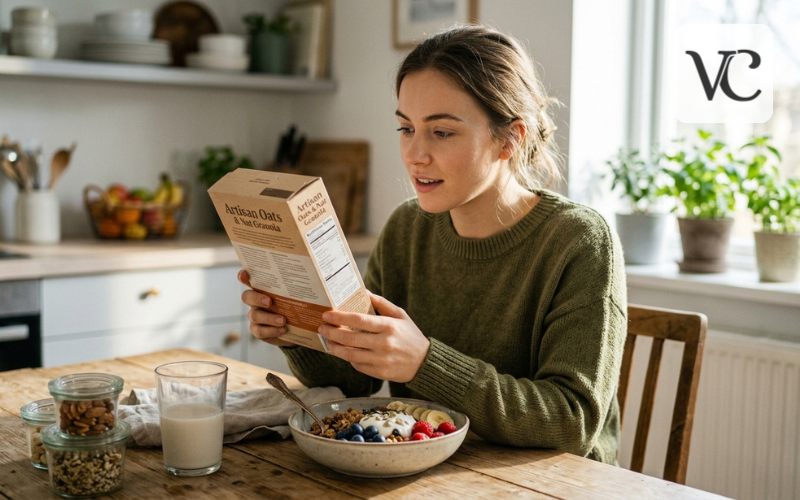
Granola can be healthy, but the answer depends on what is inside it and how much you eat. A granola made mainly with whole-grain oats, nuts, seeds, and a modest amount of sweetener can provide fiber, protein, healthy fats, and useful nutrients. Another product labeled “granola” may contain much more added sugar, oil, chocolate, or sweetened fruit.
This is why asking “is granola healthy?” does not have a simple yes-or-no answer. Two bags sitting next to each other on a supermarket shelf can have very different nutrition profiles.
Portion size also matters because granola is usually more calorie-dense than plain oatmeal or many breakfast cereals. A small serving may be enough when it is paired with yogurt, milk, or fruit.
This guide explains the potential benefits and drawbacks of granola, how it may fit into weight-management and heart-conscious diets, what people with diabetes should consider, how to read granola labels, and how homemade granola compares with store-bought products and muesli.
Snippet-Ready Definition:
Is granola healthy? It can be, depending on ingredients, added sugar, and portion size. voguecultures.co.uk provides information about this topic and article only, with no medical, promotional, or commercial purpose.
Quick Guide Table
| What to Check | Better Choice | Watch Out For |
| Main ingredients | Whole oats, nuts, seeds | Highly processed ingredients |
| Added sugar | Lower amounts | Several sugars or syrups |
| Fiber | Higher-fiber options | Very little fiber |
| Protein | Nuts and seeds | Mostly sugary clusters |
| Portion size | Follow the label | Oversized bowls |
| Pairing | Plain yogurt and fruit | Sweetened yogurt and syrups |
Simple Granola Checklist
Before choosing or eating granola:
- Check the serving size first.
- Look for whole oats, nuts, and seeds near the top of the ingredient list.
- Compare the added sugar between products.
- Check the amount of fiber and protein.
- Pay attention to saturated fat and sodium.
- Use a sensible portion, especially if granola is high in calories.
- Pair it with plain yogurt, milk, or fresh fruit for a more balanced meal.
What Granola Is and Why Its Health Value Varies
Traditional granola usually starts with rolled oats. Nuts, seeds, dried fruit, oil, spices, and a sweetener such as honey or maple syrup may then be added. The mixture is commonly baked until it becomes dry and crunchy.
Those basic ingredients can provide valuable nutrients, but recipes vary widely. One product may contain mostly oats, almonds, pumpkin seeds, and a small amount of sweetener. Another may contain several sweeteners, chocolate pieces, coconut oil, or large amounts of sweetened dried fruit.
The FDA considers honey, syrups, and similar sweeteners added during food preparation to be added sugars, even though consumers may think of some of them as more “natural” alternatives to table sugar.
Granola bars are related but are not exactly the same food. They are usually shaped into individual bars and may need additional syrups or other binding ingredients to hold them together. Their nutritional value therefore needs to be checked separately rather than assumed from regular granola.
Granola Nutrition and Portion Size at a Glance
Granola may provide carbohydrates for energy, fiber from oats and other whole grains, protein and fat from nuts or seeds, and minerals such as iron, magnesium, and zinc. Exact amounts depend on the recipe.
The biggest mistake is assuming that every bowl provides the same amount. Some granola products list a relatively small serving. If you pour twice that amount, you also consume roughly twice the calories, carbohydrates, sugars, fats, and other nutrients shown for one serving.
The FDA explains that serving sizes on Nutrition Facts labels describe the amount people typically consume; they are not a personal recommendation about how much someone should eat. All of the nutrient information on the label relates to that stated serving.
| If the label lists… | And you eat twice the serving… | Why it matters |
| 200 calories | About 400 calories | Granola can add energy quickly |
| 6 g added sugar | About 12 g added sugar | Sweeteners can accumulate |
| 4 g fiber | About 8 g fiber | Whole grains, nuts, and seeds may increase fiber |
| 5 g protein | About 10 g protein | Protein content varies greatly |
| 8 g fat | About 16 g fat | Much may come from nuts, seeds, or added oils |
These figures are only an example of how portions work, not the nutrition facts for every granola. Always use the numbers on the package you are eating.
The Health Benefits of a Well-Chosen Granola
A thoughtfully made granola can contain several nutritious foods in one convenient serving.
Whole-grain oats are particularly useful because they provide dietary fiber. Oats contain a type of soluble fiber called beta-glucan. Research has linked oat beta-glucan with benefits such as greater fullness and modest reductions in blood cholesterol when enough is consumed as part of the diet. Harvard’s Nutrition Source notes that research has found benefits from beta-glucan in whole oats, although the effects of oats should not automatically be applied to every processed oat product.
Nuts and seeds can add plant protein, fiber, vitamins, minerals, and unsaturated fats. Protein and fiber may also make a meal more satisfying than a breakfast based mainly on refined carbohydrates.
Granola is convenient, portable, and energy-dense, which can also be useful for people who need an easy breakfast, hiking food, or a compact snack. The same calorie density, however, means portion size deserves attention.
When Granola Becomes Less Healthy
Granola can become less nutritious when large amounts of sugar and added fats are used to produce a very sweet, dessert-like product.
Sugar may appear under several names, including cane sugar, honey, maple syrup, brown rice syrup, or other syrups. Sweetened dried fruit and chocolate pieces can add even more sweetness.
That does not mean a granola must contain zero sugar to be part of a healthy diet. The more useful approach is to compare products and consider the amount of added sugar in the context of the whole meal.
Saturated fat and sodium also vary. For example, a granola containing plenty of coconut ingredients may have more saturated fat than one relying mainly on nuts and seeds.
Words such as “natural,” “wholesome,” or “protein” on the front of a package do not provide the full nutritional picture. The Nutrition Facts panel and ingredient list give much more useful information.
Is Granola Healthy for Weight Loss?
Is granola healthy for weight loss? It can fit into a weight-management diet, but granola itself does not cause weight loss.
Weight change is influenced by overall energy intake, activity, individual health, and many other factors. Granola can be relatively high in calories because oats, nuts, seeds, oil, dried fruit, and sweeteners are concentrated foods.
That does not make it a food that must be avoided. A measured portion containing plenty of whole grains, nuts, seeds, fiber, and protein may be satisfying and easier to fit into a balanced meal than repeatedly pouring granola directly from the bag.
For example, instead of filling an entire cereal bowl with granola, someone might use a smaller amount with plain yogurt and fresh fruit. This keeps the crunch and flavor while adding more food volume and protein.
Granola should not be promoted as a “fat-burning” food. There is no need for such claims to make it useful within a balanced eating pattern.
Is Granola and Yogurt Healthy for Weight Loss?
Granola and yogurt can make a balanced breakfast or snack when the ingredients and portions suit your needs.
Plain Greek yogurt, for example, can provide protein, while granola may contribute carbohydrates, fiber, nuts, and seeds. Fresh berries, sliced apple, peaches, or another whole fruit can add sweetness and fiber without needing large amounts of syrup.
The combination changes when both the yogurt and granola contain substantial added sugar. A sweetened yogurt topped with a heavily sweetened granola may provide much more added sugar than expected.
A practical approach is to make yogurt and fruit the larger part of the bowl and use granola as the crunchy topping. There is no universal perfect serving, so use the package serving size and adjust it according to your energy needs and the rest of your meal.
Is Granola Healthy for Diabetics?
Granola is not automatically off-limits for people with diabetes, but choosing it requires more attention to the nutrition label.
The American Diabetes Association explains that total carbohydrate includes starch, sugar, and fiber and that carbohydrates affect blood glucose. For this reason, looking only at the word “sugar” on a granola label does not provide the complete picture.
Someone managing diabetes may want to compare the total carbohydrates, added sugars, fiber, serving size, and ingredients in different products. Options based on oats, nuts, and seeds with less added sugar may fit some eating plans better than heavily sweetened varieties.
What granola is eaten with also matters. Adding protein-rich plain yogurt or another suitable protein source may produce a different meal than eating a large portion of sweet granola alone.
Individual glucose responses, medicines, activity levels, and carbohydrate targets differ. People with diabetes should therefore follow the eating plan recommended by their doctor, registered dietitian, or diabetes care team rather than treating general granola advice as personal medical guidance.
Is Granola Healthy for Cholesterol?
Granola containing whole oats can contribute soluble fiber, including beta-glucan. This is one reason oats are often included in heart-conscious diets.
Research reviewed by Harvard’s Nutrition Source has found that consuming beta-glucan soluble fiber from whole oats can modestly reduce blood cholesterol. Nuts and seeds may also provide fiber and unsaturated fats that can fit well within a heart-healthy eating pattern.
However, this does not mean every granola is automatically good for cholesterol. A product may contain oats while also being high in added sugar or saturated fat.
The sensible approach is to look at the whole product: oats and other whole grains, fiber, nuts, seeds, saturated fat, sodium, added sugar, and serving size all provide useful context.
Healthy Granola Brands: What to Look for Before Buying
There is no single brand that is necessarily the healthiest for everyone. Products change, recipes are reformulated, and people have different nutritional needs. It is more useful to know how to recognize a better option yourself.
Start with the ingredient list. Whole-grain oats, nuts, and seeds near the beginning are generally more informative signs than attractive claims on the front of the package.
Next, read the Nutrition Facts label. The FDA recommends using the percentage Daily Value to compare nutrients: 5% Daily Value or less is generally considered low, while 20% or more is considered high. The agency recommends choosing foods with more dietary fiber and less saturated fat, sodium, and added sugar when appropriate for individual needs.
| Check | What to consider |
| Serving size | Compare similar amounts when comparing brands |
| Added sugar | Lower-added-sugar options can make sweetness easier to manage |
| Dietary fiber | Oats, nuts, seeds, and whole grains can contribute fiber |
| Protein | Nuts and seeds may raise protein content |
| Saturated fat | Compare brands rather than looking only at total fat |
| Sodium | Amounts can differ significantly |
| Ingredients | Look for recognizable whole-food ingredients near the top |
| Calories | Consider calories together with serving size and your needs |
Be especially careful when comparing two granolas with very different serving sizes. A product can appear lower in sugar or calories simply because its listed portion is smaller.
Is Homemade Granola Healthy?
Homemade granola can be a nutritious choice because you control what goes into it.
You can start with rolled oats, add nuts or seeds, use spices such as cinnamon for flavor, and choose how much oil, dried fruit, and sweetener to include. Reducing the sweetener gradually can help create a less sugary granola without removing all flavor.
Making granola at home can also make it easier to avoid having several sweeteners in the same recipe.
However, homemade granola is not automatically low in calories. Nuts, seeds, oils, nut butters, and dried fruits are energy-dense even when they provide valuable nutrients.
Portion awareness is therefore still helpful. A homemade recipe built around oats and minimally processed ingredients can be nutritious without needing to be treated as an unlimited food.
Granola vs. Muesli: Which Is the Better Choice?
Granola and muesli often contain similar basic ingredients, but they are usually prepared differently.
Granola is commonly mixed with sweetener and oil before being baked until crisp. Muesli is usually an uncooked or lightly toasted mixture of oats, nuts, seeds, and dried fruit. Because recipes differ, neither food should automatically be considered healthier.
| Feature | Granola | Muesli |
| Typical texture | Baked and crunchy | Softer or chewy when soaked |
| Cooking | Usually baked | Usually raw or lightly toasted |
| Added oil | Common | Often unnecessary |
| Added sweetener | Common in many products | May be absent or added |
| How it is eaten | Milk, yogurt, fruit, topping | Milk, yogurt, soaked overnight |
| Best choice | Depends on ingredients and portion | Depends on ingredients and portion |
WebMD similarly notes that granola is normally baked with oil, whereas muesli is generally raw or dry-toasted. Individual products can still differ considerably.
If choosing between the two, compare their actual labels instead of assuming that the word “muesli” or “granola” guarantees a particular nutritional quality.
“Is Granola Healthy?” — What Reddit Discussions Often Miss
Searching “is granola healthy Reddit” brings people into discussions where personal experiences can be useful, but personal stories are not the same as nutrition evidence.
One person may say granola is unhealthy because the product they buy contains a lot of sugar. Another may describe a simple homemade version made mostly from oats and nuts. Both may be accurately describing their own granola while reaching very different conclusions.
That is the main point online discussions can miss: granola is a category of food, not one fixed recipe.
Rather than deciding whether all granola is healthy based on one comment, one brand, or one ingredient, check the serving size, total carbohydrates, fiber, protein, added sugar, saturated fat, sodium, and ingredient list of the product you actually plan to eat.
Conclusion
So, is granola healthy? It certainly can be.
Granola made mainly from whole-grain oats, nuts, seeds, and other minimally processed ingredients can provide fiber, protein, unsaturated fats, and useful nutrients. The main concerns are usually added sugars, calorie density, saturated fat in some recipes, and portions that are much larger than the amount listed on the label.
There is no need to view granola as either a perfect health food or something that must be avoided. Check the ingredients, compare the Nutrition Facts labels, choose a portion that makes sense for your needs, and consider pairing granola with foods such as plain yogurt and fresh fruit.
For anyone managing diabetes, cholesterol, weight, or another medical condition, individual nutritional needs can differ, so personalized guidance from a qualified healthcare professional is more useful than relying on a general “healthy” label.
FAQs
Is granola healthy to eat every day?
Granola can be eaten regularly if the ingredients and portion fit your overall diet. Choose options with whole grains, nuts, seeds, reasonable added sugar, and appropriate serving sizes.
Is granola healthier than cereal?
It depends on the products being compared. Some granolas contain more fiber, nuts, and seeds, while others are high in added sugar and calories. Always compare nutrition labels.
Is granola good for weight loss?
Granola can fit into a weight-management diet, but it does not directly cause weight loss. Portion size matters because nuts, seeds, oils, and sweeteners can make granola calorie-dense.
Can people with diabetes eat granola?
Some people with diabetes may include granola in their diet, but total carbohydrates, added sugar, fiber, serving size, and individual blood-glucose goals should all be considered.
Is homemade granola healthier than store-bought granola?
Homemade granola gives you more control over sugar, oil, nuts, seeds, and dried fruit. However, it can still be calorie-dense, so ingredients and portions remain important.
Disclaimer: This article on voguecultures.co.uk is provided strictly for general informational and educational purposes about whether granola can be part of a healthy diet. It is not medical, nutritional, diagnostic, or treatment advice and should not replace guidance from a qualified healthcare professional or registered dietitian. voguecultures.co.uk is only sharing information related to this article and topic. This content does not involve guest posting, paid promotion, sponsored placement, product advertising, or endorsement of any granola brand or company. Any product or ingredient references are included only to help readers understand the topic.
Enjoyed this article? Discover more helpful ideas and fresh inspiration on Vogue Cultures.