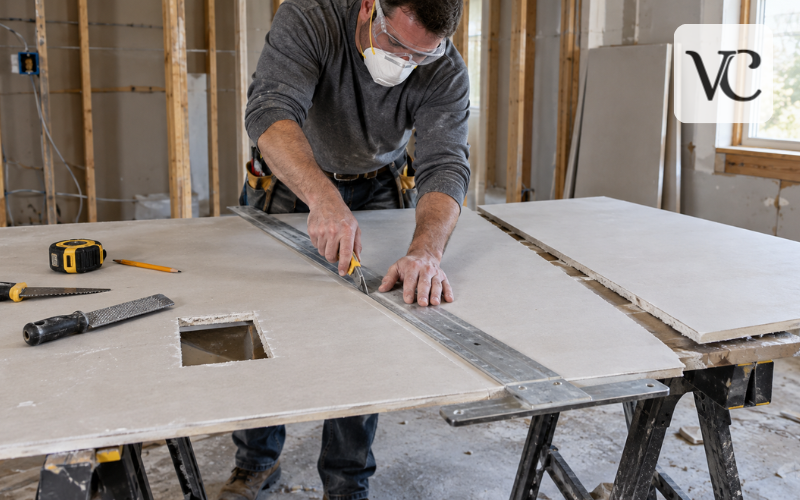
Learning how to cut drywall is easier than it first appears. For most straight cuts, you do not need a power saw or a complicated setup. The usual method is simple: mark the cut, score the front paper with a sharp utility knife, snap the gypsum core along that line, then cut the paper on the back. This score-and-snap method is widely used because it is fast, accurate, and creates much less dust than sawing through an entire sheet.
The basic technique works well for resizing full sheets and making straight edge cuts. Other jobs need a different approach. Openings for electrical boxes, pipes, doors, windows, repairs, or ceiling fixtures may call for a drywall saw, jab saw, rotary tool, or oscillating tool. Installed drywall also requires extra care because electrical wiring, plumbing, ducts, or framing may be hidden behind the surface.
Snippet-Ready Definition:
How to cut drywall involves scoring the face paper, snapping the gypsum core, and cutting the backing paper. VogueCultures.co.uk provides this guide for informational purposes only and does not perform drywall services.
Quick Guide: Choosing the Right Drywall Cutting Method
| Cutting Job | Recommended Tool | Basic Method |
| Straight cut | Utility knife + T-square | Score, snap, cut backing paper |
| Small edge trim | Utility knife or drywall rasp | Trim gradually and smooth the edge |
| Outlet or switch opening | Drywall/jab saw | Mark the opening, then cut inside the sheet |
| Pipe or irregular opening | Drywall saw or suitable rotary tool | Mark carefully and follow the outline |
| Installed drywall | Shallow hand or controlled power tool | Check behind the wall before cutting |
| Repair opening | Utility knife or drywall saw | Create clean, straight edges for the patch |
The score-and-snap method is the standard approach for most straight drywall cuts, while saws are better suited to internal and irregular openings.
Quick Step-by-Step Guide
- Measure and mark the required cut clearly.
- Place a T-square or straightedge along the cutting line.
- Score the face paper with a sharp utility knife without trying to cut through the entire sheet.
- Snap the drywall firmly along the scored line.
- Fold the waste section back to expose the rear paper.
- Cut the backing paper with the utility knife.
- Smooth rough edges lightly with a drywall rasp if needed.
When cutting drywall that is already installed, first consider hidden electrical wiring, plumbing, ducts, and framing. Avoid pushing a long blade deeply into an unknown wall cavity.
Tools and Safety Gear You Need Before Cutting Drywall
For most DIY jobs, the essential tools are a sharp utility knife, a drywall T-square or strong straightedge, a tape measure, and a pencil. A drywall saw or jab saw is useful for openings that begin in the middle of a sheet, while a drywall rasp helps smooth rough gypsum after a cut. Current USG guidance also recommends a sharp blade and smoothing cut edges when needed.
Wear safety glasses whenever dust or debris may reach your face, and wear gloves to protect your hands from blades and rough edges. If the job creates dust, use suitable respiratory protection and ventilation. OSHA notes that manual utility-knife work generally creates less dust exposure than dust-producing operations such as sanding.
Support large sheets properly before cutting them. Drywall is heavy and can bend or break under its own weight, so do not balance a full panel on a narrow or unstable surface.
Measure and Mark the Drywall Before Making a Cut
Accurate cutting begins before the knife touches the board. Measure the space where the drywall will fit, then transfer that measurement clearly to the face of the sheet. If you are making a long straight cut, place the T-square against the edge of the panel and align it with your marks.
Mark the waste side of the line with a small “X” so you know which piece will be removed. This simple habit helps prevent one of the most frustrating mistakes: cutting the correct measurement on the wrong side.
For openings, measure from fixed reference points. For an electrical box, for example, measure from a sheet edge and from the floor or ceiling, then transfer both measurements to the drywall. Check the location again before cutting.
A small amount of fitting room can help a panel slide into place without crushing its edges. Lowe’s current guide recommends leaving slight clearance rather than making the piece bind against nearby surfaces.
The Basic Method for Cutting Drywall Straight
The simplest way to cut drywall straight is the score-and-snap method. Place the sheet on a stable surface with the finished face toward you. Align your T-square or straightedge with the pencil mark and hold it firmly so it cannot shift.
Run a sharp utility knife along the guide. You only need to cut through the face paper and lightly score the gypsum underneath. Do not try to drive the knife through the entire panel. USG and current home-improvement guidance both describe a shallow score as enough to create the break line.
Once the score is complete, move the sheet so it can flex along that line. Apply firm, controlled pressure from the back. The gypsum core should break along the score. Fold the waste section back until the rear paper is exposed, then run the knife through that paper to separate the pieces.
If the edge is uneven, use a drywall rasp lightly to remove only the high spots.
How to Cut Drywall by Hand Without a Saw
If you are wondering how to cut drywall without a saw, a utility knife is usually the answer for straight cuts. Full sheets, long strips, and many small edge adjustments can all be made by hand with the score-and-snap method.
For long cuts, use a T-square. For narrow strips, support the sheet well and snap carefully. If a strip is too narrow to snap reliably, trim it with controlled knife cuts or use a rasp for a small adjustment.
Hand cutting is also useful when you want to keep dust down. A knife does not grind through the gypsum the way a saw or rotary tool does. This makes it a practical choice whenever the cut can be made cleanly without power equipment.
When to Use a Drywall Saw
A drywall saw, often called a jab saw when it has a pointed tip, is designed for openings and shapes that cannot be snapped from the edge of a sheet. It is especially useful for electrical boxes, vents, pipe openings, and irregular cutouts.
Mark the opening first. If the drywall is not installed and you can safely access the sheet, push the pointed tip through the waste area near a corner or make a small pilot hole. Then use short, steady back-and-forth strokes along the line. Current Lowe’s and This Old House guidance recommends cutting on the waste side and using steady pressure rather than forcing the blade.
At corners, pull the blade partway out, turn it, and continue. Controlled strokes reduce the chance of tearing the face paper beyond the mark.
Cutting Drywall for Outlets, Switches, Pipes, Doors, and Other Openings
Openings require more planning than a straight edge cut because their position must match something behind or around the sheet. For an electrical box, measure carefully from known reference points and draw the box outline on the drywall.
When possible, make the opening before permanently fastening the panel. Current This Old House guidance advises turning off power to the circuit and cutting box openings before installation when practical, which reduces the risk of damaging wires behind the board.
A jab saw works well for square and rectangular openings. Cut just outside or along the waste side of the marked line so the opening does not end up too small. For round pipe penetrations, use a suitable hole saw, drywall saw, or rotary tool.
Larger door and window cuts depend on the framing and whether the sheet is already attached. Whatever the opening, test-fit the sheet before fully fastening it. If it binds, trim a little rather than forcing it into place, which can damage the drywall.
How to Cut Drywall on a Wall
Knowing how to cut drywall on a wall requires more caution than cutting a loose sheet because you cannot see what is behind it. Walls can hide electrical wiring, plumbing, HVAC components, insulation, and framing.
Before making an opening, identify studs and check for hidden services. For work near electrical devices, turn off the relevant circuit and verify that the area is safe before cutting.
Start with shallow cuts. A utility knife or an oscillating tool with controlled blade depth is often safer than plunging a long saw blade deep into an unknown wall cavity. This Old House’s 2026 guidance on wall cutting warns that aggressive demolition can damage hidden pipes and wiring.
For a small damaged area, mark a neat square or rectangle and cut only as deep as needed to get through the drywall. Once the cavity is visible, you can inspect it before expanding the opening.
How to Cut Drywall for Repair
When learning how to cut drywall for repair, the goal is not simply to remove damaged material. You also want an opening that is easy to patch. Ragged holes are harder to match, so draw a square or rectangle around the damaged area and cut along clean lines.
Before cutting into the wall, locate utilities and studs. Depending on the repair method, the replacement piece needs backing or framing so it can be fastened securely. Lowe’s repair guidance recommends locating utilities first and notes that larger repairs may use an exposed stud or added backing strips to support the patch.
Test-fit the replacement piece before fastening it and trim gradually if needed. Remove loose gypsum or paper from damaged edges, and use a rasp only for small high spots.
The aim is a patch that sits naturally in the opening without being hammered, bent, or forced into place. A neat opening also makes taping and finishing the repair much easier.
How to Cut Drywall on a Ceiling
Learning how to cut drywall on a ceiling adds two challenges: gravity and hidden services above the board. Wear eye protection because dust and small pieces can fall directly toward your face. Use a stable ladder or platform, keep both hands controlled, and avoid working beneath a loose section that could drop unexpectedly.
Before cutting for a light, vent, or repair, determine what may be above the ceiling. Wiring, pipes, joists, ducts, and fixtures can all be present. Turn off power when working near electrical fixtures. Current This Old House ceiling guidance recommends shutting off power before cutting around electrical fixtures and using care when working from ladders or scaffolding.
For existing ceiling drywall, begin with a shallow opening and inspect the space before enlarging it. Avoid pushing a long blade into an unknown cavity.
If you are cutting a new sheet before installation, measure the fixture or opening carefully and transfer its position to the drywall. A drywall saw or suitable rotary cutting tool can then be used to create the opening.
How to Cut Drywall Corners and Edge Sections
Corners and notches often require two or more cuts that meet each other. Measure each leg of the shape separately, mark the waste area, and confirm the orientation before cutting.
For an L-shaped notch that reaches an edge, score and snap one section and use a drywall saw for the shorter crossing cut. Avoid making corner pieces so tight that installation damages the paper edge.
Narrow edge strips need extra support because they can break away unevenly. Score them with a sharp blade, keep the sheet flat, and apply pressure directly along the line rather than bending the entire panel.
If only a small amount must be removed, a rasp is often more controlled than trying to snap a very thin strip. Work slowly, because narrow pieces have less gypsum supporting them and are easier to damage.
How to Cut Drywall Without Cracking It
Knowing how to cut drywall without cracking it mainly comes down to proper support and a clean score. Most unwanted breaks happen when the sheet is poorly supported, the score is incomplete, or pressure is applied in the wrong place.
Place the drywall on a stable surface and make one continuous score with a sharp blade. The cut should go through the face paper and only slightly into the gypsum.
When snapping, put pressure close to the score line and let that line guide the break. Do not twist the panel or bend it like a flexible board. Lowe’s current cutting guide specifically cautions against simply bending drywall like cardboard; the score should control where the core separates.
Be especially careful with narrow strips and cuts close to corners because there is less material to support the break. If a section is too narrow to snap reliably, use a knife, saw, or rasp instead of forcing it.
A sharp blade also matters. A dull utility knife can drag across the paper instead of slicing it cleanly, making the score less predictable and increasing the chance of torn paper.
Common Drywall Cutting Mistakes and How to Fix Them
One common mistake is measuring correctly but cutting on the wrong side of the line. Mark the waste section before you start so there is no doubt about which piece you need.
Another mistake is using a dull blade. A dull knife tends to drag and tear the paper, so replace the blade when it no longer scores cleanly. Do not compensate for a worn blade by pressing much harder.
If the drywall does not snap along the line, stop instead of forcing it. Check whether the face paper was fully scored from end to end. You may be able to place the straightedge back on the mark, score the line again, and make a cleaner break.
Rough edges are usually easy to improve with a drywall rasp. Work lightly and try to keep the edge square. Removing too much gypsum can turn a small imperfection into a gap that takes more work to finish.
If an outlet or switch opening is slightly too small, trim a small amount and test the fit again. If the opening is badly oversized, do not assume the cover plate will solve the problem. A large mistake may require a proper drywall repair so the box area can be finished securely and neatly.
Conclusion
Once you understand how to cut drywall, most jobs come down to matching the cutting method to the shape and location of the cut. For ordinary straight cuts, score the face paper, snap the gypsum along the line, and cut the backing paper. For outlets, pipes, notches, and other internal openings, use a drywall saw or another controlled cutting tool that suits the job.
Accuracy matters more than speed. Measure carefully, mark the waste side, keep your blade sharp, and support the sheet so it breaks where you intend. When cutting installed walls or ceilings, treat hidden wiring, plumbing, ducts, and framing as a real safety concern rather than assuming the cavity is empty.
A clean cut should fit without being forced. Test-fit each piece before fastening it permanently, make small corrections as needed, and smooth rough edges rather than removing more material than necessary.
FAQs
Can you cut drywall without a saw?
Yes. Most straight drywall cuts can be made with a sharp utility knife. Score the face paper, snap the gypsum along the line, and cut through the backing paper.
What is the easiest way to cut drywall straight?
Use a drywall T-square as a guide and score the face paper with a sharp utility knife. Snap the board along the score, then cut the rear paper.
What tool should I use to cut holes in drywall?
A drywall saw or jab saw works well for outlets, switches, vents, and other internal openings. Mark the shape accurately and use controlled strokes along the waste side.
How do I cut drywall without cracking it?
Support the sheet properly, use a sharp blade, and make a continuous score through the face paper. Apply controlled pressure directly along the score instead of twisting the panel.
Is it safe to cut drywall that is already on a wall?
It can be, but extra caution is necessary because wiring, pipes, ducts, and framing may be hidden behind it. Check the area first and keep cuts shallow and controlled.
Disclaimer: This article on how to cut drywall is published by VogueCultures.co.uk solely for general informational and educational purposes. It is not professional construction, electrical, plumbing, or safety advice. This content is not a guest post, paid placement, sponsored promotion, or advertisement. Drywall work can involve sharp tools, dust, ladders, electrical wiring, plumbing, and other hidden hazards. Always follow tool manufacturers’ safety instructions and applicable local requirements. If you are unsure what is behind an existing wall or ceiling, or the work involves electrical or structural concerns, consider using a qualified professional.
Enjoyed this article? Discover more helpful ideas and fresh inspiration on Vogue Cultures.