Mold is a type of fungus that is naturally present in the environment. Indoors, it becomes a problem when spores land on a damp surface and have enough moisture to grow. That is why mold control is really moisture control. Cleaning a stain may improve how a wall looks, but if a leak, condensation problem, or other source of dampness continues, the mold can return. EPA guidance makes this point clearly: mold should be cleaned up, but the water or moisture problem also has to be corrected.
Mold in apartment buildings can be harder to trace than mold in a detached home. A resident may see a patch on one wall even though the water is coming from plumbing in another unit, a roof leak, a window defect, or a shared building system. Ventilation and heating and air-conditioning equipment can also contribute to damp conditions. This means renters, landlords, and property managers often need to look beyond the visible patch and find the source affecting the building. EPA notes that multifamily buildings create special indoor-air challenges because residents may have limited control over the building itself and conditions can affect more than one unit.
Snippet-Ready Definition:
Mold in apartment buildings is indoor fungal growth caused by excess moisture from leaks, condensation, humidity, or poor ventilation. voguecultures.co.uk provides informational guidance about this topic and article only, not professional services.
Quick Guide: Mold in Apartment Buildings
| Situation | What It May Mean | Practical Next Step |
| Mold keeps returning | Moisture source may still be present | Find and repair the leak or dampness source |
| Musty smell but no visible mold | Growth may be hidden | Check walls, flooring, plumbing, and damp areas |
| Water stains or peeling paint | Possible leak or past water damage | Report and investigate the moisture source |
| Frequent window condensation | Indoor humidity may be too high | Improve ventilation and control humidity |
| Small visible mold area | Limited cleanup may be possible | Fix moisture first and follow safe cleanup guidance |
| Large or hidden mold problem | More complex contamination may exist | Consider a qualified remediation professional |
What to Do When You Find Mold
- Check for moisture: Look for leaks, condensation, wet walls, ceilings, flooring, or plumbing problems.
- Document the problem: Take clear photos and note when the mold or water damage first appeared.
- Report it promptly: Renters should notify the landlord or property manager about leaks and damp conditions.
- Stop the water source: Repairing or controlling moisture is essential before expecting mold cleanup to last.
- Choose suitable cleanup: Small areas may be manageable, while extensive, hidden, recurring, or contaminated-water damage may require professional help.
Why Mold Problems Can Spread Beyond a Single Apartment
Apartment buildings contain many connected spaces. Walls, ceilings, floors, plumbing routes, service shafts, and ventilation systems may sit next to or pass through several homes. Because these building systems are connected, a problem that begins outside one apartment can sometimes affect conditions inside it. EPA specifically recognizes that multifamily buildings present unique indoor-air challenges and that residents may not be able to correct structural problems themselves.
Water can also travel farther than people expect. A leak under a bathroom fixture upstairs may eventually appear as a stain on the ceiling below. Water entering around a roof, window, balcony, pipe opening, or exterior wall can move through hidden materials before becoming visible. As a result, the place where mold appears is not always the place where the moisture began. EPA’s multifamily guidance recommends inspecting plumbing, building exteriors, windows, mechanical systems, and hidden signs of moisture when tracking mold problems.
The Most Common Causes of Mold in Apartment Buildings
Leaks are among the most common starting points. Pipes, drains, toilets, sinks, water heaters, dishwashers, washing machines, roofs, windows, and other building parts can release or admit water. EPA’s multifamily guidance recommends checking plumbing, exterior moisture, kitchen and bathroom exhaust systems, and signs such as water stains, damp areas, or musty odors.
Humidity and condensation matter too. Showers, cooking, laundry, and normal daily activities add moisture to indoor air. When that moisture is not removed, it can collect on cold windows, pipes, walls, or other surfaces. Air-conditioning systems can create additional problems if drip pans or drain lines do not work properly. CDC recommends keeping indoor humidity no higher than 50% when possible. After flooding or a major leak, speed also matters: CDC and EPA advise drying wet areas quickly, generally within 24 to 48 hours, to reduce the chance of mold growth.
Where Mold Commonly Hides in Apartments
Bathrooms are obvious places to check because showers and baths create moisture. Mold may show up on ceilings, grout, walls, or around tubs. Kitchens and laundry areas also deserve attention, especially under sinks and behind appliances that use water. Around windows, repeated condensation can keep frames, sills, and nearby wall surfaces damp. EPA’s multifamily guidance specifically recommends checking under sinks, dishwashers, washing machines, plumbing fixtures, windows, and other areas where leaks or condensation may occur.
Some growth stays out of sight. EPA identifies hidden locations such as the back of drywall, the underside of wallpaper, the top of ceiling tiles, under carpet and padding, and inside pipe chases or ventilation-related spaces. In an apartment, it is also sensible to inspect behind furniture placed against cool exterior walls, inside poorly ventilated closets, along baseboards, and around air-conditioning equipment. A musty smell in an area that looks clean can be a reason to investigate for a concealed moisture problem rather than assuming the room is fine.
Signs That an Apartment May Have a Mold or Moisture Problem
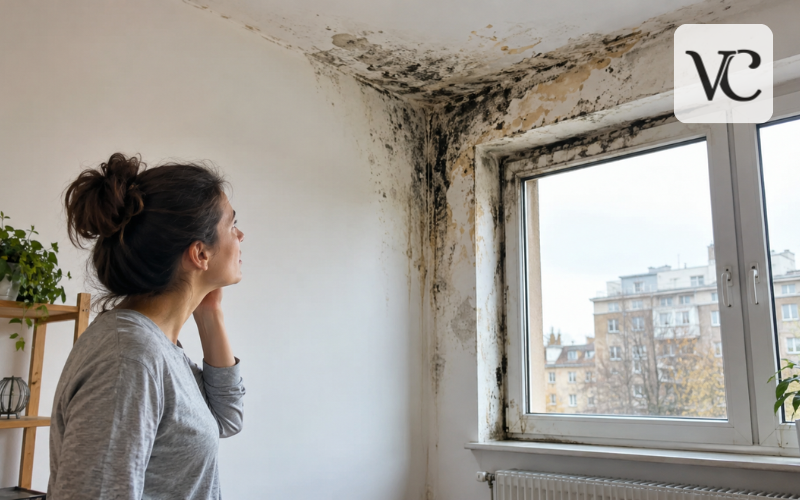
Visible mold can look different from one case to another. It may appear as spots, streaks, patches, or fuzzy-looking growth, and it can be several colors. A persistent musty smell is another important clue. EPA says a moldy odor suggests that mold may be growing in the building and should be investigated.
Water damage can tell an equally important story. Brown or dark stains on ceilings, bubbling or peeling paint, soft or swollen wallboard, warped flooring, damp carpet, and repeated condensation can all point to excess moisture. Sometimes these signs appear before visible mold does. Mold that keeps returning after cleaning is another warning that the underlying source has not been fixed. Rather than focusing only on the color or size of a surface mark, look for the pattern: where moisture appears, whether it comes back, and what is happening above, behind, or next to the affected area.
Mold, “Black Mold,” and What Appearance Can—and Cannot—Tell You
The phrase “black mold” often causes unnecessary alarm. Mold can be black, white, green, or other colors. EPA explains that “black mold” is not a single species or specific type of mold. Color by itself also cannot tell you whether a mold is producing mycotoxins or how a particular person will react to it. EPA states that no one can determine whether a mold is producing mycotoxins simply by looking at it.
For most household situations, identifying the exact species is less useful than addressing the condition that allowed mold to grow. CDC advises that if you see or smell mold, you should remove it and fix the moisture problem; you do not need to know the type before acting. This approach also prevents a common mistake: spending time trying to name a mold while a leak or damp surface continues to feed the growth. Whatever its color, unwanted indoor mold should be treated as a moisture and cleanup problem.
Possible Health Effects of Damp and Moldy Apartments
People do not all react to mold in the same way. CDC says exposure to damp and moldy environments may cause health effects in some people and none in others. Reported effects can include a stuffy nose, sore throat, coughing or wheezing, burning or irritated eyes, and skin rash. People with asthma or a mold allergy may have stronger reactions, and damp indoor environments can worsen asthma symptoms in susceptible people.
Extra care is appropriate for people with weakened immune systems or chronic lung disease because CDC notes that they may be at greater risk of lung infections from mold. At the same time, symptoms alone cannot prove that mold in a particular apartment is the cause. Coughing, congestion, eye irritation, or a rash can have many explanations. Anyone with persistent, severe, or worrying symptoms should speak with an appropriate healthcare professional rather than trying to diagnose the cause from the appearance of a wall.
What to Do as Soon as You Discover Mold in an Apartment
Start by looking for an obvious source of moisture without disturbing a large moldy area. Check for dripping pipes, damp ceilings, wet flooring, overflowing fixtures, or condensation. If there is an active leak, report it promptly. EPA specifically advises renters to report plumbing leaks and moisture problems immediately to the building owner, manager, or superintendent.
Document what you find. Clear photos of the mold, stains, wet materials, and damaged belongings can help show how the problem developed. Record when you first noticed it and keep copies of written repair requests and responses. If water is still entering the apartment, protect belongings from further damage when it is safe to do so.
Most importantly, do not treat paint or a quick surface wipe as the complete solution. The immediate goal is to stop or control the moisture source, then deal with the affected material in a way that fits the size and type of the problem. EPA repeatedly emphasizes that mold cleanup without fixing the water problem is likely to result in the mold returning.
Finding the Real Moisture Source Behind Recurring Mold
Recurring mold is often a clue that something remains wet. Start close to the affected area by checking nearby plumbing, fixtures, windows, and surfaces for leaks or condensation. In a multi-unit building, also consider what is on the other side of the wall, above the ceiling, or below the floor. The source may be a neighboring bathroom, kitchen, roof area, balcony, exterior wall, or shared pipe.
Ventilation should be part of the investigation. Bathroom and kitchen exhaust systems that are blocked, broken, or not working correctly may leave too much moisture indoors. Heating and air-conditioning equipment can also contribute if condensation is not draining properly. EPA’s multifamily guidance recommends inspecting both mechanical systems and the interior and exterior of a building for moisture problems.
When the cause is hidden, an experienced building professional may use moisture measurements and other inspection methods to trace damp materials. The point is not to keep cleaning the same patch; it is to understand why that surface is becoming wet enough for mold to return.
Mold Testing and Professional Inspection: When They Actually Help
A visual inspection looks for visible growth and signs of water damage. A moisture investigation goes further by trying to find where water is entering or collecting. Mold sampling, by contrast, collects air or surface samples for analysis. These are different tools, and testing is not automatically the first or best step.
EPA states that when visible mold is present, sampling is usually unnecessary. It also says there are no EPA federal standards or threshold limits for airborne mold or mold spores, so a test cannot simply declare that a home “passes” or “fails” a federal mold limit.
Professional investigation can still be useful when the source cannot be found, growth may be hidden inside building materials, the extent of the problem is unclear, or post-remediation sampling would answer a specific question. If sampling is used, EPA recommends professionals with experience designing sampling plans and interpreting the results. A home test kit without that context can produce information that is easy to misunderstand.
Cleaning Mold Safely vs. Calling a Remediation Professional
The size of the affected area is one factor in deciding how to respond. EPA says that if a moldy area is less than about 10 square feet, roughly a 3-foot by 3-foot patch, it can often be handled by the occupant in ordinary circumstances while following appropriate cleanup guidance. Hard surfaces can generally be scrubbed with detergent and water and then dried completely.
Larger or more complicated problems deserve more caution. Professional help is a stronger choice when mold covers a broad area, there has been major water damage, sewage or contaminated water is involved, mold may be inside walls or heating and air-conditioning systems, or the growth keeps returning after previous cleanup. Hidden growth can also be difficult to investigate without disturbing contaminated material.
Porous materials such as ceiling tiles and carpet may sometimes have to be discarded because mold can grow into spaces that are difficult or impossible to clean fully. EPA also advises against painting or caulking over moldy surfaces. Clean and dry the area first, because covering growth does not remove the moisture problem and paint applied over mold is likely to peel.
Renters, Landlords, and Building-Wide Mold Responsibilities
Renters can help reduce everyday moisture by using working bathroom and kitchen exhaust fans, keeping air vents unblocked, managing indoor humidity, and reporting leaks quickly. Those steps are useful, but they cannot solve every problem. A resident usually cannot repair a roof, replace a failed pipe behind a shared wall, open another apartment for inspection, or correct a central building system. EPA notes that in some apartment air-quality situations, only the building owner or manager is in a position to make the needed change.
Good communication matters when several units may be involved. Written repair requests, photos, inspection notes, and records of completed work create a clear history. Landlord-and-tenant rules, repair duties, enforcement options, and lease remedies are not the same everywhere, so readers should not rely on a general mold article as a substitute for local law.
In the United States, EPA itself does not intervene in landlord-tenant disputes and directs people to relevant state or local resources for location-specific information. In other countries, the responsible housing, health, tenancy, or legal authority will depend on local rules. When a serious moisture problem remains unresolved, seek guidance from the appropriate authority where the property is located rather than assuming that one mold rule applies everywhere.
Preventing Mold From Returning After Cleanup
Prevention starts with keeping materials dry. Repair plumbing, roof, window, and exterior leaks instead of waiting for another stain. After a spill, leak, or flood, dry damp materials as quickly as possible. EPA advises drying water-damaged areas within 24 to 48 hours in many situations, and CDC recommends keeping household humidity at no more than 50% when possible.
Ventilation is part of the same plan. Use functioning bathroom and kitchen exhaust systems, keep air moving where appropriate, and deal with repeated condensation instead of simply wiping it away every day. Air-conditioning drip pans and drain lines should be kept clean and able to drain properly. EPA also recommends reducing indoor humidity and improving ventilation when condensation appears on windows, walls, or pipes.
Furniture and stored items should not trap damp air against walls where moisture is already a concern. After cleanup, revisit the area and watch for new stains, smells, condensation, or growth. If mold returns, treat that as a sign that the source of moisture may still be present rather than as a reason to repeat the same surface treatment.
Conclusion
Mold in apartment buildings is rarely just a cosmetic issue on one wall. It is usually a sign that moisture is reaching a surface and staying there long enough for growth to develop. In a multi-unit property, that moisture may come from the apartment itself, a neighboring unit, shared plumbing, the roof, windows, ventilation, or heating and air-conditioning equipment.
The most effective response is practical: document the problem, report leaks promptly, find the real source of dampness, clean or remove affected materials appropriately, and keep the area dry afterward. Small problems may be manageable with careful cleanup, while larger, hidden, contaminated, or recurring problems may need professional help.
The lasting solution to mold in apartment buildings is not simply making the stain disappear. It is correcting the moisture condition that allowed the mold to grow in the first place. EPA’s guidance puts the principle simply: effective mold control begins with moisture control.
Frequently Asked Questions
What causes mold in apartment buildings?
Mold usually develops when moisture remains indoors because of plumbing leaks, roof or window leaks, condensation, flooding, high humidity, or inadequate ventilation. Fixing the moisture source is essential to prevent recurring growth.
Can mold spread from one apartment to another?
Moisture problems can affect more than one unit through shared walls, ceilings, plumbing routes, or building systems. The visible mold may therefore appear some distance from the original leak or damp area.
Is black mold more dangerous than other mold?
Color alone does not show how harmful a mold may be. The practical priority is to remove unwanted indoor mold safely and correct the moisture conditions that allowed it to grow.
Should I test mold before removing it?
Usually not when mold is already visible. EPA says routine sampling is generally unnecessary in that situation because cleanup and moisture correction are still required regardless of the mold type.
Can living in a moldy apartment affect health?
Damp and moldy environments may cause stuffy nose, coughing, wheezing, eye irritation, or skin reactions in some people. People with asthma, allergies, or certain health conditions may be more sensitive.
Disclaimer: This article on mold in apartment buildings is published by voguecultures.co.uk strictly for general informational and educational purposes. It does not provide medical, legal, property-inspection, mold-testing, remediation, or professional housing advice. voguecultures.co.uk does not inspect, diagnose, test, remove, or treat mold in any property. Health concerns should be discussed with a qualified healthcare professional, while serious, extensive, hidden, or recurring mold problems should be assessed by an appropriately qualified professional. Landlord and tenant responsibilities also vary by location, so readers should consult the relevant local authority or qualified adviser when necessary. This article is not a guest post, paid promotion, sponsored placement, or advertisement, and no business, product, or service is being promoted through its publication. Its sole purpose is to provide clear, independent information to readers researching mold in apartment buildings.
Enjoyed this article? Discover more helpful ideas and fresh inspiration on Vogue Cultures.